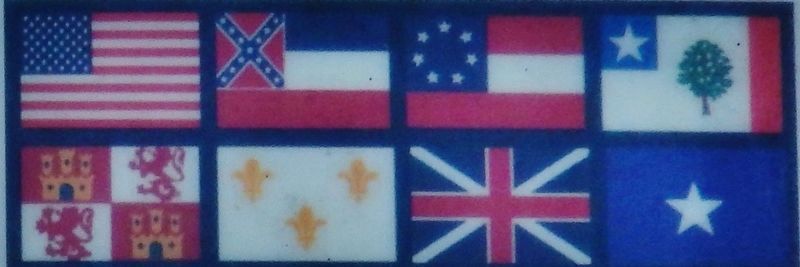
Jackson County has seen many governments. The first European settlement in the Mississippi gulf coast area was at present-day Ocean Springs in 1699. The French found the area already occupied by several American Indian tribes, with the primary . . . — — Map (db m117281) HM
In tribute to
the courageous men and women
of Jackson County, Mississippi,
who fought in World War II
for the democratic ideals
which we hold so dear. — — Map (db m102311) WM
Front
The Mississippi Gulf Coast Blues & Heritage Festival, one of the longest running blues festivals in the Deep South, was founded in 1991 by the Mississippi Gulf Coast Blues Commission, Inc. At the Mississippi Coast Coliseum in . . . — — Map (db m102158) HM
Born in Escatawpa, Mississippi on September 18. 1930.
Killed in action June 7, 1951
Entered service in Galveston, TX. G.O. Number 15, Feb. 1. 1952.
Citation (Posthumous Award) Near Pachi-Dong, Korea PFC Hanson, as a machine gunner with . . . — — Map (db m289314) HM
William Faulkner (1897-1962) is considered one of the great Southern writers. Faulkner is traditionally associated with northern Mississippi. For much of his life, Oxford, Mississippi was his home, and many of his stories were set in his fictional . . . — — Map (db m122540) HM
Captain William Boone, the nephew of the famous Daniel Boone, is thought to have been the first white settler in Jackson county, having arrived shortly after Lewis and Clark discovered Tower Rock. William Boone's son, Benningen, was the first white . . . — — Map (db m180340) HM
The first coal mine in Illinois was located one-half mile south of here along the south bank of the Big Muddy River. William Boone and his indentured servant, a man named Peter, loaded a small raft with coal from an outcropping and, after floating . . . — — Map (db m160955) HM
The Jackson Washington State Forest offers spectacular vistas of wooded hills and filled fields. The tranquility was disrupted in the fall of 1866 when the nation's first train robbery took place near Seymour. The Reno Gang, who lived in Jackson . . . — — Map (db m238780) HM
A San Jacinto Veteran • Born in Georgia, February 14, 1807 Died December 14, 1890 His Wife Jane Johnson Dale Born in Ohio, August 3, 1821 Died June 17, 1896 — — Map (db m239512) HM
The Battle of Independence was fought at this and other locations on Aug. 11, 1862. On that day, a force of Confederate soldiers launched a dawn surprise attack on the Union garrison stationed at Independence and compelled it to surrender. It was . . . — — Map (db m34924) HM
The overland route linking St. Charles with the future sight of Fort Osage in present-day Jackson County was likely the earliest trail used by American settlers heading west. On its eastern end the trail passed in the vicinity of the later towns of . . . — — Map (db m124814) HM
Today's downtown Pascagoula used to be the town of Scranton, Mississippi, until the two towns merged in 1912. The early history of the area was marked by two fires in 1921 that leveled the downtown area.
A new fire hall was built in 1925 . . . — — Map (db m117278) HM
When did it start?
Almost as soon as European colonists arrived in the 1600s, conflict arose with Indian tribes. For the next 300 years, numerous conflicts and wars took place throughout the present-day continental United States. . . . — — Map (db m268155) HM
In 1783 the Oconee River basin was the western boundary of the new United States of America. The first U.S. frontiersmen included surveyors, mapmakers, native guides, and naturalists.
To entice farmers to the new territory, the U.S. . . . — — Map (db m206381) HM
Jackson County, being on the Confederate side during the American Civil War, suffered numerous incursions by Union forces. However, it was the one of April 9, 1863, which, although small by combat standards, had far-reaching import to Union . . . — — Map (db m102301) HM
Round Island is located in the shallow Mississippi Sound only 3 miles offshore of the entrance to the Pascagoula River. By the early 19th Century increasing coastal commerce had made the need for a lighthouse critical. This first Round Island . . . — — Map (db m102363) HM
Jackson County is known for shipbuilding. Early settlers hand-crafted utility, fishing and local transportation boats to one-of-a-kind designs, but World War I saw explosive development of a modern industry. Dierks-Blodgett in Pascagoula, and . . . — — Map (db m102361) HM
Side A:
Independence, famed "City of the Trails," was for two decades the starting point of the great western trade and travel routes to Santa Fe, Oregon, and California. Settled mainly by Southerners on land ceded the U.S. by the Osage . . . — — Map (db m44323) HM
The first memorial service in Illinois, and one of the first in the nation, to honor those who had died in the Civil War, took place at Woodlawn Cemetery on April 29, 1866. On that day, a group of more than 200 veterans gathered at the old "Blue . . . — — Map (db m163493) HM
The Santa Fe Trail went through two decades of change in the Kansas City area before evolving into it's final form by about 1840. In the early years of that decade it also became the route of the Oregon Trail and California Trail.
1821 - . . . — — Map (db m50679) HM
Marble Springs Park History
Sawmill Operators, James Lynch and Reverend P.P. Bowen (Tidewater Baptist Church) first discovered the mineral springs on the south bank of Old Fort Bayou in 1852 after noticing a small stream which left some . . . — — Map (db m290182) HM
It is fascinating to look over the population figures through
the decades of Ocean Springs' history and growth.
The following population figures are from Federal Census counts,
and from calculations by regional historian Ray Bellande,
as . . . — — Map (db m290289) HM
On June 26, 1804 the Lewis & Clark Expedition known as President Jefferson's Corps of Discovery passed this place on their way west.
In 1825, treaties with the Kaw and Osage Indians opened up for settlement an area between Fort Osage to the . . . — — Map (db m252086) HM
Thin black lines indicate changes in relevance. Between each pair of lines entries are ordered geographically but all have the same relevance.
* Inflectional forms of words are their plurals, singulars, and possessives as well as gramatical tenses and similar variations.