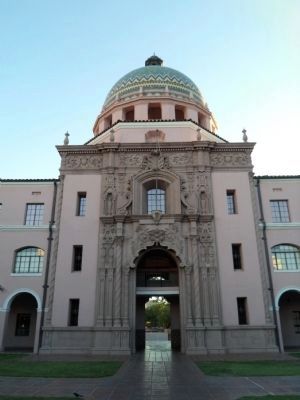
The first Pima County Courthouse, a single-story adobe structure built in 1868, was replaced in 1881 by a large two-story stone and red brick victorian building which, in turn, was removed in 1928 to make way for the present structure. This . . . — — Map (db m55222) HM
Camp Lowell was established at this location in 1866 by the U.S. Army in recognition of the strategic military importance of Tucson. The local populace was fearful of Apaches, and the camp provided military protection as well as bringing financial . . . — — Map (db m83013) HM
This cultural center was built through the efforts of the Saturday Morning Music Club. The grand opening October 28, 1927, starred violinist Jascha Heifetz. Many world-renowned artists followed upon the stage and in the galleries while local talent . . . — — Map (db m26442) HM
Named for its founder, Carmen Soto Vásquez, this was one of the first theaters in Tucson devoted exclusively to the presentation of dramatic works in Spanish. From the opening night, May 20, 1915, with a performance of "Cerebro y . . . — — Map (db m83233) HM
Jewish pioneers, among Arizona's earliest settlers, began arriving in the 1850s and for half a century they worshipped in private homes and rented quarters. In 1904, the Hebrew Ladies Aid Society, now the Sisterhood of Temple Emanu-El, . . . — — Map (db m83237) HM
Memorial to Pedro Allande, first resident commander of the Royal Presidio of Tucson and energetic captain of the Mexican Dragoons, regular Spanish army. Near this site he was wounded severely in his right leg during the attack of May 1, 1782, by 600 . . . — — Map (db m82943) HM
On November 18, 1867, the Pima County Board of Supervisors created Tucson School District 1. An old adobe building at this location was refitted for classes. Desks and benches were built, new windows were installed in the 25' x 40' classroom, and . . . — — Map (db m83010) HM
This park is a memorial to the founding of Tucson. On August 20, 1775, Lt. Col. Don Hugo Oconor, Commandant Inspector of the Frontier Provinces of New Spain, in the company of Fr. Francisco Garces and Lt. Juan Carmona officially established the . . . — — Map (db m83011) HM
The El Paso and Southwestern Railroad, originally owned by the Phelps Dodge Company, was extended from El Paso into Tucson in the fall of 1912. The handsome depot of classical design, featuring a large rotunda with a stained glass dome, was . . . — — Map (db m83028) HM
Memorial to Francisco Garcés, explorer and first Franciscan missionary to the Pima village at the foot of Sentinel Peak. In 1770 Garcés and the Pimas constructed at that site the first substantial building in Tucson, a mission residence with two . . . — — Map (db m83034) HM
Memorial to Elias Pennington, pioneer rancher, farmer, miner, freighter and lumberman. In 1857, he came from Texas with his twelve children settling in various locations around southern Arizona for several years. Near this site, in 1863, . . . — — Map (db m82942) HM
Near this site was the southwest corner of the adobe wall that surrounded the Spanish Presidio, an enclosure of 11 ¼ acres which included most of the present city – county governmental complex and the Art Museum block. Tucson was the largest . . . — — Map (db m83214) HM
The earliest documents for this property indicate that the pioneering Sosa family lived here in the 1850s. In 1878, Manuela Sosa and her husband, Michael McKenna, sold the property to Jesús Suárez de Carrillo, wife of businessman Leopoldo Carrillo, . . . — — Map (db m83228) HM
E.N. Fish came to Arizona as an enterprising merchant in 1865. Three years later he built this adobe house which served as the family residence for the next half century. Fish developed many successful businesses and his wife Maria was prominent in . . . — — Map (db m83026) HM
This adobe house incorporates portions of one of the oldest standing structures in Tucson. The two west rooms are believed to have been built before the Gadsden Purchase of 1854. Four front rooms were added in 1879.
The house was named for . . . — — Map (db m83202) HM
This house is named for its first known residents, living here in 1868. Although construction dates are not known, the Washington Street wing lies along the course of the Presidio wall, completed in 1783. Leonardo Romero, a carpenter whose shop . . . — — Map (db m83203) HM
This marker locates the northwest corner of the adobe wall which surrounded the Royal Spanish Presidio San Agustín del Tucson. In 1776 the new outpost was garrisoned by seventy Spanish cavalry troopers and Indian scouts, transferred from . . . — — Map (db m83212) HM
This marker locates the northeast corner of the adobe wall which surrounded the Royal Spanish Presidio San Agustin del Tucson. It is thought that a bastion, used as a lookout and as a defensive position, stood here. The site was excavated in 1954 by . . . — — Map (db m83213) HM
The S.P.R.R., building the nation's second transcontinental rail line eastward from California, reached Tucson on March 20, 1880. It was the occasion for one of the greatest celebrations in the history of the city and foretold the coming of a new . . . — — Map (db m83229) HM
Below this 2900-foot peak the Santa Cruz valley was farmed by the Hóhokam Indians as early as 800 A.D. When the Spaniards arrived in the 17th century, the Hóhokam had vanished and settlements of Piman people dotted the valley. One called . . . — — Map (db m83216) HM
Dr. William Austin Cannon had this house built during 1904-1905. He was the first resident botanist with the Carnegie Desert Laboratory in 1902, and worked there until 1926. Dr. Cannon sold the house in 1913 to Dr. Andrew Ellicott Douglass, an . . . — — Map (db m83014) HM
Dr. Smith built this house in 1904 in anticipation of his marriage to Maud North, a Tucson teacher. The house, which he designed, was the first building on the north side of Speedway. Dr. Smith was a University of Arizona professor of engineering . . . — — Map (db m83035) HM
The military post, established in 1862
near downtown Tucson, was moved to
this location in 1873. One of many
active forts on the Arizona frontier,
Lowell served also as a major supply
depot, influencing the economy and
social life of the . . . — — Map (db m83031) HM
The venerable Hotel Congress, designed by well-known architect, Roy Place, is the last surviving historic hotel in downtown Tucson. This three-story landmark was built in 1919 with exposed masonry construction and marble details. The hotel, south . . . — — Map (db m83200) HM
On March 12, 1885 Governor Frederick A. Tritle signed legislation creating the University of Arizona. Selim M. Franklin and C.C. Stephens, Pima delegates to the 13th Territorial Legislature fathered this Bill. Jacob S. Mansfeld solicited the . . . — — Map (db m26386) HM
Wyatt Earp joined his four brothers in the silver-boom town of Tombstone in 1879 where brother Virgil was deputy U.S. marshal. Wyatt was a sometimes-lawman himself, and hoped to become sheriff of the newly formed Cochise County in 1881. . . . — — Map (db m28929) HM
Constructed in 1928, the tower is listed on the National Register of Historic Places and has been designated as a Tucson Landmark.
The tower's Spanish colonial revival sheathing was designed by Tucson architect Roy Place and added in 1932. . . . — — Map (db m26288) HM
[ Four plaques are mounted to a four sided kiosk. ]
Side A:
Jácome’s Department
Stores, Inc.
1896 – 1980
This area was the final location of Jácome’s Department Store from 1951 to 1980. For twenty-nine years the . . . — — Map (db m40049) HM
Americans first worked the copper deposits at Ajo in 1854, one year after the Gadsden Purchase. These early American miners found abandoned workings and crude mining tools as mute evidence of earlier mining in the district.
During the next half . . . — — Map (db m30802) HM
Ajo was first located on the ground that later became the open pit mine.
The modern city was founded in its present location in 1917 coincident with the beginning of large scale mining of the copper deposits.
Ajo is the home of the New . . . — — Map (db m30759) HM
Dedicated to the enduring memory of the men and women who faithfully served in the military forces of the United States of America and in grateful acknowledgment of their contribution to this nation, which in time of peril, found in them its . . . — — Map (db m28932) HM
Injustice Challenged
Over and above any man-made creed or law is the natural law of life — the right of human individuals to live and to creatively express themselves. No man was born with the right to limit that law. . . . — — Map (db m296050) HM
Thin black lines indicate changes in relevance. Between each pair of lines entries are ordered geographically but all have the same relevance.
* Inflectional forms of words are their plurals, singulars, and possessives as well as gramatical tenses and similar variations.