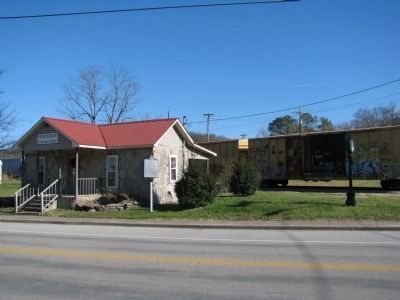
In 1850, Rice Coffey gave eight acres to the Nashville and Chattanooga Railroad on which the main line would run with a depot and freight house at the junction of the branch line to Shelbyville. In 1851, town lots were laid off. The following year, . . . — — Map (db m88407) HM
In April 1862, Major James M. Shanklin with 197 men of the 42nd Indiana Infantry campedon the west bank of Wartrace Creek, near the end of Bridgeview Street, to secure the supply line of the Nashville & Chattanooga Railroad by guarding two bridges . . . — — Map (db m152103) HM
Strolling Jim, the first World's Champion Tennessee Walking Horse, is buried in a pasture directly behind the Walking Horse Hotel. Foaled in 1936, this former work horse was ridden to the championship by Floyd Carothers at the first Walking Horse . . . — — Map (db m24165) HM
In 1909, the merchants of Wartrace constructed a wooden platform on this site. The platform was used as a stage for performances by the merchants' band and as the judges' reviewing stand for horse shows that were then held on Front Street. The . . . — — Map (db m267842) HM
(side 1)
Anatomy of a Campaign
In late June of 1863, Union Major General William S. Rosecrans launched a massive offensive from his base in Murfreesboro in an attempt to drive Confederate General Braxton Bragg’s 43,000-man Army of . . . — — Map (db m152889) HM
Wartrace is located on a 5000-acre North Carolina grant acquired by General Andrew
Jackson at an 1802 marshal's sale in Nashville. In 1805, Jackson came to the area to establish his boundaries for the opening of the lands for settlement by the . . . — — Map (db m152096) HM
Hardee's Corps retired to the Wartrace-Fairfield defensive line, January, 1863. Here they remained until late June, when Rosecrans, moving the bulk of the Federal Army of the Cumberland around the right flank to Manchester, made Bragg withdraw from . . . — — Map (db m152093) HM
The Beechwood Plantation house, which formerly stood at this site, was an important Confederate headquarters during the Tullahoma Campaign. It was built for Col. Andrew Erwin, Jr. and family in 1826. The Erwins, who were southern sympathizers, . . . — — Map (db m25862) HM
From here, Maj. Gen. W.S. Rosecrans marched his reorganized army against Bragg's Army of Tennessee, in the Shelbyville-Wartrace-Tullahoma area. Fainting with his Reserve Corps and cavalry against Shelbyville, he drove through Hoover's Gap with his . . . — — Map (db m185615) HM
Withdrawing to this area after the Battle of Murfreesboro, Gen. Braxton Bragg established his command post near here. Other units went into defensive winter quarters at Bell Buckle, Shelbyville & Wartrace. Here they remained until late June, 1863, . . . — — Map (db m81378) HM
Mary Shirley, who was born on 17 February 1762, married William McGuire on 23 February 1778 in Virginia. During the Revolutionary War William and Mary McGuire with son Michael were taken prisoner on 26 June 1780 and moved from Virginia to Montreal, . . . — — Map (db m262420) HM
(side 1)
Wilder's Raid at University Place
When Braxton Bragg retreated from the Shelbyville-Wartrace line and took up his position at Tullahoma on June 28, Union commander William S. Rosecrans sought to destroy the Elk River . . . — — Map (db m282308) HM
Pvt. Joseph P. Bashaw Co. I 7th Tenn Infantry
"I was captured and carried to Pt. Lookout Prison, where I took chronic dysentery without treatment, I came near dying before they sent me to a hospital where I began to improve a little, but what I . . . — — Map (db m297240) HM
In late June of 1863, Union Major General William S. Rosecrans launched a massive offensive from his base in Murfreesboro in an attempt to drive Confederate General Braxton Bragg's 43,000-man Army of Tennessee from its entrenchments at Shelbyville . . . — — Map (db m277761) HM
The Buffalo Road, which is a branch of the Great Buffalo Road, enters Macon County at the extreme southeast corner and travels northward following Wartrace Road (State Route 56) to the Willette Road (State Route 262). This section was called the . . . — — Map (db m180019) HM
In late June of 1863, Union Major General William S. Rosecrans launched a massive offensive from his base in Murfreesboro in an attempt to drive Confederate General Braxton Bragg's 43,000-man Army of Tennessee from its entrenchments at Shelbyville . . . — — Map (db m180859) HM
The car displayed here is a side bay window model caboose built in 1964 by the Louisville & Nashville Railroad at the company’s South Louisville yards. The exterior is restored to the original L & N red.
The purpose of a caboose was to provide . . . — — Map (db m75318) HM
After the Battle of Stones River on January 2, 1863, Union Gen. William S. Rosecrans occupied Murfreesboro. Confederate Gen. Braxton Bragg withdrew south to the Highland Rim to protect the rail junction at Tullahoma, Bragg's headquarters, . . . — — Map (db m156117) HM
(preface)
After the Battle of Stones River ended on January 2, 1863, Union Gen. William S. Rosecrans occupied Murfreesboro. Confederate Gen. Braxton Bragg withdrew south to the Highland Rim to protect the rail junction at Tullahoma, Bragg’s . . . — — Map (db m81382) HM
(preface)
After the Battle of Stones River ended on January 2, 1853, Union Gen. William S. Rosecrans occupied Murfreesboro. Confederate Gen. Braxton Bragg withdrew south to the Highland Rim to protect the rail junction at Tullahoma, Bragg’s . . . — — Map (db m75267) HM
After the war broke out, wooden frame barracks were built by North and South at permanent installations such as forts, arsenals, coastal installations, and training camps. In winter, smaller barracks were constructed with available materials and man . . . — — Map (db m129426) HM
Preface
After the Battle of Stones River ended on January 2, 1863, Union Gen. William S. Rosecrans occupied Murfreesboro. Confederate Gen. Braxton Bragg withdrew south to the Highland Rim to protect the rail junction at Tullahoma, Bragg's . . . — — Map (db m85714) HM
[Side A]
Shelbyville — “Little Boston”
Shelbyville, Tennessee, better known as “Little Boston,” was a hotbed of Unionist sentiment throughout the war. When William Rosecrans' Union army captured the town, they were welcomed as . . . — — Map (db m191662) HM
Jazz trombonist Jimmy Cleveland was a versatile musician whose work was largely confined to other artists' sessions, pit orchestras and broadcasting. Among the artists he backed were Quincy Jones, Miles Davis, James Brown, Billie Holiday, Cannonball . . . — — Map (db m267849) HM
In late June of 1863, Union Major General William S. Rosecrans launched a massive offensive from his base in Murfreesboro in an attempt to drive Confederate General Braxton Bragg’s 43,000-man Army of Tennessee from its entrenchments at . . . — — Map (db m75354) HM
In late June of 1863, Union Major General William S. Rosecrans launched a massive offensive from his base in Murfreesboro in an attempt to drive Confederate General Braxton Bragg’s 43,000-man Army of Tennessee from its entrenchments at . . . — — Map (db m75325) HM
In late June of 1863, Union Major General William S. Rosecrans launched a massive offensive from his base in Murfreesboro in an attempt to drive Confederate General Braxton Bragg’s 43,000-man Army of Tennessee from its entrenchments at . . . — — Map (db m81535) HM
In late June of 1863, Union Major General William S. Rosecrans launched a massive offensive from his base in Murfreesboro in an attempt to drive Confederate General Braxton Bragg’s 43,000-man Army of Tennessee from its entrenchments at . . . — — Map (db m207283) HM
[Front/East Side of Marker]:
The State of Maryland
In honored recognition of the historic valor
of her sons who in Blue and Gray, nobly
sustained the martial glory of their
fathers in the military operations around . . . — — Map (db m44362) HM
Thin black lines indicate changes in relevance. Between each pair of lines entries are ordered geographically but all have the same relevance.
* Inflectional forms of words are their plurals, singulars, and possessives as well as gramatical tenses and similar variations.