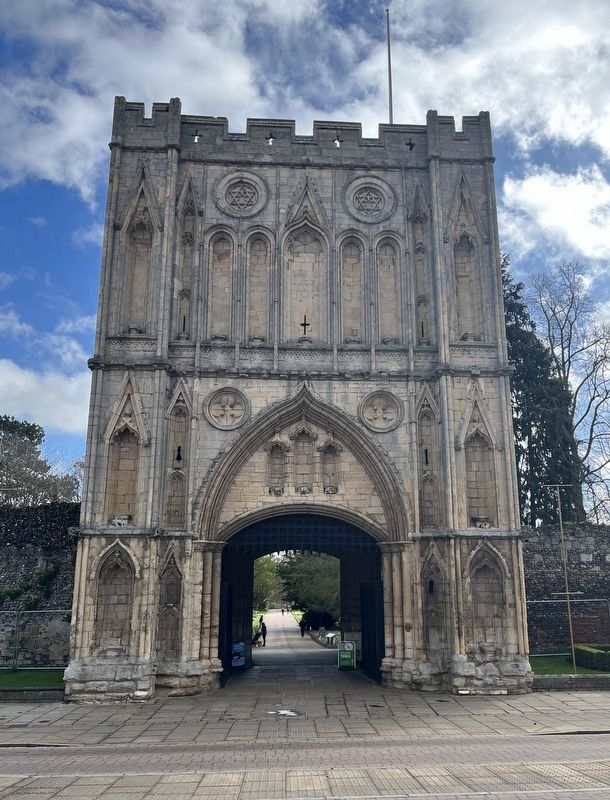
The Abbey of St Edmund was one of the largest and most powerful abbeys in the country. This imposing yet beautiful gateway was the impressive main entrance to the abbey's Great Court.
All kinds of people came through this gate to access the . . . — — Map (db m246123) HM
Bury St Edmunds Abbey was one of the largest and grandest monasteries in England. Today, it mostly lies in ruins.
The abbey was a large community, with clear roles to make everything ran smoothly - just like any organization. The abbot was in . . . — — Map (db m251119) HM
The abbot was a powerful and influential man. To reflect his importance he had a large and luxurious residence, and this ruined building known as the Queen's Chamber is all that remains.
In 1044, King Edward the Confessor gave the monks the . . . — — Map (db m246128) HM
This magnificent building has stood here since at least 1220. Step inside to discover the part it has played in the history of Bury St Edmunds and of England. — — Map (db m251123) HM
In memory of Captain Bartholomew Gosnold explorer and 'prime mover' behind the first permanent English settlement North America at Jamestown, Virginia, where he died 22 August 1607.
Also of his family buried in this churchyard: his wife Mary . . . — — Map (db m251131) HM
As the abbey grew, its organisation became more elaborate. The abbot was in charge, with support from the prior and sub-prior, and the chapter house was the centre of their management.
The monks' communal lives were highly regulated by a book . . . — — Map (db m250972) HM
This gateway led directly to the Abbey Church. The abbey's many visitors would all pass through here, from kings and queens to humble pilgrims in search of a miracle.
Like the Abbey Gate to the north, this gateway provided an elaborate and . . . — — Map (db m246732) HM
This large, square area was the cloister, the heart of the main monastic buildings. From here the monks could access everything they needed for their daily lives and stay separate from the outside world.
In this corner you would have been . . . — — Map (db m250973) HM
Over one thousand years ago, building began on the abbey's first stone church.
By the early 10th century St Edmund's body was moved to Beodricsworth, which became known as Bury St Edmunds. A large wooden church was built here, probably . . . — — Map (db m246126) HM
You are looking into the crypt. Now exposed, it was originally a low, dark, vaulted interior.
This eastern end of the Abbey Church was the oldest part built around 1080-95 during the rule of Abbot Baldwin. Above the crypt was the presbytery or . . . — — Map (db m250971) HM
In the Middle Ages, this area was a huge open courtyard with access to all of the working areas of the abbey. People, horses and carts would have been coming and going all day.
Ahead of you were the courtroom, the guest house, and the . . . — — Map (db m246124) HM
The heart of any monastic church was the choir the space where the monks sat in individual seats called choir stalls.
At Bury, the choir occupied the area below the central tower and into the nave to the left. Monks gathered here eight times . . . — — Map (db m253102) HM
Near this spot
on the 20th November A.D. 1214,
Cardinal Langton & the barons
swore at St Edmund's altar
that they would obtain from
King John
the ratification of
Magna Charta.
Where the rude buttress totters to its fall,
And . . . — — Map (db m250976) HM
St Edmund was originally buried in a simple chapel near to where he was killed. His body was moved to Bury in the early 900s, and around 100 years later building began on a new stone church. The abbey grew into one of the largest churches in Europe. . . . — — Map (db m251126) HM
The magnificent west front provided the first impression of the Abbey Church to its many visitors.
Its unusually wide design and looming central tower would have been an imposing sight. It was richly decorated in a similar style to the Norman . . . — — Map (db m250974) HM