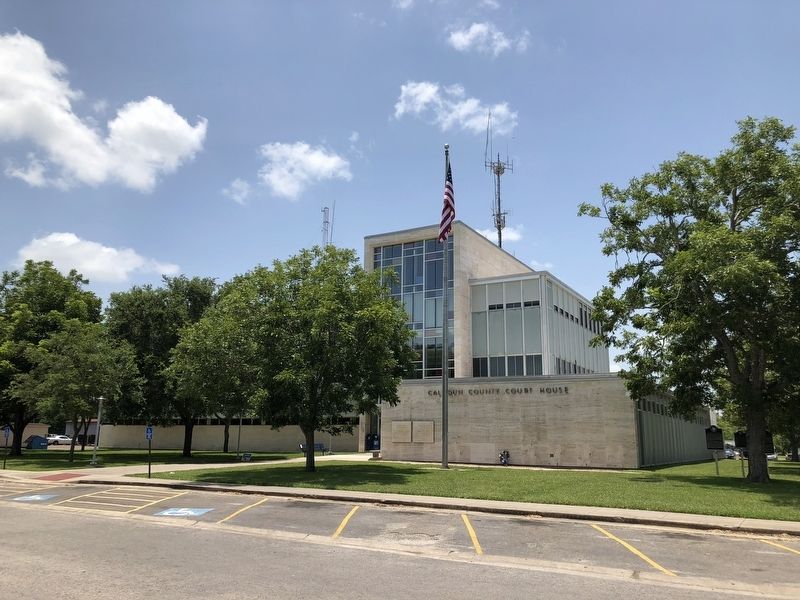
In the mid-twentieth century, Calhoun County was beginning an unprecedented period of growth. Howard G. Hartzog, Sr. was an active community leader who guided the county as a private citizen, county judge and as a state representative by diligently . . . — — Map (db m120672) HM
On April 20, 1842, a group of nobles convened at Biebrich am Rhein and incorporated as the Adelsverein. They elected Count Karl von Castell as their president and then pledged a goal to purchase land in Texas. From 1821 to 1910, more than five . . . — — Map (db m182230) HM
Located on the elevated ridge at Indianola Beach, this cemetery is one of three that served the port of Indianola during the 19th century. The oldest existing grave marker, that of James Chilton Allan, bears a date of 1851. Also buried here are . . . — — Map (db m208261) HM
Henry Joseph Huck was born on August 3, 1822, in Ottenhöfen, Baden, in southern Germany. He graduated from Heidelberg University and, with the inheritance from his mother's death, Henry ventured to London and established a merchant business at the . . . — — Map (db m182236) HM
In November of 1863, in the midst of the Civil War, the Union Army arrived in Calhoun County. Union and Texas troops rarely met on the field of battle in Texas, as most of the war was concentrated in the east and south of the country. The Union . . . — — Map (db m120714) HM
As part of the U. S. Naval initiative to control Texas Confederate ports, the gunboats "Clifton" and "Westfield" turned to the town then known as Lavaca after easily taking Galveston and Indianola. On October 31, 1862, under a flag of truce, . . . — — Map (db m173656) HM
In February 1863, local inventor E. G. Singer developed and tested a torpedo with a unique spring action ignition system on the shores of Lavaca Bay. With nine other Lavaca citizens including Singer's financial partner Dr. J. R. Fretwell and . . . — — Map (db m172433) HM
After independence from Spain, Mexico utilized the Empresario System to settle the province of Texas with loyal citizens. Seeing his opportunity, Don Martin de Leon applied on April 8, 1824, to the provincial delegation of San Fernando de Bexar for . . . — — Map (db m181115) HM
Texas land empresario Henri Castro contracted to bring colonists of various European nationalities to Texas beginning in 1842. The first of these were Alsatians, most of whom spoke German and held German sympathies. They arrived at Galveston, their . . . — — Map (db m181211) HM
Many of the graves in this cemetery reflect the hardships encountered by residents of Indianola, one of Texas' leading 19th century ports. The earliest marked grave is that of a child, William Woodward. His death occurred in 1852, a year when . . . — — Map (db m207844) HM
Panel 1
The first German settlements in Texas were Industry in Austin County, founded by Friedrich Ernst in 1831, Biegel in Fayette County, founded by Joseph Biegel in 1832, Cat Spring in Austin County, founded by the von Roeder, Kleberg, . . . — — Map (db m210312) HM
After Texas was annexed into the United States in 1846, part of what was once De Leon’s Colony was organized as Calhoun County, giving the county access to valuable cropland and bays—the most important being modern-day Matagorda . . . — — Map (db m117439) HM
Late in the 19th century, a small settlement named Alligator Head, named for its particular landscape, developed on the coast of Matagorda Bay in Calhoun County. In 1910, the Calhoun County Cattle Company filed a plat for a town site and named it . . . — — Map (db m182668) HM
In Whose Honor Jefferson County, Texas
Was Named Chief Justice of Calhoun County
1848-1856 Born in Kentucky
March 12, 1801 Died July 25, 1865 — — Map (db m237452) HM
Founded in the aftermath of a Comanche raid on the nearby settlement of Linville, the town of Lavaca (the cow) was established in 1840. The busiest port in the Matagorda Bay area and a major center for over-land export of cattle and other goods, . . . — — Map (db m53110) HM
The oldest known grave here is that of Major Horam Watts, the customs collector at Linnville and casualty of a Comanche raid on that nearby settlement, Aug. 8, 1840. The site was called Ranger Cemetery after the burial in 1850 of Margaret Peyton . . . — — Map (db m181210) HM
Being the western most point of Anglo-American settlement and the closest town to San Antonio de Bexar, Gonzales was the center of the Texas revolutionary activity. In July 1826 the original settlement was abandoned after two Indian attacks but was . . . — — Map (db m290095) HM
(This is Florida's first bi-lingual marker. The second language is Apalachicola Muskogee/Creek.) Apalachicola Creek Indians permanently settled Calhoun County in 1815; wars forced them out of Alabama. A new Tribal Town was built by Chief Tuskie . . . — — Map (db m48489) HM
Pioneer horticulturist Gilbert Onderdonk (1829-1920) exhibited early talent in his native New York, developing new varieties of potatoes that earned him recognition when he was still a teenager. After graduating from the New York State Normal School . . . — — Map (db m192582) HM
Located along Chocolate Bayou, which empties into Chocolate Bay
dividing Port Lavaca and Indianola, the Chocolate Community
predates the organization of Calhoun County. In 1846, Massachusetts
native and Old 300 family head Sylvanus Hatch . . . — — Map (db m297388) HM
Thin black lines indicate changes in relevance. Between each pair of lines entries are ordered geographically but all have the same relevance.
* Inflectional forms of words are their plurals, singulars, and possessives as well as gramatical tenses and similar variations.