Abraham Lincoln's Survey of the Sangamo Town – Athens Road Relocation
Beginning January 1, 1834, New Salem was to receive mail on a new schedule. The Stage was to leave Springfield each Saturday at 4:00 am for the Warren Court House in . . . — — Map (db m78609) HM
The store of Ebenezer Capps was located just north of this site at the northeast corner of Main and Fourth streets.
The location of Main street is not the same today as when Lincoln was here. Vandalia existed long before the coming of . . . — — Map (db m42486) HM
An important trail in the history of Illinois ran atop this ridge. Called the Edwards Trace, an early word for trail, its use reaches back to antiquity when herds of bison and other large mammals traveled along its path. For millennia, prehistoric . . . — — Map (db m156781) HM
Few cities in America lave a history as rich and of such importance to the early development of its state as Lockport, Illinois.
Two significant problems confronted the young State of Illinois in the 1830s: the capitol building was falling . . . — — Map (db m254719) HM
The Old State Capitol was the fifth Statehouse in Illinois history. The building served as Capitol from 1839 to 1876. Its cornerstone was laid during ceremonies held July 4, 1837. During the 1840s and 1850s the building dominated Springfield's . . . — — Map (db m312816) HM
Abraham Lincoln laid out the original sixty blocks of Petersburg, Illinois between November 1835 and February 1836. In 1832, Peter Lukins and George Warburton had laid out a few lots for a new town. Lukins and Warburton played a card . . . — — Map (db m57348) HM
This building, one of the first brick buildings in Sangamon County, was built in the spring of 1834 by John Broadwell. His father, Moses Broadwell, a native of Elizabethtown, New Jersey, came to Illinois in 1820. He and his son John built a brick . . . — — Map (db m129230) HM
The Underground Railroad refers to the efforts of enslaved African Americans to gain their freedom by escaping bondage. Acts of self-emancipation made runaways "fugitives" according to the laws of the time. While most began and completed their . . . — — Map (db m48450) HM
Union Veteran G.K. Greening and wife Eliza moved from Cornland, Illinois to Lynn Haven and built this bungalow home in 1913. Interior plaster walls, trim work and exterior details were typical of the early Craftsman-style bungalows of that time and . . . — — Map (db m297496) HM
In June 1830 farm hand Abraham Lincoln was working on the farm of his relation, William Hanks, just a few blocks from the main square in Decatur. Suddenly, he heard a disturbance coming from the square. Hopping the fence and heading to the . . . — — Map (db m183839) HM
(center panel:)
Called the Illinois Traction System until 1937, the Illinois Terminal System was 550 miles of electrified railroad, linking farm communities of central Illinois to the bigger cities of Peoria, Springfield and St. Louis. . . . — — Map (db m162227) HM
In the empty lot before you once stood two small houses. The 1850 census tells us two families lived here. The Jenkins and the Blanks shared walls and a common goal: to improve the lives of African Americans. Both families became advocates for . . . — — Map (db m190190) HM
One of the first comprehensive highway tree planting projects in Illinois is along this route which leads to the New Salem State Park. The planting, which was completed in 1934, was sponsored by the Women's Horner Clubs of Sangamon County. — — Map (db m42764) HM
Many people look at Mount Rushmore, carved in the Black Hills of South Dakota, as a monument to four Presidents, but land surveyors see it as "three surveyors and one other guy." Washington, Jefferson, and Lincoln all were land . . . — — Map (db m48744) HM
Abraham Lincoln visited the town of Athens on numerous occasions in the 1830s and 1840s. By then, Athens had become a thriving community - since its first settlement in 1819. Initially, Lincoln's first visits were just north of town, to the home . . . — — Map (db m267029) HM
In mid-August, 1908, white Springfield residents lynched
two African Americans during what became known as
the Springfield Race Riot. The mob action was one of many such Incidents in the United States which claimed the lives of thousands of . . . — — Map (db m288506) HM
The Illinois State Penitentiary at Alton was the first institution built with public funds in Illinois. Previously, prisoners sentenced in county courts were incarcerated in crude buildings, often constructed of logs that were inadequate for the . . . — — Map (db m211622) HM
Eva Carroll Monroe (1868-1950) was devoted to helping some of spring field's most at - risk citizens - African American orphans and widowed women. She performed her
work during a time when government aid was sparse and there
often was . . . — — Map (db m285841) HM
The farm on which George Washington Carver grew up was owned by Moses and Susan Carver. While George’s path in life took him far from here, he considered this farm his first home.
In the 1830s, Moses and Susan Carver moved from Sangamon . . . — — Map (db m42007) HM
Lyceums were community associations that sponsored lectures, debates, and discussions. Eastern Protestant missionaries and educators brought the concept to frontier Illinois. Promoters hoped their Lyceums would disseminate knowledge and . . . — — Map (db m57166) HM
Elijah Estep (1828-1901), San Saba County's second tax assessor-collector, was born in Sangamon County, Illinois. He married Abigail Montgomery (1826-1868) and the couple was living in the community of Cherokee when San Saba County was founded. . . . — — Map (db m158119) HM
Abraham Lincoln traveled past this spot while he served as a state representative in Vandalia. This location marks the route of a road that ran from Vandalia to Springfield, Illinois. Traces of the roadway are still visible today. The roadway . . . — — Map (db m42527) HM
"Drive the Locomotive through our land, and you will have business, activity, prosperity, and mettle." -Benjamin Godfrey
In 1834, a group of visionaries in Springfield, Illinois, led by Abraham Lincoln, proposed laying railroad tracks . . . — — Map (db m144836) HM
The farm on which George Washington Carver grew up was owned by Moses and Susan Carver. While George’s path in life took him far from here, he considered this farm his first home.
In the late 1830s, Moses and Susan Carver moved from Sangamon . . . — — Map (db m311927) HM
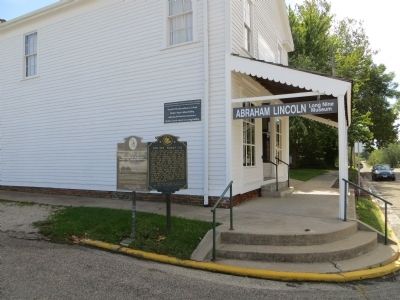
The delegation from Sangamon County for the 1836-1837 Session of the legislature quickly became known as the "Long Nine."
The seven representatives and two senators were all six feet or taller. Five were lawyers, three were farmers, and one . . . — — Map (db m42485) HM
On August 14, 1908, a mob gathered at the Sangamon County Jail and demanded the release of George Richardson and Joe James, two black prisoners. Richardson was accused of raping Mabel Hallam, a white woman; and James was accused of the murder of . . . — — Map (db m199935) HM
[Front of Marker:]
DONNER
Here lies George Donner, Jr., a California Pioneer and a Donner Party survivor. He was born 10 August 1836 in Sangamon County, Illinois, the eldest son of Jacob Donner and Elizabeth Blue Hook. In April 1846 . . . — — Map (db m30305) HM
In the Old State Capitol nearby,
President-Elect Abraham Lincoln
used the Governor's Office as Headquarters
until he left for Washington.
Early in the Civil War,
Ulysses S. Grant
also served here as Special Military Aide
to . . . — — Map (db m312825) HM
Samuel D. Rude
Born 1865 in Farmersville, Collin County, Texas. The son of I.J. and Sarah Alexander Rude. Married Sarah Pyeatt in 1888, to which union was born five children - Hester, Lela, Ike, Myrtle and Dorothy.
Homesteaded N.E. of . . . — — Map (db m289126) HM
Thin black lines indicate changes in relevance. Between each pair of lines entries are ordered geographically but all have the same relevance.
* Inflectional forms of words are their plurals, singulars, and possessives as well as gramatical tenses and similar variations.