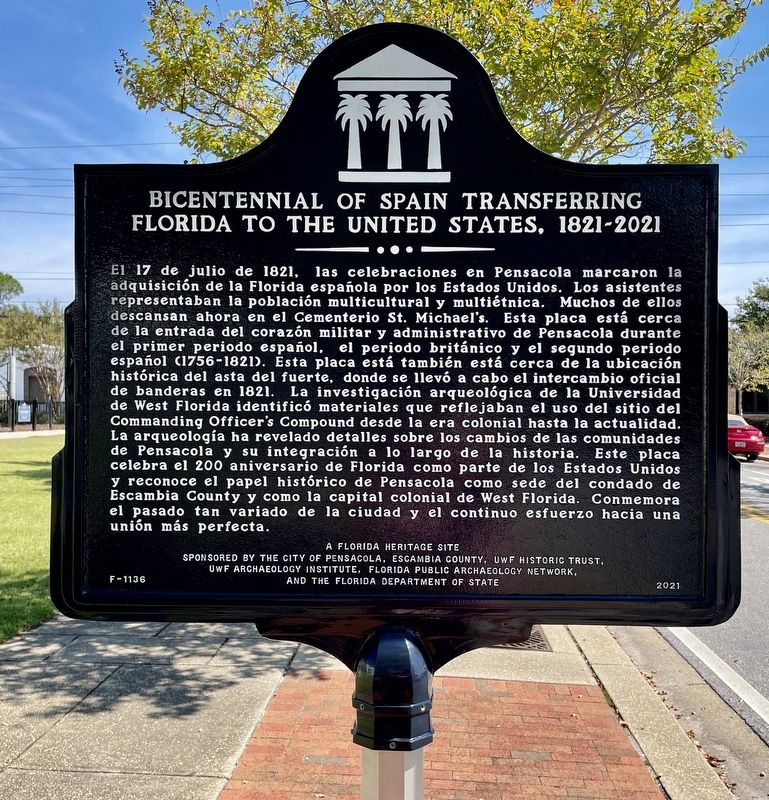
On July 17, 1821, celebrations in Pensacola marked the United States'
official acquisition of Spanish Florida. The people in attendance
represented Pensacola's diverse multicultural and multiethnic population.
Many of them now rest in nearby St. . . . — — Map (db m183424) HM
Pensacola is a city of families. Among the most notable is the James family, whose matriarch Lillie Anna helped educate hundreds of children in her own home. Born Lillie Anna Brown in 1876, she was raised in the Tanyard neighborhood of Pensacola. . . . — — Map (db m298186) HM
Julian Ole Olsen, Sr. was a native Pensacolan born of Danish immigrants. He was instrumental in the development of Bayview Park, creating the Julian Olsen Youth Track Meet, youth athletics, amateur boxing matches, and was a former professional . . . — — Map (db m298197) HM
The usage of crypts has waned over the years since they first became popular in the first half of the 19th century and were more common in St. Michael’s Cemetery, which is located along Alcaniz Street. The crypt here is the only example in this . . . — — Map (db m298493) HM
The body of Martha F. Screven was the first to be buried in the cemetery. Over 20,000 interments followed. With proper management, there is ample space to accommodate burials over the next 200 years. — — Map (db m298490) HM
Helen Fisher was the first Pensacola woman to marry a Naval aviator (Edward O. McDonnell). So many women followed that Pensacola earned the moniker, “mother-in-law to the Navy”. — — Map (db m298495) HM
Mary Lewis Willis was the granddaughter of Betty Washington, who was the only sister of George Washington. After moving here with her husband, who was a brick manufacturer, she died from yellow fever and was buried near her house in Cantonment. Her . . . — — Map (db m298499) HM
Born June 24, 1782 Frederick County, Virginia Died October 7, 1834 Pensacola, Florida Granddaughter of Betty Washington who was the only sister of George Washington Mary W. Willis was also the mother of Princess Catherine D. Murat of the Court of . . . — — Map (db m298500) HM
Zinc or “white bronze” markers are a rarity in most cemeteries; however, they weather the best. They are not plagued by algae, mildew, or fungus. When these monuments were introduced in the 1880s, they were the less expensive alternative to granite . . . — — Map (db m298889) HM
At age nine, in 1859, Philip Keys Yonge moved to Pensacola with his family from Marianna, Florida. The Yonge family came to Florida from England during the British Colonial Period. He began a career in the lumber business in 1876 at the Muscogee . . . — — Map (db m80040) HM
Though several European nations controlled Pensacola in its 460-year history, Spain reigned the longest. Spain made Pensacola the capital city of West Florida, turning the small, rural town into a thriving municipal center. Two hundred years ago, . . . — — Map (db m183441) HM
The Pensacola streets you walk on today are the same ones used in 1821.
The city's layout follows a plan made during the British period (1763-1781).
British Principal Surveyor Elias Durnford redesigned the old Spanish town
using a grid system. . . . — — Map (db m183445) HM
Established by German immigrant Conrad Kupfrian (1833-1892), the 100-acre Kupfrian’s Park opened in the early 1880s and provided a distinctive entertainment and recreational venue for Pensacola residents for over thirty years. Kupfrian constructed . . . — — Map (db m72245) HM
This cemetery has been a burial ground for those who died in Pensacola since the mid to late 18th century. There are thousands of unmarked burials. Markers, monuments, and tombs survive from the 1820s onward. Buried here are people of all ages, . . . — — Map (db m183431) HM
Constructed in 1805, the octagonal
Tivoli Dance Hall and adjacent
tavern became entertainment
centers for Pensacola's diverse
populace, offering dancing, gaming,
and food and drink. Balls were
common and, by 1821, there was an
active theatre . . . — — Map (db m183442) HM
In the early 1800s, revolution and unrest loosened Spain's control over its colonies in the western hemisphere. As Spain dealt with greater crises elsewhere, Spanish Florida became vulnerable to British forces and their Native American allies, as . . . — — Map (db m183447) HM
On this site, Pensacola Junior College (PJC) opened its doors on September 13, 1948. It was the first public junior college created by the Florida Legislature under the Minimum Foundation Program Act of 1947, signed into law by Governor Millard F. . . . — — Map (db m72248) HM
This is the site of Francis B. "Frank" Bonifay's law office. Bonifay was the first Probate Judge of Escambia County Alabama 1869 - 1870. Jesse Howard was elected in 1871 and served for a short time but resigned and Bonifay served from 1870 - 1874. . . . — — Map (db m130674) HM
A native of Maine, Ebenezer Dorr spent fourteen months as a prisoner of war in England during the War of 1812. He was captain of his own ship for many years, trading at ports around the world. In about 1827,
Dorr moved his family to Escambia County . . . — — Map (db m80050) HM
For much of his life, William Miller owned a sawmill east of Pensacola; however, he is best remembered as the senior Confederate general who defended Tallahassee from Federal occupation at the battle of Natural Bridge. Born in New York, he was . . . — — Map (db m298494) HM
Located 1½ miles south, town of Pollard established 1861 at juncture of Alabama & Florida and Mobile & Great Northern railroads. Named for Charles T. Pollard, builder of Alabama & Florida Railroad.
One of largest military training camps of . . . — — Map (db m84371) HM
In the closing phases of the First Seminole War (1817-1818), a U.S. supply boat was attacked by Creek Indians. The boat was ascending the Escambia River from Pensacola in Spanish West Florida, and was bound for Fort Crawford in the American Alabama . . . — — Map (db m242608) HM
A native of Massachusetts, Perry adopted Pensacola, becoming its only resident to rise to Confederate general and the first from here to serve as Governor of Florida. Educated at Lee Academy and Yale University, Perry moved prior to graduation to . . . — — Map (db m298492) HM
The Early Life of T. T. Wentworth, Jr.
Theodore Thomas Wentworth Jr. was born July 26, 1898, in Mobile, Alabama, to Elizabeth Goodloe and T. T. Wentworth, Sr. In 1900, the Wentworth family moved to Pensacola.
Young Tom helped . . . — — Map (db m91123) HM
A pre Civil War structure, this is the oldest church building remaining in Escambia County, Alabama. Confederate veterans related stories that mules and horses were sheltered inside during harsh winter months. Circuit riders served the church in the . . . — — Map (db m84388) HM
Side 1
Old Escambia County Court of Record Building (1912-1978)
During the early 1900s, the Florida Legislature established a new court of record to serve the rapidly-growing Escambia County. Completed in 1912, this Neo-Classical . . . — — Map (db m146500) HM
Obelisk west side
Born at Columbus, GA., June 6th, 1840,
Died in Washington, D.C. December 1st, 1897.
He fought for the Confederacy as Sergeant-
Major, Adjutant and Captain, at Shiloh, Corinth,
Chickamauga and other . . . — — Map (db m80076) HM
From 1934 to 1999, many visitors fondly appreciated a goldfish pond that was located here in memory of Mabel Tart, wife of David H. Tart, Sr. She died at age 44, leaving behind a husband and four children. Her grave nearby in Section 57, Lot 2 was . . . — — Map (db m298899) HM
Mary “Mollie” McCoy was Pensacola's most renown madam. Upon her death, visiting her tombstone became associated with a better love life. Mollie became a prostitute while serving as a washer woman in an Alabama Regiment during the Civil War. She . . . — — Map (db m298768) HM
Truly an Escambia County landmark, Robbins and McGowin Co. organized in March 1897 with the consolidation of the J. I. Robbins and J. G. McGowin Stores, the millinery of Miss L. A. Cunningham, the Blacksher-Miller Commissary, and the J. E. Finlay . . . — — Map (db m130673) HM
In 1886, the AME Zion Burial Association purchased this land for a burial ground. Many people coming out of slavery migrated to Pensacola to find work following the Civil War. While most families had been in North America for generations, they did . . . — — Map (db m298465) HM
Morris Slater — better known as Railroad Bill — is considered the most infamous black train robber in American history. A turpentine worker, he had become upset over gun licensing fees and went “postal” — robbing and killing passengers and workers . . . — — Map (db m298888) HM
An 1843 graduate of the U.S. Military Academy, Samuel G. French was a decorated hero in the Mexican War where he sustained wounds, but gained prominence as a Major General in the Confederacy. After rising to the rank of captain, French resigned . . . — — Map (db m298497) HM
Texas fugitive, John Wesley Hardin (1853-1895) was captured here on August 23, 1877. Hardin was wanted and dangerous, and his capture became national news that brought notoriety to Pensacola. Hardin had reportedly killed 27 men. He bragged he had . . . — — Map (db m91105) HM
Thin black lines indicate changes in relevance. Between each pair of lines entries are ordered geographically but all have the same relevance.
* Inflectional forms of words are their plurals, singulars, and possessives as well as gramatical tenses and similar variations.