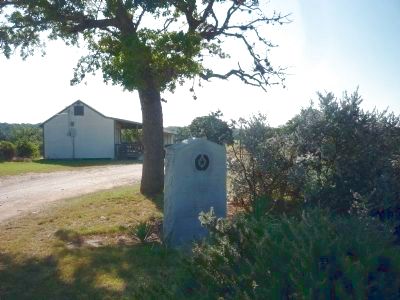
On East Main Street (U.S. 290) south of Industial Loop, on the right when traveling west.
Established by the United States Army
December 5, 1848
as a protection to travelers and
settlers against Indian attack.
Named in honor of Major Martin Scott,
Brevet Lieutenant Colonel,
5th United States Infantry,
killed at Molino . . . — — Map (db m126961) HM
1900 - 1920
The Dawn of a New Century
The years following the turn of the century heralded sweeping changes in agriculture throughout Texas and the nation. Advances in technology led to improved irrigation and farming methods . . . — — Map (db m91053) HM
On Farm to Market Road 1376 1 mile south of Farm to Market Road 1888, on the right when traveling south.
Teacher and inventor Jakob Brodbeck (1821-1910) conceived the idea of building an airship while sailing to the U.S. in 1846. Born and educated as a teacher in Plattenhardt, Germany, he began teaching in the Kingdom of Württemberg, where he worked on . . . — — Map (db m214271) HM
On West Main Street at North Adams Street, on the right when traveling west on West Main Street.
Fredericksburg,
the county seat of Gillespie County, is steeped in history.
1846
Deriving its name from Prince Frederick of Prussia, this Texas town was founded on May 8, 1846, by 120 German immigrants under the auspices of the . . . — — Map (db m196215) HM
On West Main Street (U.S. 290) at South Milam Street, on the left when traveling west on West Main Street.
Between 1844 and 1846, thousands of German immigrants under the auspices of the Society for the Protection of German Immigrants in Texas, better known as Adelsverein, landed at Galveston and Indianola. Their ultimate destination was the 3,878,000 . . . — — Map (db m164039) HM
Near Ranch Road 1 at Lower Albert Road, on the right when traveling east.
First kiln, eastern Gillespie County. Built 1874 by Andreas Lindig, trained in his native Germany in quicklime making. On his homestead, he found rock to be hauled to this site by ox-wagon, using 7 loads of rock for each “batch” of . . . — — Map (db m90811) HM
On Anhalt Road 1.2 miles north of Texas Highway 46.
Anhalt began in the 1850s as a small, predominantly German, farming and ranching settlement. Originally known as Krause settlement, its name changed to Anhalt, meaning “stopping place,” with the opening of the Anhalt Post Office in the Krause store. . . . — — Map (db m283885) HM
Near Landa Park Drive at Monument Drive, on the right when traveling north.
Panel 1
The first German settlements in Texas were Industry in Austin County, founded by Friedrich Ernst in 1831, Biegel in Fayette County, founded by Joseph Biegel in 1832, Cat Spring in Austin County, founded by the von Roeder, Kleberg, . . . — — Map (db m210312) HM
Near E. Austin Street at N. Lincoln Street, on the left when traveling east.
Fredericksburg, the county seat of Gillespie County, is steeped in history.
1846
Deriving its name from Prince Frederick of Prussia, this Texas town was founded on May 8, 1846, by 120 German immigrants under the auspices of the . . . — — Map (db m94093) HM
Near W. Main Street (U.S. 290) west of N. Adams Street.
From 1846 to the 1970’s, forty-four school districts served the educational needs of the children of Gillespie County. This marker honors the history of public education in Gillespie County and the Vereins Kirche, the first public school established . . . — — Map (db m94226) HM
On State Highway 16 0.2 miles south of Horseshoe Bend, on the right when traveling south.
By 1848, Carl Hilmar Guenther (1826-1902), master millwright, had completed his apprenticeship in Germany and immigrated to the U.S.. In search of opportunities and a good grist mill site, he journeyed south from Wisconsin to New Orleans, and then . . . — — Map (db m135095) HM
On West Austin Street 0.1 miles west of North Crockett Street, on the left when traveling west.
This home was built in 1872-73 by German immigrant Heinrich Bierschwale, a teacher in the rural schools of Gillespie and Mason counties. He later served as county and district clerk in Gillespie County. The two-story stone vernacular house . . . — — Map (db m163966) HM
Born and educated in Plattenhardt, Germany. Came to Texas in 1846 and settled in Gillespie County. He became the second school teacher of the Vereins Kirche. He was also involved in the development of Gillespie County by serving as county surveyor, . . . — — Map (db m94227) HM
On East Main Street (U.S. 290) 0.1 miles west of North Washington Street, on the right when traveling west.
Constructed about 1860, this building was acquired by German native Anton Maier (b. 1813) in 1866. A merchant who held several Gillespie County offices, Maier deeded the property to his son-in law, August Alberthal, in 1900. The German vernacular . . . — — Map (db m197125) HM
On South Lincoln Street 0.1 miles south of East Main Street (U.S. 290), on the right when traveling south.
This home was built in the 1860s by German stonemason Lorenz Schmidt, a pioneer settler in the Adelsverein Colony and builder of many early structures, including the Vereins Kirche. Originally a story-and-a-half, the house was enlarged to two floors . . . — — Map (db m197356) HM
On South Lincoln Street 0.1 miles north of East San Antonio Street, on the left when traveling south.
Gillespie County native William Rausch (1864-1939) and his wife, Olga (d. 1943), bought this property in 1894. They lived in an existing house until 1906, when they built this home. A stonemason and carpenter by trade, Rausch probably did much of . . . — — Map (db m197120) HM
On West Main Street (U.S. 290) at North Crockett Street, on the right when traveling west on West Main Street.
Gillespie County Judge in 1852-62, 1864, and 1876-90, William Wahrmund (1824-90) hired local stonemasons H. Hennersdorf and Louis Schmidt to build this residence near his own home and store in 1875. Over a period of years, the house was occupied . . . — — Map (db m163931) HM
Near Ranch to Market Road 783 at Ranch to Market Road 648, on the right when traveling north.
Organized by German Lutherans in September 1896 under a brush arbor at nearby Lange’s Mill, this church has been part of Gillespie County history for over 100 years. A frame church building erected in 1898 was replaced by this Gothic Revival . . . — — Map (db m91744) HM
Near Ranch to Market Road 2323 0.3 miles south of Schneider-Moellering Road, on the right when traveling south.
School classes for the children of German immigrants in the Cherry Spring community were held in homes until 1885, when this limestone schoolhouse was completed on land donated by H. Bratherich. On dedication day, students formed a parade to the new . . . — — Map (db m91632) HM
On W. San Antonio Street west of S. Adams Street (Texas Highway 16), on the left when traveling west.
This two-story stone structure served as the fourth jail for Gillespie County, organized in 1848. It was constructed by the firm of C.F. Priess and Bro. in 1885. The ground floor housed a holding area and living quarters for the jailer. The second . . . — — Map (db m94291) HM
On Spotted Fawn Trail at Agave Court, on the left when traveling south on Spotted Fawn Trail.
Born in Redert, Nassau, Germany, Jacob Neffendorf (1822-1910) came to Texas in 1845 aboard the barque Neptune. He was in the group who surveyed the Fredericksburg townsite and also helped move families here from New Braunfels in 1846. . . . — — Map (db m197055) HM
On Farm to Market Road 1631 3 miles north of Ranch to Market Road 2721, on the left when traveling north.
Oldest rural Lutheran church in Gillespie County. The Rev. M. Haag served as first pastor. Charter members numbered 17. A frame building with walls of rough boxing planks was dedicated June 22, 1884. Size: 25 x 30 feet with a 40-foot . . . — — Map (db m155681) HM
On West Travis Street at North Pecan Street, on the right when traveling west on West Travis Street.
Built about 1870, this residence was purchased by Johann Walter in 1871. Walter, who served as sheriff of Gillespie County from 1874 to 1888, lived here with his family until his death in 1897. In 1901 Walter's widow, Maria, sold the house to Robert . . . — — Map (db m196994) HM
On Stahl Street at East Blanco Road, on the left when traveling south on Stahl Street.
As early as 1874 there were attempts to lay ribbons of rail from San Antonio to Fredericksburg. San Antonio businessmen chartered The San Antonio and Fredericksburg Narrow Gauge Railway Company to accomplish this task, but failed. Several other . . . — — Map (db m173905) HM
On South Main Street 0.1 miles south of West Hosack Street, on the right when traveling south.
Charles (Carl) Weyrich bought this lot in 1877, shortly after relocating from Gillespie County. Weyrich established himself as a tinsmith and married Sophia Beyer in 1878, commissioning this building around the same time. Weyrich’s business . . . — — Map (db m172053) HM
On King William Street south of Beauregard Street, on the right when traveling north.
Alfred Giles is remembered as a major architect who designed many edifices throughout Texas in the late 19th and early 20th centuries.
Born in 1853 in Hillingdon, Middlesex County, England, Giles spent his early days as an architect's . . . — — Map (db m118800) HM
On West Main Street (U.S. 290) 0.1 miles South Orange Street, on the left when traveling west.
Four front rooms with outside stair to attic built 1849 by German settler Henry Kammlah I smokehouse and rooms at rear added 1875. Old world technique of wall plaster over woven twig supports used in interior. Henry Kammlah II and wife Amelia, . . . — — Map (db m157158) HM
On West Main Street (U.S. 87/290) east of North Crockett Street. Reported permanently removed.
Church for all denominations, school and community hall. Built, summer 1847, after the Comanche peace treaty made by John O. Meusebach, Commissioner, German Emigration Company. Located in Main Street between Courthouse and Market Square of . . . — — Map (db m35864) HM
On Park Road 49 at Klein Road, on the right when traveling west on Park Road 49.
Lyndon Baines Johnson first came to this school as a four-year-old in knee breeches and a collar. Here, surrounded by 30 students spanning seven grades, he received his first formal education. The future president attended the Junction School for . . . — — Map (db m91132) HM
On Luckenbach Loop Road at Farm to Market Road 1376, on the right when traveling south on Luckenbach Loop Road.
The Rev. August Engel (1818-1904), a circuit riding Methodist preacher and teacher, immigrated to Texas in 1846 from Germany. In 1859 he married Katharina Ernst (1837-1920). They had six children.
August Engel served as postmaster for five . . . — — Map (db m157171) HM
On East Main Street (U.S. 290) 0.1 miles east of South Washington Street, on the right when traveling east.
German-born Frederick Kiehne (1811-98), a blacksmith and Gillespie County commissioner, built this structure in 1850. It was the first two-story home in Fredericksburg, although many older residences had sleeping lofts. The hand-cut limestone, adobe . . . — — Map (db m197358) HM
On Main Street at N. 6th Street, on the right when traveling east on Main Street.
Created in 1858 out of Bexar County, Kimble County was attached temporarily to Gillespie County for judicial purposes. It was named for Lt. George C Kimble slain March 6, 1836, in the siege of the Alamo. The county was organized in 1876 and the . . . — — Map (db m102796) HM
Thin black lines indicate changes in relevance. Between each pair of lines entries are ordered geographically but all have the same relevance.
* Inflectional forms of words are their plurals, singulars, and possessives as well as gramatical tenses and similar variations.