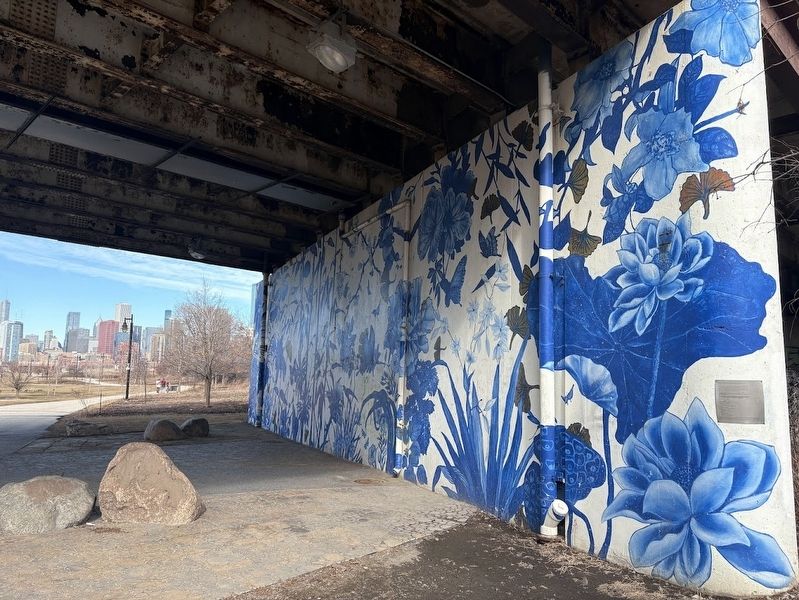
Near 19th Street near Wells Street, on the right when traveling west.
The mural is inspired by the traditional decorative art form of cloisonné, which was at its artistic peak during the Jingtai reign in the Ming Dynasty, when vibrant cobalt blue was used as the predominant color on enamel.
This artistic . . . — — Map (db m267229) HM
[English]
[English translation of the Chinese inscription - South Side (Front)]
A memorial of the Chinese Consolidated Benevolent Association of Chicago
The utmost of the former sages arrives . . . — — Map (db m266972) HM
On 24th Place near Princeton Avenue, on the right when traveling east.
For Celebration of the Bicentennial Commemoration of The United States of America
The Age of Great Comity
By Confucius
When the Great Way is implemented, the world-state is for the equality of all peoples. The sagacious and capable are . . . — — Map (db m266963) HM
Appellate Court Justice
First Asian-American Appellate Court Justice in Illinois
First Chinese-American Female Judge in Illinois
First Chinese American Female Elected to Public Office in Chicago — — Map (db m290358) HM
[English text on the north-facing side of the base:]
Ping Tom Memorial Park was named in honor of the leading force behind its creation, Chinatown's most noted civic leader, Ping Tom. A lifelong resident of Chinatown, Ping Tom became president . . . — — Map (db m267230) HM
On Wells Street at 19th Street, on the left when traveling north on Wells Street.
Ping Tom Memorial Park was dedicated on October 2, 1999. The design was inspired by traditional Chinese gardens in Suzhou, China, with pathways to link defined spaces that mimic courtyards. The park features a pagoda-style pavilion, four dragon . . . — — Map (db m267398) HM
On West Cermak Road at South Wentworth Avenue, on the right when traveling west on West Cermak Road. Reported permanently removed.
There are three existing ancient Nine Dragon Walls in China. They are located in Datong, Shanxi Province and Beijing. The Nine Dragon Walls are originated from Screen Walls in ancient Chinese architecture.
Ancient Chinese believed 9 to be the . . . — — Map (db m81418) HM
On 63rd Street east of Latrobe Avenue, on the right when traveling west.
This portal displays two relief sculpture and a limestone lintel. Both architectural artifacts were salvaged from Chicago firehouses that have been demolished. The terra-cotta reliefs on the columns were originally installed on the facade of a fire . . . — — Map (db m264428) HM
On West 63rd Street at Central Avenue, on the right when traveling west on West 63rd Street.
The Crane and Moreland Building was originally constructed on this site in 1927 by Martin Moreland and George Crane. The three-story building housed offices and small businesses on the first floor with apartments on the upper two floors. Designed by . . . — — Map (db m285426) HM
On South State Street north of East 31st Street, on the left when traveling north.
In 1913, Ida B. Wells-Barnett organized black-led Alpha Suffrage Club to promote women's right to vote. Former meeting site one block north. — — Map (db m191130) HM
On South Doctor Martin Luther King Junior Drive at East 26th Street, on the right when traveling north on South Doctor Martin Luther King Junior Drive.
On 33rd Street at Dearborn Street, on the right when traveling east on 33rd Street.
To house employees of his meat-packing facility, Philip D. Armour Sr. constructed a series of apartments that filled the area bounded by 33rd Street, Armour Street (now Federal), 34th Street, and Dearborn Street.
The building included . . . — — Map (db m299627) HM
These nine structures are what remains of "The Metropolis," one of the nation's most significant landmarks of African-American urban history. Developed during the first decades of the 20th century, this "city-within-a-city was home to numerous . . . — — Map (db m270515) HM
On South Martin Luther King Jr. Drive at 35th Street, in the median on South Martin Luther King Jr. Drive.
Will the Negro, in the language of Andre Malraux, find a meaning in his humiliation, make his slums and his sweat-shops his modern cathedrals out of which will be born a new consciousness that can guide him toward freedom? . . . — — Map (db m270703) HM
On South Martin Luther King Drive at 35th Street, in the median on South Martin Luther King Drive.
Depicted here are some of the geographic, cultural and historical features of this area - the "Black Metropolis" of Chicago. In the period after the First World War, an African American community of vitality and influence developed along these . . . — — Map (db m270715) HM
On South Giles Avenue north of 35th Street, on the right when traveling south.
One of the few surviving collections of rowhouses on the South Side, dating from the late-19th and early-20th centuries and including early works by famed architects Louis H. Sullivan and Frank Lloyd Wright. — — Map (db m270289) HM
On South Martin Luther King Drive at East 32nd Street, on the right when traveling south on South Martin Luther King Drive. Reported missing.
Named in honor of the late Illinois Senator Stephen A. Douglas, Camp Douglas, established in 1861, was the earliest and largest Union military camp in the Chicago area. The camp stretched from 31st Street to 33rd Place and from Cottage Grove Avenue . . . — — Map (db m125027) HM
On South State Street, on the right when traveling north.
Chicago Bee Building
Z. Erol Smith, architect
1929-31
This Art Deco-style building was constructed as
the headquarters for the Chicago Bee newspaper,
which was founded by noted African American
entrepreneur Anthony Overton. It also . . . — — Map (db m188754) HM
On South Indiana Avenue, on the right when traveling north.
Chicago Defender Building
Built 1899; remodeled 1915
This former Jewish synagogue was home to the
Chicago Defender from 1920 until 1960. Founded
by Robert S. Abbott in 1905, the newspaper
became nationally known for its . . . — — Map (db m188261) HM
On East 35th Street east of South State Street, on the right.
The 1919 Chicago Race Riot, part of what is known as the Red Summer, erupted on July 27th after a Black youth, Eugene Williams, was killed by a white man for swimming in a part of Lake Michigan unofficially reserved for white people. That killing . . . — — Map (db m270462) HM
Near South State Street 0.1 miles north of 35th Street, on the right when traveling south.
This defining structure of 20th-century architecture is one of the masterpieces of this world reknowned architect. Designed to house the Illinois Institute of Technology's departments of architecture, planning, and design, the building's dramatic . . . — — Map (db m270262) HM
On South Martin Luther King Drive 0.2 miles south of 32nd Street, on the right when traveling south. Reported permanently removed.
Enlistment and training center for U.S. Union Armed Forces. Site of enlistment of Private Charles H. Griffin, January 5, 1864 Co. B, 29th Reg’t U.S. Col’d Infantry USCT. Prisoner of War camp where 6,000 Confederate soldiers of the Civil War died. — — Map (db m125614) HM WM
On Fort Dearborn Drive just north of East 31st Street, on the right when traveling north.
“A riot is the language of the unheard.” —Dr. Martin Luther King
Sunday, July 27, 1919, a group of boys rafting on Lake Michigan drifted over an invisible racial barrier. Rocks were thrown from the breakwater and Eugene Williams was . . . — — Map (db m166545) HM
On South Giles Avenue at 38th Street, on the right on South Giles Avenue.
The District's five groups of masonry row houses, built between 1886 and 1892, are designed in architectural styles ranging from Italianate, Queen Anne, Romanesque, and Classical Revival to the unusual Flemish Revival style. The house at 3800 S. . . . — — Map (db m299691) HM
On East 39th Street east of South Giles Avenue, on the right when traveling west.
The District's five groups of masonry row houses, built between 1886 and 1892, are designed in architectural styles ranging from Italianate, Queen Anne, Romanesque, and Classical Revival to the unusual Flemish Revival style. The house at 3800 S. . . . — — Map (db m299692) HM
On South Calumet Avenue at East 38th Street, on the right when traveling south on South Calumet Avenue.
The District's five groups of masonry row houses, built between 1886 and 1892, are designed in architectural styles ranging from Italianate, Queen Anne, Romanesque, and Classical Revival to the unusual Flemish Revival style. The house at 3800 S. . . . — — Map (db m299693) HM
On South Calumet Avenue south of 38th Street, on the right when traveling south.
The District's five groups of masonry row houses, built between 1886 and 1892, are designed in architectural styles ranging from Italianate, Queen Anne, Romanesque, and Classical Revival to the unusual Flemish Revival style. The house at 3800 S. . . . — — Map (db m299694) HM
On South Calumet Avenue north of Pershing Road, on the right when traveling north.
The District's five groups of masonry row houses, built between 1886 and 1892, are designed in architectural styles ranging from Italianate, Queen Anne, Romanesque, and Classical Revival to the unusual Flemish Revival style. The house at 3800 S. . . . — — Map (db m299699) HM
On 35th Street west of South Michigan Avenue, on the right when traveling east.
[Plaque on the front:]
In the name of the people of Illinois, I command peace
[Plaque on the rear:]
Chicago police attacked at the Haymarket
May 4, 1886
Eight officers killed
Mathias J. Degan • John J. Barrett • George F. Miller • . . . — — Map (db m270274) HM
On South Martin Luther King Drive, on the right when traveling south.
Ida B. Wells-Barnett
1862-1931
Social reformer
Ida B. Wells-Barnett spent her life crusading against lynching
in America. An advocate for civil rights, woman’s suffrage and
economic justice, her anti-lynching campaign stirred the . . . — — Map (db m181804) HM
On South Martin Luther King Drive at East 29th Street, on the right when traveling south on South Martin Luther King Drive.
[Beneath Louis Armstrong:] Jazz trumpeter, bandleader, composer
[Beneath Lil Hardin-Armstrong:] Jazz pianist, bandleader, composer — — Map (db m308569) HM
On South Doctor Martin Luther King Junior Drive at Eastgate Place, in the median on South Doctor Martin Luther King Junior Drive.
This bronze monument depicts a man wearing a suit made of shoe soles rising form a mound of soles. The soles, worn and full of holes, symbolize the often difficult journey from the South to the North. It commemorates all the African-American men and . . . — — Map (db m308339) HM
The home of the Italian beef, deep-dish pizza, and the Vienna Beef hot dog (hold the ketchup!) is also the city that gave us the skyscraper, open-heart surgery, and reverse-flowing river technology. There's no place else like Chicago, and we're . . . — — Map (db m299629) HM
The home of the Italian beef, deep-dish pizza, and the Vienna Beef hot dog (hold the ketchup!) is also the city that gave us the skyscraper, open-heart surgery, and reverse-flowing river technology. There's no place else like Chicago, and we're . . . — — Map (db m299630) HM
On South State Street south of East 35th Street, on the right when traveling north.
Overton Hygienic Building
Built 1922-23
Built as the headquarters for the Overton
Hygienic Co., one of the nation's foremost
producers of African-American cosmetics, this
structure also housed the Victory Life Insurance
Company and . . . — — Map (db m180693) HM
On East 31st Street at South Prairie Avenue on East 31st Street.
The son of freed slaves, Paul Laurence Dunbar published his first collection of poetry entitled
"Oak and Ivy" in 1893. Early in his career, he edited a newspaper published by friend, Orville
Wright, of aviation fame. Dunbar later befriended . . . — — Map (db m299640) HM
Near South Indiana Avenue near East 33rd Boulevard.
Pilgrim Baptist Church
Adler and Sullivan, Architects
1891
The decorative and planning skills of Sullivan and the engineering ability of Adler are embodied in the strong masonry forms of this building, embellished with terra-cotta . . . — — Map (db m189477) HM