1038 entries match your criteria. Entries 401 through 500 are listed.⊲ Previous 100 — Next 100 ⊳
Montana National Register Sign Program Historical Markers
Aluminum plaques "Listed in the National Register of Historic Places by the United States Department of the Interior in cooperation with the Montana Historical Society."
As Bozeman made its bid for state capital, the construction of fashionable homes and buildings contributed to the town’s promotional efforts. Economic depression in 1893 and designation of Helena as state capital in 1894 tempered the boomtown . . . — — Map (db m192376) HM
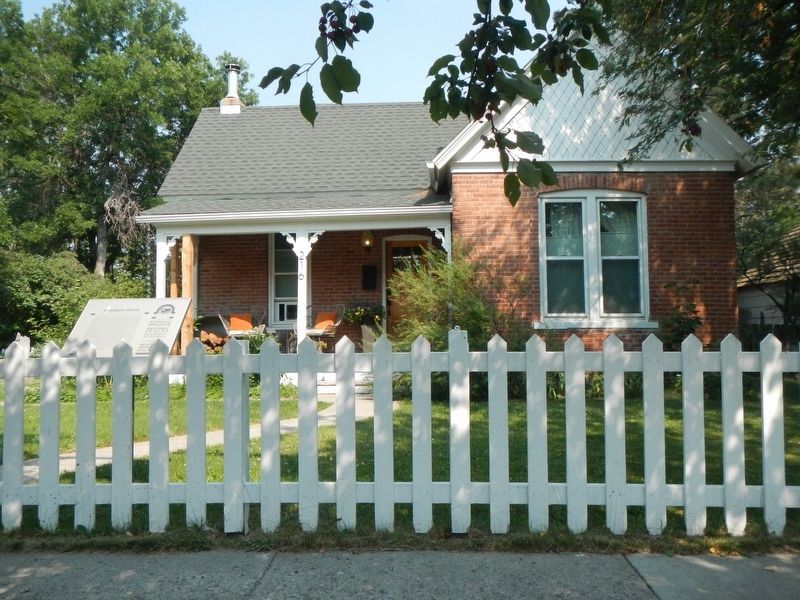
A full-length front porch welcomed visitors to the clapboard home constructed on this lot in 1904. Robert and Edith Cooley purchased the residence from Golden Rule bookkeeper R. A. Black the following year. The couple had moved to Bozeman in 1899 . . . — — Map (db m192235) HM
The first services were held in this lovely Gothic style Episcopal church in October 1890. Built at a time when Bozeman hoped to become the capital of Montana, the church reflects the optimism and prosperity that came on the heels of the gold rush . . . — — Map (db m192067) HM
Optimistic Bozeman entrepreneurs John Dickerson, Walter Cooper, and Nelson Story (of cattle drive fame) platted the Park Addition in 1883. Despite the arrival of the Northern Pacific that year, the addition remained undeveloped until the late 1890s, . . . — — Map (db m192180) HM
Thomas and Anna Noble came to Bozeman in 1890 from Salesville. Thomas, an experienced logger, secured employment with the Prey Lumber Company. After S. C. Kenyon purchased the firm, Kenyon and Noble became partners in the business, furnishing early . . . — — Map (db m192177) HM
Railroad anticipation sparked a frenzied building boom prompting a shortage of brick that postponed completion of this popular watering hole for nearly two years. Begun in 1880, Phil Skeehan’s Tivoli Beer Hall finally opened in 1882. William Beall . . . — — Map (db m192023) HM
John Quincy Adams of the Milwaukee Land Company, a subsidiary of the Chicago, Milwaukee and St. Paul Railway, platted the present town of Three Forks in 1908. Unlike most railroad officials, Adams and his son, B. S. Adams, took an unusual personal . . . — — Map (db m192664) HM
Aviation captivated America during the 1920s, particularly when Charles Lindbergh flew solo across the Atlantic in 1927. The United States made rapid strides and airfields opened all over the country. The town of Belgrade constructed Gallatin . . . — — Map (db m206125) HM
The Milwaukee Land Company, a subsidiary of the Milwaukee Road, established the town of Three Forks in 1908. Company land agent John Q. Adams chose this townsite and held a lot sale in 1908. Buyers came by the trainload, purchasing 250 lots. . . . — — Map (db m192666) HM
The town of Three Forks, born to serve as a division point for the Chicago, St. Paul, and Milwaukee Railway, took root in 1908. As the town grew to a sizable settlement of 2,300, the Empire Theatre opened to serve local audiences. Manager David R. . . . — — Map (db m192662) HM
Arrival of the Milwaukee Railroad caused Three Forks to move (1908-1910) one mile up the Missouri River from its 1863 townsite, as happened with many sister towns in the developing West. Milwaukee Railroad purchasing agent John Q. Adams saw need for . . . — — Map (db m141722) HM
Solid bank buildings were designed to assure customers that their money was safe from both theft and bank failure—a tenuous premise in the days before Federal Deposit Insurance. Here Romanesque arches, rusticated sandstone, thick masonry walls, and . . . — — Map (db m192663) HM
The Forest Service granted Jess Pierman a special-use permit to build a hotel and restaurant here in 1910. A large tent accommodated guests until the present hotel was under construction in the fall of 1912. Doll Bartlett began cooking for Pierman . . . — — Map (db m255676) HM
In 1905 Union Pacific officials began construction of a branch line in the pine-forested wilderness from Ashton, Idaho, to the western edge of Yellowstone Park. As the final tracks were laid in 1907, Samuel P. Eagle, Alex Stuart, Charles Arnet and . . . — — Map (db m123342) HM
As tourism blossomed during the first decades of the twentieth century, the Union Pacific Railroad considered how to better accommodate travelers. Officials conceived the idea of building restaurants and pavilions architecturally similar to the . . . — — Map (db m255675) HM
This Property
Contributes To The
West Yellowstone Oregon
Shortline Terminus
Historic District
Listed In The
National Register
of
Historic Places
By the United States
Department
of
Interior
In Cooperation With
The . . . — — Map (db m103600) HM
Pioneering Southern Methodist minister Learner Blackman Stateler preached his first sermon in Willow Creek on Christmas Day 1864, in a cabin built by a local farmer. Like many of the area’s early residents, Stateler was a Southern sympathizer from . . . — — Map (db m193003) HM
Women, and especially club women, played outsized roles in creating and maintaining the community institutions - churches, schools, and libraries - that they and their families valued. Providing an outlet for women to exercise their leadership . . . — — Map (db m161119) HM
The arrival of the Milwaukee Railroad in 1908 established Lavina as an important regional center. D. W. Slayton’s Mercantile and L. C. Lehfeldt’s Adams Hotel were the cornerstone businesses of the bustling community. Slayton and Lehfeldt, along with . . . — — Map (db m188967) HM
T. C. Power’s stage line established a stop in 1883 where the town of Lavina was born. In 1907, the Milwaukee Road came through attracting new businesses, among them the Slayton Mercantile Co., established in 1908 by Daniel Webster Slayton. A . . . — — Map (db m188968) HM
Rancher Ludwig C. Lehfeldt sold 33,000 acres of ranch land to the Milwaukee Road in 1907 prompting the relocation of the Lavina townsite. Realizing the need for a hotel, Lehfeldt hired architects Link and Haire—who drew the plans for the 1910 . . . — — Map (db m188964) HM
Before his death in 1896, pioneering Jewish businessman William Weinstein owned many lots, including this one, in Philipsburg. By 1902, his daughter Alice Weinstein Hannah owned the property and the one-story wooden dwelling that stood on the site, . . . — — Map (db m205462) HM
Local rancher Lee Degenhart financed the construction of this building in 1910. Fred Haverty, a contractor from Hal, Montana, who later ran a car dealership here in Philipsburg, was the builder. Design features include the original ornamental leaded . . . — — Map (db m45224) HM
Built circa 1887, Lutey's Grocery and the Barrett and Jacky Harness Shop originally shared occupancy of this one-story commercial building. By the 1890s, Valentine Jacky shared this building with C. T. Huffman who supplied groceries to Philpsburg . . . — — Map (db m45226) HM
Brothers Morris and Humphery Courtney built this multi-purpose building in 1918 with the profits from manganese mining acquired during World War I. The building speaks to the coming of the automobile as the basement housed the Granite County Garage . . . — — Map (db m49371) HM
In the 1880s and 1890s, masonry structures gradually replaced the frame buildings left from Philipsburg’s mining camp days. Doe and Hoyer constructed this commercial brick building in 1887. Modini’s Grand Hotel and Restaurant was located in the west . . . — — Map (db m205451) HM
Reverend Milton Cook organized Philipsburg’s first Presbyterian congregation in 1877 and Reverend George Edwards came from Missoula to preach once a month. But it was not until 1891 that Reverend Samuel Wishard established a permanent Presbyterian . . . — — Map (db m205541) HM
The first permanent home for Granite County offices was completed in 1913. Prominent Montana architects John Link and Charles Haire designed the building. Its cut stonework is, appropriately, made of Montana granite. Granite County commissioners . . . — — Map (db m45229) HM
The Granite County Jail was constructed in 1896, three years after Granite County was carved from two adjacent counties and Philipsburg made the county seat. The town served as a hub to extensive area mining and, later, ranching. The jail was the . . . — — Map (db m45228) HM
The excellent design and spacious interior of this two-story commercial building represents Philipsburg’s prosperity and substantial population during the 1890s. Constructed for J.K. Merrill and Sons between 1892 and 1894, Freyschlag Huffman and . . . — — Map (db m49370) HM
Michael Kaiser, founder of Philipsburg Water Company, built this grand hotel in 1881. One of Philipsburg's oldest masonry structures, the original hotel boasted a wrap-around porch extending halfway around the building. Second-story French doors, . . . — — Map (db m45218) HM
Meetings in Philipsburg of Flint Creek Lodge No. 11 date back to 1867. This structure, built in 1911, provided a permanent home for the community-oriented fraternal organization. Chambers for lodge meetings occupy the entire top floor. The ground . . . — — Map (db m45222) HM
Prominent businessman Angus A. McDonald constructed this two-story masonry theater in 1891. A metal-covered stage loft rises above the roof as evidence of the structures historic function. Beneath the south end were dressing rooms for the traveling . . . — — Map (db m49373) HM
Colonel J.W. Morse built Morse Hall in 1887. This elaborately detailed public lecture hall also served as county courthouse after 1893, an opera house, town hall, library and general community center. Its splendid second story dance floor was the . . . — — Map (db m45213) HM
During the 1880s masonry structures began to replace wood-framed buildings from the mining camp days to form the present town. George H. Harn, who at that time ran one of two local brickyards, probably built this fine residence with his own bricks. . . . — — Map (db m205544) HM
Philipsburg's early-day fortunes ebbed and flowed with mining. Today, its historic district is one of Montana's best preserved late-19th-century mining towns, with commercial, public and private buildings dating from the boom period of silver . . . — — Map (db m45209) HM
Philipsburg's early-day fortunes ebbed and flowed with mining. Today, its historic district is one of Montana's best preserved late-19th-century mining towns, with commercial, public and private buildings dating from the boom period of silver . . . — — Map (db m45210) HM
One of a network of Jewish merchants who supplied miners in the Rocky Mountain West, nineteen-year-old Benjamin Pizer arrived in Helena from Poland with his wife Jessie Silverman and their newborn son David in 1869. With limited capital, he . . . — — Map (db m45217) HM
First known as the Hyde Block, this building was constructed by banker Joseph Hyde and his wife, Mary, in 1888. It housed the First National Bank until the silver crash of 1893. In 1904, Frank Sayrs purchased the building and it has since held a . . . — — Map (db m45220) HM
A beautifully embellished pedimented gable and open porch with spindled balustrade, turned columns, and decorative details highlight this splendid two-and-one-half-story Queen Anne style residence of salmon-colored brick. Mary Schuh, a longtime . . . — — Map (db m205543) HM
In January 1889, St. Andrew’s Episcopal Church opened its doors to hold one of the first services in a church in Philipsburg. Placed within the cornerstone the previous year were a Bible, some coins, names of donors, and a copy of the Philipsburg . . . — — Map (db m205457) HM
The cornerstone for St. Paul’s Methodist Episcopal Church was laid in 1887. Dedicated September 15, 1890, this modest but rather sophisticated structure was one of Philipsburg’s early churches. Choice of brick and prolonged construction reveal the . . . — — Map (db m205459) HM
Around the mountain from the mining camp of Cable in 1866 came Polish-born merchant William Weinstein with a wagon-load of goods to sell. He became Philipsburg's first general merchant, constructing the eastern half of this building in the late . . . — — Map (db m45212) HM
Charles A. and Frank J. Wilson, brothers from Wisconsin, built and established their businesses in this building by 1888. The building originally housed a furniture store on one side, a feed store on the other and a miners' boarding house/living . . . — — Map (db m45214) HM
Prominent Missoula architect A. J. Gibson designed and built this two-story commercial building in 1905. The fine design includes a metal modillioned cornice and panels with a full height glass storefront and polished granite skirt below. The Walker . . . — — Map (db m45223) HM
Alexander “Nosey” D. Smith came to Havre as a Great Northern Railroad conductor when the first trains came through town in the mid-1890s. He purchased two lots for $5 in 1897 and built this late Victorian Folk style home in 1902. . . . — — Map (db m142676) HM
The sunburst motif on the front gable end of this single-story, hipped-roof residence signals the builder’s debt to the Queen Anne style. Havre pioneer Daniel H. Boone and his wife, Elizabeth, owned the four-square residence. Built before 1903 and . . . — — Map (db m142675) HM
A battlement-topped octagonal turret—a traditional military architectural symbol—distinguishes Fort Assinniboine’s Company Officers’ Quarters. Built in 1880 under supervision of Major J. C. C. Lee, the six-unit building asserted . . . — — Map (db m142742) HM
A row of thirteen mansard-roofed officer's quarters, flanked by two flat-roofed apartment buildings, defined the north east side of the parade grounds. Ten of the buildings were duplexes, most like this one, designed to house married officers and . . . — — Map (db m142798) HM
Prominent builder Abe Crosson acquired this property in 1911. By 1916, a booster brochure proclaimed the frame Colonial Revival residence one of Havre’s beautiful homes. In 1936, Great Northern Railroad conductor Ray VanBuskirk and his Irish-born . . . — — Map (db m252319) HM
According to the United States War Department, Fort Assinniboine was established in 1879 “for the purpose of protecting the citizens of Montana from the hostile incursions of Indian tribes dwelling in that region; and especially ... the Sioux . . . — — Map (db m142772) HM
With its graceful dormer and full-length front porch supported by Tuscan columns, the front of this one-story, hipped-roof building looks like an attractive and comfortable residence. The back of the building, with its small, arched barred windows . . . — — Map (db m142774) HM
Red brick, finely crafted stonework, and a colonnade reminiscent of a Greek temple brought an imposing federal symbol to Havre in the 1930s. Securing state and federal funds for this post office was an expression of optimism during economic . . . — — Map (db m142645) HM
The post’s first library was relegated to a small space at the back of the Signal Corps office, but in 1888-89 the military spent $1,409.13 to build a one-story, brick, hipped-roof library with multiple wings. A visiting Helena reporter called the . . . — — Map (db m142773) HM
The quintessential businessman, Lou Lucke arrived in Havre in 1903, where he founded a shoe repair and later a clothing store and a dry cleaning business. He also speculated in real estate. When the homestead boom in turn boomed Havre, Lou and local . . . — — Map (db m142672) HM
In its final years as a military outpost in 1904 and 1905, Fort Assinniboine underwent an extensive effort to expand and modernize its facilities. Great Falls contractors Frank Coombs and Duncan Brothers built this residential duplex in 1905 for . . . — — Map (db m142679) HM
In its final years as a military outpost in 1904 and 1905, Fort Assinniboine underwent an extensive effort to expand and modernize its facilities. Great Falls contractors Frank Coombs and Duncan Brothers built this residential duplex in 1905 for . . . — — Map (db m142741) HM
Frontier capitalist C. A. Broadwater received the contract to provide locally manufactured bricks and timber, hauled from the Bear’s Paw Mountains, to construct Fort Assinniboine. He hired five hundred Métis (mixed-blood Chippewa-Cree) from the . . . — — Map (db m142775) HM
Before refrigeration, rural Americans preserved perishables in root cellars. The fort’s first root cellar, a 100-by-20- foot structure, was built in 1879-80. In 1902 the government invested $3,900 (about $237,000 in 2011 dollars) to replace the . . . — — Map (db m142799) HM
Havre's first Episcopal church service was held in 1900 at Fort Assinniboine, south of Havre. After the arrival of the Reverend Leonard J. Christler in 1907, regular services were conducted in town. The Reverend Christler immediately began plans for . . . — — Map (db m252321) HM
Havre's first Episcopal church service was held in 1900 at Fort Assiniboine, south of Havre. After the arrival of the Reverend Leonard J. Christler in 1907, regular services were conducted in town. The Reverend Christler immediately began plans for . . . — — Map (db m142671) HM
Immense herds of bison once roamed the great North American prairies. As many as 30 million of the great shaggy beasts moved seasonally in herds of 25 to 300, following the same patterns year after year. Bison, or buffalo, were the lifeblood of the . . . — — Map (db m142638) HM
For centuries Native Americans have been coming to these pure, flowing hot water springs for rest and healing. Legend tells that they called this area Peace Valley. They agreed to lay down their weapons when they sojourned here, believing that the . . . — — Map (db m186201) HM
In 1888, Jefferson County voters passed a $40,000 bond issue to build a permanent courthouse. Flourishing gold and silver mines and the advent of the railroad meant the county would see its population quadruple between 1870 and 1890, and there . . . — — Map (db m186193) HM
Montana pledged its commitment to children with disabilities in 1887 when Territorial Governor Preston Leslie requested funds for a Montana Deaf and Dumb Asylum. Its title, although shocking by today’s standards, reflects accepted nineteenth-century . . . — — Map (db m186195) HM
Swiss miner Peter Wys discovered the lucrative silver veins of the Elkhorn Mine that would eventually yield $14 million. After Wys died in 1872, Helena entrepreneur Anton M. Holter and partners developed the Elkhorn Mine. Holter sold out to an . . . — — Map (db m290533) HM
Newlyweds Lot and Hilda Borden arrived in Whitehall early in 1900, and for the next seventy years, their business contributed to the local economy. At first, Lot ran a saloon and Hilda a cafe. The Bordens built the east portion of the present . . . — — Map (db m193009) HM
The 1887 Dawes Act gave Congress the power to survey Indian reservations, assign land (allotments) to individual Indians, and open the remaining land to homesteaders. Although tribal leaders, including Chief Charlo and Sam Resurrection, resisted . . . — — Map (db m219655) HM
Congress opened the Flathead Reservation for homesteading in 1910, setting aside several tracts of land for townsite purposes. The town of D’Aste was platted soon after. Thomas P. Quinn operated a store and post office at D’Aste, serving fifty-three . . . — — Map (db m219139) HM
Homebuilding across the country stopped completely during World War II as materials were diverted to the war effort. When residential construction resumed after the war, architects broke with past traditions and embraced modernism. One-story ranch . . . — — Map (db m219135) HM
The first circuit-riding Methodist ministers, “the Lord’s Horsemen,” arrived in Montana in the 1870s to establish congregations among the territory’s early population. Settlers came to the Flathead when reservation lands opened to homesteading in . . . — — Map (db m219136) HM
Two forges and an interior wood partition seared with the impressions of cattle brands manufactured on site attest to this property’s long history as a blacksmith shop. Canadian immigrant Treffle Bergeron opened (and likely built) the lot’s first . . . — — Map (db m220205) HM
In September 1887, the Helena Weekly Herald noted “nine first-class brick residences” under construction on South Rodney Street. Among them were three nearly identical duplexes, called Galen Estates after one of the development’s principal . . . — — Map (db m188209) HM
A small L-shaped dwelling with a full-length front porch stood on this lot by 1875 according to an early bird’s-eye map of Helena. German Catholic rancher Herman Rosenbaum and his wife Mary purchased the house in 1879. The neighborhood was perfect . . . — — Map (db m188210) HM
An early one-story wooden dwelling stood here by 1884, replaced by 1888 with a two-story brick residence, set slightly back from the street. The home soon found itself ensconced in a busy commercial district. Neighbors included saloons, grocery . . . — — Map (db m188329) HM
Jacob T. Gove, a miner and assayer, developed the Bonanza Chief gold mine near Montana City in 1883, netting over $9,000 from three carloads of ore. With his small fortune, he opened an assay office, built the house next door at 229 for his family, . . . — — Map (db m188180) HM
Mining required back breaking labor and, after the easy pickings were gone, substantial capital. How did prospectors decide whether to continue working particular veins? They brought ore samples from their claims to an assay office, where they were . . . — — Map (db m188179) HM
Two distinct front porches attest to the separate histories of these two nineteenth-century homes, combined into one in the late twentieth century. The older of the two at 490 West Main was built between 1865 and 1875. Segmentally arched windows and . . . — — Map (db m187480) HM
Senator T. C. Power met A. C. Johnson in Chicago and, taking a liking to the young man, offered him a job out west. The nineteen-year-old came to work as chief clerk at Power’s Fort Benton Mercantile in 1879. Power and Johnson became friends and . . . — — Map (db m187736) HM
George and Anna Pascoe, both natives of England, moved to Helena from Butte in 1908. George died soon after the couple purchased this home in 1911. Although he was not long a resident of Helena, George, “with a cheery smile and a good word for . . . — — Map (db m187740) HM
The fanciful façade of this nineteenth-century showcase was intended to convey a powerful message. Completed in 1889 for the insurance company of Samuel J. Jones at a cost of $40,000, the vivid imagery is an advertisement, showing how insurance . . . — — Map (db m186556) HM
Charles Hendrie opened Helena’s first iron foundry on this site before 1868. The property’s third owner, Benjamen K. Tatem, built this two-story residence circa 1875. Wide eaves, low hipped roof, and tall arched windows proclaim Italianate . . . — — Map (db m187475) HM
An octagonal tower, decorative brickwork, one-story open porch, and hipped roof identify this appealing Queen Anne style residence built circa 1883. That year launched a period of neighborhood expansion and prosperity, kindled when the tracks of the . . . — — Map (db m188086) HM
Legend has it that architect James F. Stranahan built this striking residence of locally quarried blue granite for his bride, Leona, in 1889. Stranahan died, however, leaving the home unfinished. Records do show that Leona briefly owned the . . . — — Map (db m188520) HM
Established by the state legislature in 1901, Montana’s Board of Health was originally housed in two small offices in the capitol building. As the state devoted more attention to public health during the Progressive Era, the Board’s responsibilities . . . — — Map (db m186778) HM
Historic maps and early directories reveal that this splendid business block was constructed circa 1890. Morris Auerbach, in business with Israel L. Israel and Adolph Marks during the 1890s, was the original occupant. Their Boston Clothing Company . . . — — Map (db m186610) HM
Newlyweds Isaac Boyer and Carrie Feldberg Boyer moved to their new home within a year of their 1907 marriage. The refined, hipped-roof residence may well have been built to order. The two-story house features popular Colonial Revival style details, . . . — — Map (db m187660) HM
The home of territorial Governor Benjamin Potts sat on this property from the 1870s until this grand residence was built for prominent Helenans Charles B. and Mable Power circa 1907. Power’s father was merchant prince and early U.S. Senator T. C. . . . — — Map (db m188332) HM
Prominent Helena investor and real estate developer Charles W. Cannon commissioned the firm of Wallace and Thornborgh to construct this building for $10,000. Completed in 1890, the building reflects expansion and urbanization in the downtown area . . . — — Map (db m187145) HM
Most of Helena’s earliest commercial buildings fell victim to the fires that plagued the gulch. This simple 1860s commercial building, originally a single story of stone construction, was a notable exception, surviving a disastrous conflagration in . . . — — Map (db m186670) HM
According to reminiscences of the Butts family, builders of the Pioneer Cabin next door, two cabins stood on this lot in 1865. William Davenport likely built one for his family and the William H. Parkinsons occupied the other. Sallie Davenport, . . . — — Map (db m187373) HM
Helena entrepreneur William Chessman built these exemplary Queen Anne style townhouse apartments in 1891 while in residence across Sixth Avenue at 304 North Ewing. Gables, bays, and a rounded turret handsomely demonstrate the architectural . . . — — Map (db m188458) HM
William C. Child came to Montana from Iowa in 1870 as an agent for the Wells Fargo Express Company. President U. S. Grant soon appointed him territorial land office registrar and Child made a small fortune in mining investments. This two-story barn, . . . — — Map (db m188331) HM
John B. Sanford was born on a farm in Maine to Quaker parents. His father, then retired, had been captain of a whaling vessel. Sanford came to Montana in 1864 at the age of 29. On the journey west he formed a partnership with 24-year old Christmas . . . — — Map (db m187589) HM
Following World War II, Montana’s growing state agencies desperately needed all types of space. Consequently, in 1946 the Montana State Postwar Planning and Construction Commission recommended building a laboratory where all testing for state . . . — — Map (db m186915) HM
The Colorado Building is a rich illustration of Helena’s commercial blossoming during the early twentieth century. The Mountain States Telephone and Telegraph Company built the structure in 1922, thereby completing this block in the town’s more . . . — — Map (db m187243) HM
Reputedly the first two-story building on Main Street and one of Helena’s few remaining structures dating to the 1860s, this stone building originally housed offices and furnished lodgings. Miner and prominent merchant E. M. Dunphy purchased the . . . — — Map (db m186607) HM
Locally quarried blue-gray granite complements the shingled upper stories in this commanding nineteenth-century home. Both this residence and the one next door are stellar examples of the eclectic Shingle style. The wide porch and asymmetry are . . . — — Map (db m187674) HM
Elisha Poad arrived in Helena in 1867 by way of mining camps in California and Nevada. Poad was a native of Cornwall, England, an area with over two thousand years of mining history. Attracted to Helena’s placer mines, he was later associated with . . . — — Map (db m187478) HM
Lydia Jane English was recently widowed when she and her family moved into this substantial Italianate style residence, built in 1888. Her husband, miner Harvey W. English, was a prominent Helena pioneer who served in the territorial legislature, as . . . — — Map (db m188181) HM
1038 entries matched your criteria. Entries 401 through 500 are listed above. ⊲ Previous 100 — Next 100 ⊳