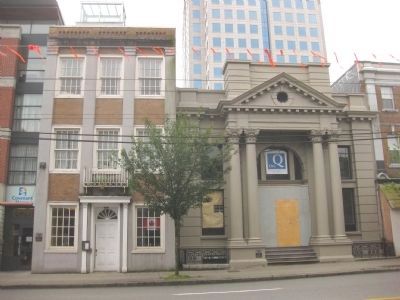
On West Pender Street close to Hamilton Street, on the right when traveling east.
This building is an integral part of the Victory Square area dating back to 1929. The facade was renovated in 1948 by architect W.H. Birmingham. It was given Neo-classical treatments including a decorative cornice installed below the original . . . — — Map (db m54517) HM
On Carrall Street, on the left when traveling south.
This hotel dates back to 1887, part of the rapid development of the city prior to and upon arrival of the Canadian Pacific Railway. The original hotel here, known as Tremont House, was a wood frame building with a second floor balcony spanning the . . . — — Map (db m236472) HM
On Burrard Street at Nelson Street, on the right when traveling north on Burrard Street.
This landmark building, completed in 1957 as the head office for BC Electric Company, is a significant example of the Internationalist style of modern architecture. Floors are cantilevered from a central load bearing concrete core and supported by . . . — — Map (db m32348) HM
On West Hastings Street, on the right when traveling north.
BC & Yukon Chamber of Mines
Architect: John C. Day
This was built in 1926 as the corporate offices for the Royal Financial Trust Co., in Classical and Gothic ornamentation with terra cotta cladding. By 1931 the company was . . . — — Map (db m236785) HM
Canada Pacific Railway Station
Architects: Barott, Blackader & Webster
As the terminus for the Canadian Pacific Railway, this site has been an important landmark since the completion of the railway in 1886. This Neo-Classical . . . — — Map (db m236312) HM
On Granville Street close to West Hastings Street.
In the early 20th century, bank buildings were designed to recall classical temples and evoke a sense of permanence and dignity. The Neo-Classical design, imposing Ionic columns, decorative stonework, and prominent roof cornice of this building make . . . — — Map (db m33025) HM
This eclectic 1903 building was one of 2,507 public libraries paid for by the Scottish-American industrialist Andrew Carnegie, the richest person in the world when he retired in 1901. Carnegie believed in the "Gospel of Wealth" and gave away 90% of . . . — — Map (db m32318) HM
On West Hastings Street, on the right when traveling east.
Ceperley Rounsefell Building
Architects: Sharp and Thompson
Built in 1921, this was the headquarters of one of the province's largest insurance and real estate firms with roots going back to the city's incorporation. Henry . . . — — Map (db m236783) HM
Cordage Building
Architect: Hugh Braunton
This residential hotel built in 1911 replaced an older section of the Granville Hotel which had connected to what is now the Grand Hotel to the west. Its elegant Edwardian and Classical . . . — — Map (db m236411) HM
On Seymour Street just south of Dunsmuir Street, on the left when traveling north.
This unusual building is one of the few surviving Art Deco buildings in downtown Vancouver. Its roofline an exuberant crenelated cornice built in cast concrete and designed in a curvilinear waterfall theme. Downing is best known as the architect of . . . — — Map (db m41926) HM
On Beatty Street at Dunsmuir Street, on the right when traveling north on Beatty Street.
This fortress-like building has served as the drill hall and armoury for the British Columbia Regiment since its opening by HRH the Duke of Cornwall and York in 1901. The solid building with three-foot thick walls, was constructed of Gabriola Island . . . — — Map (db m54225) HM
On West Hastings Street at Cambie Street, on the right when traveling west on West Hastings Street.
Thomas Flack commissioned this landmark commercial building in 1898, following his return from a prosperous venture to the Klondike gold fields. Completed in 1900, it framed one of the city's most prominent intersections, facing the first provincial . . . — — Map (db m53619) HM
George Leslie's Lane Cottage
Builder: George Leslie
This circa 1901 Yaletown home was relocated to Mole Hill in 2002 and restored by the Vancouver Heritage Foundation. It was originally situated on the lane at [t]he rear of . . . — — Map (db m236746) HM
On Water Street, on the right when traveling west.
Greenshields Building
Builder: J.J. McLuckie
This former Warehouse was constructed in 1901-02 as two separate buildings designed to appear as one. Greenshields, Son & Company was a prominent Montreal-based dry goods firm which . . . — — Map (db m236396) HM
On West Georgia Street at Howe Street, on the right when traveling north on West Georgia Street.
This distinguished hovel designed in the Georgian Revival style was opened in 1927 by Edward Prince of Vale, who later became King Edward VII. Though the 1920s prominent buildings such as this were quickly replacing the area's early houses and . . . — — Map (db m236323) HM
On Hornby Street, on the left when traveling north.
Architects: John S. Archibald & John Schofield
In 1887, the first Hotel Vancouver opened at Georgia and Granville Streets. It was replaced in 1916 by more lavish building at the same location. In 1928, construction began on the third and . . . — — Map (db m236318) HM
On Granville Street, on the right when traveling north.
Orpheum Theatre
Architects: B. Marcus Priteca & Frederick J. Peters
The Orpheum, built and financed by local entrepreneur Joseph F. Langer, was part of the Chicago-based Orpheum Circuit theaters. It opened in 1927 as the largest . . . — — Map (db m236733) HM
On Granville Street just south of Robson Street, on the left when traveling north.
This rare example of an art deco exterior employing colourful terra cotta with Egyptian overtones was designed by the architects of Vancouver's city hall as part of a 1929 building renovation. The interior structure dates from a saloon built in 1888 . . . — — Map (db m285298) HM
On West Georgia Street just west of Richards Street, on the right when traveling west.
Built in 1929 for the brokerage firm S.W. Randall Company, this commercial building is a good example of the design of the city's downtown office development at the time of the Great Depression. The brick cladding is enriched by the terra cotta . . . — — Map (db m54834) HM
The Robinson Block was built in 1889 Zebulon Franks, a Jewish immigrant from Russia who arrived in 1887, relocated his general supply store here from Carrall Street in the early 1890s. It catered to resource industry workers - loggers, fishers, . . . — — Map (db m236403) HM
On Barclay Street, on the right when traveling north.
Roedde House
Attributed to Francis Mawson Rattenbury
This Queen Anne style home of Vancouver's first bookbinder was built by Gustav and Matilda Roedde in 1893. Efforts to restore the house and establish a unique heritage park . . . — — Map (db m236348) HM
On Jervis Street, on the left when traveling west.
St. Paul's Anglican Episcopal Church
Architect: W.H. Archer
This attractive wooden Gothic Revival church, built in 1905, was modelled after a typical English Parish church. Regional influences in the building can be seen in . . . — — Map (db m236749) HM
On Dunsmuir Street at Seymour Street, on the left when traveling west on Dunsmuir Street.
Of the turn-of-the century hotels built in the downtown area before World War I, this is the last one that has survived as a hotel. Noted architect W.T. Whiteway designed it in 1913. He was the architect of the Sun Tower, the original 1903 Woodard's . . . — — Map (db m41988) HM
On Water Street, on the right when traveling east.
Taylor Building
Architects: Grant & Henderson
Walter Taylor and Edward Clarence Taylor commissioned this commercial building in 1911. Walter Taylor was the founder and managing director of the Empress Manufacturing Company, . . . — — Map (db m236398) HM
The Grand Motel was built in 1889. It was known as the Granville Motel until its expansion in 1904. Designed by Noble Stonestrott Hoffar, one of Vancouver's earliest architects, it is a fine example of the Victorian Italianate style, and one of . . . — — Map (db m236409) HM
Thomas Fee House
Architects: Parr and Fee
This early West End home was designed and built in 1904 as the private home of Thomas Fee, a partner in the well-known architectural firm of Parr and Fee. The firm was responsible for the . . . — — Map (db m236747) HM
Near Stanley Park Drive 0.3 kilometers north of West Georgia Street.
The Vancouver Rowing Club was established in 1899 when the Burrard Inlet Rowing Club joined the Vancouver Boating Club. Throughout it's history the Vancouver Rowing Club has played an important part in the athletic and social life of Vancouver. This . . . — — Map (db m31941) HM
On Hastings Street (Provincial Highway 7A) at Seymour Street, on the right when traveling east on Hastings Street.
Originally designed for the Union Bank of Canada, this Greek temple-style bank opened as the local head office of the Bank of Toronto in 1920, when Hastings Street was lined with ten other banks and served as Vancouver's main business street. . . . — — Map (db m255467) HM
On Cambie Street at Pender Street, on the right when traveling north on Cambie Street.
This handsome Edwardian Commercial style building was completed in 1911 for Francis Carter-Cotton, a newspaper publisher and member of the provincial legislature who previously hired Arthur Cox to design the neighbouring Province Building . . . — — Map (db m255444) HM
On Burrard Street at West Hastings Street, on the left when traveling north on Burrard Street.
Marine Building
Architects: McCarter & Nairne
Once the tallest building in the British Empire, the
Marine Building enjoys a special heritage status as
an internationally acclaimed example of Art Deco
architecture. Completed in . . . — — Map (db m284732) HM
On Hastings Street (Provincial Highway 7A) close to Homer Street, on the right when traveling east.
This 1903 ‘temple bank’ was the first bank built in Vancouver designed in the form of a classic Greek temple instead of the High Victorian Gothic style. It served as the local headquarters of the Royal Bank until 1931. The design is twentieth . . . — — Map (db m255482) HM
On Pender Street at Beatty Street, on the right when traveling east on Pender Street.
This prominent Beaux-Arts office tower was built in 1911-12 for the Vancouver
World newspaper, the tallest building in the British Empire when it was
completed. Its publisher, Louis D. Taylor, served as Mayor eight times between
1910 . . . — — Map (db m255465) HM
On West 10th Avenue, on the right when traveling east.
Grocer Fred Welsh was the first owner of this home which was built in 1894 during the early development of the Mount Pleasant neighbourhood. This Queen Anne style cottage has elaborate wooden decoration including delicate brackets, shingles and . . . — — Map (db m236645) HM
On West 10th Avenue, on the right when traveling east.
This 1908 house is a good example of the Edwardian Builder style which was popular during the city's building boom in the early years of the 20th century. These wooden frame buildings were often two and a half stories with a full front porch simple . . . — — Map (db m236641) HM
On West 10th Avenue, on the right when traveling east.
Like its neighbour at 118 West 10th Avenue, this house is characteristic of Edwardian design which was popular in the early 20th century. The upper storey balcony with its arched opening and balustrade is a particular attractive feature. This house . . . — — Map (db m236639) HM
On West 10th Avenue, on the left when traveling west.
JC. Turnbull built and briefly lived in this 1909 Queen-Anne-styled home. It was later acquired by Jacob Grauer, a postmaster at Eburne, whose sons became public figures. The front facade features outstanding ornamentation, coloured glass windows, . . . — — Map (db m236647) HM
On West 2nd Avenue at West 5th Avenue, on the right when traveling north on West 2nd Avenue.
Nye’s Gas Station
Architects: Townley and Matheson
The firm of Townley and Matheson, best known for designing Vancouver's City Hall further up Cambie Street, designed this early brick gas station in 1922 for Captain Percival Nye . . . — — Map (db m236701) HM
Vancouver City Hall
Architects: Townley and Matheson
Built in 1935-36 as a symbol of Vancouver's growth, City Hall is a prime example of Moderne design. Its geometric silhouette, stylized bands of ornamentation, elegant light . . . — — Map (db m236651) HM
Model School
Architect: E.E. Blackmore
Built in 1905 as an elementary school for teacher-training, this was the first institutional building in the area. This richly textured sandstone building with deeply set windows, a formal . . . — — Map (db m236687) HM
Normal School
Architects: Pearce & Hope
Gothic Revival details such as the arched entranceway, rough granite and sandstone walls, and stained glass windows contribute to this building's image of permanence. School teachers from . . . — — Map (db m236689) HM
This rare surviving 1894 Victorian home was one of the first homes built in Fairview Slopes. Within a decade houses covered the entire neighbourhood. Shaw House draws from the Italianate style with elements of the Eastlake style, such as elaborate . . . — — Map (db m236698) HM
On West Pender Street near Hamilton Street, on the right when traveling east.
This small scale but well-executed example of Beaux-Arts classicism was designed by Thomas Hooper (the architect of Shaughnessy's Hycroft Mansion) and Elwood Watkins. Built in 1907 for Thomas Talton Langlois' BC Permanent Loan Company, after 1935 it . . . — — Map (db m54523) HM
On West Pender Street at Carrall Street, on the right when traveling west on West Pender Street.
The Chi Kung Tong, later the Chinese Freemasons, purchased this building in 1907. It included meeting rooms, a male dormitory and a Chinese school - uses common to Chinese Society Buildings. The Chi Kung Tong assisted early immigrants from China who . . . — — Map (db m53798) HM
On West Hastings Street at Cambie Street, on the right when traveling west on West Hastings Street.
This ornate Beaux-Arts skyscraper was commissioned by Imperial Trust in 1906 but opened in 1910 as the Dominion Trust Building after this company assumed the debt and completed construction. It was the tallest building in the British Empire at that . . . — — Map (db m54360) HM