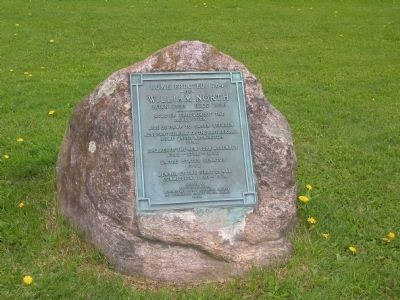
Home, Erected 1784
- Of -
William North
Born 1755 Died 1836
—————————
Soldier Throughout The
Revolution
Aide De Camp To Baron Steuben
Adjutant General Of The Provisional . . . — — Map (db m27494) HM
Dutch Word Meaning
Beechdale. DeGraff House
Where 40 Schenectady
Militia Fought Off French-
Indian Raiding Party
Town of
Glenville
— — Map (db m104952) HM
Lock 8
The Erie Canal's Lock 8 on the Mohawk River includes a three-span movable dam. Measuring
510 feet wide, it is often mistaken for a bridge. When activated, it and lower boats by as
much as 15 feet.
The Stockade . . . — — Map (db m251148) HM
You are standing at the remains of Lock 25 of the Historic Erie Canal.
Construction of the Erie Canal began in 1817 and opened in its entirety in 1825. The Erie Canal is considered the engineering marvel of the 1800s. When the federal . . . — — Map (db m193907) HM
Work began here in Rotterdam in 1908 on Erie Barge Canal Lock 8. In addition to constructing Lock 8, engineers built a three-span moveable dam (about 510 feet wide) that raises boats heading upstream as much as 15 feet when the dam is activated. . . . — — Map (db m130555) HM
From the beginning, it was the waterway that attracted people to Schenectady. Dutch settlers founded Schenectady in 1661 as part of the New Netherland Colony. The name "Schenectady" is said to be derived from the Mohawk word for "on the side of the . . . — — Map (db m146740) HM
In its early years, Schenectady was a frontier community, centered on farming and trade with the Five Nations of the Iroquois Confederacy (or Haudenosaunee). Life for early settlers was highly focused on the Mohawk River. One of the most precious . . . — — Map (db m146897) HM
Known as Duane's Bush in the late 18th Century, the Schenectady County Forest (in which you are standing) constitutes No. 92 of the 100 "Great Lots" formed by James Duane when he divided and sold his 50,000 Acres in 100-acre parcels.
According . . . — — Map (db m211417) HM
Historic Vale Cemetery Vale Cemetery opened in 1857 as a non-denominational, not-for-profit cemetery and a classic example of the Rural Cemetery Movement. The Rural Cemetery Movement envisioned cemeteries as public places with parks, lakes, . . . — — Map (db m135164) HM
History of the Long Path
During the 1930s, a plan was developed by Vincent J. Schaefer of the Mohawk Valley Hiking Club and others to connect the southern New York hiking trails with the Adirondack hiking trail system. This proposed trail . . . — — Map (db m179658) HM
New York State Canal System National Historic Landmark 2016
Original Erie Canal locks measured 90 feet long and 15 foot wide to fit canal boats around 60 feet long and seven feet wide. When New York State began building the expanded Barge . . . — — Map (db m272169) HM
For more than 90 years, today's Erie Boulevard was the path of the Erie Canal.
The Erie Canal was transformed into Erie Boulevard between 1924 and 1926.
The Erie Canal, a marvel of 19th Century engineering, played a transformational role in . . . — — Map (db m289127) HM
The Niskayuna train station opened in 1843 to serve the new Troy & Schenectady Railroad.
It was built by the City of Troy to forge
economic ties with Schenectady and compete with the Mohawk & Hudson line, running between Albany and the Electric . . . — — Map (db m270691) HM
While on a scouting trip in Schenectady to locate an industrial site for the Edison Machine Works, Harry Livor noticed two empty factory buildings adjacent to the Erie Canal. They had recently been built for the McQueen
Locomotive Works, a rival . . . — — Map (db m159851) HM
Altamont Fairgrounds
The Albany Agricultural Society sponsored the first fair in Albany County in 1819. For the next 70 years fairs were held in Albany and in the surrounding towns and villages. In August 1892, local businessmen . . . — — Map (db m283615) HM
When New York Governor DeWitt Clinton first proposed the Erie Canal, naysayers mocked it as "Clinton's Ditch" and
"Clinton's Folly." By the time it opened in 1825, however, the waterway was heralded as one of the world's greatest engineering . . . — — Map (db m271804) HM
(south side)
In memory of the
soldiers & sailors from
Schenectady County,
who aided in the
suppression of the
Great Rebellion of
1861-5.
(north side)
Erected by the
Ladies Monument
Association of the City
of . . . — — Map (db m128133) WM
Imagine what it was like before Americans began their love affair with the automobile. Local travel outside the cities was often difficult, uncomfortable and limited to horse-drawn carriages. The highway system we now take for
granted was . . . — — Map (db m159899) HM
In 1901, the Schenectady Locomotive Works, manufacturer of steam locomotives since 1848, merged with seven smaller companies (including Brooks Locomotive Works and Richmond Locomotive Works) to form ALCO, the American Locomotive Company . . . — — Map (db m159873) HM
Today, it is the proud home of SUNY Schenectady, but the former Hotel Van Curler once welcomed famous performers and corporate travelers. Inside, you'll still find the marble pillars and terrazzo of the hotels first floor reception space (now the . . . — — Map (db m267980) HM
The stonework surrounding you is the remains of lock 23 of the Enlarged Erie Canal. Canal boats, drawn by mules and horses, passed through the chambers on either side of you on their way toward revolutionizing transportation in the mid-nineteenth . . . — — Map (db m25101) HM
Hotel Van Curler
Built 1925
Has been placed on the
National Register
Of Historic Places
By the United States
Department of the Interior
— — Map (db m50859) HM
in honor of
Mr. & Mrs. W.W. Christman
———————
"I Give, Bequeath, Devote, Devise,
Shelter to Every Bird That Flies"
———————
Dedicated by
The Mohawk . . . — — Map (db m7152) HM
Updated 2008 Marker:
The Chamber of Schenectady County
Welcomes You To
Schenectady
Settled by Arent Van Curler 1661
Burned by the French and Indians
Feb. 8, 1690
The original 1924 marker read:
Erected by Chamber of . . . — — Map (db m15074) HM
The American Locomotive Company (ALCO) and its predecessor, Schenectady Locomotive Works, manufactured locomotives from 1849 until 1969. For 120 years they designed and sold high quality, state-of-the-art locomotives to railroads and governments on . . . — — Map (db m125514) HM
The American Locomotive Company (ALCO) and its predecessor, Schenectady Locomotive Works, manufactured locomotives from 1849 until 1969. For 120 years they designed and sold high quality, state-of-the-art locomotives to railroads and governments on . . . — — Map (db m299238) HM
Built in 1847 by John Barker.
Operated Continuously As A
Store Until 1945. Believed
To Have Been A Stop On The
Underground Railroad. — — Map (db m57384) HM
Thin black lines indicate changes in relevance. Between each pair of lines entries are ordered geographically but all have the same relevance.
* Inflectional forms of words are their plurals, singulars, and possessives as well as gramatical tenses and similar variations.