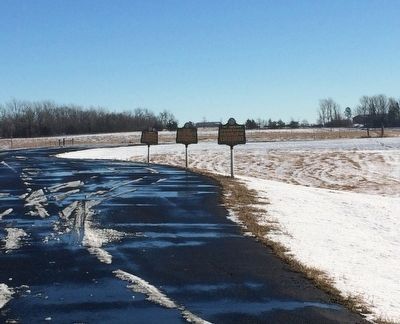
On State Highway 10 0.3 miles east of 451st Ave., on the right when traveling west.
A grove of tall, stately pine trees two miles north of this marker whisper the tale of two Dakota Indian brothers, Clarence and Joseph Grey, who died in an early winter snowstorm in November 1958, while trapping along the coteau. Their bodies were . . . — — Map (db m185162) HM
On State Highway 10 0.3 miles east of 451st Ave., on the right when traveling west.
The Dakota winter of 1937 stretched out too long for farm boys Charles Almos and Clayton Week. They lived with their parents on the Coteau des Prairies eight and ten miles west of Sisseton. During their high school years, the boys shared room and . . . — — Map (db m185164) HM
On State Highway 10 0.3 miles east of 451st Ave., on the right when traveling west.
On a pleasant winter day, January 6, 1903, Knut Throndson, an 1892 homesteader from Hellingdal, Norway, decided to visit his closest neighbors, Tobias and Bertha Herigstad, who lived less than a quarter mile east of this spot. Knut's wife, Caroline, . . . — — Map (db m185163) HM
On 478th Avenue (State Highway 127) at 102nd Street, on the right when traveling south on 478th Avenue.
You are entering
Roberts County
South Dakota
Long the home of Sisseton, Wahpeton & Cuthead Yanktonaise Sioux, it became part of Deuel & Cheyenne Counties in 1862; Deuel extending N to 46th parallel (4 miles N) in 1872. The Reservation . . . — — Map (db m185183) HM
On State Highway 34 0.7 miles west of 405th Ave., on the right when traveling west.
Long before the white man, an Indian Trail from the sanctuary at Pipestone Quarry to the "Three Rivers of the Sioux" near Ft. Thompson passed closely by. The whiteman's first road in Dakota, the Ft. Ridgely & South Pass Wagon Road, forded the James . . . — — Map (db m177446) HM
On South Dakota Route 34 1 mile east of 405th Avenue, on the right when traveling east.
Ruskin Park was synonymous with excitement, entertainment and romance from its inception.
The area's first pioneers settled along the James River near here in 1873. The Santee and Rodee families homesteaded south of here near a large grove . . . — — Map (db m179938) HM
On U.S. 212 at Fishers Lane, on the right when traveling east on U.S. 212.
Before white settlers came, this vicinity was inhabited by the Yankton tribe of the Sioux nation and numerous reminders of these people can still be seen in the burial mounds, storage cellars and artifacts that have been found.
Fisher Grove . . . — — Map (db m180980) HM
On U.S. 281 0.4 miles north of 171st St., on the right when traveling north.
The Sioux tribes established, near here, Council Rock as a central meeting place for all the bands. Using a black oviate rock measuring 6” x 11” surrounded by a circle of stones 15 feet in diameter, representatives of each tribe sat with feet . . . — — Map (db m185465) HM
On U.S. 281 0.4 miles north of 171st Street, on the right when traveling north.
Readfield's claim as the Pheasant Capital of the World dates back to 1908. The first successful stocking of pheasants in South Dakota took place in June, 1908 when H.P. Packard, H.J. Schalke and H.A. Hagman secured three pairs of pheasants from . . . — — Map (db m102058) HM
Here, you are halfway from the mouth of the source of the Missouri. Here was the centre of the Fur Trade for half a century, with eight different fur posts and two military posts within your vision. (See Map on reverse). This was, before white man . . . — — Map (db m190170) HM
On Native American Scenic Byway (Highway 83) 0.1 miles south of 5th Avenue.
The oldest continuous white settlement in the area of South Dakota.
First visited by Verendrye, who took over for France by planting a lead plate on March 31, 1743. A monument marks the spot. It is over the R.R. track first street to right, . . . — — Map (db m187074) HM
Near Fort Chouteau Road 0.3 miles east of State Route 1806.
This tablet marks the site and
commemorates the institution of
Fort Pierre Choteau Trading Post
chief landmark of fur-trading period, 1822 – 1864
on the Upper Missouri River between
the Platte and the Yellowstone.
Founded, 1832, . . . — — Map (db m177392) HM
On Native American Scenic Byway (U.S. 83) 0.1 miles south of 5th Avenue.
For half a century the area near the Mouth of Bad River was one of America's Fur Capitals. There were ten fur posts here over the years in 1805 Lewis & Clark's reports of the richness of the fur trade on the Missouri was causing a turmoil and in . . . — — Map (db m187065) HM
On U.S. 14 east of Boomer Street, on the right when traveling west.
Up the canyon on U.S. 14 to the west, the Ft. Pierre-Deadwood Trail of 1876-86, the main artery of commerce to the "gold diggins” of the Black Hills had its course. Untold thousands of patient oxen pulled millions of tons of freight over that . . . — — Map (db m177390) HM
On Deadwood Street north of Main Avenue, on the right when traveling south.
The National Register listed the Stockgrowers Bank and it is the single example of Romanesque Revival architecture in Fort Pierre. The building represents an interesting and well-executed adaptation of the style to the needs of the small frontier . . . — — Map (db m224400) HM
On Verendrye Drive (2nd Street) 0.4 miles north of West 2nd Avenue.
Here on March 30, 1743, the Verendryes buried a lead tablet to claim this region for France. This tablet found on Feb. 16, 1913, is the first written record of the visit of white men to South Dakota. — — Map (db m177391) HM
On U.S. 14 0.1 miles west of Diamond Willow Place.
Fur trade route from Missouri River, Ft. Tecumseh (Pierre) to Ft. William (1832). John (1834) later Laramie via Badlands Pass S of Scenic and White and Niobrara Rivers. Harney’s Expedition (1855) to overawe the Sioux and 1876-88 Stage and Wagon . . . — — Map (db m179942) HM
On Ash Avenue at Main Street, on the left when traveling east on Ash Avenue.
In 1882, Norvel Blair, an African American born into slavery in Tennessee, sent two sons to explore homesteading prospects in Sully County. Soon, Norvel along with several members of the Blair family filed claims on the land, which they turned into . . . — — Map (db m246267) HM
On 455th Avenue 0.1 miles north of 287th Street, on the right when traveling north.
The first general store
in Turner County
was erected on this site
in 1875 by
Gus and Carrie Gilbert.
Swan Lake was the county
seat of Turner County
from 1859-1883. — — Map (db m183584) HM
On 450th Avenue 0.4 miles north of 279th Street, on the right when traveling south.
Before Social Security, old age assistance, and other social safety nets, poor farms throughout the United States provided a place for those suffering through desperate times. The Turner County Poor Farm housed primarily aged and disabled men, . . . — — Map (db m183492) HM
On Swan Lake Drive east of 455th Avenue, on the right when traveling east.
November 13, 1866, James C. Bunker and his survey crew reached Swan Lake and surveyed the lands adjacent thereto. The Yankton to Sioux Falls stage road then ran around the west side of the Lake.
In 1869, William W. Aurner and his . . . — — Map (db m183500) HM
On 479th Avenue (State Highway 11) at 301st Street, on the right when traveling north on 479th Avenue.
Archie M. Gubbrud was born December 31, 1910, the eldest son of Marius T. Gubbrud and Ella Rommereim Gubbrud at his parental farm home in Norway Township, Lincoln County. He was brought up on this farmstead with a post office address of Alcester, . . . — — Map (db m189890) HM
On 479th Avenue (State Highway 11) at 301st St, on the right when traveling north on 479th Avenue.
Camp SCS-3 (DPE-211 in 1934): located in city park of NE Alcester. Companies: 2746--8/3-10/1/34 & 6/27/35-8/14/41; 4725V--8/15/41 - 5/27/42.
The Civilian Conservation Corps was a federal work - relief program during the Great Depression. . . . — — Map (db m190163) HM
On East Cedar Street (State Highway 46) at North 2nd Street, on the right when traveling east on East Cedar Street.
William J. Bulow was born in 1869 in Claremont County, Ohio. Receiving an LLB in 1893 from the University of Michigan, he came to South Dakota and opened a law practice in Beresford, where he served as mayor and city attorney before his election as . . . — — Map (db m293718) HM
On 476th Ave. 0.2 miles north of Groethe Rd., on the right when traveling north.
When the famous Norwegian-American novelist Rölvaag (1876-1931) came to America, he worked on the 200-acre farm of Severt Eidem (NE quarter, Section 12, and 40 acres, Section 1, Brule Township), two miles north of this corner. Rölvaag's first book . . . — — Map (db m190165) HM
On Main Street west of Franklin Street, on the right when traveling west.
Lewis & Clark camped here and said much ‘elk sign’ on August 22, 1804 and held first election in northwest that evening.
In 1856, the Sioux City-Ft. Randall Military Road passed hereby.
Eli Wixson arrived on 22 July 1859 and built a log . . . — — Map (db m180963) HM
On East Main Street west of North Grant Street, on the right when traveling east.
Lewis & Clark reached a point in what is now Sioux City on August 20, 1804 near the mouth of Floyd River. Sergeant Charles Floyd, who had been taken sick with a "Biliose Chorlick" the day before, died near a bluff on the east side of the river. The . . . — — Map (db m190114) HM
On County Road 1B at 479th Avenue, on the right when traveling north on County Road 1B.
The second rude cross erected on that miraculous day in May, 1876, when Father Pierre Boucher led his pilgrimage of Catholics & Protestants on an eleven mile trek seeking Divine Intervention in the grasshopper plague, was where you see the large . . . — — Map (db m190124) HM
On Main Street, on the right when traveling north on Main Street.
Dakota's first flour mill was established in 1867, after the Legislature gave them a water right on the Big Sioux five miles northeast, by Preston Hotchkiss & Amos Dexter on Lot 3, Section 32, Township 91, Range 48. They sold to Crill & Sargent in . . . — — Map (db m190127) HM
On County Road 1B 0.1 miles north of 481st Avenue, on the right when traveling north.
Just 14 miles from Sioux City on the Military Road from that place to Ft. Randall, this house was built of logs by Francis Reandeau about 1861. A Frenchman, he and his son, Lyzimon, whose name is carved on one of the original logs, ran this stage . . . — — Map (db m190126) HM
On Main Street at 4th Street, on the right when traveling north on Main Street.
The Huge wooden cross in the cemetery, replaced the rude one erected on that day in May, 1876, when Father Pierre Boucher led his pilgrimage of Catholic & Protestant marchers back to Jefferson, after an eleven mile trek seeking Divine Intervention . . . — — Map (db m180962) HM
On Main Street (State Highway 105) at Fourth Street, on the right when traveling north on Main Street.
The vicinity of Jefferson, even before the organization of Dakota Territory in 1861, was a French-Canadian community and Catholic services were held sporadically prior to the advent of Father Pierre Boucher in 1867. In 1862 a small log building . . . — — Map (db m189898) HM
On State Highway 105 0.1 miles south of First Street, on the left when traveling south.
Was a road house twelve miles from Sioux City run by Desiree Chausee. It was a log building right here. It was also the site of Willow's Post Office. Postmasters were William Mathers, 19 August 1861; Desire Chausee in 1864; Charles Heath in 1865 and . . . — — Map (db m190149) HM
On 476th Avenue 0.1 miles south of 330th Street (County Highway 6), on the right when traveling south.
In 1872, Elmwood Cemetery, formerly known as "Isaac Quick's Burying Ground," was established about half a mile north of the town of Texas City. Texas City had been established in 1870 by Solomon B. Stough and William Dunmere Long, residents of . . . — — Map (db m315753) HM
On Military Road north of River Drive, on the right when traveling north.
Created with its twin, North Dakota, 2 November 1889, its 77,047 square miles ranks 15th in size. Those square miles include: exceptional corn land in the SE, grass land in the W, wheat land in the N and productive land all over. Its . . . — — Map (db m190154) HM
On State Highway 50 0.7 miles east of SD - 11, on the right when traveling west.
This granite block erected by the Old Settlers Association of Union County, South Dakota, marks the site of Fort Brule Built in 1862 by soldiers and settlers as protection against renegade and hostile Indians. Abandoned in 1868 Dismantled . . . — — Map (db m190166) HM
On State Highway 50 at Fourth Avenue, on the right when traveling east on State Highway 50.
Rev. S.W. Ingham, a travelling Missionary, in 1861 baptized Minnesota Watson, daughter of Thomas and Adeline Watson, who with A.J. Bell and wife were its earliest members in the Brule Creek community. The Indian War of the Outbreak in August 1862 . . . — — Map (db m189894) HM
On 476th Avenue (South Dakota Route 50) at County Road 25, on the right when traveling south on 476th Avenue.
Stately church edifices frequently have humble beginnings and so with St. Paul Lutheran Church, one of South Dakota's finest. The humble log church pictured hereon was erected in 1867 by the members of the Norwegian Evangelical Lutheran Congregation . . . — — Map (db m189892) HM
Near Interstate 29 at milepost 26 at State Route 50.
The rich farm country of southeast South Dakota lies in the triangle formed as the Missouri River, to the west, and the Big Sioux River, east of here, flow toward their confluence about 37 miles southeast of this point. This was the land that drew . . . — — Map (db m179908) HM
Near Grand Crossing Boulevard West 0.1 miles south of 20th Street West.
In 1882, a dramatic rescue of white captives held by a band of hostile Santee
Sioux, took place near this spot. A group of eleven young Teton Sioux boys left
Ft. Pierre on a cold November day determined to overtake and meet with the Santees to . . . — — Map (db m180985) HM
On U.S. 83 close to U.S. 12, on the right when traveling south.
This monument marks the side of Bangor County seat of Walworth County 1884 -1909 Scranton 1883-1884 Bangor 1884-1904 Selby 1904-1905 Bangor 1905-1909 Selby 1909-1950 — — Map (db m190167) HM
On 307th Avenue (U.S. 12) 0.5 miles north of Scranton Ave, on the right when traveling north.
George T. was born to George and Emma on a farm south of Selby
in 1903. He received his education here and at the University of
SD graduating with a law degree in 1927. Madge Turner and he were
married in 1928. While operating his own law firm . . . — — Map (db m190168) HM
On 134th Street (U.S. 12) close to 309th Avenue, on the left when traveling west.
Historically that meridian is significant. For two generations the Insurance Companies and other worldwide lending agencies would not, as a matter of agreed policy, lend a shiny dime west of this line. There reason was that some geographer had . . . — — Map (db m177393) HM
On South Dakota Route 50 0.8 miles east of 451st Avenue, on the right when traveling east.
In 1822, the Columbis Fur Company established a post at Audubon’s Point, opposite the mouth of Petite Arc Creek. Later taken over by the American Fur Company. William Dickson was factor from 1832 until his death before 1840 when Father Christian . . . — — Map (db m180969) HM
Near 308th Street 3 miles north of State Highway 50, on the right when traveling west.
Following earlier Missionary work, this church began in Dakota Territory among Scandinavian Lutherans as early as 1861, and was organized October 8, 1864 with Reverend Emil Christenson as minister. The church built in 1869 was built of lumber . . . — — Map (db m177659) HM
On Picotte Street at East 4th Street, on the right when traveling north on Picotte Street.
Born at Ft. Tecumseh (Pierre), the son of Honore Picotte, an American Fur Co. factor and Eagle Woman, he was educated at St. Louis. Marrying a Yancton woman, he became a leader in that Band and was influential in the Treaty of 1858 ceding land and . . . — — Map (db m177658) HM
On West 6th Street at Douglas Avenue, on the right when traveling east on West 6th Street.
Founded in 1861
by
The Rev. Melancthon Hoyt, D.D., LL. D.
First Missionary to Settle in
Dakota Territory
This Building is the Third
Church Home of
The Yankton Episcopal Parish. — — Map (db m177979) HM
On Cedar Street south of West 4th Street ( Highway 50), on the right when traveling south.
In September 1862 - after a skirmish with Hostile Indians near James River, it was determined to finish stockade at once, north wall being of sod with ditch in front already finished, and East wall of posts with boards on either side with earth . . . — — Map (db m211589) HM
On East 3rd Street at Mulberry Street on East 3rd Street.
C. J. Holman, for a Sioux City group, rivals of Frost, Todd & Co.'s Upper Missouri Land Company came in March 1858, was run off by threatening Indians but returned in May and built cabin, after fracas with F. T. & Co. employees and lived there till . . . — — Map (db m177606) HM
On Cedar Street 0.1 miles south of West 4th Street, on the right when traveling south.
Dakota Territories first bank was that of Mark M. Parmer started at Yankton in September, 1869 which became the private banking partnership of Parmer and Moses K. Armstrong in 1872. On December 27, 1872, the First National Bank of Yankton, a . . . — — Map (db m177711) HM
On East 4th Street (South Dakota Route 50) at Capital Street, on the right when traveling west on East 4th Street.
Dakota Territory, extending N to Canada and W to the summit of the Rockies, a fourth larger than Texas, was created March 2, 1861. Lincoln appointed William Jayne Governor and he arrived at Yankton June 8th. Dakota had 2,326 white citizens; the . . . — — Map (db m177859) HM
On 31st Street (South Dakota Route 50) at Fox Run Parkway, on the right when traveling west on 31st Street.
"Wild Bill" Hickok, famous gunman, was shot in the back of the head at Deadwood on August 2, 1876 by Jack McCall, who was tried for murder at Yankton on 4-5-6 December, found guilty, sentenced by Judge Peter C. Shannon on January 3, 1877. The . . . — — Map (db m177713) HM
On West 4th Street (State Highway 50) east of Broadway Avenue (U.S. 81), on the right when traveling east.
This 6-foot wall of sod and earth with a ditch in front was located about 150 foot South of this marker. This wall 450 foot long was commenced on Sept. 1, 1862, the first construction. — — Map (db m211587) HM
On Pine Street north of East 6th Street, on the left when traveling north.
In February 1912, the Yankton City Council approved city engineer Hugh C. Liebe's plan for a new concrete arch bridge at Pine Street over Rhine Creek (later renamed Marne Creek during World War I). In April, the council awarded a $3,700 construction . . . — — Map (db m211680) HM
On West 3rd Street at Broadway Avenue (U.S. 81), on the right when traveling east on West 3rd Street.
This boulder marks the site of
The Yankton Stockade
in which the people of the
surrounding country took refuge
during the Sioux Outbreak of 1862 — — Map (db m178447) HM
On Capital Street 0.1 miles south of East 4th Street, on the right when traveling south.
At Deadwood on August 2, 1876, Jack McCall shot "Wild Bill" Hickok in the back of his head. When a vigilante court tried him, he claimed Bill had killed his brother and the vigilantes let him go. Later, due to his boasting, at Laramie City, US . . . — — Map (db m177712) HM
On Linn Street at Third Street, on the right when traveling south on Linn Street.
Indian war of Outbreak, August 1862 threatened to spread into Dakota and a “strong point” for all settlers near Yankton was built in September under Capt. F. M. Ziebach. The west wall, of posts with boards on either side and earth packed between 450 . . . — — Map (db m177907) HM
On West Riverside Drive 0.3 miles south of West 4th Street (State Route 50), on the right when traveling east.
William McMaster (1877-1968) was a progressive Republican banker and politician who fought for farmers facing hard times. He was also involved in building this Meridian Bridge.
Orphaned at 17 in Iowa, he graduated from Beloit College and came . . . — — Map (db m177897) HM
On East 10th Street 0.3 miles east of Broadway Avenue (U.S. 81), on the right when traveling west.
Joseph Ward, a graduate of Brown University and Andover Seminary came to Yankton Academy but it was taken over by the school board and became Yankton High School, the first secondary schools in Dakota.
In May 1881, Yankton College was . . . — — Map (db m177858) HM
364 entries matched your criteria. Entries 301 through 364 are listed above. ⊲ Previous 100