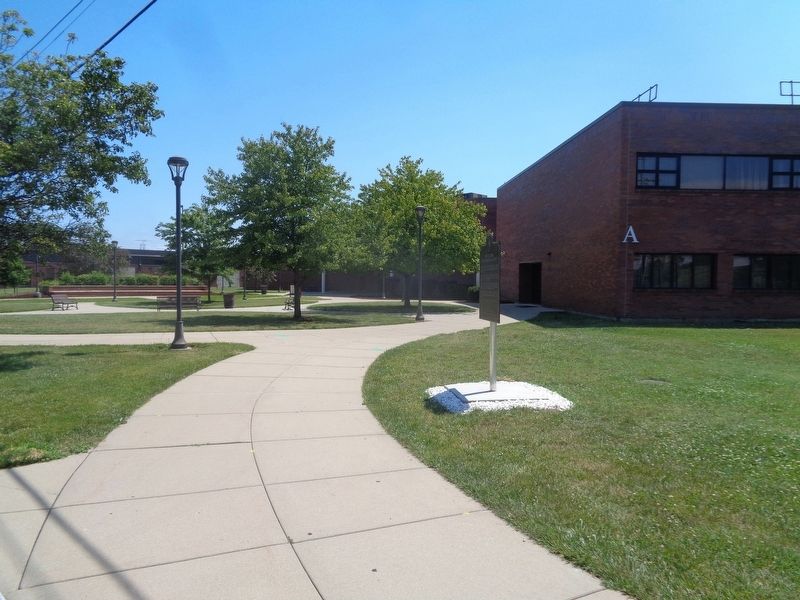
One of American history's most violent race riots took place here on July 2, 1917. Hundreds of citizens were brutalized in a day of death, burning, and destruction. White rioters lynched, shot, and burned innocent blacks, burned their homes, and . . . — — Map (db m228260) HM
"They related that there are mines of gold and silver.... There is reason to believe that the French who will settle among the Illinois Indians will make all these rich discoveries when the colony becomes more thickly populated." Thus, John Law, . . . — — Map (db m143282) HM
On this site stood the home of the Deneen family long associated with the history of McKendree College -- Rev. William L. Deneen; Professor Samuel H. Deneen; and Charles S. Deneen, Governor of Illinois, 1905-1913, and US Senator, 1925-1931. They . . . — — Map (db m143284) HM
Born in Angelbachtal, Baden-Wurttemberg in present-day Germany, Hecker studied law at the University of Heidelberg.
Hecker was one of the leaders who championed for democratic reforms in the 1848 uprisings in Germany. Like many other . . . — — Map (db m228249) HM
At the end of the nation's most famous senatorial campaign between
Abraham Lincoln and Stephen A. Douglas, both men appeared on these
courthouse grounds to address the excited citizens of Stark County in
1858. Douglas arrived on October 26 and . . . — — Map (db m150575) HM
Birthplace of Jane Addams 1860 - 1935 Humanitarian, Feminist, Social Worker, Reformer, Educator, Author, Publicist, Founder of Hull House, Pioneer, Settlement Center Chicago, 1889. President Women's International League for Peace and, Freedom. Nobel . . . — — Map (db m128729) HM
The second round in a seven-round bout between political giants Stephen A. Douglas and Abraham Lincoln was held in Freeport on August 27, 1858. In what has become a legendary struggle, Lincoln and Douglas contested for a seat in the United States . . . — — Map (db m93499) HM
On August 27, 1858, Abraham Lincoln and Stephen A. Douglas, on a platform erected near State and Douglas Streets, met in the second of their seven joint debates. Douglas answer to Lincoln’s “Freeport Question” helped him to win the senatorial race, . . . — — Map (db m233242) HM
At Kellogg’s Grove, four miles south of here, two engagements were fought during the Black Hawk War. On June 16, 1832, Capt. A.W. Snyder’s company defeated a band of Indians; but on June 25, Indians led by Black Hawk defeated Maj. John Dement’s . . . — — Map (db m233217) HM
In 1837, James Pendergast bought this lot in Mackinaw at what was then the intersection of Monroe and Market Streets. In 1843, he began hauling lumber from Pekin for an addition to the existing home, which when completed would become a one and a . . . — — Map (db m308465) HM
One of 175 Civil War regiments that gave African-American men the
chance to fight for the Union, the 29th U.S. Colored Infantry was
organized April 24, 1864, and dismissed Nov. 6, 1865. With 2072 men from
Illinois, Missouri and Wisconsin, it was . . . — — Map (db m253003) HM
Nance Legins-Costley of Pekin and her three eldest children were the first
enslaved persons Abraham Lincoln helped free. Nance was born in 1818 into
indentured servitude in Kaskaskia, Illinois Territory. She was sold in 1827 in
Springfield to . . . — — Map (db m253036) HM
William Henry ‘Bill’ Costley was the oldest son of Benjamin and Nance (Legins)
Costley and was born 1840 in Pekin. Born into indentured servitude with his two
older sisters Amanda and Eliza Jane, they and their mother had their freedom
confirmed . . . — — Map (db m253035) HM
On July 5, 1918, the steamboat Columbia sank upstream
from this spot near what was then Wesley City. What began
as one of the season's premier social events ended in tragedy.
The Pekin South Side Social Club sponsored the . . . — — Map (db m253050) HM
On June 25, 1862, the Union League of America was founded at Pekin, Illinois, to promote patriotism and loyalty to the Union. Its members hoped to counter northern disillusionment with President Lincoln's military policies after early Union . . . — — Map (db m267236) HM
Abraham Lincoln attended court in the fine two story rectangular brick courthouse with four Grecian columns and copper dome on this site. Here in 1842 he was challenged to a duel by James Shields. Lincoln last spoke here August 30, 1858. — — Map (db m12184) HM
The Candlewood Bridge, also known as the Cemetery Road Bridge, was constructed in 1894 to cross the south branch of Farm Creek. With a 27-foot span, the double arch limestone bridge is 15 feet above the waterline. City engineer and Washington . . . — — Map (db m312841) HM
Abraham Lincoln's travels along the 8th Judicial Circuit brought him through Washington many times, but only two visits of Lincoln are documented. On November 2, 1848, Lincoln came to Washington with Anson G. Henry of Springfield to stump for . . . — — Map (db m306203) HM
Union County was created January 2, 1818, when Illinois was still a territory. County commissioners established Jonesboro as the county seat on land donated by John and Juliet Grammer.
During the frigid winter of January 1839, thousands of . . . — — Map (db m161167) HM
On September 15, 1858, in the midst of the senatorial campaign of that year, Abraham Lincoln and Stephen A. Douglas met at Jonesboro in the third of the famous series of debates which made Lincoln a national figure. The debate was held in a grove . . . — — Map (db m160956) HM
On April 28, 1867, the National Women's Fraternity Movement began here in the home of Jacob Holt. In a second floor bedroom, shared by Ada Bruen and Libbie Brook, twelve Monmouth College co-eds founded I.C. Sorosis, known today by its Greek motto, . . . — — Map (db m55447) HM
Wyatt Berry Stapp Earp, famous for the 1881 gunfight at the O.K. Corral in Tombstone, Arizona Territory, was born on March 19, 1848, in Monmouth. According to family history, his birthplace is located at 406 South 3rd Street. When Earp was two, his . . . — — Map (db m55448) HM
Illinois Agricultural College at Irvington was the first college in the state for instruction in scientific and practical agricultural methods. It was chartered by the Illinois General Assembly in 1861 and opened in 1866. The main buildings were . . . — — Map (db m146179) HM
The music for this song was composed by Jonathan Edwards Spilman in 1836. He entered the ministry in 1858 and became pastor of the First Presbyterian Church in 1881. This church had been organized by his brother Benjamin F. Spilman on November 25, . . . — — Map (db m177871) HM
This house was built by early settler John Craw prior to 1817. In 1835 it was purchased by John M. Robinson, U.S. Senator (1831-43) and Illinois Supreme Court Justice (1843). The house was later occupied by his daughter Mrs. Robert Stewart and his . . . — — Map (db m177875) HM
Colonel Everton J. Conger, who commanded the troops capturing, Abraham Lincoln's assassin, John Wilkes Booth, built this house in 1871. He practiced law in Carmi, became a Federal judge in Montana Territory, and later moved to Hawaii where he was an . . . — — Map (db m177874) HM
This building was erected in 1828 by James Ratcliff, nicknamed "Old Beaver" because of his energy. He was a founder of Carmi (1816), an inn-keeper, merchant, and postmaster, and White County's first Clerk, Recorder and Probate Judge. Abraham . . . — — Map (db m177869) HM
Alma mater of United States Senators William E. Borah, Idaho, and Wesley L. Jones, Washington. This educational institution was chartered by the Cumberland Presbyterian Church (1873). From the 1890's until 1935 it was a public school. It was . . . — — Map (db m177845) HM
In 1816 the Reverend James McGready of Kentucky organized Sharon, the first Presbyterian church in Illinois, with Peter Miller, James Mayes and James Rutledge as ruling elders. Three miles northeast of this site B.F. Spilman, active Presbyterian . . . — — Map (db m154623) HM
This church was the cradle of Methodism in White County. Early pioneers risked Indian raids to worship in the cabins of Robert Land and John Hanna. In 1812 presiding elder Peter Cartwright sent circuit rider John Smith to this settlement. This . . . — — Map (db m177839) HM
Before the bombing of Pearl Harbor on December 7, 1941, and entry of the United States into World War II, 95 percent of the crude oil delivered to east coast oil refineries was transported by tanker ships with 90 percent of that oil from Texas . . . — — Map (db m154609) HM
John Baker, Fulton's first permanent settler, arrived in 1835 and built his three-room log cabin and outbuildings nearby. He lived in amity with the Indians and kept a rude hostelry. Later Fulton's first doctors, Daniel and Lucinda Reed, made the . . . — — Map (db m230432) HM
This house was the head office of the Modern Woodmen of America, a fraternal life insurance society. When that organization first became an Illinois corporation in 1884, the house was the home of Dr. Henry M. Kennedy, head clerk of the fraternal . . . — — Map (db m308298) HM
Buried in this cemetery are President Ronald Reagan's
paternal Irish ancestors. His great-grandparents,
Michael and Catherine Mulcahey Reagan, emigrated in
1856 and after Michael's 1884 burial in Calvary Hill
Cemetery (now part of Fulton . . . — — Map (db m230416) HM
Early Fulton communal
activity centered around this
trigon. The ferry, powered
successively by man, horse,
and steam, landed at its north
end. Stores, hotels, warehouses
and saloons faced all three
sides. Later the sawmills
rented it to . . . — — Map (db m230385) HM
Dement House, an imposing, lavishly
furnished stone hotel, was built
on this lot in 1855. It was sold
to satisfy judgments in 1858. In
1861 it was used to house a
military academy, which was
incorporated as a veterans college
in 1867. This . . . — — Map (db m230352) HM
Prophetstown occupies the site of the village of the Winnebago Prophet, which the Illinois volunteers destroyed on May 10, 1832, in the first act of hostility in the Black Hawk War. — — Map (db m78268) HM
Construction on the “Hennepin Canal,” as it was commonly known, began in 1892 and was completed in 1907 at a cost of more than seven million dollars. The main canal extended 75 miles from the Illinois River near Hennepin to the Rock . . . — — Map (db m78269) HM
On July 18, 1856, Abraham Lincoln spent the night in this house as the guest of William Manahan. Lincoln had been invited by Robert Lange Wilson to address a John C. Fremont rally in Sterling. Wilson was a member of the famous Long Nine of the . . . — — Map (db m308297) HM
On February 6, 1911, Ronald Wilson Reagan, the 40th president of the United States, was born in Tampico in an upstairs apartment at 111 South Main Street.
His father, John “Jack” Reagan, of Irish-Catholic ancestry, was a clerk in the H. C. . . . — — Map (db m230436) HM
In 1837 the town of Lockport was laid out by the Illinois and Michigan Canal commissioners and a residence-office was built. The first floor of the permanent structure was completed in 1837, and became headquarters for construction and . . . — — Map (db m94016) HM
This was the site of the Arnold Tavern, first government franchised Post Office in present day Will County (1834-1845). The present building was the home of Dr. E.C. Wight, one of the first physicians in northern Illinois (1836), and a post-house . . . — — Map (db m132023) HM
This is the site of Mont Joliet,
a national eminence named for the
explorer Louis Jolliet. 140 feet
above the Des Plaines River bed.
First shown on a 1674 map the
mound served for almost 175 years
as a landmark for measuring distances on the . . . — — Map (db m231111) HM
Mineral rich spring waters were discovered along the French trail called the “Grand Trace” south of this location around 1720. A trading post called Eau Mineral, later Sulfur Springs, was established there and by 1846, Sulfur Springs boasted a post . . . — — Map (db m167457) HM
Creal Springs Seminary stood 350 feet east southeast of this marker and opened on September 22, 1884. It was built on a five-acre tract purchased from Edward Creal by Gertrude Brown Murrah and her husband, Henry Clay Murrah, in March 1884. The . . . — — Map (db m167454) HM
Wilhelmina “Minnie” Vautrin, (1886-1941) was born in Secor,
Illinois, to French immigrants. Her mother died when Minnie
was 6, and she was raised by her father and grandparents. She
excelled at school and worked her way through Illinois
State . . . — — Map (db m239248) HM
After taking Kaskaskia on July 5, 1778, George Roges Clark, Acting under Virginia authority, sent Father Pierre Gibault, as his envoy, to Vincennes. Gibault convinced the villagers there to take an oath of loyalty to the Americans. In early August, . . . — — Map (db m176262) HM
447 entries matched your criteria. Entries 401 through 447 are listed above. ⊲ Previous 100