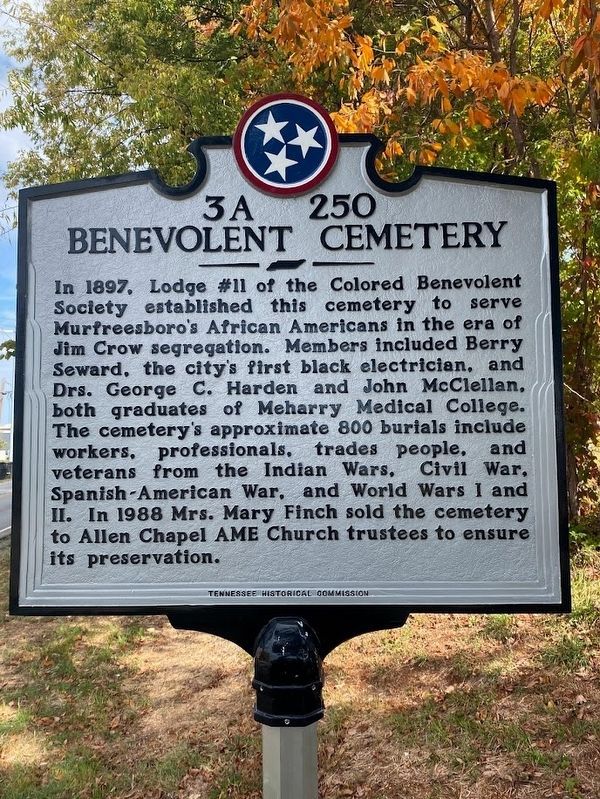
In 1897, Lodge #11 of the Colored Benevolent Society established this cemetery to serve Murfreesboro's African Americans in the era of Jim Crow segregation. Members included Berry Seward, the city's first black electrician, and Drs. George C. Harden . . . — — Map (db m186061) HM
This building. designed by architects
Long & Kees with E. C. Jones supervising, was dedicated to the worship
of God on Jan. 1, 1893. It was the second home of Second Presbyterian
Church (organized Dec. 28, 1844)
until sold to the AME Church in . . . — — Map (db m148963) HM
The early settlement of “Petersburg” was granted a post office in 1858. At that time, the village’s name was changed to Arrington for the nearby creek. Among the early families were Buchanan, Couch, Crockett, Duff, King, Morris, . . . — — Map (db m112079) HM
Lot 60 at the Corner of Cameron & Church Street
In 1867 Rev. Otis O. Knight of Nashville purchased Lot 60, selling the southern half to ex-slave A.N.C. Williams, and the northern half for the construction of Wiley Memorial Methodist Episcopal . . . — — Map (db m69010) HM
This congregation traces its history to 1866, when a group of Black workers at the Long Lake Cotton Plantation gathered together informally to organize a church. The following year the owners of the plantation designated a plot of land on which the . . . — — Map (db m246929) HM
Methodism among African American Texans predates the civil war with the first church being established in 1848. the earliest known African American minister in Brazos county was reverend Emmanuel Hammitt who served under Reverend W.S. South after . . . — — Map (db m239014) HM
Following Emancipation, Federal Union soldiers arrived in Millican, along with the Freedmen's Bureau, to assist in the transition to Reconstruction. At the same time, the Ku Klux Klan first appeared in Millican, parading through Black . . . — — Map (db m267494) HM
Named for Bishop Benjamin Franklin Lee (1841-1926), Lee Chapel African Methodist Episcopal Church was organized in 1888. Led by the Rev. George E. Smith, who also organized the first school for Blacks in Brownwood, the congregation first held . . . — — Map (db m248291) HM
Henry Ossian Flipper (1856-1940) was the first African-American graduate of the United States Military Academy at West Point in 1877. Born into slavery in Thomasville, Georgia, he came from a family of achievers; his brothers were an African . . . — — Map (db m60727) HM
William E. Kendall, an Anglo lawyer from Richmond, Texas, subdivided his plantation here into 100-acre farm tracts in 1869. He sold the land exclusively to Freedmen and by the 1880s a distinctly African American community named Kendleton had . . . — — Map (db m201991) HM
This structure, erected during the pastorate of the Rev. J.E. Edwards, replaced the first Reedy Chapel Church on this site, destroyed by the 1885 Galveston fire. Contractor E.F. Campbell began construction in 1886. Four storms hit the island that . . . — — Map (db m68579) HM
Trustees of the Methodist Church purchased this lot in 1848 as a worship site for Black slaves. Meetings were held outdoors until a building was erected in 1863. At the end of the Civil War (1865), ownership of the property was transferred to the . . . — — Map (db m63531) HM
One of oldest churches in Galveston. Congregation
was organized before 1870, when former Galvestonian
Henry H. Brower sold this church site to the Shiloh
African Methodist Episcopal Church. Purchase was
made through Brower's agent, Nahor B. . . . — — Map (db m245422) HM
The African American Methodist community in Galveston dates to 1848, when Gail Borden deeded land on Broadway for a salve church. Following the Civil War, the congregation changed its affiliation from Methodist Episcopal Church, South, to the . . . — — Map (db m143601) HM
Organized in 1869, Saint Paul African Methodist Episcopal Church has been a part of First Ward history for over a century. The first Pastor of the church was the Rev. David Wren. Services were held in a brush arbor until a sanctuary was built in . . . — — Map (db m159239) HM
Wesley Chapel African Methodist Episcopal Church traces its history to 1875, and is believed to be the oldest African American congregation in San Marcos. The first church building was erected on this site in 1879, and later was replaced by a . . . — — Map (db m149884) HM
Following the close of the Civil War in 1865, Armstead Barker brought his family to this area. Other African American families followed, and their settlement became known as Gum Creek. By the mid-1880s, African American children in the area attended . . . — — Map (db m269216) HM
Following the Civil War and Emancipation, the small but vibrant black population around Moulton began to be served by missionaries of a newly formed offshoot of the Methodist Church called the African Methodist Episcopal (AME) Church. In 1867, . . . — — Map (db m164251) HM
Organized in 1875, this was one of the first black churches in Giddings. The congregation was named for the Rev. James A. Shorter (1817-1887), ninth bishop of the African Methodist Episcopal Church. The Rev. Anthony Anderson (1843-1922), one of the . . . — — Map (db m179041) HM
This congregation began meeting for informal worship services during the early 1870s at the home of Tempie Washington. By 1873, the thirteen original members were meeting in their own sanctuary on San Antonio street. The Rev. Frank Green served as . . . — — Map (db m26148) HM
This congregation was organized in 1869 by the Rev. Richard Robert Haywood, an early Texas missionary in the African Methodist Episcopal church. Trustees of the church bought land at this site in 1881, and worship services were held in a small . . . — — Map (db m43062) HM
Organized during the 1880’s by the Reverend T. Saunders, this congregation has served as a focus of black religious, social, and cultural activity in Utah from territorial days to the present. In 1907 property at this spot was acquired, and a church . . . — — Map (db m35829) HM
The parking lot you are standing in was built upon land donated by Lt. Col. Leonard Harris, U.S. Army (Ret.), and his cousin John Howard "Duffy" Smith. Their family was deeded property here shortly before the Civil War. Allegedly, Robert . . . — — Map (db m235927) HM
Loudoun County experienced continuous Union and Confederate activity during the war. Carter's Mill Road, in front of you, provided access to the agricultural abundance of Oatlands and other farms south and east of here, where the use of slave . . . — — Map (db m124387) HM
Built 1867
Historic Use
School for African Americans of the area, 1867-1957; served also as a church for that community.
Current Use
Site of a living-history program for area fourth graders role playing actual . . . — — Map (db m214375) HM
Elizabeth Gavino Hubert Lushington (1873-1929) was born in Antigua and came to the United States as a ward of Bishop Hubert, a minister of the African Methodist Episcopal (AME) church in New York City. In 1890 she married Augustus Nathaniel . . . — — Map (db m179740) HM
Since the late 19th century, Fayette Street has
been a gateway to the business, social, and
Cultural life of African Americans here. Institutions such as Mt. Zion A.M.E. Church (founded
in 1870), St. Mary’s Hospital (1926-1952), . . . — — Map (db m104550) HM
St. John’s African Methodist Episcopal Church has been registered as a Virginia Historic Landmark pursuant to the authority vested in the Virginia Historic Landmarks Board Act 1966.
This property has been entered in the national Register . . . — — Map (db m203412) HM
The Reverend John Offer was the first pastor of Bethel A.M.E. Church in Eastville, Virginia serving from 1866 to 1871 and again from1885 to 1888. He was instrumental in building the church’s first meeting house and parsonage. — — Map (db m288526) HM
The church behind yu was in the center of Portsmouth's Underground Railroad activity late in the 1850s. Built in 1857 and first called the African Methodist Society, both the building and several members of the congregation - mostly free Blacks - . . . — — Map (db m293244) HM
Emanuel A.M.E. Church is rooted in the African Methodist Society that was formed soon after the founding in 1772 of the Methodist Society in Portsmouth. The African Society met independently until Nat Turner's insurrection in 1831, worshiped with . . . — — Map (db m36867) HM
The congregation of Emanuel Church was formed out of the Methodist society by Robert Williams, who erected a meetinghouse on South Street in 1772. Thus, two societies were established, the Black people called their society the African Methodist . . . — — Map (db m165996) HM
Glasgow Street Park, a historic site and cemetery of Monumental United Methodist Church, holds the grave of Adj. William Ball Jr. He was one of a total of about 30 Monumental members and others, so buried at this site prior to the 1840s. . . . — — Map (db m301896) HM
Beulah African Methodist Episcopal (AME) Church was founded in 1868. Originally, it was known as The Colored Methodist Church of Farmville. The original wooden-framed building was destroyed, by fire in 1898. The cornerstone on the present . . . — — Map (db m31318) HM
Beulah African Methodist Episcopal (AME) Church was founded in 1868 as the Colored Methodist Church of Farmville. The original wood-frame building was destroyed by five in 1898. The cornerstone on the present building was laid in 1901.
A . . . — — Map (db m181202) HM
In 1954, after the Supreme Court ruled in Brown v. the Board of Education of Topeka that American schools must integrate, Senator Harry S. Byrd and several Virginia governors followed the policy of "massive resistance." Integration was . . . — — Map (db m181154) HM
This Old English/Episcopal Cemetery contains the graves of these Revolutionary War soldiers: Maj. Henry Bedinger, Anthony Kerney, Lt. Daniel Bedinger, James Kerney Sr., William Morgan Jr., William Lemen, Caleb Levick, Robert Tabb, and the . . . — — Map (db m157759) HM
The Gloria Dei Church is a striking example of the Gothic Revival style, which was locally popular between 1915 and 1945 for the design of religious buildings. The façade is of brick and limestone. Decorative elements include Gothic-arched door and . . . — — Map (db m53469) HM
John Hill first set eyes on Madison while visiting a relative who was attending the University of Wisconsin. He moved his family here from Atlanta in 1910 to join a modest community of about 140 African Americans. In 1917, Hill bought a house and . . . — — Map (db m33612) HM
These vernacular buildings are significant for their association with, and are among the last vestiges of, Madison's first African-American community. Both were moved to the site by African-American civic leader, John Turner. The two-story, . . . — — Map (db m54181) HM
St. Mark African Methodist Episcopal (AME) Church, the oldest historically Black congregation in Milwaukee, has served as a cornerstone of Milwaukee’s Black community since its founding in 1869. Organized by a group of community leaders that . . . — — Map (db m314586) HM
St. Mark African Methodist Episcopal Church, the first African-American church built in Wisconsin, once stood on this site. The property was purchased in 1869, the year the congregation was organized. Construction on the St. Mark A.M.E. church . . . — — Map (db m35201) HM
The Nazrey African Methodist Episcopal (AME) Church
In 1848, refugees from American slavery built this church by hand to serve Amherstburg's growing Black community. It is named for Bishop Nazery, who led many congregations, . . . — — Map (db m300325) HM
Beginning in the 1830s, at least 30 families fleeing enslavement and racial oppression in the United States settled in the Banwell Road area in Sandwich East. They had the opportunity to purchase land through two Black-organized land settlement . . . — — Map (db m90183) HM
Founded c. 1835 as St. Paul's AME Church, Stewart Memorial Church represents the longest surviving predominantly Black congregation within the City of Hamilton. First housed in a log structure on Rebecca Street, just east of John Street North, . . . — — Map (db m219569) HM
[London Public Library Board marker text:]
The "Fugitive Slave Chapel”, one of two churches
built by London's Black community before 1855.
In 1858 the abolitionist, John Brown, addressed
a meeting here, soliciting support for the
movement . . . — — Map (db m285261) HM
African Methodist Episcopal Church,
Original Building
Built: 1848
Thames Street, City of London
In 1847, land was purchased on Thames Street in London, Canada West (now Ontario) by the African Methodist Episcopal (AME) Church to . . . — — Map (db m285262) HM
The Salem Chapel, British Methodist Episcopal Church was the first Black church in St. Catharines. Originally known as the African Methodist Episcopal Church, the name was changed to reflect their loyalty to the British Empire. In 1793, the . . . — — Map (db m289265) HM
A Community Church
Foundations of the British Methodist Episcopal (BME) Church were excavated during the archaeological investigations that took place in 2015. For Toronto's early Black community, this church was a place of worship . . . — — Map (db m293790) HM
449 entries matched your criteria. Entries 401 through 449 are listed above. ⊲ Previous 100