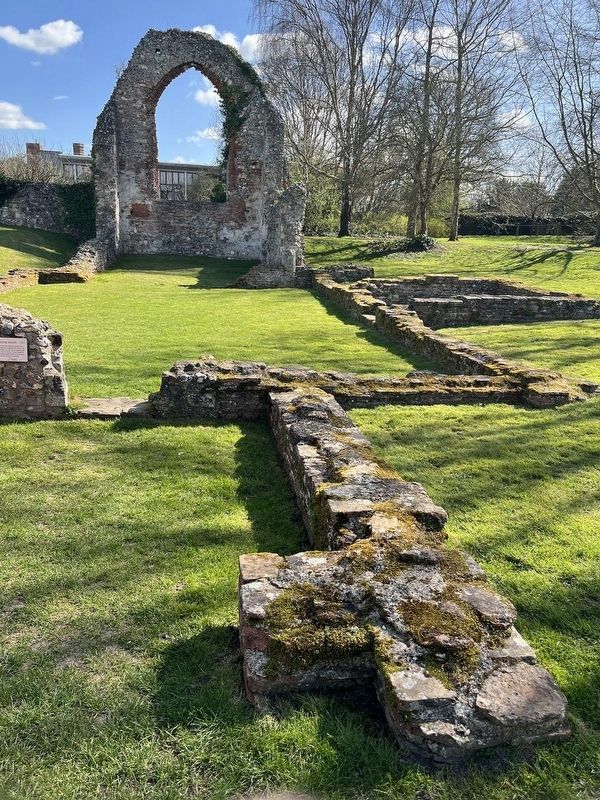
Neglect and natural disasters led to the decline of the royal palace and what remained of the abbey.
The palace built here by Henry VIII was used by a noble family, the Wottons, until the death of Lady Wotton in 1659. Under their heirs, the . . . — — Map (db m272921) HM
"James Simmons was Canterbury's leading citizen in the late eighteenth, early nineteenth century. Stationer, printer, newspaper proprietor, seller of patent medicines, distributor of stamps, mill owner, banker, benefactor and reshaper of Canterbury, . . . — — Map (db m301377) HM
This plaque was unveiled on June 1st 1992 by the Lord Mayor of Canterbury to commemorate the 50th anniversary of the Baedeker raid on this city on the night of June 1st 1942 and is placed at the centre of the devastation
“The darkness has . . . — — Map (db m246890) HM WM
The Buffs
(Royal East Kent Regiment)
1572 — 1967
Veteri Frondescit Honore
( back )
A Man of Kent
This Statue was Unveiled
by
Her Majesty Queen Margrethe II
Of Denmark
on
11th September 2015
The Commission of . . . — — Map (db m129520) HM WM
Burgate was one of the seven Roman gates of Durovenum Cantiacorum, was probably constructed around AD 270-90. As the point of entry of the Roman road from Richborough (Rutupiae), Burgate would have been one of the principal Roman gates and was . . . — — Map (db m279916) HM
Over eight million horses died during the First World War, of which many travelled through Kent on their way to the continent.
The Canterbury War Horse represents conflict and the loss of human and animal life without being over literal, and is . . . — — Map (db m301538) HM WM
( inscribed around the top of the column )
Dedicated to the Honoured Memory of the Men of who fell in the Great War
In Grateful
Commemoration
Of the Officers
Non-Commissioned Officers
And Men of Canterbury
Who Gave Their . . . — — Map (db m129513) WM
This tower is one of a pair rebuilt in the late 1950s when the city wall between Ridingate and St George's Gate was reconstructed. Though both were rebuilt in their medieval form, archaeological excavation in the 1950s found that the tower closer to . . . — — Map (db m279981) HM
This square space was the abbey's cloister. It housed
one of the great centres of book production in
medieval England.
The monks that lived here followed the Rule of St Benedict, with
set times to eat, sleep, and attend services in the . . . — — Map (db m271912) HM
Christopher Marlowe
Born in Canterbury 1564
Died at Deptford 1593
The statuette above represents
Sir Henry Irving
Tamburlaine
The statuette above represents
Sir Johnston Forbes Robertson
Dr. Faustus
The statuette above . . . — — Map (db m129600) HM
The area in front of you is the crypt of the Norman church, used by the monks for burials and prayer.
The Normans did not believe the original Anglo-Saxon churches were worthy enough to house the sacred remains of the saints at the monastery, . . . — — Map (db m272919) HM
The mound was first created in the first or second century as one of several burial mounds south-east of the early Roman town. By the time the Roman town walls were constructed (AD 270-90) it was still of sufficient size to be incorporated into the . . . — — Map (db m279915) HM
In 1538, Henry VIII closed the abbey, bringing to an end over nine centuries of monastic life on the site. A royal palace was built and a fine garden was laid out.
In the 1530s, Henry VIII seized control of the church in England from the Pope. . . . — — Map (db m272920) HM
Jesus said 'I call you friends'
The Friends are the Cathedral's fan club, a group of like-minded people who admire the building, its history and the community which surrounds it.
The Friends' Garden was created with support from a . . . — — Map (db m303312) HM
In Memory of
George Robert Canning
4th Lord Harris
He was distinguished by his public service
beyond the seas and in his own country and county
and held in grateful memory by all lovers of
cricket and field games. His name is inscribed . . . — — Map (db m129521) HM
Augustine's original church and later additions to it were destroyed by the Normans, who built a much larger church here. You are standing in its nave. To the left, a piece of its inner wall and part of a tower still stand.
Augustine founded . . . — — Map (db m271866) HM
For the greater safety
and convenience
of passengers
this bridge was widened
10 feet in the year 1769
Joseph Royle Esq.
being mayor. The expense
was supplied by
voluntary contributions
from this city
and its neighborhood
55 . . . — — Map (db m129526) HM
1. Sir Roger Manwood's tomb, the work of Colt, who also designed Elizabeth I's tomb, is in the church, where he endowed an annual sermon on 'the frailty and vain delights of the world'. As Lord Chief Baron of the Exchequer, he gained Hackington's . . . — — Map (db m316794) HM
Jesus said 'The kingdom of God is at hand. Heal the sick'
The building of an Infirmary began on this site c.1120, under the direction of Prior Wibert, who was the head of the monastery.
It was where sick and elderly monks could be looked . . . — — Map (db m301533) HM
The famous Anglo-Polish novelist Joseph Conrad (Józef Teodor Konrad Nalecz Korzeniowski) was born in Ukraine in the Russian Empire to a Polish szlachta landowning family, well-known in Polish revolutionary, anti-imperialist circles. His . . . — — Map (db m271907) HM
Jesus said 'I am the vine you are the branches'
Canterbury is home to a striking variety of plane tree, easy to spot due to its impressively wide trunk. Commonly known by the nickname of the 'baobab' plane, after its resemblance to the . . . — — Map (db m279956) HM
Alexander James Beresford Hope, a Kent MP, was shocked to learn how this once sacred place had fallen into ruin. He returned the site to religious use, and later excavations revealed its ancient origins.
Beresford Hope bought the site in 1844 . . . — — Map (db m272922) HM
You are now standing over the site of Riding Gate. The defences of the Roman town, including six principal gates, were built c. A.D. 270-90. Until its destruction in 1782 Riding Gate was not only the finest surviving Roman entrance into Canterbury, . . . — — Map (db m272928) HM
(Mid 16th Century)
Gateway to the former Place House, home of William Roper and his wife Margaret, daughter of Sir Thomas More. — — Map (db m279984) HM
To the glorious memory and in grateful
remembrance of the devoted & heroic services
of the officers, non-comd officers and men of
The Buffs — East Kent Regiment
and of the
Imperial Yeomanry of East Kent
Who gave their lives in . . . — — Map (db m129601) WM
To
The Memory of
the
Officers
Non-Commissioned
Officers and Men
Royal East Kent
Yeomanry
Royal East Kent
Yeomanry
Raised 1794
Disbanded 1921
South Africa
1900 — 1901
“Gallipoli 1915”
“Egypt . . . — — Map (db m129523) WM
This field and hill were improved, and these terraces, walks and plantations, made in the year 1790, for the use of the public, at the sole expense of James Simmons, Esq of this city, alderman and banker, to perpetuate the memory of which generous . . . — — Map (db m129603) HM
In AD 597 an Italian monk called Augustine came here to bring Christianity to the English.
Up until this time, the English people worshipped ancient pagan gods. Pope Gregory I, who had been moved by the sight of pagan English children being . . . — — Map (db m271865) HM
Leader of the mission to bring back Roman Christianity to Kent in 597 and first Archbishop of Canterbury. Initiated the Abbey outside the walls of Canterbury and was buried there in 604. — — Map (db m301793) HM
Richard Harris Barham was born in 1788 at 61 Burgate, across the road from this Wetherspoon pub. Using the pen name Thomas Ingoldsby, he wrote The Ingoldsby Legends which first appeared in 1840 in a periodical edited by Charles Dickens.
These . . . — — Map (db m279913) HM
This inn lies on the site of Canterbury's Roman Theatre which was first built about AD80, about the same time as the Colosseum in Rome. It was rebuilt in about AD 210 as one of the largest theatres in Britain. The walls were mainly robbed out by . . . — — Map (db m246323) HM
Anglo-Saxon kings and early archbishops were buried here, including St Augustine himself.
The brick foundations in front of you are the only visible remains of Augustine's first church, built soon after AD 597. You are facing the Porticus of . . . — — Map (db m272918) HM
Jesus said 'Let anyone who is thirsty come to me and drink'
This garden is named after the octagonal, two-storey Water Tower built c.1160. Inside the tower was a large tank for distributing water to various other buildings, and an . . . — — Map (db m301535) HM
This is one of the oldest and most important monastic sites in England. It was from here that the conversion of the English people to Christianity began.
Sent on a mission by the Pope, the Italian monk Augustine began building the first . . . — — Map (db m271854) HM
You are in the former yard of St Mary de Castro church -- which stood on, or near, this spot and which was built only two decades after St Augustine landed in Kent in AD597 to convert the Anglo-Saxons to Christianity.
This early church was . . . — — Map (db m301375) HM
Westgate
The Westgate, built in c. 1380 on the site of a Roman gate, is one of the finest surviving medieval gateways in Britain and one of the first major fortifications to incorporate facilities for guns. Though built as a fortification against . . . — — Map (db m129527) HM
The first gate on this site was built in the late third century A.D. as part of the Roman town defences. Nothing is known of the arrangement of the Roman gate. but in the late Anglo-Saxon period a chapel dedicated to the Holy Cross was situated . . . — — Map (db m303311) HM
In 1548 Worth Gate was blocked and a new street (Castle Row and Worthgate Place) was formed to by-pass the castle. This new road which went round the bailey wall and ditch on the east had a new opening, Wincheap Gate, created for it in the city . . . — — Map (db m129606) HM
Abbot Wulfric II built an unusual tower here to link two Anglo-Saxon churches together. You are looking at its crypt.
In the 7th century, a church dedicated to St Mary was built to the east of Augustine's original church. Abbot Wulfric, one of . . . — — Map (db m272917) HM
This tower is one of approximately twenty-four built as part of the medieval defences of Canterbury in the late fourteenth century. Excavation nearby in 1954 suggested that by the fourteenth century the earlier Roman wall had all but disappeared and . . . — — Map (db m272459) HM