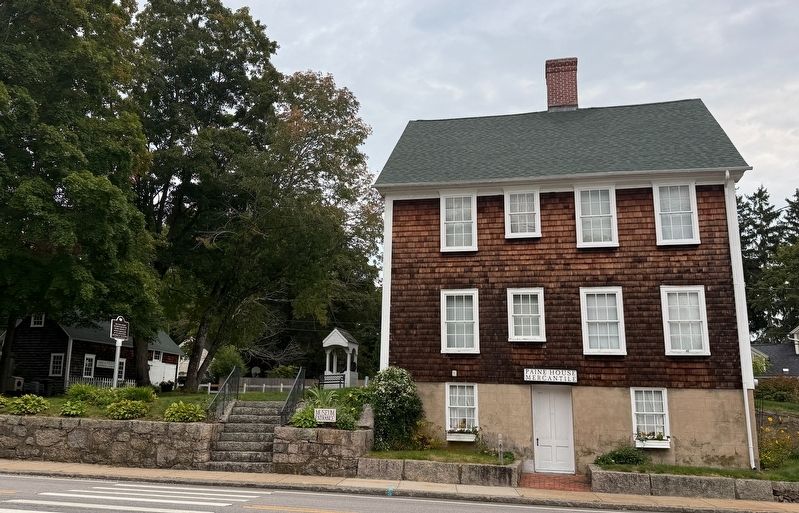
Paine House Museum has been placed on the National Register of Historic Places in 1974 by the United States Department of the Interior — — Map (db m311522) HM
Homestead OverviewIn 1770, this house was built by 27 year-old Quaker and iron-master, Nathanael Greene. The building is a well-preserved 18th Century structure of simple, yet refined design. The iron forge, which was located on the Pawtuxet . . . — — Map (db m83326) HM
Cemetery HistoryThe first Greene family interment occurred in 1786 with the death of Miss Margaret Greene, daughter of Jacob (General Greene’s brother) and Margaret Greene. There are seventeen identified interments in the cemetery and four . . . — — Map (db m83400) HM
Dedicated to these men of the Pawtuxet Valley area who were lost in action in Vietnam
PFC John J. Appolonia USMC 5-31-68 •
SSgt David W. Lilly USA 1-9-71 •
PFC Danial E. Nelson USMC 6-23-69 •
E-6 Kenneth Palmer USA 6-13-68
May . . . — — Map (db m311836) WM
Used as Headquarters for the French
Troops on their march to and from
Yorktown 1781-1782
Maj. Gen. Nathanael Greene
Gen. Lafayette
Gen. Rochambeau
RI Commemorative Committee for
Maj. Gen. Nathanael Greene
Coventry . . . — — Map (db m189625) HM
Dedicated to the citizens of the Town of Coventry who served in the World War
Frank A. Adams •
Walter E. Adams •
George W. Andrews •
Ralph W. Andrews •
Walter Armata •
Albert B. Ash •
Walter G. Ash •
Thomas H. Ashton •
Fred L. . . . — — Map (db m311845) WM
This memorial is erected by the townspeople of Coventry in memory of those who paid the supreme sacrifice in World War II 1941-1945 and in honor of the men and women who served our country for world peace.
Killed in Action . . . — — Map (db m311833) WM
The village of Summit was called Perry’s Hollow in the 18th century.
Located on a ridge between the Flat River and the Moosup River Watersheds, the name “Summit” signified a high point along the adjacent railroad line.
Summit developed when the . . . — — Map (db m107453) HM
Armory of the
Kentish Guards
has been placed on the
National Register
of Historic Places
in 1970
by the United States
Department of the Interior — — Map (db m223020) HM
General James Mitchell Varnum Brigadier General of the Continental Army was instrumental in creating the Rhode Island Black Regiment which provided the first genuine route to freedom for Afro-American people in Rhode Island — — Map (db m58174) HM
On June 12, 1775
The General Assembly for the state of Rhode Island met on this site and enacted a resolution to charter and arm two sloops for the protection of trade and appointed Abraham Whipple to be commander with the rank and power of . . . — — Map (db m58263) HM
1774-1974
Kentish Guards Drill Field
To those Kentish Guardsmen who in 1774 utilized this field to prepare themselves for the conflict that assured our independence. This tablet was dedicated on the 200th Anniversary of the Kentish Guards . . . — — Map (db m58261) HM
Dedicated November 11, 1980
Albert J. Michaud
U.S. Army
Albert J. Michaud Jr.
U.S. Navy
In their memory and those who made the supreme sacrifice for the freedom of others. — — Map (db m223023) WM
Stationed at the Varnum Memorial Armory
15 July 1918 through 14 January 1996
Seventy Seven Years and Six Months of ServiceFrom, Unit
June 1916, Varnum Provisional Training Co. •
July 1918, 16th Co. R.I. State Guard • . . . — — Map (db m223029) HM WM
Built in 1872 by William Northup on the former site of Scalloptown. This chapel was the first fully integrated congregation in East Greenwich. — — Map (db m58389) HM
Founders
Oct. 1, 1907.
Howard V. Allen •
Benjamin H. Arnold •
D. Ray Arnold •
George E. Bailey* •
Henry D. Banks •
Walter O. Barber •
Albert S. Benson •
Thomas W. Black, Jr. •
Nathaniel H. Brown* •
William A. Browning* . . . — — Map (db m223030) HM WM
Erected by Varnum Continentals 1914 on the second site of Rhode Island Central Bank, first bank in East Greenwich 1840-1857
To the memory of
James Mitchell Varnum
of East Greenwich
Brig. Gen. Continental Army 1777-1779 • . . . — — Map (db m223025) HM WM
Location: Conimicut Shoal, entrance to Providence River, Narragansett Bay
41 43 01 N 71 20 42 W
Originally Established: 1868
Present Light House Established: 1882 / Automated: 1963
Construction Material: Cast iron / Present Optic: 250 mm . . . — — Map (db m198179) HM
The Conimicut Light, a symbolic Rhode Island's rich maritime heritage is associated with a long history of efforts to protect shipping in and out of the rocky waters of Narragansett Bay, and with the creation of transportation routes that have . . . — — Map (db m251141) HM
This building, erected in 1919, was a center of the early 20th century marine trade, which maintained small commerical and pleasure craft that called Pawtuxet Village their home port. In 1975, the old boat house was obtained by the City of . . . — — Map (db m251143) HM
This American Liberty Elm was named after "The Liberty Tree: Our Country's first Symbol of Freedom." On the morning of August 14, 1765, the people of Boston awakened to discover two effigies suspended from an elm tree in . . . — — Map (db m251144) HM WM
Only the bravest of Rhode Islanders would venture into the dark House of Horrors, steeling themselves against the frightening sight of the Giant Bat, the Torture Chamber, the Sawmill stunt, and the ride's most mysterious attraction, the Viking . . . — — Map (db m251135) HM
Rocky Point was traditionally accessed via Narragansett Bay. In 1860, the American Steamship Company ran ships to the park's pier several times a day. The pier, a constant fixture at the park, was not untouched by the ravages of nature, however. . . . — — Map (db m251125) HM
On the 29th of June, in the year 1877, the first Presidential phone call was made between Rutherford B. Hayes who was at Rocky Point and Alexander Graham Bell in Providence. Mr. Fred Gower, the managing agent of Professional Bell, moderated the . . . — — Map (db m251139) HM
Playing baseball is a national pastime and a favorite sport of the locals. However, at the turn of the 20th century the Puritan morality laws, also known as Blue Laws, prohibited the playing of baseball on Sundays. The Blue Law did not stop the . . . — — Map (db m251120) HM
This 60-foot arch is one of 11 "archways to understanding" sponsored by General Foods during the 1964-65 New York World's Fair. The original arch had an electronic message panel that would display Fair-related information such as weather . . . — — Map (db m251128) HM
On September 11, 1906, Harry G. Travor submitted a patent application for a roundabout that operated as a centrifugal swing with suspended seats. This patent detailed the historic Rocky Point ride known to generations of park enthusiasts as the . . . — — Map (db m251137) HM
Rocky Point was traditionally accessed via Narragansett Bay. In 1860, the American Steamship Company ran ships to the park's pier several times a day. The pier, a constant fixture at the park, was not untouched by the ravages of nature. In 1883, . . . — — Map (db m251124) HM
On any hot New England summer day, many Rhode Islanders could be found eagerly standing in line for a day pass to the inground pool. Not only was this pool a summertime favorite, but it was unique because it was filled using the salt water from . . . — — Map (db m251130) HM
In 1840, Captain William Winslow began to bring his Sunday school class to Rocky Point for weekend outings. These proved so popular, in 1847, he purchased 89 acres and began transporting people via steamboat to the site and serving a shore . . . — — Map (db m251122) HM
The Skyliner was considered a relaxing alternative to the park's more hair-raising rides. Similar to a ski lift, it carried passengers from one side of the park to the other, providing a bird's-eye view of the amusement park. After reaching a . . . — — Map (db m251132) HM
The Peter Freeman Lot (Warwick Historical Cemetery #26) is an historic cemetery protected by State and City regulations. The Lot is described as 100 feet by 75 feet in size, containing 22 individuals (with 20 inscribed headstones and one . . . — — Map (db m150256) HM
In memory of the Civil War veterans who served their country from 1861 to 1865 from the Town of West Greenwich, R.I.
Samuel L. Albro •
James P. Briggs •
Thomas B. Briggs •
John M. Cleveland •
Israel A. Cleveland •
Charles Cottrell . . . — — Map (db m311948) WM
This marker commemorates the men and women of West Greenwich who achieved American independence. These Patriots, believing in the noble cause of liberty, fought valiantly to found a new nation.
1775-1783
Presented by the West Greenwich . . . — — Map (db m311518) WM
Dedicated to the memory
of
George E. Fiske
and
in grateful appreciation
of the services of
Charles C. Crocker Jr. •
Edward A. Robbins •
Earl B. Harrington •
Edward O. Harrington •
Wilfred A. Gileau •
John H. Potter • . . . — — Map (db m311849) WM
☀️
⏳
West Greenwich
In recognition of the citizens of West Greenwich who served in World War II 1941 1945 and in loving tribute to those who sacrificed their lives in defense of liberty and world peace
Died in . . . — — Map (db m311946) WM
Thank you for visiting the Station Fire Memorial Park, the sacred ground where 100 individuals lost their lives February 20, 2003. We hope the gardens surround you with comfort, peace, and a place for reflection. . . . — — Map (db m311950) HM
On this site stood the East Ferry freight shed, waiting room, office and ferry slips. For 294 years, ferries carried passengers, livestock and goods between Jamestown and Saunderstown to the west and Newport to the east. It was the oldest . . . — — Map (db m311981) HM
Memorial
to the veterans
of
Jamestown, Rhode Island
who served in the
Spanish - American War
World War One
World War Two
The Korean War
The Vietnamese War — — Map (db m88699) WM
On this Island of Conanicut known previous to 1636-38 as Quinungate, was the summer camping ground of the Narragansett Indians. Here met Chief Canonicus and Roger Williams and made an alliance between the Narragansett and Mohegan Indians with the . . . — — Map (db m311573) HM
Dedicated to the veterans of Jamestown whose patriotic and honorable service in our nation's wars and conflicts is remembered by a grateful community.
Colonial wars •
Revolutionary War •
War of 1812 •
Mexican War •
Civil War • . . . — — Map (db m311983) WM
In 1829, Congress appropriated $1,250 for a 600-pound fog bell for Beavertail. Prior to that time the keeper fired a cannon on foggy nights. That same year a fog bell house was built adjacent to the tower.
Beavertail has probably seen more . . . — — Map (db m88667) HM
1678
Town of Jamestown is incorporated. There are about 150 residents.
1705
Jamestown Town Council orders that a Watch House be built at "Beaver Tail."
1712
Jamestown Town Council . . . — — Map (db m88673) HM
Beavertail Light was lit with whale oil for many decades. Whale oil was smoky, hard to light at cold temperatures, and the quality varied greatly. In addition, early lights were dim and burned twenty to thirty gallons of oil a month.
In the . . . — — Map (db m56679) HM
Below this concrete cap sits the stone foundation Beavertail's 1749 lighthouse.
Initially built to provide safe passage into Newport's colonial harbor, it was designed and built by Peter Harrison, "America's first architect," who later . . . — — Map (db m56457) HM
The first assistant keeper at Beavertail Light was hired about 1859. It appears that the early assistant keepers shared part of the keeper's quarters or lived in one of the outbuildings on site.
In 1898, the U.S. Lighthouse Board added this . . . — — Map (db m88631) HM
The Beavertail Lighthouse Museum
welcomes visitors to the site of America's Third Oldest Lighthouse
Est. 1749
Originally built in 1898 for the assistant keeper, this restored house is now operated as a museum sponsored . . . — — Map (db m311885) HM
The Beavertail Lighthouse Museum
welcomes visitors to the site of America's Third Oldest Lighthouse
Est. 1749
This building built in 1898 for the Assistant Keeper and the adjacent built in 1856 for the Lighthouse Keeper. These restored . . . — — Map (db m311886) HM
The Beavertail Lighthouse Museum
welcomes visitors to the site of America's Third Oldest Lighthouse
Est. 1749
This building built in 1856 for the Lighthouse Keeper and the adjacent building built in 1898 for the Assistant Keeper. These . . . — — Map (db m311987) HM
The current tower was built in 1856 to replace a deteriorating 1753 structure.
The granite tower rises to a height of 40.9 feet and measures 10 feet on each side. It is constructed of 27 rows of granite blocks, weighing a total of 180 tons. . . . — — Map (db m88666) HM
Although most lighthouse keepers were married, at many small lighthouses they lived a solitary life while their families remained on the mainland. Beavertail, being on Conanicut Island, allowed the keepers and their family to live at the site. . . . — — Map (db m88672) HM
You are looking at the West Passage, one of two entrances to Narragansett Bay, New England's largest estuary. There are over 30 islands in the bay. There is very little commercial shipping in the West Passage since it is much shallower than the . . . — — Map (db m310857) HM
What resembles a submarine on the surface just over a mile southwest of this point is all that remains of the Whale Rock Lighthouse.
Whale Rock is a flat ledge about a half acre in size, yet it claimed at least eight ships and six lives . . . — — Map (db m88648) HM
Rhode Island Rebels
In the early 1770's — even before the Declaration of Independence — Narragansett Bay was the scene of frequent confrontations between the British Navy and Rhode Islanders. The British aggressively enforced their . . . — — Map (db m312031) HM
Conanicut Battery
A Revolutionary Fort
Built by Americans in 1776
Grounds cleared and tablet placed by the Daughters of the American Revolution of Rhode Island — — Map (db m56383) HM
Conanicut Battery
On Prospect Hill
A National Historic Site
In this National Historic Site are lasting relics of Jamestown's past and America's heritage.
⚓
Circa 1400
Evidence of a native American . . . — — Map (db m312030) HM
This area along the crest of Prospect Hill was an integral part of the Narragansett Bay coastal defense system from 1916 to 1945. From here, military observers had an unobstructed view of the approaches to the Bay, as well as East and West passages . . . — — Map (db m56678) HM
Inception
Fort Getty was built between 1901 and 1905, one of several forts built in response to an 1886 report by William Endicott, President Grover Cleveland's Secretary of War, detailing the country's vulnerability to attack from the sea. . . . — — Map (db m312034) HM
Situated atop 50-70 foot high cliffs with clear views of the horizon and Block Island to the south. Fort Wetherill held an important strategic position within an extended harbor defense system of Narragansett Bay during World Wars I and II.
The . . . — — Map (db m189619) HM
The Harbor Mine or Torpedo Complex was constructed during the period of 1908 to 1911 as part of a comprehensive harbor defense system for Narragansett Bay. The two-story concrete structure served as a Mine Storage Warehouse in which the parts . . . — — Map (db m56683) HM
Historically, the rocky cliffs behind and above the buildings of the Harbor Mine Complex were of military significance to Rhode Island's earliest colonists, who built earthen fortifications on its headland and installed cannon to protect nearby . . . — — Map (db m242649) HM
The current Jamestown mill was built in 1787, shortly after the American Revolution. It is wind-powered and was used primarily to grind dried kernels of white flint corn, also called "Indian" corn, into cornmeal for human consumption and into . . . — — Map (db m312036) HM
Jamestown Windmill
has been placed on the
National Register
of Historic Places
in 1973
by the United States
Department of the Interior — — Map (db m312035) HM
This large flat stone with the narrow circular channel and a spout carved in it is believed to be a leaching stone. Similar stones were used to make cider, but the channels were wider and deeper.
A leaching stone was used to extract, or . . . — — Map (db m312038) HM
The Jamestown mill is a three-story octagonal tower with a domed cap, or bonnet, that rotates to bring the sails, or arms, into the wind. Its horizontally sloping sides are made of hand-hewn chestnut shingles on the outside.
The Milling . . . — — Map (db m312037) HM
This sculpture shows the present-day Sakonnet shoreline and an approximation of the shoreline 13,000 years ago.
Archaeological evidence and Wampanoag tradition tell us that people have lived at Sakonnet continuously since the end of the . . . — — Map (db m307031) HM
To your left is an ancient road that follows a ridge left by a retreating glacier about 13,000 years ago.Together with local waterways, this road connected the Sakonnets to 68 other Wampanoag villages to the north and east, and to other Native . . . — — Map (db m307032) HM
Attuck (deer) is sculpted entirely from native timber and driftwood collected in Rhode Island over the course of eight months. His frame is built from a fallen cedar, a sacred material in tribal communities. The enduring strength of . . . — — Map (db m312220) HM
Buying & Selling Acoaxet
After the war many Native people owned
land in Acoaxet with English-style deeds.
Mamanuah preserved his homelands by remaining
loyal to the English during King Philip's War and by selling
Awashonks' land instead . . . — — Map (db m307138) HM WM
This Tablet erected by the Rhode Island Society of Colonial Wars in recognition of the exceptional services rendered by Col. Benjamin Church. His fearless leadership and effective command during King Philip's War 1675-1676 — — Map (db m307061) WM
Distrust for the Newcomers
The Sakonnets and the English were not friends.
As many as 3,000 Sakonnets lived here in the 1600s.
They saw European ships sail by beginning in the 1500s.
European newcomers brought diseases but the
Sakonnets were . . . — — Map (db m307016) HM WM
Elisabeth Pabodie,
daughter of the Plymouth Pilgrims, John Alden & Priscilla Mullin, the first white woman born in New England.
Here lyteth the Body of Elisabeth the wife of William Pabodie who dyed . . . — — Map (db m312206) HM
Fal Solomon:
Indentured Here
Fal Solomon was a Sakonnet girl
ordered into indenture here
at the Wilbor House.
In 1757 an epidemic swept through Sakonnet. Fal
Solomon became ill, and her parents likely died. Dr.
William Wilbor brought . . . — — Map (db m307045) HM
Henry Tillinghast Sisson
1831 - 1910
Colonel of the Fifth Rhode Island
Artillery Regiment
Lieutenant Governor of Rhode Island
In appreciation of the valor of
Colonel Sisson
and
the Fifth Rhode . . . — — Map (db m312213) HM
Honoring Awashonks
The land you are standing on was once
reserved for Awashonks and her people.
Awashonks is the best known Sakonnet sachem. She
led her people during the 1660s and 70s. This was a
chaotic time when the English used trickery, . . . — — Map (db m306910) HM WM
In honor of the men and women of Little Compton who served in the Korean Conflict, 1950-1953
Arruda, James A. •
Bernard, Rodolphe H. Jr. •
Bodington, Richard F. •
Brayton, Arthur •
Brownell, Carlton C. •
Chaves, George F. • . . . — — Map (db m312202) WM
In grateful appreciation of one hundred and twenty years of Christian service in this community by the
Methodist Episcopal Church
established in 1820 and united with the United Congregational church in 1940 — — Map (db m312204) HM
Mishoon
Dugout canoes provided Wampanoag people with transportation throughout the Northeast.
Mishoon is the traditional term for dugout canoe in my Wampanoag language. The dugout canoe practice and tradition that existed here for thousands of . . . — — Map (db m307132) HM
The Wampanoag people have a spiritual connection to plants that goes back to our creation. It is a relationship. When we are interacting with these plants, it is the way we would interact with any of our family members. We visit. We have ceremony . . . — — Map (db m312221) HM
An Apology and a Promise
The Little Compton Historical Society recognizes the harm done to the Wampanoag people by Little Compton's European settlers. We apologize for our part in that harm, and we are working to repair some of the damage . . . — — Map (db m312222) HM
Squant features prominently in our stories. She is a great being that oversees the health of the plants. especially berries. Squant was said to be married to Moshop the great giant who dragged his toe, causing the water to wash in and separate . . . — — Map (db m307124) HM
The Sakonnets did not fence their fields. English settlers did. Many of the stone walls you see today mark original English property lines. As early as 1661 Awashonks repaid debts to an English settler in Tiverton with stone walls built by her . . . — — Map (db m306949) HM
A weeku (weety8) is a Wampanoag house. The Sakonnets, and other Wampanoag communities in Massachusetts and eastern Rhode Island, would live in different types of houses depending on what time of year it was. During the spring and summer, . . . — — Map (db m307133) HM
Take A Walk On Your Land
To forever protect and preserve this property as farmland, development rights were
purchased by the Little Compton Agricultural Trust ("Ag Trust") in partnership with the
RI Department of Environmental Management.
. . . — — Map (db m307051) HM
The Sakonnet Diaspora
The descendants of the Sakonnets are a diaspora.
The Sakonnets began leaving their homelands in the Late 1600s, driven away by war, European diseases English encroachment, and fear. English neighbors burned a Native . . . — — Map (db m307144) HM
Three Sisters: A Symbiotic Garden
Living things grow best in relationship with others.
Oral history is imperative in preserving the culture of
Indigenous communities. For thousands of years, our
stories have encapsulated the experiences of . . . — — Map (db m306944) HM
This description arises from the antiquity of turtles and by picturing the rough shape of the continent. The northern United States and Canada are its head and front limbs; Florida and California are its back legs; and Mexico is the tail. Like . . . — — Map (db m312218) HM
United
Congregational
Church
Organized
1704
This building erected
1832
In commemoration
of the
Methodist
Church
Founded in 1820 and united with this church in 1940 . . . — — Map (db m312208) HM
In honor of the men and women of Little Compton who served in our nation's conflicts
Russel L Sisson, Vietnam •
Antone Desouza III, Desert Storm •
Frank Desouza, Desert Storm •
David D Dougherty, Desert Storm •
James S Waite Jr, . . . — — Map (db m312039) WM
In honor of the men and women of Little Compton who served in the Vietnam Conflict
Dec. 22, 1961 - May 7, 1975
John M. Babbitt •
Robert I. Carr •
Richard Davoll, Jr. •
George P. Demenezes •
Arnold E. Gifford •
Harold A. Gifford . . . — — Map (db m312040) WM
Welcome to Sakonnet
Sakonnet is the traditional homeland
of the Sakonnet Wampanoag people.
People have lived at Sakonnet for over 13,000 years.
This exhibit shares their story from the end of the
last ice age to the present day. . . . — — Map (db m306958) HM
Wilbor House
Built circa 1690 by Samuel & Mary Wilbor
Home of eight generations
East end, 17th century, West end, 18th century
Additions, 19th & 20th century — — Map (db m306880) HM
In honor of the men and women of Little Compton who served in World War II
Almeida, Antone Jr. •
Almeida, Louis A. •
Andersen, Vernon A. •
Arruda, George •
Arruda, Louis •
Arruda, Manuel Jr. •
Auger, Armond A. •
Bahia, . . . — — Map (db m312200) WM
In honor of the men and women of Little Compton who served in the World War 1917 - 1919
Almeida, John •
Barker, Earl C. •
Barker, Everett C. •
Brownell, Ralph H. •
Burchard, John C. •
Carter, Charles E. •
Carter, William S. • . . . — — Map (db m312042) WM
To commemorate the birthplace of the Rhode Island Red breed of fowl which originated near this location Red fowls were bred extensively by the farmers of this district and later named "Rhode-Island-Reds" and brought into National prominence by the . . . — — Map (db m56093) HM
1000 entries matched your criteria. Entries 101 through 200 are listed above. ⊲ Previous 100 — Next 100 ⊳