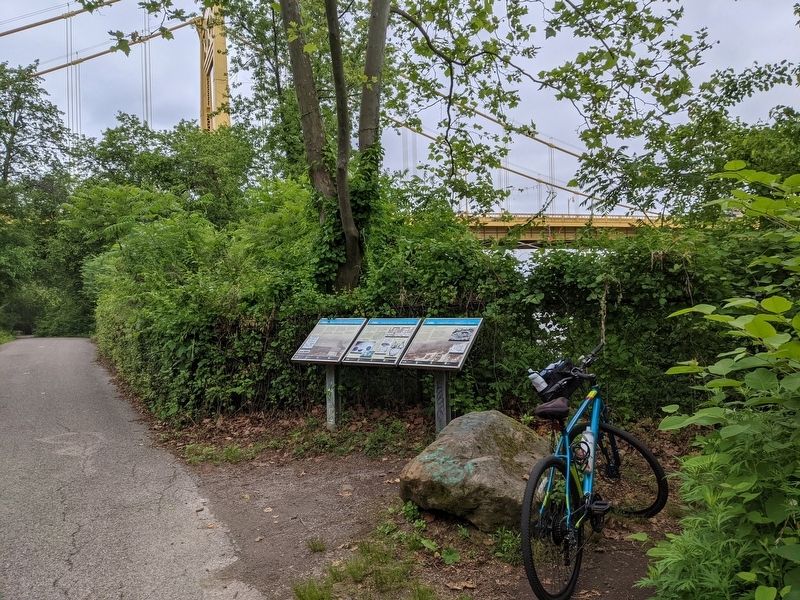
The Pennsylvania Canal was Pittsburgh's most important transportation system until the 1850s when railroads began to replace the old canal system. Irish workers dug the canal across the state from the Susquehanna River near Harrisburg to the . . . — — Map (db m174462) HM
The loading basin and western terminus of the State-built railroad, canal, and Portage over the Alleghenies uniting eastern and western Pennsylvania was here. Built in 1826-1834. In 1857 sold to the Pennsylvania R.R. — — Map (db m42182) HM
A state-owned canal system, built 1826-34, to connect Philadelphia, Pittsburgh, and Erie. This 104-mile division ran from Johnstown to Pittsburgh and was part of the canal’s mainline. In 1827, Dam #1 was constructed at Leechburg, and it supplied the . . . — — Map (db m114801) HM
Beaver Division built 1831-1834. Two locks at Rochester, five in New Brighton and two at Eastvale overcame the falls of the Beaver River. The canal was extended to Erie in 1834. Canal traffic ceased in 1871. Few remains are visible today. — — Map (db m45790) HM
The Beaver Division of the Pennsylvania Canal System was one of the most important developments in early Beaver County history. This combination of a canal and slack water navigation system began at the mouth of the Beaver River and extended to . . . — — Map (db m206673) HM
To honor the memory of John Blair 1766-1832 Pioneer farmer, merchant and public servant advocate of good roads, promoter of the Pennsylvania Canal and Allegheny Portage Railroad foremost citizen of his time in what is now Blair County and when . . . — — Map (db m162042) HM
“This day [June 11] the first clearance on the Delaware Division of the Pennsylvania Canal was issued from his office to the Mauch Chunk Canal Boat No. 30, Capt. William C. Zanes, bound to Bristol with 30 tons of coal.”
The . . . — — Map (db m31224) HM
Delaware Canal
Here is Lock No. 12 in a series of 23 lift locks, numbered from Bristol to Easton. Just above here is one of the nine aquaducts by which the canal and its traffic crossed courses of small streams.
Pennsylvania Canal
A . . . — — Map (db m17586) HM
A system of State-built public works to connect Philadelphia, Pittsburgh, Lake Erie. The Delaware Division, Bristol-Easton begun 1827; operated by the State 1831-58, and by private owners to 1931. A State Park since 1940. — — Map (db m147859) HM
”On June 10, 1838, a boat laden with forty tons of merchandise was carried through the Lehigh navigation from Mauch Chunk to White Haven in fourteen hours, and drawn by one set of horses, and that the locks on said navigation are of a capacity . . . — — Map (db m153403) HM
Division was built from Northumberland to Lock Haven in 1828-34. Until 1889, carried iron, lumber, and manufactures from this area to eastern markets. Here Bald Eagle Cross-Cut Canal joined the division, connecting with it by two locks, a dam, . . . — — Map (db m150086) HM
William Jennings - President Christian W. Lynch - Vice-president William Wills - Secretary Patrick F. Duncan - Treasurer Frank M. Masters - Chief Engineer Ralph Modjeski - Consulting Engineer Paul P. Cret - Consulting Architect The Vang . . . — — Map (db m19710) HM
This Division was built, 1826-33; operated until 1901. Here, at old Clark's Ferry Towpath Bridge, the State's great inland canal traffic in iron, coal, and lumber crossed the Susquehanna. Lykens Valley coal trade, by way of Wiconisco Canal, . . . — — Map (db m6901) HM
A State-owned canal system, built 1826-34, to connect Philadelphia, Pittsburgh, Lake Erie. The first lock on the canal to be dedicated, March 13, 1827, was "Penn Lock," 150 yards east. It was replaced in 1859 by Locks No. 10 and 11. — — Map (db m6775) HM
The rise of Harrisburg's importance and distinction as one of the major transportation centers in the eastern United States was launched on March 14, 1827, by the laying of the cornerstone at the eastern end of Walnut Street downtown for the . . . — — Map (db m6831) HM
History
Prior to European settlement this land was inhabited by the Susquehannock and Delaware Indian tribes.
Around 1750 Samuel Hunter married the widow Catherine Chambers and settled here to run her gristmill.
The Fort at . . . — — Map (db m253256) HM
History
Prior to European settlement this land was inhabited by the Susquehannock and Delaware Indian tribes.
Around 1750 Samuel Hunter married the widow Catherine Chambers and settled here to run her gristmill.
The Fort at . . . — — Map (db m85934) HM
History
Prior to European settlement this land was inhabited by the Susquehannock and Delaware Indian tribes.
Around 1750 Samuel Hunter married the widow Catherine Chambers and settled here to run her gristmill.
The Fort at . . . — — Map (db m253259) HM
History
Prior to European settlement this land was inhabited by the Susquehannock and Delaware Indian tribes.
Around 1750 Samuel Hunter married the widow Catherine Chambers and settled here to run her gristmill.
The Fort at . . . — — Map (db m253286) HM
History
Prior to European settlement this land was inhabited by the Susquehannock and Delaware Indian tribes.
Around 1750 Samuel Hunter married the widow Catherine Chambers and settled here to run her gristmill.
The Fort at . . . — — Map (db m253318) HM
Greenways are corridors of protected open space managed for conservation and recreation. Greenways often follow natural land or water features, linking nature reserves, parks, cultural features and historic sites with each other and with . . . — — Map (db m253315) HM
The Pennsylvania Canal was a boon to travel and shipping. The Commonwealth of Pennsylvania funded its construction starting in 1828. Before the canal, travel from Philadelphia to Pittsburgh took seven days. Canal travel reduced the time to three . . . — — Map (db m253307) HM
End of Erie Extension of the Pennsylvania Canal system. Work begun here July 4, l838. Canal formally opened Dec. 5, 1844, by arrival of "R. S. Reed" with Mercer County coal, and "Queen of the West" with passengers. — — Map (db m180007) HM
The Juniata Division of the Pennsylvania Canal was completed to Huntingdon in 1830, and regular shipping to and from this point got underway in the Spring of 1831. The canal ran beside the river, on the right-of-way now occupied by the railroad. . . . — — Map (db m177058) HM
First salt well in the vicinity was drilled, 1813-14. By the 1830's this area had become a leading United States salt producer. Important to its shipment was the Pennsylvania Canal's Western Division. The canal crossed here, 1829-1864, and was the . . . — — Map (db m49208) HM
This section of the canal was built between 1830-1833. The canal was used to transport coal, Mules or horses pulled canal boats. The anthracite coal from northeast Pennsylvania was conveyed to the iron furnaces through the canal network, which also . . . — — Map (db m136367) HM
Northern terminus, Beaver Division of Pennsylvania Canal system, completed to this point, 1834. Important shipping point before completing "Cross-Cut Canal" to Ohio, 1838, and Erie Extension to Greenville, 1840. — — Map (db m51143) HM
Getting goods and people to and from Williamsport in the early 1800s was no easy feat. Roads were few and often impassible. The West Branch of the Susquehanna served as a "water highway" for Williamsport's citizens — who numbered just 60 in 1806. . . . — — Map (db m191999) HM
Preserved here are three locks of the Pennsylvania Canal, Juniata Division. Unique in that three locks and levels were adjacent. Stonework and the old bed of the canal can be seen. — — Map (db m90768) HM
In 1826 Daniel Montgomery, for whom the town of Danville was named, was elected president of the Board of Canal Commissioners. The North Branch Canal was surveyed in 1826-27 with construction of the canal between Northumberland and Nanticoke . . . — — Map (db m89804) HM
A system of State-built public works to connect Philadelphia, Pittsburgh, Lake Erie. The Delaware Division, Bristol-Easton, begun 1827; operated by the State 1831-58, and by private owners to 1931. A State Park since 1940 — — Map (db m86091) HM
In March 1828, the state legislature authorized the construction of the "canal system" so that the products of Pennsylvania could be transported effectively. The West Branch Division of the Pennsylvania Canal System started at Muncy, went through . . . — — Map (db m178289) HM
The North Branch and West Branch Divisions, built 1828-34, joined here in Northumberland at a canal basin. Boats with coal from Nanticke or lumber from Williamsport locked down into the river nearby and re-entered the Canal on the west bank. — — Map (db m14327) HM
This Division, built 1829-32, carried coal until 1901, from Nanticoke mines to Northumberland, and from there to inland towns and seaport cities. From Lackawanna Creek downwards there were 2 dams, 14 locks, and 7 aqueducts. Traces of towpath and . . . — — Map (db m87646) HM
This Division was built in 1828-33. It extended to the eastern end of the Allegheny Portage Railroad at Hollidaysburg, a distance of 127 miles. Just west of here, the Canal crossed the Juniata by an aqueduct which was used until 1901. Abutment and . . . — — Map (db m19541) HM
This State-owned artificial water-way system, built 1826-1834, was designed to connect points like Philadelphia, Pittsburgh, and Erie in a vast inland trade. It embraced six chief canal divisions and two railroads. Here the Susquehanna, Juniata, and . . . — — Map (db m19708) HM
Built 1823-31; operated until 1901. It extended from Duncan's Island to Northumberland. In its 41-mile course, the Division embraced 13 locks, 7 aqueducts, old Shamokin Dam, and West Branch Towpath Bridge. Traces of the Canal can be seen at points . . . — — Map (db m19709) HM
1821: Harrisburg & Millerstown Turnpike chartered.
1829: Pennsylvania Canal opened through Perry County.
1849: Pennsylvania Railroad completed through Perry County.
The building of turnpikes, . . . — — Map (db m308098) HM
In November 1829, a canal boat loaded with elected officials arrived in Newport from Mifflintown. The boat was drawn by two white horses. An American flag was flying, a cannon roaring and a band playing! Thus, the canal era officially opened . . . — — Map (db m175051) HM
Completed in 1833 as a part of Pennsylvania Canal. It was 5/8 mile long and had 3 lift locks. A dam provided slack water, enabling boats to cross the river, thus creating a great trade center here. — — Map (db m43357) HM