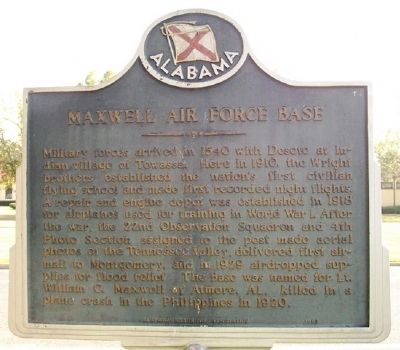
On Ash Street west of Poplar Street, on the right when traveling west.
(Side A)
Air University
The Air Corps Tactical School moved to Maxwell in 1931. Brilliant young officers like Chennault, Eaker, Fairchild, Hansell, Kuter, LeMay, Quesada, and Vandenberg formulated the aerial strategies and tactics . . . — — Map (db m64437) HM
On Maxwell Boulevard at Magnolia Drive, on the right when traveling west on Maxwell Boulevard.
Maj Gen Muir S. Fairchild
February 1946 – May 1948
Maj Gen Robert W. Harper
May 1948 – October 1948
Gen George C. Kenney
November 1948 – July 1951
Lt Gen Idwal H. Edwards
August 1951 – . . . — — Map (db m64368) HM
On Maxwell Boulevard at Magnolia Drive, on the right when traveling west on Maxwell Boulevard.
Post-Vietnam Era marked a turning point for AU. Lt Gen Furlong, AU commander, launched a three year campaign to overhaul the curriculum which became known as “Putting the ‘War’ back into War College.” Between 1975 and 1976 AU gained . . . — — Map (db m64375) HM
On Twining Street north of Ash Street, on the left when traveling north.
Remaining in operation longer than any bomber in U.S. military history, the B-52 was the Strategic Air Command's principal long-range heavy bomber from the time it became operational in 1955. Affectionately known as the BUFF (Big Ugly Fat . . . — — Map (db m64474) HM
On Twining Street north of Ash Street, on the right when traveling north.
In 1941, before Pearl Harbour, President Franklin D. Roosevelt agreed with Prime Minister Winston S. Churchill, to provide flight training for British and Commonwealth pilots in the U.S.A. by the U.S. Army Air Corps.
Over 4,000 pilots were . . . — — Map (db m64476) HM WM
The Cessna T-41 was derived from a standard Cessna Model 172 light aviation aircraft. Between 1965 and 1969 the USAF purchased 211 T-41A variants "off the shelf" for the preliminary flight screening of pilot candidates; another 52 T-41C variants . . . — — Map (db m64482) HM
On Maxwell Boulevard at Magnolia Drive, on the right when traveling west on Maxwell Boulevard.
Charged with developing doctrines and concepts for the employment of air power, AU produced the first basic doctrine manuals for the Air Force. AU also gained notoriety with projects such as Corona Harvest, which studied and developed . . . — — Map (db m64374) HM
On Maxwell Boulevard at Magnolia Drive, on the right when traveling west on Maxwell Boulevard.
To accommodate expansion of programs, a five million dollar construction project began in 1954 to give AU a modern, integrated academic center with a collegiate atmosphere and facilities in keeping with its educational mission.
We’re . . . — — Map (db m64372) HM
On Maxwell Boulevard at Magnolia Drive, on the right when traveling west on Maxwell Boulevard.
The Army Air Forces school was assigned its first commander, Major General Muir S. Fairchild, in February 1946, and renamed Air University in March. The dedication ceremony occurred 3 Sep 1946. The first classes at the Air War College and the . . . — — Map (db m64370) HM
On Maxwell Boulevard at Magnolia Drive, on the right when traveling west on Maxwell Boulevard.
During the early 1950’s, Air Force leaders decided to consolidate and relocate professional military and continuing education activities, as well as commissioning and specialized schools to Maxwell and Gunter Air Force Bases.
”(Air . . . — — Map (db m64371) HM
General (ret) Welch was born in 1934 in Guymon, Okla., and graduated from Liberal (Kan.) High School in 1952. He enlisted in the Kansas National Guard in October 1951, serving with the 161st Armored Field Artillery until enlisting in the U.S. . . . — — Map (db m64500) HM
On Maxwell Boulevard at Magnolia Drive, on the right when traveling west on Maxwell Boulevard.
Air University began new Air War College and Air Command and Staff College programs in 1987 which met newly mandated “Joint” education requirements. These programs emphasized joint war fighting.
”The basic reason for the . . . — — Map (db m64378) HM
On Lemay Plaza 0.1 miles south of Maxwell Boulevard, on the right when traveling south.
This facility is dedicated to the memory of Senator Lister Hill who faithfully served his state and the nation for forty-five years as a member of the House of Representatives and the United States Senate. An Infantry Officer during World War I, . . . — — Map (db m79082) HM
On Maxwell Boulevard at Magnolia Drive, on the right when traveling west on Maxwell Boulevard.
Lt. William C. Maxwell (Side A)
William Calvin Maxwell was born Nov. 9, 1892 in Natchez, Ala. An Army ROTC student at the University of Alabama, he left in 1917 to enlist in the Army. He received his commission in April 1918, after . . . — — Map (db m64367) HM
On Bay Street 0.1 miles north of Ash Street, on the left when traveling north.
Maj. Gen. Claire L. Chennault
Born in Commerce, Tx, on 6 Sep 1893, Chennault was commissioned in 1917 and received his wings in 1919. A graduate of and instructor at the Air Corps Tactical School, he became a leading advocate of pursuit . . . — — Map (db m72169) HM
On Chennault Circle east of Twining Street, on the left when traveling east.
First flown in May 1958, the Phantom II originally was developed for U.S. Navy fleet defense and entered service in 1961. The USAF evaluated it for close air support, interdiction, and counter-air operations and, in 1962, approved a USAF . . . — — Map (db m64504) HM
On Chennault Circle east of Twining Street, on the left when traveling east.
Ordered in 1951 by the Strategic Air command as a long-range escort fighter, the F-101 lineage included several versions: Low-altitude fighter-bomber; photo-reconnaissance; two-seat interceptor; and transition trainer. To accelerate production, . . . — — Map (db m64503) HM
On Chennault Circle east of Twining Street, on the right when traveling east.
In tribute to the perseverance and achievements of the Wright Brothers and the leadership and foresight of the Citizens of Montgomery, Alabama. Together they established the nation's first school of civil aviation in March, 1910, launching America . . . — — Map (db m64567) HM
On Ash Street west of Poplar Street, on the right when traveling west.
The North American B-25 Mitchell, named after America's greatest military martyr (Gen Billy Mitchell), made its maiden flight on 19 August 1940 and was ordered in large numbers straight off the drawing board by the Army Air Corps. Internal . . . — — Map (db m64449) HM
On Chennault Circle east of Twining Street, on the left when traveling east.
Developed as a follow-on to the F-86 Sabrejet used in the Korean Conflict, the F-100 was the world's first production airplane capable of flying faster than the speed of sound in level flight (760 mph). The prototype, the YF-100A, made its first . . . — — Map (db m64553) HM
On Poplar Street south of Chennault Circle, on the left when traveling south.
The F-86, the USAF's first swept-wing jet fighter, made its initial flight on October 1, 1947. The first production mode flew on May 20, 1948, and on September 15, 1948, an F-86A set a new world speed record of 670.9 mph. Originally designed as . . . — — Map (db m64586) HM
On Poplar Street at Maxwell Boulevard, on the left when traveling north on Poplar Street.
In the mid-1950s, the USAF required a trainer with higher performance than the T-33 to better prepare student pilots for the latest tactical aircraft that were then coming into service. The aircraft chosen was the T-38A which offered high . . . — — Map (db m64433) HM
On Maxwell Boulevard at Magnolia Drive, on the right when traveling west on Maxwell Boulevard.
During the late 1950’s three courses at Air Command and Staff College: the Weapons course, the Squadron Officer course, and the Academic Instructor course, became separate schools under the AU umbrella.
”…It is regrettable that what . . . — — Map (db m64373) HM
On Maxwell Boulevard at Magnolia Drive, on the right when traveling west on Maxwell Boulevard.
HQ USAF realigned AU under Air Training Command (ATC) in 1978. For five years AU remained a part of ATC. On 1 July 1983, AU regained its major command status. ROTC was reassigned to ATC. The College of Aerospace Doctrine, Research and Education, . . . — — Map (db m64376) HM
On Chennault Circle east of Twining Street, on the left when traveling east.
In 1951, Republic Aviation began a project to develop a supersonic tactical fighter-bomber to replace the F-84F. The result was the F-105 "Thunderchief," later affectionately nicknamed the "Thud." The prototype YF-105A first flew on October 22, . . . — — Map (db m64505) HM
On Twining Street north of Ash Street, on the left when traveling north.
The Sikorsky MH-53 is a variant of the USAF's HH-53 'Super Jolly Green Giant' air rescue helicopter, which was developed in turn from the US Navy's CH-53 'Sea Stallion' heavy lift helicopter. The MH-53 has been optimized for long-range . . . — — Map (db m64451) HM
On Lemay Plaza 0.1 miles north of East Shumacher Avenue, on the right when traveling north.
Established here in 1931, was the birthplace and nurturing ground of American air doctrine. In the ferment of a decade of thought and debate, the Air Corps Tactical School gave rise to concepts for the strategic and operational deployment of U.S. . . . — — Map (db m79085) HM
On Maxwell Boulevard at Magnolia Drive, on the right when traveling west on Maxwell Boulevard.
In 1931 Maxwell Field began its mission to educate Army Air Corps officers in strategy, tactics, and techniques of air power. Many early Air Force leaders attended Air Corps Tactical School here including Generals Vandenberg, Twining, White, and . . . — — Map (db m64369) HM
On Maxwell Boulevard at Magnolia Drive, on the right when traveling west on Maxwell Boulevard.
The tradition of excellence established by Air University pioneers will continue throughout the next fifty years… AU’s ability to educate people and develop critical thinkers is a mission that continues today. Now, more than ever, the United . . . — — Map (db m64427) HM
All discipline for the moment seems not to be joyful, but sorrowful, yet, for those who are trained by it, afterwards, it yields the peaceful fruit of righteousness.
Hebrews 4:11
Maj. Norman L. Lowry III
Capt. Willie T. Mays
Capt. . . . — — Map (db m64484) WM
On Ash Street west of Poplar Street, on the right when traveling west.
Recipient of the
Medal of Honor
for
Conspicuous Gallantry
and
Intrepidity in Action
20 February 1944
Mission on 20 February 1944
Target: Leipzig, Germany
1st. Lt. William R. Lawley, Jr. & Crew
305th Bomb Group 8th Air . . . — — Map (db m64450) HM
On South Hansell Street at Kilpatrick Avenue, on the left when traveling south on South Hansell Street.
Dedicated
to the memory of
Gill Robb Wilson
Author – Airman – American
Elder Statesman
For Aerospace Power
Founder of
Civil Air Patrol
September 18, 1893 . . . — — Map (db m96846) HM
On Maxwell Boulevard at Magnolia Drive, on the right when traveling west on Maxwell Boulevard.
Deja vu, once again, 1993, AU was aligned with ATC but this time to form Air Education and Training Command. Enlisted professional military education was consolidated, Officers Training School moved to Maxwell, and ROTC and CCAF were again part . . . — — Map (db m86055) HM
Front
Dedicated to Air and Maintenance Crews
who flew and maintained the H-43 and
the ones who made the supreme sacrifice
"That Others May Live"
And never let us take lightly the freedom for
which they . . . — — Map (db m95537) HM WM
This monument is dedicated in honor of Airman First Class John L. Levitow of Hartford, Connecticut, the first Air Force enlisted man to receive the Congressional Medal of Honor. On the night of 24 February 1969, Airman First Class Levitow was a . . . — — Map (db m95394) HM
Citation to Accompany the Award of The Air Force Cross
to
Arthur M. Black
Airman Third Class Arthur M. Black distinguished himself by extraordinary heroism in connection with military operations against an . . . — — Map (db m95516) WM
Citation to Accompany the Award of The Air Force Cross
to
Charles D. King
Airman First Class Charles D. King distinguished himself by extraordinary heroism in connection with military operations against an . . . — — Map (db m95493) WM
Citation to Accompany the Award of The Air Force Cross
to
Dennis M. Richardson
The President of the United States of America, authorized by Title 10, Section 8742, United States Code, awards the Air Force . . . — — Map (db m95512) WM
Citation to Accompany the Award of The Air Force Cross
to
Duane D. Hackney
Airman Second Class Duane D. Hackney distinguished himself by extraordinary heroism in connection with military operations against . . . — — Map (db m95525) WM
Citation to Accompany the Award of The Air Force Cross
to
Eugene L. Clay
Staff Sergeant Eugene L. Clay distinguished himself by extraordinary heroism in connection with military operations against an . . . — — Map (db m95528) WM
Citation to Accompany the Award of The Air Force Cross
to
Larry W. Maysey
Sergeant Larry W. Maysey distinguished himself by extraordinary heroism in connection with military operations against an opposing . . . — — Map (db m95527) WM
Citation to Accompany the Award of The Air Force Cross
to
Michael E. Fish
Sergeant Michael E. Fish distinguished himself by extraordinary heroism in connection with military operations against an opposing . . . — — Map (db m95492) WM
Citation to Accompany the Award of The Air Force Cross
to
Nacey Kent Jr
Sergeant Nacey Kent Jr, distinguished himself by extraordinary heroism in connection with military operations against an opposing armed . . . — — Map (db m95498) WM
Citation to Accompany the Award of The Air Force Cross
to
Richard L. Etchberger
Chief Master Sergeant Richard L. Etchberger distinguished himself by extraordinary heroism in connection with military . . . — — Map (db m95529) WM
Citation to Accompany the Award of The Air Force Cross
to
Robert Gutierrez, Jr.
Staff Sergeant Robert Gutierrez, Jr. distinguished himself by extraordinary heroism in military operations against an armed . . . — — Map (db m95457) WM
Citation to Accompany the Award of The Air Force Cross
to
Russell M. Hunt
Sergeant Russell M. Hunt distinguished himself by extraordinary heroism in connection with military operations against an opposing . . . — — Map (db m95526) WM
Citation to Accompany the Award of The Air Force Cross
to
Theodore R. Hamlin
Sergeant Theodore R. Hamlin distinguished himself by extraordinary heroism in connection with military operations against an . . . — — Map (db m95489) WM
Citation to Accompany the Award of The Air Force Cross
to
Thomas A. Newman
Sergeant Thomas A. Newman distinguished himself by extraordinary heroism in connection with military operations against an opposing . . . — — Map (db m95497) WM
Citation to Accompany the Award of The Air Force Cross
to
Timothy A. Wilkinson
Technical Sergeant Timothy A. Wilkinson distinguished himself by extraordinary heroism in military operations against an . . . — — Map (db m95474) WM
Citation to Accompany the Award of The Air Force Cross
to
Victor R. Adams
Technical Sergeant Victor R. Adams for extraordinary heroism in connection with military operations against an opposing armed force . . . — — Map (db m95510) WM
Citation to Accompany the Award of The Air Force Cross
to
William A. Robinson
Airman First Class William A Robinson distinguished himself by extraordinary heroism in connection with military operations . . . — — Map (db m95514) WM
Citation to Accompany the Award of The Air Force Cross
to
William H. Pitsenbarger
Airman First Class William H. Pitsenbarger distinguished himself by extraordinary heroism in connection with military . . . — — Map (db m95520) WM
Citation to Accompany the Award of The Air Force Cross
to
Zachary J. Rhyner
Senior Airman Zachary J. Rhyner distinguished himself by extraordinary heroism in military operations against an opposing armed . . . — — Map (db m95459) WM
Dedicated to the brave
men who served
at Lima Site 85
Lt Col Clarence F Blanton ♦
MSgt James H Calfee +
SSgt John Daniel
SSgt James W Davis +
CMSgt Richard L Etchberger ♦
SSgt Henry G Gish +
TSgt . . . — — Map (db m117079) HM WM
This statue holds the image of Corporal Vernon L. Burge, the first enlisted man in the history of American military aviation to train as a pilot. His first flight was a reward arranged by the Wright Brothers for assisting with the 1909 Wright . . . — — Map (db m95509) HM
On East North Road at Turner Boulevard, on the left when traveling north on East North Road.
Gunter Annex
On 27 Aug. 1940, the AAF leased the Montgomery Municipal Airport for use as a military airfield. During WW II, the field was the home of the AAF Basic Flying Training School and was named in honor of Mayor William A. Gunter. It . . . — — Map (db m68111) HM
Front
Khobar Towers
Dhahran Saudia Arabia
25 June 1996
Right side
Eglin AFB Florida
MSgt Kendall K. Kitson, Jr.
TSgt Daniel B. Cafourek
TSgt Patrick P. Fennig
TSgt Thanh Van Nguyen . . . — — Map (db m95392) WM
This monument is dedicated
to those crew members that
paid the ultimate sacrifice
while serving on the AC-47D
in Southeast Asia.
You will always
be remembered
Pleiku • Da Nang
Bien Hoa • Phu Cat
Tan Son Hhut • Nha Trang . . . — — Map (db m220525) HM WM
On South Bainbridge Street north of Washington Avenue, on the left when traveling north.
Alabama's Third Century
As Alabama looks beyond its bicentennial year, the future
holds unprecedented opportunity and familiar challenges.
Where coal mines and cotton fields once dominated the
landscape, Alabamians devise cutting edge . . . — — Map (db m182652) HM
Near Dexter Avenue at North Decatur Street, on the right when traveling east.
A native of Opelika, Alabama, he is the son of Clement C. Torbert and Lynda Meadows Torbert. He was educated in the Opelika public schools. He attended the United States Naval Academy and received his B.S. Degree from Auburn University in 1951. He . . . — — Map (db m86073) HM
Near North Bainbridge Street north of Dexter Avenue, on the right when traveling south.
Made in Alabama
Alabama has contributed to the nation's arts and
entertainment life since statehood. In the mid-twentieth
century, it shaped American culture in profound ways.
In a career launched from Montgomery radio and . . . — — Map (db m182641) HM
Near Maxwell Boulevard just east of North Holt Street, on the right when traveling west.
The Air Force presence in Montgomery, Alabama began in April 1918 with the
establishment of the U.S. Army Air Service's Aircraft and Engine Repair Depot #3 at
the same site as the earlier Wright Brothers' flying school. On November 8, 1922,
the . . . — — Map (db m146981) HM
On Maxwell Boulevard east of North Holt Street, on the right when traveling west.
In 1910, Wilbur and Orville Wright opened a flying school on the
Kohn plantation west of Montgomery where for three months they
trained aviators and made history with the first night flight. Today,
Maxwell AFB, home of the Air University, the Air . . . — — Map (db m146978) HM
Near Upper Wetumpka Road west of Vonora Avenue, on the right when traveling east.
Buried here are 78 officers and men of the Royal Air Force who lost their lives whilst training in Montgomery, Alabama during the Second World War.
Nearly 1,000 men who died during that war or the First World War when serving with the forces . . . — — Map (db m267522) HM WM
On West Jeff Davis Avenue at Adeline Street, on the right when traveling west on West Jeff Davis Avenue.
Side 1:
Sherman, Sr. and Nettie White lived at this address on W. Jeff Davis Ave. Both teachers, they taught their children Sherman Jr., Willa, James, and Samson to love their country and value education. Willa, James, and Samson would graduate . . . — — Map (db m71084) HM
Near Maxwell Boulevard east of North Holt Street, on the right when traveling west.
On December 17, 1903, Orville and Wilbur Wright made the first controlled, powered, and sustained heavier-than-air human flight at Kitty Hawk, North Carolina. Over the next seven years, the brothers continued to develop their flying machine and had . . . — — Map (db m146980) HM
On Maxwell Boulevard at 1st Avenue, on the right when traveling west on Maxwell Boulevard.
Dedicated by the people of Montgomery to the skilled pilots -- past, present and Future -- who risk and give their lives to demonstrate the capabilities of air power to the American people. The Thunderbirds: the Air Force's Ambassadors in Blue . . . — — Map (db m64429) HM
On Ray Thorington Road (County Road 75) 0.8 miles west of Pike Road (County Road 85), on the left when traveling west.
Montgomery's first military flying installation was established 200 yards south of this spot in November of 1917. The facility was named for Captain Ralph L. Taylor, who was killed in an airplane crash at Mineola Field, New York in August of 1917. . . . — — Map (db m86474) HM
Near Willowbrook Street north of Alabama Route 67 when traveling west.
The first primary training aircraft produced for the military
service following World War II, the T-34 Mentor entered service
with the U.S. Air Force in 1950. Not until 1954 did the Navy
decide to procure the Beech Aircraft Corporation product . . . — — Map (db m165153) HM WM
Near Willowbrook Street north of Alabama Route 67 when traveling west.
The Vietnam War had one iconic helicopter, which was specifically
the UH-1 utility helicopter, most referred to as the "Huey". This was the most
employed of all helicopters in the Vietnam War. The Huey was known as "the
workhorse of the . . . — — Map (db m165159) HM WM
On University of North Alabama Highway (Alabama Route 157 at milepost 19), 0.4 miles south of State Crusher Road, on the right when traveling north.
Eight U.S. Army Air Corps officers and enlisted men were killed one-fourth mile east of here near the Roundtop Community on Sunday, April 9, 1944, at 2:20 p.m. when their B-26C Martin Marauder bomber, nicknamed the “Katy-Did”, crashed nose-down, . . . — — Map (db m80562) HM
On Alabama Route 17 0.2 miles south of Iron Bridge Road, on the right when traveling south.
Named in honor of George Noonan Downer, Sr. who rendered exemplary community service for more than 50 years. Gov. John Patterson was dedicatory speaker on Nov. 7, 1961. Mr. Downer was born at Cooksville, Miss., July 31, 1888. Served 30 years as . . . — — Map (db m92648) HM
On Memorial Parkway at Corman Avenue, on the right when traveling south on Memorial Parkway.
The Bell AH 1 (Model 209) is a two bladed, single engine attack helicopter manufactured by Bell Helicopter. It shares a common engine, transmission, and rotor system with the older UH-1 Iroquois, known as the Huey. The AH-1 is also referred to the . . . — — Map (db m267934) WM
On Airport Road 0.1 miles west of Sikorsky Road, on the right when traveling west.
The first African-American pilots in U. S. military history utilized
this hangar, located originally at Tuskegee Army Air Field. Built by
Nashville contractors McKissack and McKissack, the base was the first
major Army Air Forces base . . . — — Map (db m115025) HM
In the early 1930's, Anchorage was accessible by rail or air, but any travel outside the city was expensive and slow. The only roads out of the city were the rough road to Spenard Lake and a 22 mile loop north of town. After the first light . . . — — Map (db m260221) HM
In September 1940, Elmendorf Army Airfield was completed. Soldiers lived in tents while the remainder of the airbase and temporary facilities at Fort Richardson were built. The military build-up played a major role in the development of . . . — — Map (db m260229) HM
By 1943 [sic-probably 1948] Anchorage had 50 airlines. Most consisted of surplus DC-3 aircraft, based at Merrill Field. Customers would write their name on a sign-up sheet for a specific destination. When the plane was full it would leave. The . . . — — Map (db m260232) HM
On West 4th Avenue, on the right when traveling west.
In the early 1950's, Anchorage had 2 paved streets, 1 stoplight, 2 small skyscraper apartments and a new high school. The road to Seward and the new Anchorage International Air Terminal were completed. We were the first American city to have . . . — — Map (db m260233) HM
On Sijan Avenue north of 32nd Street, on the right when traveling west.
Dedicated to the men and women of the 3rd
Wing who established a proud legacy of
excellence and built what is today America's
premier airpower wing. — — Map (db m254621) HM
On Sijan Avenue north of 32nd Street, on the right when traveling west.
The 3rd Wing, in one form or another, has served the United States on a
continuing basis since its activation as the US Army Surveillance Group on
1 July 1919. Including squadrons active in World War I (the 19th and 90th
Fighter Squadrons), . . . — — Map (db m254540) HM WM
On Sijan Avenue north of 32nd Street, on the right when traveling west.
As a lieutenant assigned to the 3rd Attack
Group in 1922, he made the first United States
coast-to-coast fight in under 24 hours. He
later earned the Medal of Honor for his
leadership during the carrier-based Doolittle
Raid against mainland . . . — — Map (db m254620) HM WM
On Sijan Avenue north of 32nd Street, on the right when traveling west.
One of the most dynamic combat leaders of the
3rd Bombardment Group during the Pacific
campaign, Colonel Henebry led the group
during the attack on the Japanese stronghold
at Rabaul, He was promoted to the rank of
Colonel at the young age . . . — — Map (db m254627) HM
On Sijan Avenue north of 32nd Street, on the right when traveling west.
He earned the Medal of Honor by giving his
life during a night attack against a North
Korean convoy. He continued to fly his
crippled 3rd Bombardment Wing B-26 so that
his crew could bail out. — — Map (db m254617) HM WM
On Sijan Avenue north of 32nd Street, on the right when traveling west.
As a lieutenant, he led the 3rd Bombardment
Group on the March 1942 deployment to
Australia. Colonel Strickland commanded the
group during the March 1943 Battle of
Bismarck Sea. — — Map (db m254628) HM WM
On Sijan Avenue north of 32nd Street, on the left when traveling north.
First flown in 1953, the Convair F-102 Delta Dagger
was designed as a high-altitude, high-speed
interceptor for use against Soviet Union bombers
entering production at the time.
The F-102A on display is painted with the markings of
the . . . — — Map (db m254364) HM WM
On Sijan Avenue north of 32nd Street, on the right when traveling west.
He joined the 3rd Attack Group after completing flight school in 1925. Promoted to four-star rank in 1954, he served as Commander, Far Eastern Command and later as Commander-in-Chief, NORAD. — — Map (db m254630) HM WM
On Sijan Avenue north of 32nd Street, on the right when traveling west.
The second Air Force Chief of Staff, he began his flying career with the 3rd Attack Group in 1924. His early experience helped him with major responsibilities during World War II, including planning the Normandy invasion. Vandenberg AFB in . . . — — Map (db m254611) HM WM
On Sijan Avenue north of 32nd Street, on the right when traveling west.
As a lieutenant, he served in various positions
with the 3rd Attack Group from 1932-1935.
During World War II, he was one of the
foremost air commanders and commanded
forces in both theaters. Following the war, he
went on to become Chairman . . . — — Map (db m254616) HM
On Sijan Avenue north of 32nd Street, on the right when traveling west.
General McCloud's untimely death on 26 July 1998, ended a remarkable and promising
career that began when he graduated number one in his class from Officer Training School in
1969. Upon graduation from flight school, he served as an F-106 and . . . — — Map (db m254426) HM
On Sijan Avenue north of 32nd Street, on the left when traveling north.
In 1999, the 3rd Wing Commander requested a C-130 for
static display in Heritage Park. The National Museum of
the USAF identified an excess Lockheed Martin C-130E
Hercules, Serial No. 64-0553 from the 86th Wing,
Ramstein AB, Germany, in May . . . — — Map (db m254369) HM WM
On Sijan Avenue north of 32nd Street, on the right when traveling west.
The Lockheed P-38 Lightning, originally designed to meet the 1937 Army Air Corps requirements
for a high altitude interceptor, became one of the most versatile fighters of World War II. It saw
action in every American theater of operations . . . — — Map (db m254425) HM WM
On Sijan Avenue north of 32nd Street, on the left when traveling north.
The Lockheed T-33 Tee Bird was developed as a
trainer version of the F-80 Shooting Star. It saw
extensive service as a trainer and as a combat support
and radar target evaluation aircraft. The Tee Bird was
the longest-serving military . . . — — Map (db m254367) HM WM
On Sijan Avenue north of 32nd Street, on the right when traveling west.
An innovative and dynamic commander of the 3rd Attack Group who pioneered early ground attack missions, Colonel Hickam was killed November 1934 while attempting a night landing. Hickam AFB in Hawaii is named in his honor. — — Map (db m254612) HM
On Sijan Avenue north of 32nd Street, on the right when traveling west.
As a lieutenant, he led the 3rd Bombardment
Group's first combat mission of World War II
and was later awarded the Distinguished
Service Cross for his leadership under great
adversity. General Ruegg retired in 1972 after
commanding the . . . — — Map (db m254625) HM
5589 entries matched your criteria. Entries 101 through 200 are listed above. ⊲ Previous 100 — Next 100 ⊳