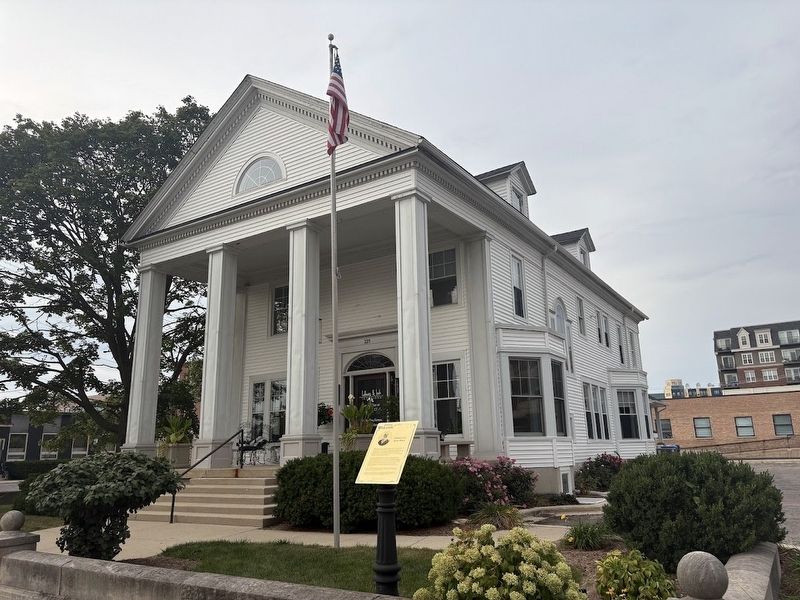
Marcellus Ephraim Jones built this handsome home in 1865. It originally stood at the southwest corner of Naperville Road and Indiana Street. Jones was a carpenter and house mover and held many important local public offices, serving as Township . . . — — Map (db m284804) HM
Near this site in 1832 a 100-foot square stockade enclosed by wooden pickets, with two blockhouses on diagonal corners, was built. Here Captain Morgan L. Payne and his company of forty-five men protected the settlers from roaming Sauk Indians during . . . — — Map (db m97574) HM
The stone posts located 75 yards to the south of this sign mark the front gate of the house occupied by then-Colonel George C. Marshall, Jr. and his wife, Katherine, in 1936. Marshall lived here while serving with the Illinois National Guard in . . . — — Map (db m316200) HM
First Congregational Church of Naperville, founded July 13, 1833 is the oldest church in DuPage County and the oldest Congregational church founded in Northern Illinois. — — Map (db m290267) HM
Black Hawk War
1832
William Barber • William Brown
Civil War
1861-1865
Aseph J Adams • Eldridge Adams • William Adams • Sterlin D Akin • Andrew Allison • Valentine Andres • Charles B Andreuss • George H Apthorp • August Ashe • . . . — — Map (db m288719) WM
Battle of Virden Monument State of Illinois Coal Office
UMWA District 12
Illinois AFL-CIO
City of Virden • John E Hein • John & Sondra Narmont • Wayne & Liz Joplin • John & Jeannie Alexander
In memory of Stephen & Luriel Narmont by . . . — — Map (db m195832) HM
Craftsman style bungalow built for Albert Franklin Swinson (1883-1954), native of Sampson County, clerk with the Atlantic Coast Line Railroad; and wife, Mary W. Blair (1888-1934). Purchased in 1945 by Harry Francis Snow (1903-1980), native of Dupage . . . — — Map (db m266108) HM
First woman elected to the Illinois General Assembly
"Not until our own time was the phrase 'We the People'
changed to include women."
-First Inaugural Address
January 4, 1923
Lottie Holman O'Neill was born on November 17, 1878, in . . . — — Map (db m270339) HM
John Dudley was born February 25, 1758 in Old Saybrook, Connecticut. In 1776 at the age of 18, he enlisted in the New Hampshire militia and served at Fort Ticonderoga in Colonel Reed's Regiment. There Dudley and the rest of the American troops . . . — — Map (db m230990) HM WM
As early as the 1830's slaves made their way to freedom crossing through Illinois on their way north to Canada. They traveled on the Underground Railroad. Downers Grove historians Montrew Dunham and Pauline Wandschneider tell us "The Underground . . . — — Map (db m270475) HM
Belmont Prairie was just a field where the neighborhood kids played until it was "discovered" in the 1970s. A nearby neighbor turned in a photography assignment that caused his instructors to ask where he took the shots. Botanists and ecological . . . — — Map (db m270267) HM
Before and during the Civil War, thousands of freedom seekers fled northward to escape bondage. Aided by abolitionists and other sympathetic allies, these men, women, and children often traveled by night on foot or by wagon, boat, or train. By day . . . — — Map (db m286023) HM
This arched gateway, located in Villa Park, Illinois, marks the beginning of the Great Western Trail that extends for 12 miles through DuPage County. The trail was constructed on an abandoned spur of the Chicago Great Western Railway. The spur, . . . — — Map (db m244829) HM
Stephen J. Scott was the first settler on the confluence land after the US Government surveyed it. The Scott cabin's cistern (underground water storage) was discovered just south of the commemorative plaque.
Where Did the Scotts Come . . . — — Map (db m308676) HM
This wildlife refuge is a memorial to Robert and Ada McKee, whose life goal was to preserve for all of us the finest woods and wetlands of DuPage County. Robert McKee served as the district's first superintendent from 1932-1962.
Robert and Ada . . . — — Map (db m275050) HM
Early Path Beginnings…
At age 70, May Watts wrote a letter to the editor of the Chicago Tribune, published on September 25, 1963 that began:
"We are human beings. We are able to walk upright on two feet. We need a footpath. . . . — — Map (db m255159) HM
In 1841, Dr. Elijah Smith of New Jersey, Itasca's founding father, first came to the area which would one day become the Village of Itasca. On the initial leg of his journey, he experienced train travel as he went west to the city of Detroit. From . . . — — Map (db m286405) HM
Shortly after purchasing St. James Farm, Chauncey and Marion McCormick constructed a state-of-the-art dairy barn and assorted outbuildings to support their award-winning herd of Guernseys. The herd was established in 1926, and at the time, DuPage . . . — — Map (db m288832) HM
The former DuPage County Courthouse and its clock tower, built in 1896, rise just to the south of the trail. The first courthouse on this site was quickly built in 1868, after a divisive county-wide referendum supported moving the county seat . . . — — Map (db m256811) HM
Warren Lyon Wheaton, one of the founders of the community that bears his
and his brother Jesse's name, built his home on this site in 1848. Though no
longer evident, the original home has been incorporated within this much
larger structure.
. . . — — Map (db m230989) HM
These two statues, one symbolizing agriculture and the other industry, once stood over the main entrance of the Board of Trade Building built in 1885. The statues greeted commodity traders and the public for 45 years. Thought lost forever when the . . . — — Map (db m47760) HM
In honor of the citizens of Downers Grove buried here and elsewhere who served in the Civil War (1861-1865)
Buried Here at Main Street Cemetery
William H. Attwood, 156th Illinois Infantry, Co. D • Isrel L. Blackburn, 124th US Colored . . . — — Map (db m269222) HM WM
Son of John P. and Mary C. Cotes
Born 1836
Pvt Comp B, 105th Ill Vol Inf
Civil War
Died at Murphysboro, Tenn.
July 25, 1863
Age 26 yrs — — Map (db m270615) HM WM
Famous Masons
Winston Churchill • Davey Crockett • Benjamin Franklin • John Glenn • Douglas MacArthur • Wolfgang Mozart • Audie Murphy • Arnold Palmer • Paul Revere • Theodore Roosevelt • Harry S. Truman • John Wayne
Famous Naperville . . . — — Map (db m286388) HM
Here stood
Pre-Emption House
Tavern of pioneer days
Built by George Laird in 1834
Inn for travelling merchants and horsetraders
Wayside station for marketbound settlers
Center of gay social life of country round about
. . . — — Map (db m257266) HM
This monument was erected by the DuPage County Centennial Association to commemorate the first centennial of DuPage County. The monument stands on the site of the first DuPage County Court House. Here was the seat of the county government until . . . — — Map (db m290288) HM
"We are human beings. We are able to walk upright on two feet. We need a footpath. Right now there is a chance for Chicago and its suburbs to have a footpath, a long one."
Exerpt from the May Watts letter to the editor of the . . . — — Map (db m288776) HM
Abraham Lincoln was 30 years old in 1839, Storytelling and humor defined Lincoln's reputation as he grew from chopping wood, storekeeping and "riding" the Eighth Circuit, to leading a divided nation. He and Joe Naper, our city's founder, served in . . . — — Map (db m290309) HM
Founded in 1830 by Stephen J. Scott, his wife, Hadassah, son, Willard Sr., and other children in the family.
While on a hunting trip with his son Willard Sr., Stephen J. Scott discovered the DuPage River near what is now Plainfield. Impressed . . . — — Map (db m308677) HM
Home of the first settler of DuPage County. A flowing spring attracted Bailey Hobson to come from Indiana to build a cabin in 1830 and a home in 1835. Hobson was a farmer, miller and soldier in the Black Hawk War.
The mill site, now . . . — — Map (db m234774) HM
[Front side:]
We resolve that these dead shall not have died in vain
Honor • Gratitude
[Plaque on rear side:]
We resolve... "that these dead shall not have died in vain"
Black Hawk War 1832
Brown, Wm.
Mexican War 1847-48 . . . — — Map (db m257064) WM
This land was home to the Potawatomi people before they were pushed out by waves of United States settler encroachment, federal policies of indigenous removal, and treaties negotiated under threat of military action. In this area, 1832, was a key . . . — — Map (db m257030) HM
The ridge you see along the opposite bank of Salt Creek was put there 10,000 years ago by the Wisconsin Glacier.
Near the end of the Ice Age, the Wisconsin Glacier expanded south and west into northern Illinois, pushing rock and soil along . . . — — Map (db m264862) HM
North American Bison
• The North American bison is the largest mammal found on this continent. An adult bison can weigh between 1,800 and 2,400 pounds.
• The North American bison is the national mammal of the United States, having . . . — — Map (db m291403) HM
Much of the history of the Old Dutch Mill is lost in the past. It is known, however, that construction was started in 1847 by Frederick Fischer and was finished in 1850 on the site on which it now stands.
When the property was purchased in 1925 . . . — — Map (db m257832) HM
Dedicated with grateful reverence to the men and women of Du Page County
This tract is part of the original grant to the first white settler, Bailey Hobson.
These millstones are from the Hobson Mill built on this site in 1834, one of the . . . — — Map (db m305063) HM
Naperville's geographical history is whimsically depicted on the thirty-six sculpted bronze squares embedded here. The artist has created a puzzle for viewers as they search the topographical map for familiar landmarks. A covered wagon represents . . . — — Map (db m257182) HM
Lester W Weber
Company M, 3rd Battalion,
7th Marines
1st Marine Division
United States Marine Corps
February 23, 1969
Republic of Vietnam — — Map (db m288853) HM
The Ben Fuller House is one of, if not the oldest surviving buildings in DuPage County. The farmhouse was built sometime between 1835 and 1842 by Benjamin Fuller, one of DuPage County’s earliest settlers. Mr. Fuller reportedly arrived to the area . . . — — Map (db m48058) HM
Thin black lines indicate changes in relevance. Between each pair of lines entries are ordered geographically but all have the same relevance.
* Inflectional forms of words are their plurals, singulars, and possessives as well as gramatical tenses and similar variations.