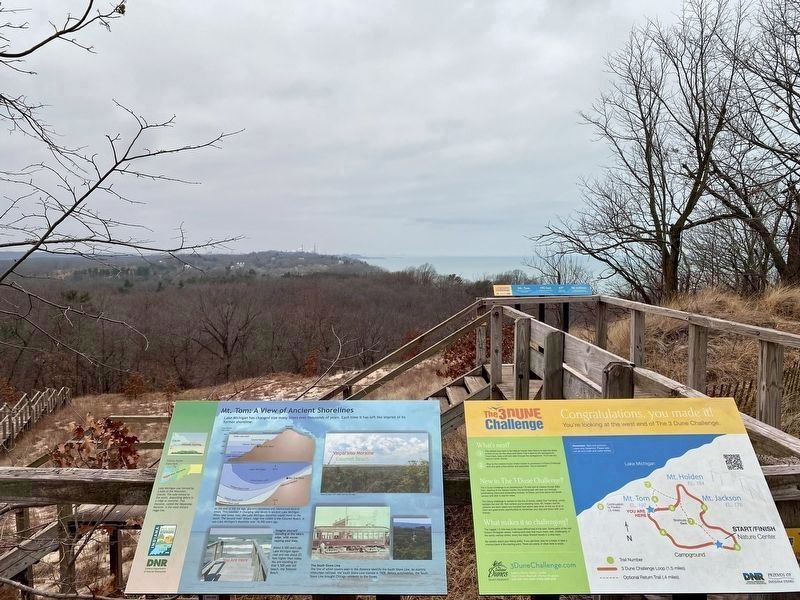
Lake Michigan has changed size many times over thousands of years. Each time it has left the imprint of its former shoreline.
Lake Michigan was formed by a lobe of the Wisconsin Glacier. The lobe halted to the south, depositing debris in a ridge . . . — — Map (db m254907) HM
In 1997, restoration began on Coffee Creek. The goal was to slow erosion and provide habitat for wildlife. Over 2,000 feet of stream bank has been restored and the health of the creek and the creatures who live here have increased dramatically. . . . — — Map (db m270994) HM
The Brown Mansion is an example of the Queen Anne style of domestic architecture that flourished in England and American during the late 1800s.
An Englishman by birth, George Brown immigrated to New York in 1852 at the age 25. Attracted by the . . . — — Map (db m152860) HM
This sign honors the dedication and vision of the people who were instrumental in the creation of Indiana Dunes State Park. Each saw the park from their own perspective, experiences, and emotional connections, but all played a role in the creation . . . — — Map (db m312675) HM
They came in peace
LCPL James R. Baynard USMC
LCPL Danny R. Estes USMC
ETC(SW) Michael W. Gorchinski USN
2nd Lt Maurice E. Hukill USMC
HM2 George N. McVicker II USN
SSGT Thomas P. Thorstad USMC
Dedicated to our Indiana men killed . . . — — Map (db m268622) WM
Front of memorial:
To the veterans who
served their country
we dedicate
this memorial to their
noble deeds and to the
everlasting memory of
their courage and
sacrifice
May we pause in silent
prayer of gratitude
Back of . . . — — Map (db m267750) WM
The 650-foot section of Dunes Creek in front of you has been restored to improve habitat, water quality and recreational experiences.
Dunes Creek has a watershed that encompasses 7,407 acres of the surrounding landscape. State and national park . . . — — Map (db m296477) HM
Honoring all who served
Martin Aaron Korean • Raymond Ambrose WWII • James F Bapst WWII • George Barnard Civil War • John H G Bayles Civil War • Walter Bratt Civil War • Jerry Braginton Korean • William Brincka WWII & Korean • Charles Brown . . . — — Map (db m269460) WM
In 1925, Indiana Dunes became a state park due to the efforts of the Prairie Club of Chicago. Today, ongoing conservation projects allow the park to continue as an important ecological site. This boardwalk is such a project.
Fluctuating water . . . — — Map (db m270649) HM
You are entering a remnant of the Great Marsh that once extended from Gary to Michigan City. The marsh was a nursery for waterfowl and other wildlife.
The Great Marsh is the low area between two ancient shorelines of Lake Michigan. . . . — — Map (db m300173) HM
This propeller from the J.D. Marshall is a reminder of the
dangerous power of Lake Michigan storms. On June 11,
1911, the J.D. Marshall sank 300 yards offshore from the
Beach Pavilion.
The J.D. Marshall was a steamship, designed to haul . . . — — Map (db m278989) HM
Over 11 square miles of marshes, savannas, oak forests, and other landscapes drain into Lake Michigan
at this point.
You are standing in the Dunes Creek watershed which drains into Lake Michigan and
encompasses all of the Indiana Dunes . . . — — Map (db m161460) HM
In plant succession, one plant community replaces another, until finally a stable community develops. Moving inland from the beach, more plant species appear.
In 1896, Dr. Henry Cowles, University of Chicago, began bringing his students here. . . . — — Map (db m261808) HM
Alice Mabel Gray, known as "Diana of the Dunes" of regional folklore, had a free spirit and love for the Indiana Dunes that propelled her to make the wild shoreline her home for nine years.
In the early 1900s, shanties rather than beach . . . — — Map (db m306415) HM
Diana of the Dunes, born Alice Mabel Gray, shunned the 1900s conventional world, choosing instead to live in the remote coastal dunes of Indiana. Her free spirit and love for the region created a lasting impression in these sands.
Diana's . . . — — Map (db m306426) HM
Unlike the ultra-modern homes of steel, stone, and glass constructed for the Century of Progress, the Cypress Log Cabin provided a refreshing contrast in terms of the material it was constructed with and its rustic design. Sponsored by the . . . — — Map (db m260190) HM
Real estate developer Robert Bartlett purchased five demonstration houses from the 1933-34 Chicago World's fair. He moved four of the Century of Progress
Homes by barge across Lake Michigan to Beverly Shores and one by truck. These houses . . . — — Map (db m161344) HM
Intended as a showcase of modern design and
innovative building materials, this house played a
pioneering role in the development of passive solar
heating. This was much to the surprise of its Chicago
architect, George Fred Keck.
One cold . . . — — Map (db m161342) HM
Walter Scholer, an architect from Lafayette, Indiana,
known for designing many buildings on Purdue
University's campus, designed the Wieboldt-Rostone
House. This Century of Progress Home was created to
showcase Rostone, an exciting new . . . — — Map (db m161337) HM
The Armco-Ferro House, designed by Robert Smith, Jr.,
of Cleveland, Ohio, was an ode to the virtues of porcelain enamel and steel-expressed in the form of a prefabricated home.
It is the only remaining Century of Progress home that met the . . . — — Map (db m161339) HM
"In a sense, this Florida house is a manifesto for the whole sub-tropical world or for any place where open air living is desirable, for it is a house which brings the
indoors out and the outdoors in."
Raley, Dorothy . . . — — Map (db m260191) HM
"I don't think you're a great gardener until you are passionate."
-William Brincka
If anyone should know what makes a great gardener, it's William Brincka. A professor at the Art Institute in Chicago for more than 30 years, Brincka . . . — — Map (db m269428) HM
"Part of my personality does things on a grand scale. I can't have just one friend—everyone has something different to offer. It's the same with plants. One hosta doesn't say 'hosta' to me. I want to know all their faces."
-William Brincka . . . — — Map (db m269628) HM
This area reflects the harmony of both wet and dry ground, a living ecosystem that Basil Cross nurtured with devotion. Each late autumn, he meticulously cut the plants back in small pieces to ensure the wildflower seeds would find light and . . . — — Map (db m300008) HM
Steel and wood ski jump with adjustable height and length was built here for Ogden Dunes Ski club, incorporated in 1927 to promote winter sports. Five annual events with international competitors were held 1928-1932, with 7,000 to 20,000 spectators. . . . — — Map (db m64162) HM
This plaque, in honor of our pastor the Reverend Carl F. Mengeling, is placed here by the grateful members of Nativity of Our Savior Parish to commemorate the silver jubilee of his ordination to the holy priesthood.
Under his leadership as our . . . — — Map (db m293404) HM
Founding Pastor
Nativity of Our Savior Catholic Church
First parish founded in the Diocese of Gary
Born: February 25, 1919 in Fort Wayne, IN
Ordained Priest: June 15, 1946
Died: April 30, 2005
Pastor of Nativity of Our Savior . . . — — Map (db m293401) HM
As railroad lines expanded through U.S., conflict occurred between competing lines. Michigan Central Railroad, with track in Porter County since 1851, briefly defied state militia and court orders (1874) to allow Baltimore and Ohio Railroad to cross . . . — — Map (db m64164) HM
Following the 1929 stock market crash, almost 18 million people became unemployed. Two million became homeless. Newly elected Franklin D. Roosevelt implemented emergency measures, among them the Civilian Conservation Corps (CCC). . . . — — Map (db m254915) HM
Opened to traffic by the Dunes Highway Association, November 14, 1923.
A.S. Hess, President
W.E. Jewell, Vice President
O.B. Johnson, 2nd Vice President
Z.B. Campbell, Treasurer
W.K. Greenebaum, Secretary — — Map (db m10762) HM
The design on the firepit is taken from traditional Myaamia ribbonwork patterns. Ribbonwork is a sewing art originally made with silk ribbons. In the mid-1700s, we began getting silk ribbons in trade. At first, we sewed them in lines on our . . . — — Map (db m299156) HM
Change is the best word to describe the Bailly Homestead since 1822. In the 1820's when the Potawatomi Indians brought their beaver pelts by canoe to trade with Joseph Bailly, the main house was yet to be built. Made of white oak logs with . . . — — Map (db m306274) HM
1800
1822 - Joseph Bailey's arrival to set up fur trading along the Little Calumet River, railroads, a race track, a mineral spa, and brick factories have all played a part in the ever changing face of the Town of Porter.
1826 - The Treaty . . . — — Map (db m254776) HM
First white settler in Porter County, coming with his family in 1822, making a permanent home in the woodlands on the bank of the Little Calumet. — — Map (db m267193) HM
Indiana Dunes Tourism and the National Park Service acknowledge with great respect that the Indiana Dunes are within the traditional lands of the Bodéwadmik / Potawatomi and Myaamia / Miami Peoples past and present.
We honor with gratitude the . . . — — Map (db m299129) HM
On this site stood the former Dunes Park District Headquarters of the Indiana State Police. The two-story, brick facility was constructed and opened in 1937 as part of the federal WPA (Works Progress Administration) initiative started by President . . . — — Map (db m202846) HM
Composed of infantry regiments from Indiana, Wisconsin, and Michigan, the Iron Brigade fought with Army of the Potomac during the Civil War (1861–1865). Received name for valor at battle of South Mountain, Maryland (1862). Sustained combat . . . — — Map (db m202747) HM
At Le Petit Fort, near this site, a battle was fought on December 5, 1780, between American forces under command of Lt. Thomas Brady and Jean Baptiste Hamelin and British forces under command of Dahreau de Quindre. — — Map (db m206530) HM
Dedicated to the honor of the men and women who served our country in World War II •
Dedicated to the honor of the men and women who served our country in Vietnam War •
Dedicated to the honor of the men and women who served our country in . . . — — Map (db m267324) WM
Although Indiana became a state in 1816, northwestern Indiana was essentially a wilderness when Joseph Bailly arrived in 1822 from Michigan with his wife Marie and their children to build their homestead. The 500,000 acre Kankakee Marsh, located . . . — — Map (db m306272) HM
J.D. Marshall Propeller
This propeller is from the steam barge J.D. Marshall. It weights over 4,000 pounds! It was made in 1891 and has 4 blades. Modern boats use a 3-blade propeller for improved efficiency with decrease of horsepower. . . . — — Map (db m267110) HM
Indiana Dunes State Park exists in part because of the efforts of the Prairie Club. This fountain was donated to the State of Indiana in 1932 by the Prairie Club in thanks for the State's decision to create Indiana Dunes State Park. . . . — — Map (db m254903) HM
When rain falls on hard surfaces like parking lots, roads, and rooftops, it becomes stormwater runoff that flows quickly across land, into storm drains, and then to streams, rivers, and eventually Lake Michigan.
This area of natural drainage . . . — — Map (db m307452) HM
Swedish immigrants played an important role in northwestern Indiana. During the 1850's, many Swedes came from Chicago to work at the local sawmill. By the 1860's, they were purchasing land for farming, and working for local businesses.
The . . . — — Map (db m260277) HM
Joseph Bailly, one of the first settlers in northwest Indiana, arrived here with his family in 1822. He chose this site to establish his trading post because it was on the Little Calumet River. It was also near two major
Indian trails, the Lake . . . — — Map (db m260283) HM
Indiana Dunes' beaches are home to spectacular sunset views, including Chicago's distant skyline 32 miles away.
Willis Tower (formerly Sears Tower)
The Willis Tower's antennas are normally white, but change colors in March, May, July, . . . — — Map (db m280292) HM
The 154.5 foot steamship J.D. Marshall was built in 1891 to haul lumber. She was later converted to collect and transport sand. Fully loaded, she sprung a leak and sank in a storm on June 11, 1911. Three crewmen were trapped below deck and drowned. . . . — — Map (db m278985) HM
Born 1899 in Illinois, Teale became an influential naturalist, author, and photographer who won 1966 Pulitzer Prize for his book Wandering Through Winter. Teale wrote that boyhood summers and holidays spent near here at his grandparents' . . . — — Map (db m202711) HM
149 entries matched your criteria. Entries 101 through 149 are listed above. ⊲ Previous 100