677 entries match your criteria. Entries 401 through 500 are listed.⊲ Previous 100 — Next 100 ⊳
Quakerism Historical Markers
This series is on the history of Quakers (The Religious Society of Friends), including notable Meeting Houses, burial grounds, individuals, settlements and schools.
This series is not about things named after Quakers but are not related to Quakerism, such as Quaker State Oil or Quaker Oats.
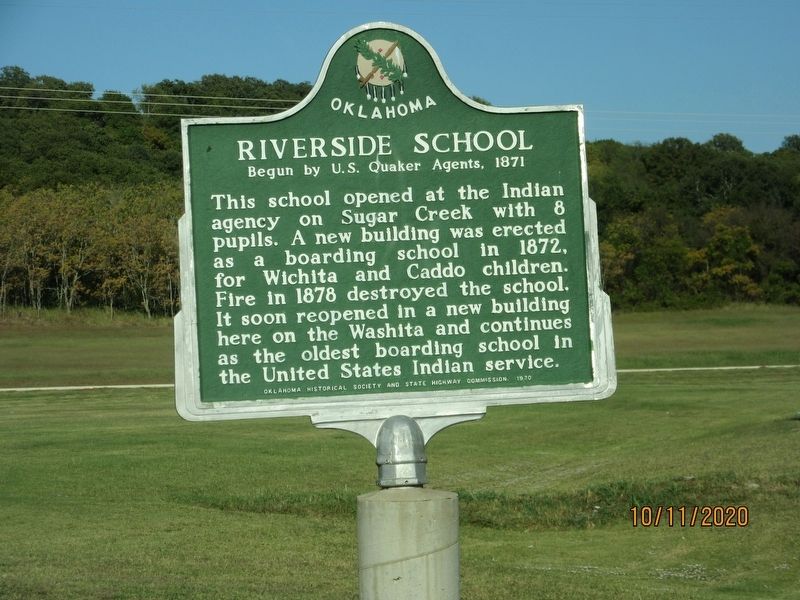
This school opened at the Indian agency on Sugar Creek with 8 pupils. A new building was erected as a boarding school in 1872, for Wichita and Caddo children. Fire in 1878 destroyed the school. It soon reopened in a new building here on the Washita . . . — — Map (db m166713) HM
Agriculture has always been a part of the culture of the South Mountain area. Settlers were originally drawn to a wild land to cultivate the soils and raise crops, and today agricultural and community leaders to work together to inspire a new . . . — — Map (db m284665) HM
The Historic South Mountain Fruit Belt encompasses about 20,000 acres and forms a fertile crescent (half moon shape) covering the southeastern slopes of South Mountain in the western half of Adams County. The soils are deep, well drained and . . . — — Map (db m159877) HM
Founded 1681 by William Penn as a Quaker Commonwealth. birthplace of The Declaration of Independence and The Constitution of The United States — — Map (db m8055) HM
Founded 1681 by William Penn as a Quaker Commonwealth.
Birthplace of
The Declaration of Independence
and
The Constitution of the United States — — Map (db m95201) HM
Townsend was founder of an early iron business in county. Being of Quaker stock, he was an active abolishonist. His home built in 1835, was an important stop on the underground railroad before and during the war between the states. — — Map (db m50283) HM
Founded 1681 by William Penn as a Quaker Commonwealth. Birthplace of The Declaration of Independence and The Constitution of the United States — — Map (db m91128) HM
Top Marker
Friends Cemetery
Founded 1794
Originally 6 acres of ground was purchased from William Webb, Frederick County, Maryland, for 15 shillings per acre, August 30, 1794, by "Members of the Society of People called Quakers to . . . — — Map (db m114345) HM
Established 1725 as Oley; name changed to Exeter, 1742. Present stone meeting house built 1759 near site of two previous log structures. Buried here are members of the Boone, Ellis, Hughes, Lee, and Lincoln families. Meetings discontinued 1899; . . . — — Map (db m296063) HM
Connecting Progress and History
In 1690, there were few navigable inland waterways in the Quaker colony established by William Penn. Penn recognized the need for a route by which to access and settle the lush countryside and harvest its . . . — — Map (db m160655) HM
Walking a labyrinth has been a spiritual practice in
many faith traditions, including Christianity, for
centuries. Distinctive labyrinths grace the
transepts of the 13th century cathedrals of
Chartres, Reims, and Amiens in France, where
they . . . — — Map (db m277629) HM
Bristol Friends Meetinghouse, built between 1711 and 1713, is the oldest
building in Bristol Borough. Built of brick, it survived the great fire of 1724
that destroyed most of the town's other earliest structures.
English Quakers settled . . . — — Map (db m277624) HM
This prison cell is modeled on a cell from the old Bucks County Jail, the former occupant of this site. Designed by the noted Philadelphia architect Addison Hutton, the jail was built in 1884 and was based on Quaker ideas of reflection and . . . — — Map (db m114616) HM
The first Falls Meeting House
built here in 1690
on 6 acres given by
Samuel Burges
The second House, 1728
The third, present, house, to left, 1789
The fourth, present, house, to right, 1841
Here
William Penn
attended and . . . — — Map (db m30601) HM
One of the first places settled in Pennsylvania, this village has retained a great many of the fine houses of its provincial period. The Friends Meeting organized in 1683 was attended by William Penn in 1701. The original building of 1692 stood near . . . — — Map (db m160197) HM
Buried here are soldiers who died from wounds suffered in the two Battles of Trenton, Dec. 1776-Jan. 1777, and from disease incurred during the harsh winter. After the battles, Washington's troops occupied four hospital buildings in this village, . . . — — Map (db m23446) HM
Quaker Samuel Moon resided here in the late 1700s and early 1800s. As a well known carpenter, he was particularly skilled in making Windsor chairs. This celebrated and prized antique originally served a functional role in public buildings and . . . — — Map (db m30610) HM
Founded 1681 by William Penn
as a Quaker Commonwealth.
Birthplace of
The Declaration of Independence
and
The Constitution of
the United States. — — Map (db m28401) HM
Famed primitive artist. His subjects included farmscapes & Biblical scenes; he painted more than fifty versions of The Peaceable Kingdom, based on a prophecy of Isaiah. Also a coach & sign painter; a Quaker preacher. Lived here on Penn . . . — — Map (db m32066) HM
Edward Hicks (1780-1849), son of Isaac and Catherine Hicks, was a Quaker minister, sign painter and folk artist, most famous for over sixty versions of his Peaceable Kingdom paintings. Born in Langhorne, his mother died when he was young, . . . — — Map (db m32316) HM
Newtown Friends Meeting is an active place of worship for approximately 250 area Quakers. Newtown Meeting was co-founded by Quaker minister, sign painter and folk artist Edward Hicks, now highly acclaimed for his renditions of The Peaceable . . . — — Map (db m32212) HM
Quaker businessman and abolitionist. Moore made his home a safe house for freedom seekers traveling on eastern Pa. routes of the Underground Railroad. One was Christiana Riot participant William Parker. Over three decades Moore assisted about 600 . . . — — Map (db m139892) HM
Prominent authority on astronomy and author of more than one hundred books and articles. Sitterly was a career physicist with the Bureau of Standards, U.S. Department of Commerce. She received the American Astronomical Society award in 1937 and was . . . — — Map (db m51270) HM
Shortly after William Penn and English Quakers began arriving here in
1682, Penn gave his daughter a 15,000 acre tract named "Letitia's Manor".
It was later divided into smaller tracts and one of those was Kennett
Township, named after a . . . — — Map (db m293003) HM
Indian Hannah The last of the Indians in Chester County was born in the vale about 300 yards to the East on the land of the protector of her people the Quaker assemblyman William Webb Her mother was Indian Sarah and her grandmother . . . — — Map (db m240065) HM
Quaker abolitionists, the Mendenhalls harbored freedom seekers on the Underground Railroad in their nearby home, Oakdale. Originally members of Old Kennett Meeting, which became divided on the issue of slavery, they helped found Longwood Progressive . . . — — Map (db m146700) HM
An early female scientist considered one of the best educated female naturalists of her day, Lewis dedicated her life to the study of botany and zoology. She exhibited her Chart of the Animal Kingdom at the Centennial Exposition in 1876, and won . . . — — Map (db m84957) HM
During the Battle of the Brandywine on September 11, 1777, the American Army used the walls of this Quaker Burial Ground in their first line of defense. Both armies used this meetinghouse of Quaker pacifists as a hospital. Behind the wall is the . . . — — Map (db m191732) HM
Gilbert Cope, eminent genealogist and historian, was born in the house on this property. Author of a number of genealogies of Chester County families, he was dedicated to the preservation of Quaker records and of the archives of Chester County. . . . — — Map (db m42519) HM
Born a Quaker, Barnard became a member of the Progressive Friends movement and upheld its active affirmation of the ideals of temperance, equality of women, and abolition of slavery. His farm became a station on the Underground Railroad. He and his . . . — — Map (db m42520) HM
A pioneer physician and educator, in 1860 Preston founded the Woman's Hospital of Philadelphia, where she later established one of the nation's first nurses’ training schools. A graduate of the Female Medical College of Pennsylvania, she became its . . . — — Map (db m72326) HM
Originally called Pennville, the Grampian Hills P.O. served the area (1833-1892) when it became Grampian. The first county rural mail delivery started here in 1900, carrier E.A. Spencer. In the 1820s Quaker pioneers built a log meeting house at the . . . — — Map (db m106659) HM
The nearby friends meeting-house, built about 1775, was the place of worship for early Quaker settlers among the pioneers of this region. Catawissa itself was laid out by William Hughes, a Berks County Quaker. — — Map (db m46230) HM
The oldest town in Dauphin County; laid out in 1755 by George Fisher, Quaker. It was an important port at the junction of the Pennsylvania and Union Canals in the 19th century. Site of early flour, lumber, and iron industries. — — Map (db m7165) HM
Chichester Meeting for Worship was established in 1682 and began holding monthly meetings in 1684. The current unimproved fieldstone meetinghouse was built in 1769 and replaced an earlier c. 1688 log structure that was destroyed by fire. A . . . — — Map (db m157344) HM
Upper Chichester Township. “Chichester Liberty” was established in 1683 by William Penn. Upper Chichester Township separated from Lower Chichester Township in 1759.
The Upper Chichester area was claimed both by the Swedes (1643) . . . — — Map (db m154914) HM
Built by noted Quaker, Jonathan Maris, c. 1750, this fieldstone farmhouse retains many early features such as a walk-in cooking fireplace and six corner fireplaces. The property was purchased by Robert Culbertson after the civil war and remained . . . — — Map (db m159613) HM
Founded 1681 by William Penn
as a Quaker Commonwealth.
Birthplace of
The Declaration of Independence
and
The Constitution of
The United States — — Map (db m259455) HM
Here in 1675, William Edmundson convened the first recorded meeting for worship of Friends (Quakers) within present Pennsylvania. This was at the home of Robert Wade, who in 1682 greeted William Penn upon his arrival in Chester. — — Map (db m4091) HM
First lodged in America in "Essex House" on this site October 28, 1682 the guest of Robert Wade Here the earliest Quaker settler on this side Delaware River, 1676, purchaser of the property, then called "Printzdorp," from the earlier occupant, . . . — — Map (db m14967) HM
Born at Riverview, near here, Garrett was a prominent abolitionist and Underground Railroad activist. He moved to Wilmington, DE in 1822, and sent many fugitive slaves to his brothers at Riverview, Fernland Farms, and here at Thornfield. He was a . . . — — Map (db m67355) HM
The stone gristmill at this site was built in 1704 by Nathaniel Newlin, a Quaker who emigrated from Ireland in 1683. The mill, restored to working order, is a fine example of a vital segment of Colonial economic life. — — Map (db m72347) HM
This site has been a center for Friends' activities since 1684. The older section of the current structure, since remodeled, was built in 1700 as an addition to the original log meetinghouse where William Penn worshiped in the eleventh month . . . — — Map (db m66654) HM
Located on ground that was originally part of the County Poor Farm Property in 1850. This lot was first sold in 1872 by Edward Price for $1,121. Elton B. Gifford, a Quaker merchant from Philadelphia, purchased the site in 1877 from James Farnum and . . . — — Map (db m205585) HM
In 1892, inventor Pusey received a U.S. patent for the paper matchbook. Three years later he sold his patent to the Diamond Match Company, and soon millions of matchbooks were being produced each year. A Civil War veteran and longtime Philadelphia . . . — — Map (db m71906) HM
An antiwar campaigner and women's and civil rights activist. Olmsted traveled the world on behalf of the Women's International League for Peace and Freedom. WILPF's advocacy was consistent with her Quaker beliefs. She headed the national WILPF . . . — — Map (db m187653) HM
Nathan Matlack, a Welsh immigrant, Quaker and blacksmith, bought 148 acres where in 1760 for 580 pounds. In 1782 his son, Simeon, married Elizabeth Yarnall, also a Birthright Friend. Simeon purchased this property from his father in 1788. Simeon and . . . — — Map (db m146285) HM
Site of Friends Meeting since 1686. Present building erected 1851. A school and library were established here in 1832. Benjamin West, noted American artist, attended this Meeting when he was a boy. — — Map (db m81503) HM
An English-born Quaker and lastmaker, Pusey (1651-1727) purchased 250 acres from William Penn in 1681. As agent and grist mill manager for him, and colonial office holder, he was visited by Penn here. — — Map (db m81740) HM
A center of Friends' activities since 1686. The second house, built about 1721, served as an officers' house and a hospital for Valley Forge encampment. — — Map (db m81490) HM
Founded 1681 by William Penn as a Quaker Commonwealth. Birthplace of THE DECLARATION OF INDEPENDENCE and THE CONSTITUTION OF THE UNITED STATES. — — Map (db m84902) HM
Founded 1681 by William Penn as a Quaker Commonwealth. Birthplace of THE DECLARATION OF INDEPENDENCE and THE CONSTITUTION OF THE UNITED STATES. — — Map (db m84766) HM
The 80-mile Philadelphia & Columbia Railroad was the first state-financed and constructed rail line in the U.S. (1823-1834); Pennsylvania Railroad precursor. Original cost estimate: $5,000 per mile in 1823. On completion, actual cost: $34,500 per . . . — — Map (db m177348) HM
The Friends Meeting House opposite was built in 1799. It was erected to provide a place of worship for the numerous Quaker settlers of this region — — Map (db m89953) HM
Founded 1681 by William Penn as a Quaker Commonwealth.
Birthplace of
THE DECLARATION OF INDEPENDENCE
and
THE CONSTITUTION OF THE UNITED STATES. — — Map (db m41599) HM
Founded 1681 by William Penn as a Quaker Commonwealth.
Birthplace of
THE DECLARATION OF INDEPENDENCE
and
THE CONSTITUTION OF THE UNITED STATES. — — Map (db m41603) HM
This land is part of an original tract which was granted to "the people called Quakers" by Daniel Stroud, son of Jacob Stroud, on July 25, 1811. The entire grant extended south from Elizabeth Street (Main St.) for the purpose of the "erection of . . . — — Map (db m161042) HM
The oldest Presbyterian church in Montgomery County and mother church, directly or indirectly, to ten offspring churches. Founded in 1714 by the Rev. Malachi Jones, the first pastor. The original church stood in the center of the graveyard and was . . . — — Map (db m122481) HM
Abolitionists Thomas and Hannah Atkinson and other members of Upper Dublin Friends Meeting conducted an Underground Railroad station at the farm next door. Individuals who escaped slavery are buried in the meetinghouse cemetery. Son Wilmer created . . . — — Map (db m84894) HM
Revolutionary patriot, state official, and member of Continental Congress, 1780-81. Colonel of a rifle battalion, Philadelphia Associators, 1775-76; served in Battle of Princeton. A founder, Society of Free (or "Fighting") Quakers, 1781. Member, . . . — — Map (db m23660) HM
Noted for a major role in establishing and defending an independent Vermont in 1777, he was a frontier entrepreneur, an officer of the Green Mountain Boys and in the 1775 American Revolution northern campaign. Allen was an author and principal . . . — — Map (db m23650) HM
The first religious meeting hereabout, now known as Abington Meeting of the Society of Friends (Quakers) was held here in 1683. This was the home of Richard and Joan Wall who came from Hasfield near Cheltenham England in 1682. Their granddaughter, . . . — — Map (db m38725) HM
Nearby stood “Roadside,” the home of the ardent Quakeress, Lucretia C. Mott (1793-1880). Her most notable work was in connection with antislavery, women's rights, temperance and peace. — — Map (db m22119) HM
Merion Friends Meeting House
has been designated a
National Historic Landmark
This site possess national significance in commemorating the history of the United States of America
This Meeting was established by the Merioneth . . . — — Map (db m68649) HM
One of Americas Earliest Railroads,
it was first powered by horses, later by steam. The right-of-way was on the south-side of Montgomery Avenue across from Merion Friends Meetinghouse.
This railroad was a major route for escaping slaves . . . — — Map (db m68652) HM
Continuously used since its erection in 1695 by Quakers, this Meeting House is thought to have been visited by William Penn. Welsh carpenters are believed responsible for its highly unusual cruciform architecture. — — Map (db m68646) HM
From our earliest times, the cemeteries of Pottstown have been for the most part associated with churches. The original Sprogell burying ground was an exception, as was that of the Potts, Rutter and Hobart families (although this cemetery was in a . . . — — Map (db m23851) HM
"I knew that my propensity for tools and ingenuity was great. Erskine was the Skribe and a good mechanic and excellent councellor."
— Josiah White, 1832
Josiah White was a devout Quaker . . . — — Map (db m157324) HM
In the decades following the American Revolution, the young nation's old cities began their growth into urban centers. The early nineteenth century ushered in new opportunities for development, and the city of Philadelphia assumed its position at . . . — — Map (db m193933) HM
Laurel Hill soil was broken in October 1836 to receive the remains of its first permanent resident, a Quaker woman by the name of Mercy Carlisle. While catering to the average citizen, the cemetery's founders were likewise determined to invest . . . — — Map (db m193958) HM
Landmarks
❶ [Unreadable] Hospital of Philadelphia
[Unreadable] the 1860's to train women as doctors and nurses. It is now Sarah Allen Senior Housing Project.
❷ Pennsylvania Railroad YMCA
Originally the . . . — — Map (db m211003) HM
About
At the beginning of the 19th century, Quaker philanthropist William Sansom changed the face of Philadelphia when he bought the 700 blocks of Walnut and Sansom Streets and started construction of Sansom's Row — the first row of houses in . . . — — Map (db m214203) HM
Caught between his private doubts about slavery and his public responsibilities as president, George Washington navigated a nation deeply divided over slavery. Privately, George Washington often expressed discomfort with the institution and a . . . — — Map (db m306989) HM
Founded by Philadelphia Quakers in 1689 and first chartered by Penn in 1701, it was Pennsylvania's first public school and is the oldest continuously operating Friends school in the world. Pioneering educational initiatives were based on public . . . — — Map (db m191909) HM
Here in 1688, at the home of Tunes Kunders, an eloquent protest was written by a group of German Quakers. Signed by Pastorius and three others, it preceded by 92 years Pennsylvania’s passage of the nation’s first abolition law. — — Map (db m46804) HM
Established 1703. Enlarged and redesigned in 1843. Resting place of Lucrecia Mott and Robert Purvis and other 19th century leaders in the struggles to abolish slavery and win equal rights and justice for women, African and Native Americans, . . . — — Map (db m210881) HM
This burial ground is part of lands given to George Fox by William Penn in 1681 and willed by Fox in 1690 to Friends… "for a meeting house and school house and a burying place, and for a play ground for the children in the town to play on, and . . . — — Map (db m210884) HM
This burial ground is part of lands given to George Fox by William Penn in 1681 and willed by Fox in 1690 to Friends… "for a meeting house and school house and a burying place, and for a play ground for the children in the town to play on, and . . . — — Map (db m220478) HM
Established in 1703, this burial ground was part of a 16-acre land grant given to the Quakers by George Fox. He left the land for a school, a garden, a burial ground and a meeting house. During the winter of 1777, the British occupied the meeting . . . — — Map (db m220479) HM
William Penn granted this land to George Fox, the founder of the Religious Society of Friends. Among the people buried here are many Quakers and over 100 members of the Pennsylvania Abolitionist Society.
Quakers worked to end slavery as part . . . — — Map (db m220480) HM
When General William M. Reilly of the Pennsylvania National Guard died in 1896, his will established a trust fund to create bronze monuments to Revolutionary War heroes. In 1938, when the trust fund had grown large enough, work on the memorial . . . — — Map (db m191719) HM
A Quaker activist passionate about public health and education, Jeanes set up a bequest to fund a facility that became Jeanes Hospital and Fox Chase Cancer Center. She also financed the Jeanes Foundation, or Negro Rural School Fund, and appointed . . . — — Map (db m160450) HM
Built in 1768 for John Johnson. This was home to three generations of a Quaker family who worked to abolish slavery and improve living conditions for freed African Americans. In the 1850s the house was a station on the Underground Railroad. Here and . . . — — Map (db m5929) HM
Founded by Germantown Quakers in 1885. This Club joined the national Boys Club Federation in 1906 - the first member to serve an African American population. Under president John T. Emlen & executive director William T. Coleman, it earned a . . . — — Map (db m82945) HM
Germantown Friends
1688
for Emancipation
of
Slaves
Am I not a woman and a sister?
Am I not a man and a brother?
Anthony Benezet
School
All welcome
1784
Pennsylvania Hall
1838
Phila. Female Anti-Slavery . . . — — Map (db m220469) HM
The Underground Rail Road
In the years before the Civil War, there was a route that slaves could take to freedom. It came to be called the "Underground Rail Road" a secret network of safe houses or "stations" operated by "station masters", . . . — — Map (db m220470) HM
John Bartram, 1699-1777, a third generation Quaker whose family settled in the Darby community 1683. In 1728 he purchased 102 acres here and began a botanical garden. He traveled the North American English colonies collecting plants, seeds and . . . — — Map (db m214140) HM
Historic Bartram's Garden preserves the 18th century home and botanical garden of the Bartrams—America's pioneering family of naturalists, botanists, and explorers.
John Bartram (1699 - 1777) born in nearby Darby to a Quaker family, moved to . . . — — Map (db m214134) HM
Founded in Philadelphia in 1917, the AFSC has given practical expression to the faith of the Religious Society of Friends (Quakers). Its worldwide humanitarian work has reflected a commitment to nonviolence & justice. Co-recipient, Nobel Peace . . . — — Map (db m83475) HM
During World War II, some 12,000 men who were classified as conscientious objectors to war -- about fifteen percent of them from Pennsylvania -- served in non-military occupations across the United States. Under the leadership of Mennonite, Quaker, . . . — — Map (db m81958) HM
Friends Select School provides a strong, academic education to elementary and secondary school-aged children. Overseen by two Meetings of the Religious Society of Friends (Quakers), the school traces its roots to the founding of the nation’s . . . — — Map (db m107000) HM
The sustainable renovation of Friends Center is an expression of Quakers’ commitment to a responsible relationship with the earth and all of its inhabitants. The meetinghouse and office buildings were modified to reduced energy consumption, . . . — — Map (db m83477) HM
677 entries matched your criteria. Entries 401 through 500 are listed above. ⊲ Previous 100 — Next 100 ⊳