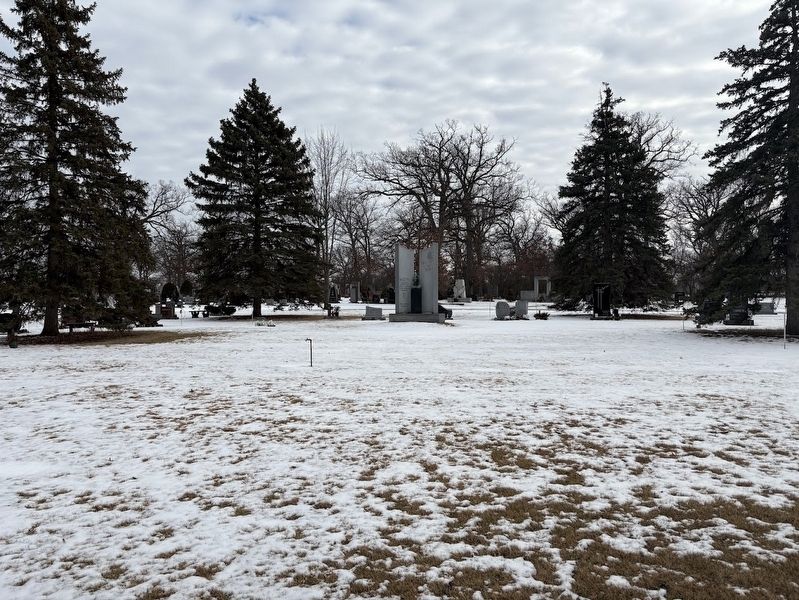
[Lithuanian language text:]
Lietuvos Respublikos Prezidentas
Tautos Žadintojas Varpininkas
Laisvės Lietuvių Tautai!
[English translation:]
President of the Republic of Lithuania
The Bell Ringer of the Nation
Freedom for . . . — — Map (db m267210) HM
Founders
Francis Broadchulis • John Chmelevski • Matthew Damijonaitis • Michael Keidanski • Walter Meilukas • John Norwaish • Joseph Skutas • Joseph Smith • Joseph Scwhitt • Adam Tauras • James Witty — — Map (db m266866) HM
Consecrated in 1904, Resurrection Cemetery was established to serve the Polish Catholic community. In 1969, the "Millennium Shrine" commemorating a thousand years of Polish Christianity was blessed by Karol Cardinal Wojtyla, who later became Pope . . . — — Map (db m265060) HM
Consecrated in 1904, Resurrection Cemetery was established to serve the Polish Catholic community. In 1969, the "Millennium Shrine" commemorating a thousand years of Polish Christianity was blessed by Karol Cardinal Wojtyla, who later became Pope . . . — — Map (db m265071) HM
Father to the Migrants
Padre del Migranti
Padre de los Migrantes
Bishop of Placenza
Apostle of Catechism
Founder of the Missionaries of St. Charles - Scalabrinians and the Missionary Sisters of St. Charles Borromeo - Scalabrinians . . . — — Map (db m255986) HM
In 1874, Ezra Carpenter Eggleston purchased 140 acres of farmland along the Chicago and Northwestern Railway so he could subdivide it, convince the train to stop there and build a town. He named his dream "Mount Prospect" because it was on one of . . . — — Map (db m315211) HM
John Conrad Moehling was a crucial force in Mount Prospect's early growth and development. The German farmer-turned-businessman was recognized by his contemporaries as a leading and progressive merchant. In 1882, Moehling purchased the first general . . . — — Map (db m315220) HM
John Meyn emigrated from Schleswig-Holstein, Germany to the United States in 1882 when he was 19 years old. He learned the blacksmith trade in Germany and had been assisting a blacksmith in Arlington Heights when, in 1885, John Conrad Moehling . . . — — Map (db m315210) HM
[English langauge tablet on the left side of memorial in front of the sculpture:]
Monument in honor and memory "Golgota of the East"
Dedicated to the martyrdom of Poles who gave their lives for the Fatherland-hostages of the war slain in . . . — — Map (db m267937) HM WM
Consecrated in 1872, St. Adalbert Cemetery was opened to serve the growing Polish Catholic community and is the largest single cemetery within the Archdiocese in burials totaling over three hundred thousand. The cemetery is also the burial place for . . . — — Map (db m267973) HM
We are Assyrians
In God we trust
Lachen — Hormis
This memorial is erected to the greater and honor of God and in remembrance of the descendants of the great Assyrian and Babylonian Empires, known to the world as the
Garden of Eden . . . — — Map (db m245888) HM
Did you know the Chicago hot dog originates from the German frankfurter, brought to the United States by immigrants in the 1800s?
This planter contains the ingredients for classic Chicago-style relish: cucumbers, tomatoes, onions, celery, . . . — — Map (db m312090) HM
From 1840 until 1960, Schaumburg was a patchwork of family farms populated by hard-working German-Americans. Spring Valley's Volkening Heritage Farm represents the rural landscape that existed here during the 1880s when farm work was accomplished . . . — — Map (db m302166) HM
From 1840 until 1960, Schaumburg was a patchwork of family farms populated by hard-working German-Americans. Spring Valley's Volkening Heritage Farm represents the rural landscape that existed here during the 1880s when farm work was accomplished . . . — — Map (db m302167) HM
The Tinley Park United Methodist Church has a long history in the community, maintaining at least two churches for many years.
The older congregation dates to 1858 and was originally known as the New Bremen Religious Society. They had erected a . . . — — Map (db m263829) HM
This house, seen to the right in the photo above, was hand-built in 1887 by Swedish immigrant August Ekdahl. For over 100 years, this small frame house has contributed to the cultural and economic heritage of Western Springs. This house has served . . . — — Map (db m257029) HM
Western Springs, officially incorporated in 1886, was emerging from its frontier days when this house was built, and much of the land was shifting from farmland and prairie to residential houses and businesses. Ekdahl's shop was located across . . . — — Map (db m257025) HM
This circular stone seating area provides a quiet place to stop and take in the serenity of nature. A signature element of landscape architect Jens Jensen (1860-1951), a council ring is intended to suggest communication and friendship without . . . — — Map (db m277539) HM
This circular stone seating area provides a quiet place to stop and take in the serenity of nature. A signature element of landscape architect Jens Jensen (1860-1951), a council ring is intended to suggest communication and friendship without . . . — — Map (db m277540) HM
This circular stone seating area provides a quiet place to stop and take in the serenity of nature. A signature element of landscape architect Jens Jensen (1860-1951), a council ring is intended to suggest communication and friendship without . . . — — Map (db m277831) HM
Built in 1865 as the Zion German Presbyterian Church on Dundee Road near Milwaukee Avenue and used as a church until 1962. Relocated in 1968 to this present site and preserved as a historical reminder of the past by Wheeling Historical Society and . . . — — Map (db m277833) HM
Polish Inscription
Płk Antoni Skarbek-Szacki
"Bohun", "Dąbrowski"
Legendarny Dowodca Brygady Świętokrzyskiej NSZ
Urodził sję 1 marca 1902 r. w Wilnie.
W 1919 r, . . . — — Map (db m267572) HM WM
Less than a half-mile from this windmill is where Henry Holstein and his wife Louisa settled in Bloomingdale from Germany in the 1850s. Purchasing farmland near the southwest corner of Bloomingdale Road and Schick Road, they built a windmill for . . . — — Map (db m282669) HM
In 1864 the Chicago, Burlington and Quincy Railroad started passenger service from Aurora to Chicago. By 1884 there were 20 stations on the fine. The first station building at East Grove now called Fairview was built about 1890 and was of frame . . . — — Map (db m271009) HM
This two part commercial building with a store below and office space above is one of the 19th century buildings that still represents the look of old Main Street. The building with Victorian pressed brick on the front and face brick on the sides is . . . — — Map (db m271918) HM
Elmhurst College was founded in 1871 as an educational institution of the German Evangelical Synod of North America.
On October 17 1970, during the centennial homecoming, the national alumni association dedicated this marker to honor Elmhurst . . . — — Map (db m256923) HM
This house is an original Lisle farmhouse. In its 175 years of history, only two families lived in it.
The Lisle area began being populated by non-native people after the signing of the Treaty of Chicago in 1833. In 1849, Jacob and Mary . . . — — Map (db m304946) HM
The Snibley, Stenger and Olesen families farmed this land.
German immigrant Jacob Snibley brought his family to Naperville in 1835. They established a farm and built a house of locally quarried limestone on this property in the 1850s. . . . — — Map (db m305111) HM
On November 2, 1838, Olof Krans was born as Olof Ersson in Sweden. Departing from the Gefle seaport in what is now Gävle, Sweden when he was 12 years old, Olof arrived in Bishop Hill with his parents initially coming from the small hamlet of Sälja . . . — — Map (db m311399) HM
A letter was presented to the City of Galva by the Governor of Gävleborg County, Sweden in 1966 recognizing Galva, Illinois as being a sister city to Gävle, Sweden. Gävle, Sweden is the County “seat” of Gävleborgs län and where many Swede's came to . . . — — Map (db m311568) HM
The “Push” was Sweden’s economic answer to reducing its population. The “Pull” was America’s economic answer to help develop its land. In the 1840's, significant numbers of Swedish citizens began to immigrate to the United States. The “Push” to . . . — — Map (db m311398) HM
Christopher Livingston came to Loda from Ireland in the 1860's. He was the area peddler. This was his house and store which he gave to the cemetery for use as a tool shed. It was moved from town to its present location June 5, 1927. “Christy” . . . — — Map (db m303668) HM
The Atkinson Cemetery was established March 11, 1875, by James Atkinson, who granted the land as a community burial ground. The first recorded burial (1843) was of Sarah A. Short, daughter of Thomas Jefferson and Martha "Patsy" (Maddux) Short. The . . . — — Map (db m236731) HM
Esper A. Petersen founded the Esper A. Petersen Foundation in 1944
Born in Denmark, Esper came to the United States as a poor immigrant in the early 1920's. Successful in his endeavors, he wanted to share his good fortune with deserving . . . — — Map (db m307977) HM
This is the area where the first Norwegian
migrants spent the first winter in the
Fox River settlement in 1834. Across the
road is where Cleng Peterson had his famous
dream and vision of better things for his
countrymen. This resulted in . . . — — Map (db m310036) HM
Here is commemorated the 100th anniversary of the first permanent Norwegian settlement in the United States by Cleng Peerson and other pioneers from Norway. They and their descendants, who still live here have contributed largely to the development . . . — — Map (db m309627) HM
Hauge Lutheran Church
c. 1852
On May 6, 2016 was honorably placed on the
National Register of
Historic Places
by the United States
Department of the Interior
This building stands to remind us of the Norwegian pioneers who . . . — — Map (db m272439) HM
Collinsville, Illinois is proud to be the Horseradish Capital of the World, producing roughly 60% of the global supply.
Horseradish has been grown in Collinsville since the 1800s when German immigrants brought the farming practice to the . . . — — Map (db m305993) HM
Virtually every older city in America was first populated by immigrants. In Edwardsville, the Czech Hall was built in 1906 by Czechoslovakian settlers as a gym and meeting hall. In 2002, it was named to the National Register of Historic Places. . . . — — Map (db m281138) HM
The 1900 U.S. census listed the Village population at 1,300 people. Those who were foreign born include: Germany-106, Russia-58, Bohemia-57, Italy-51, England-45, Austria-20, Ireland-13, Wales-12, 17 others from Europe and 22 born in the Indian . . . — — Map (db m271238) HM
Granite City grew up a mill town, drawing its expanding population from the flood of Central European immigrants who came to this new land with not much more than their heritage and optimism, in search of freedom and opportunity.
Two German . . . — — Map (db m205771) HM
Standing 16 feet tall, this enamelware coffee pot isn't just a roadside novelty - it's a symbol of Granite City's industrial heritage. Modeled after the iconic graniteware produced by the NESCO Company, it honors the very process that gave our . . . — — Map (db m280901) HM
Standing tall at 20 feet, this muffler man isn't just a roadside icon - he's a tribute to every blue-collar worker who built the city from the ground up. Clad in a hard hat and steel-toed boots, with a lunchbox proudly marked "Made in . . . — — Map (db m288809) HM
This Celtic cross honors the memory of more
than fifty souls buried here in the early 1850s.
These immigrants from Ireland were driven
from the land of their birth by famine and
disease. They arrived sick and penniless, and
took hard and . . . — — Map (db m270566) HM
The Marbold farmstead was the central hub of the Marbold family farmland holdings, which consisted of over 4,000 acres. The original house, called Elmwood, was built in 1850 by John Marbold, a German immigrant and prominent Greenview farmer and . . . — — Map (db m267658) HM
In 1850, John Dahmer, a German immigrant, constructed this vernacular German cottage. Peter Miller bought the home in 1858 annd ran a blacksmith shop next door that provided shoes for horses and he repaired farm equipment in a shed between the house . . . — — Map (db m291321) HM
The Miller Fiege house was built was built in 1850 by Johannes Dahmer. It is a vernacular German cottage with Italianate influences; a brick house on a limestone foundation, one and a half stories in height; with segmental - arched brick lintels . . . — — Map (db m291420) HM
The rich soil and abundant food sources of the American Bottom made this area ripe for development, Native Americans living here could harvest crops, fish and wildlife from the floodplain, while gathering nuts and berries from the neighboring . . . — — Map (db m227109) HM
Colonel William R. Morrison
One of Waterloo's most renowned and distinguished citizens was Colonel William R. Morrison, to whom the city owes its library.
The library building at the corner of Library and Park Streets was Colonel . . . — — Map (db m219967) HM
St. Paul United Church of Christ, of Waterloo, Illinois, had its beginning in 1846, in response to the formation of new denomination in Europe…a merger of many churches of German Reformed and Lutheran origin into the United Evangelical Church of . . . — — Map (db m220354) HM
The first French people came to Illinois during the seventeenth century because of political instability in France. The settlers took a trail from Kaskaskia to Cahokia called the "Hill Trail" Along this trail, just south of Waterloo, is a spring . . . — — Map (db m219731) HM
The Moore family left a distinguished mark on Waterloo's history.
Some time after settlement at Bellefontaine had been made, Captain James Moore, having established to some degree amicable relations with the Indians, took steps toward . . . — — Map (db m219950) HM
(all photo captions)
• Like many in our community, Louis Sedentop made his living as a farmer. Arriving in America from Germany in 1835, he settled on eighty acres of land in Montgomery County. He married Honora Leonard in 1859 and they . . . — — Map (db m281220) HM
Son of Rev. Dr. Ozel Roe,
of Woodbridge N.J.
left New York for the West
Oct. 15, 1819,
settled in Diamond Grove
in Feb. 1820,
died Oct. 12, 1821
Aged 48 yrs.
An emigration society organized
in the City of New . . . — — Map (db m295004) HM
Ishmail Bobbitt • Constantine Clarkson • Martin Burris • Joseph Jackson
Samuel Jackson • Bourland Jolly • James Jordan • Lawrence Killebrub
Edward Moody • David McPeeters • John Robertson • Elisha Smith
William Scott • . . . — — Map (db m287385) WM
New Philadelphia Soldiers
Soldiers known to have lived in the town of New Philadelphia:
William H. Austin. Co. K, 16th U.S. Infantry.
Clark P. Beebe. Co. K, 99th Illinois Infantry. Killed in service.
Harrison Brown. Co. K, . . . — — Map (db m302487) HM
The New Philadelphia community was racially and ethnically integrated. Americans of both African and European descent came from Kentucky, Virginia, Missouri, Pennsylvania, Ohio, Delaware, New York, and the New England states.
[Inset township . . . — — Map (db m302477) HM
The historic village of Prairie du Rocher was established in 1722 by French settlers. It was named Prairie du Rocher, which means "Prairie of the Rocks", referencing the bluffs that surround the area. This area was an ideal place to settle due to . . . — — Map (db m224238) HM
From its earliest days, Springfield has always been a multicultural community some of the city's earliest residents were enslaved African Americans brought to Springfield in the 1820s. Later, the city was home to an ever-expanding list of ethnic . . . — — Map (db m285789) HM
Born in Frankfurt am Main, Germany, Bunsen fled to St. Clair County in 1834 after participating in a failed revolt. He farmed with other Latin Farmers and taught school. He was elected a delegate to the Illinois Constitutional Convention of 1847. . . . — — Map (db m208519) HM
A native of Rhenish Bavaria, Henry Kaysing settled in Belleville in 1834. After careers as a butcher and a flour and feed store owner he retired in 1868 and constructed this two-story building as a rental. From the 1870s to the 1890s it housed . . . — — Map (db m262548) HM
During 1855-1856 Jacob Maurer from Hesse Darmstadt, Germany, constructed a three-story building with two ground-floor storefronts and residences above. He opened for business in 1856, selling hardware on the west side of the building and dry goods . . . — — Map (db m265754) HM
Two generations of Moehles shod horses and mules at this location. German immigrant Vollrath Moehle established a blacksmith shop after serving in the Civil War. His son, Walter Moehle, constructed this building in 1908 with a blacksmith shop on the . . . — — Map (db m262547) HM
Between 1880 and 1920, nearly 24 million immigrants arrived in the United States. Many found work in the mines, mills, and factories of America's rapidly expanding industrial sector.
In 1913 American Zinc, Lead and Smelting Company . . . — — Map (db m167916) HM
This nature trail was officially completed in October 2006. The Stemler family emigrated from Nordenstadt Germany in 1832. This trail traverses much of the original family homestead, and the first family home, a log cabin, can still be seen just . . . — — Map (db m305386) HM
Born in Angelbachtal, Baden-Wurttemberg in present-day Germany, Hecker studied law at the University of Heidelberg.
Hecker was one of the leaders who championed for democratic reforms in the 1848 uprisings in Germany. Like many other . . . — — Map (db m228249) HM
Dutch culture is alive and well in Fulton. Fulton's Dutch heritage dates to its earliest days and the arrival of the first Dutch settlers.
The First Arrivals
In 1856, Thomas Smith became the first of many Dutch to settle in Fulton. . . . — — Map (db m230369) HM
George Kiser, an African-American, moved to Joliet from Missouri in the early 1900s. A laborer at the Joliet Iron Works, he worked in noisy, hot and dangerous conditions. The mill employed workers from all over the world - migrants from the south . . . — — Map (db m158086) HM
Exceptional in its historical detail and social conscience, this mural honors the canal and quarry workers who literally helped build the 'City of Stone' in the 19th century. Depicting the lives, struggles, and families of the men who moved earth, . . . — — Map (db m304204) HM
1830's – Ger. immigrants began setting in Lawrenceburgh.
1839 – Congregation formed. Like many other early church groups they met in the old Methodist Episcopal Meeting House erected in 1821 on Walnut Street where the Liedertafel Hall now . . . — — Map (db m222851) HM
Elkhart became a major center for the Mennonite church after John and Salome Funk moved here from Chicago in 1867. He was founding pastor of Prairie Street Mennonite Church at this location in 1871. His Mennonite Publishing Company connected . . . — — Map (db m236149) HM
Madison's history is filled with a wide variety of ethnic pioneers and settlers, including Jewish, Irish, German, French and African Americans, qualifying it as a true American melting pot. The first census of America taken in 1790 revealed that 77% . . . — — Map (db m206728) HM
Bavarian Jewish immigrants Adam and Solomon Gimbel worked as peddlers before establishing a dry goods and clothing store here by 1848. Regular advertising and quality goods drew customers, and the business prospered. The company moved to . . . — — Map (db m272751) HM
In the early 1900s, immigrants, white migrants, and black southerners came to Gary for work in the steel industry. Rev. William G. Seaman founded City Church downtown in 1926 to serve as a Christianizing influence on the diverse population. The . . . — — Map (db m200385) HM
Irish immigrants Dennis and Catherine Buckley fled the Potato Famine in the mid-1800's and purchased the original 79 acre homestead for 50¢ per acre from soldiers who had received land grants after the war. Thrilled to own his own land, Dennis . . . — — Map (db m286188) HM
One of the most striking features of the Haskell & Barker Historic District is the number of large churches with tall spires that include St. Mary's Catholic Church, St. Stanislaus Catholic Church, the First Congregational Church, and the First . . . — — Map (db m292860) HM
This property
Independent
Turnverein
has been placed on the
National Register
of Historic Places
by the United States
Department of the Interior
— — Map (db m132865) HM
Romanians came to Indiana in the early 1900s in search of a better life. Attracted by industrial jobs, many joined other Eastern European immigrants and settled in nearby communities, working in packinghouses and factories. They preserved their . . . — — Map (db m238740) HM
Switzerland County was settled in 1802 by Swiss colonists who came to this Ohio River area to cultivate grapes for wine-making. Authors Edward Eggleston, writer of "The Hoosier School-Master," and brother George, were born here. Vevay, the county . . . — — Map (db m238871) HM
National Old Trail Road in Wayne County is marked by the 18-foot high Madonna of the Trail statue. The National Road was a primary route for immigration into Indiana and provided access to essential eastern markets for Hoosier companies. Two such . . . — — Map (db m238934) HM
German immigrant William P. Jungclaus established a general contracting firm in Indianapolis with family in the 1870s. In 1895, he incorporated the William P. Jungclaus Co. as its successor and opened its headquarters and mill site here. The . . . — — Map (db m303424) HM
German, Irish, Scottish, Danish, and Welsh immigrants moved to this neighborhood starting in the mid-1800s. In the 1890s, Italian families who made their livings selling fruit and vegetables, particularly Sicilians, began to settle in the . . . — — Map (db m303438) HM
German, Irish, Scottish, Danish, and Welsh immigrants moved to this neighborhood starting in the mid-1800s. In the 1890s, Italian families who made their livings selling fruit and vegetables, particularly Sicilians, began to settle in the . . . — — Map (db m303441) HM
Much of this predominantly residential neighborhood was originally “Woodlawn”, the farm of pioneer lawyer and banker Calvin Fletcher. In 1871, the Fletcher Place Methodist Episcopal Church rose at the corner of Fletcher and Virginia Avenues and . . . — — Map (db m303437) HM
By 1900, a thriving community of Greek immigrants lived in Indianapolis. Over the next decade, many gained American citizenship, owned shops and restaurants, and incorporated a Greek Orthodox Church. The church, later named Holy Trinity, had . . . — — Map (db m306978) HM
Arabic-speaking Syrian immigrants settled here on Willard St. by 1893 in small, crowded multiple-family row homes. They created a vibrant neighborhood alongside Black Americans and European immigrants. Searching for economic opportunities in the . . . — — Map (db m238603) HM
Ladino-speaking Sephardic Jews from
the Ottoman Empire, including Hyman
and Rachel Passo, settled on
Indianapolis's southside in the early
1900s. Over several decades. Sephardic
families built a vibrant community,
became citizens, and . . . — — Map (db m289087) HM
Born in Austria. Came to Ligonier in 1917 as a Jewish peddler, selling a variety of used items including car parts. He opened an auto dealership of Chevrolet, Pontiac, and Oldsmobile until 1955 when son Joseph took over the business. — — Map (db m72840) HM
In memory of Hugh Faris Russell, pioneer trustee of Oak Ridge Chapel and his grandsire, Joseph Russell who, a convert of John Wesley, was disinherited for conscience sake and driven from his native shore of Isle of Kail County Down, Ireland A.D. . . . — — Map (db m268977) HM
This memorial honors a man who devoted his life to protecting Indiana's natural landscapes.
Richard Lieber emigrated from Germany to the United States and became a successful Indianapolis businessman.
During the late 1800s, Americans began . . . — — Map (db m268928) HM
1. As the State's 1916 centennial celebration approached, Lieber put forth the idea of creating a state park system.
Colonel Richard Lieber
"The time has come when Indiana must halt the destruction of the forests, the neglect of . . . — — Map (db m268983) HM
Swedish immigrants played an important role in northwestern Indiana. During the 1850's, many Swedes came from Chicago to work at the local sawmill. By the 1860's, they were purchasing land for farming, and working for local businesses.
The . . . — — Map (db m260277) HM
Railroads brought thousands of immigrants into America's heartland, eager to claim land and start new lives. They quickly plowed the prairie into farms. The buffalo disappeared and Native American lives changed forever.
A Door and a Window . . . — — Map (db m294161) HM
Location of two attempts at communal living: The Harmonists under Reverend George Rapp, 1814-1825, and the Owenites under philanthropist Robert Owen, 1825-1826. New Harmony remained, an important cultural center for many, years thereafter. — — Map (db m47821) HM
"In 1854, German Immigrants settled into a rural area of Indiana they named Santa Fe. When the community applied for a post office, their application was rejected because there was already a Santa Fe, Indiana. The Santa Claus, Indiana Post Office . . . — — Map (db m286719) HM
"In 1854, German Immigrants settled into a rural area of Indiana they named Santa Fe. When the community applied for a post office, their application was rejected because there was already a Santa Fe, Indiana. The Santa Claus, Indiana Post Office . . . — — Map (db m286723) HM
French-speaking Swiss immigrant Jean
Jacques Dufour came to the United States
in 1796 to establish a commercial
vineyard. In 1802. he received a 2,500-acre land grant from Congress to cultivate
grapes in this region. Swiss immigrants
joined him . . . — — Map (db m289221) HM
The first demographic waves of German immigrants occurred in the 1680s when they settled in Pennsylvania. In the nineteenth century, Germans continued to come to America in waves. Quite a few settled in this area between 1836 and 1840. The most . . . — — Map (db m226796) HM
In the early 1900s, Arabic speaking
Christian Syrians established a
community here, part of a
movement of Middle Easterners
contributing to the growth of
cities in Indiana and U.S. Syrians
began their lives in this city as
poor pack peddlers . . . — — Map (db m226133) HM
Hungarians seeking economic opportunities settled in Terre Haute at the start of the 20th century and created a vibrant community. Many worked for coal mines, railroads, and manufacturing industries. In response to dangerous conditions and low . . . — — Map (db m259922) HM
1676 entries matched your criteria. Entries 301 through 400 are listed above. ⊲ Previous 100 — Next 100 ⊳