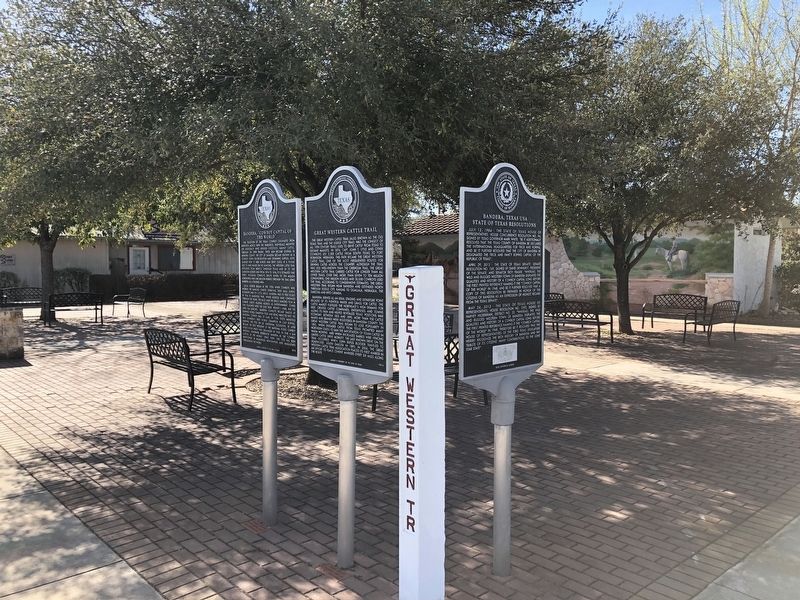
The Great Western Cattle Trail (also known as the Old Texas Trail and the Dodge City Trail) was the longest of all 19th century trails used to drive cattle from Texas to distant markets. In 1874, Capt. John T. Lytle and other cowboys led 3,500 . . . — — Map (db m130351) HM
Freedman and soldier Hendrick Arnold (1804-1849) was awarded land following the Texas Revolution for his participation in the Siege of Bexar and the Battle of San Jacinto. He received six surveys in what was then Bexar county, including this . . . — — Map (db m201897) HM
Size: 40 feet long
Weight: 44,000 pounds
Diet: Herbivore
Habitat: China, India, Kazakhstan and Pakistan
Period: 33-23 million years ago (Ice Age) — — Map (db m189443) HM
Size: 8 to 10 feet tall
Weight: 8,000 to 12,000 pounds
Diet: Herbivore
Habitat: North and Central America
Period: 33.9 Million years to 11,000 years ago — — Map (db m189436) HM
Entered the year-old town of Bandera in March, 1854. Leader was Lyman Wight, church elder who had separated from followers of Brigham Young and taken a colony of 250 to Texas in 1846.
Settling first in Austin, then Fredericksburg (where they . . . — — Map (db m130135) HM
Built 1873 for E. Huffmeyer & brother, by B.F. Langford, Sr., contractor; of native stone.
Bandera's oldest building. Used over 30 years by W.J. Davenport, Sr., as general store. Damaged by fire, 1936.
Restored and remodeled by Thomas . . . — — Map (db m111521) HM
Built 1881. Local stone, cypress floors used. Housed county offices until 1890. Used 57 years. Recorded Texas Historic Landmark - 1965 — — Map (db m130354) HM
This winding, 100-mile trail from San Antonio to Kerrville was, during the 19th century, a strategic patrol road traveled by Texas Rangers to protect the surrounding area from hostile Indian attacks.
During uneasy pioneer days roads such as . . . — — Map (db m117711) HM
Colonel John Henry "Jack" Lapham (1885-1956) was a son of a co-founder of the Texas Company (later Texaco). He was living in San Antonio by 1920 and had many business interests, Jack, his wife, Julie Edna (Capen), and their four children all had . . . — — Map (db m304488) HM
In the late 1850's, Jose Policarpio" Polly" Rodriguez (1829-1914), a noted US Army scout with 2nd Calvary, became one of the first settlers of Bandera County. His first purchase of 600 acres included this property. Ultimately, he acquired over . . . — — Map (db m189491) HM
Named for Policarpo Rodriguez (1829-1914), Texas Ranger, Army Scout and Guide; 1858 Privilege Creek settler. Converted here to Methodist faith, built with his own hands, in 1882, chapel of native stone, where he and others have preached. . . . — — Map (db m155675) HM
An official Texas Historical Landmark
In 1880, the Rev. Jose Policarpio "Polly" Rodriguez (1829-1914) completed this chapel on his ranch. Plans began when he selected this gentle rise west of nearby Privilege Creek. Then, he faced the building . . . — — Map (db m189489) HM
The State of Texas Governor
To all to whom these presents shall come, greeting know ye that this official certificate is presented in recognition of:
Bandera, "Cowboy Capital of the World" receiving a Texas historical commission . . . — — Map (db m177189) HM
This home was constructed in the 1870s by Georgia stonemason James Henry White for Charles F. Schmidtke (1839-1884). A native of Germany, Schmidtke was an early Bandera merchant, grist miller, and lumber mill operator. White's grandson J. Calvin . . . — — Map (db m307866) HM
Size: 79 in - 98 in
Weight: 660 pounds
Diet: Carnivore
Habitat: Every continent, except Australia and Antarctica
Period: 1,600,000 to 11,000 years ago (Ice Age) — — Map (db m189434) HM
Polish settlers, who came to Bandera in 1855, built this convent and Catholic school in 1874. All classes, except religion and music, were moved in 1882 to a nearby frame school building. In 1922 a second story was added to the native limestone . . . — — Map (db m130357) HM
Size: Up to 30 feet long
Weight: 4,400 pounds
Diet: Herbivore
Habitat: Colorado, Oklahoma and Utah
Period: 154 to 144 million years ago (Jurassic) — — Map (db m189435) HM
Communities in the 19th century relied on mills to provide lumber, shingles, flour and cloth. Local millers and blacksmiths were integral community members, providing the necessary materials for early development. Stephen F. Austin reported in 1833 . . . — — Map (db m130356) HM
With deserving respect for all men and women of every Military Department of the United States Armed Forces, the membership of faithful veteran comrades, in Bandera County, unite in the formal dedication of this monument to those whose . . . — — Map (db m162841) WM
Artist John Warren Hunter (1903-93), son of J. Marvin Hunter, was born in Kimble County and known for his scenic depictions of Texas. A 1923 graduate of Bandera High School, he soon began printing the Harper Herald with his wife Lora. After . . . — — Map (db m162319) HM
Joe H. Newcomer (Jan. 19, 1910 - Dec. 23, 1967) Special Texas Ranger, Deputy Sheriff, Justice of Bandera County, World War II Shipboard Security Officer for Chemical Company, Also Uvalde Alderman, County Clerk, Chief of Police. Member . . . — — Map (db m155439) HM
All Gave Some - Some Gave All
A.E. McClendon 1 •
Ad Flowers 4 •
Albert Duke 13 •
Albert Faris 6 •
Allen Keese 4 •
Allen Keese 7 •
Alva Swinney 4 •
Alvin Allen 11 •
Amos Weed 4 •
Andrew Reed 5 •
Andrew Slinsky 1 •
Andy Reed 1 . . . — — Map (db m304549) WM
In a desire to help the town grow, Medina businessman Brown H. Stokes (1897-1940) established Stokes Tourist Courts at his 11-acre riverfront property and family homestead. By 1939, the courts comprised 10 cottages, built by local masons the . . . — — Map (db m270495) HM
125 Years of Bandera history!
Polly Texas Pioneer Association, a local 501.c.3 non-profit, is proud to announce its acquisition of Polly's Schoolhouse. The schoolhouse was built in 1892 by J.P. "Polly" Rodriguez. The schoolhouse served as . . . — — Map (db m189492) HM
Polly, Texas was founded by Jose Policarpio "Polly" Rodriguez (1829-1914) in 1858. Polly was a noted frontieraman, surveyor and US Army scout with the 2nd Calvary who became one of the first settlers of Bandera County. His purchase of acreage and . . . — — Map (db m189485) HM
During the mid-1800s the Texas Hill Country was the site of many hostile encounters, some deadly, between pioneer immigrants whose permanent settlements ran counter to area Native Americans accustomed to unrestrained hunting and gathering. One . . . — — Map (db m155608) HM
Founded 1883, named for Henry Taylor. He, Gid Thompson and other early settlers gave land and founded school. First trustees were D. Harper, H. Kennedy, H. Taylor. First one-room frame building had homemade desks and recitation benches. . . . — — Map (db m111332) HM
This farming community was a growing settlement in July of 1867 when a group of Indians on horseback attacked Romanus Gross, age 51, and his 19-year-old son George on land belonging to the elder Gross' son-in-law, Michael Kauffmann. A party of men . . . — — Map (db m155710) HM
Land for this schoolhouse was given to Bexar County in 1919 by Albert F. Boldt. During that year this two-room building was constructed by local resident Fritz Gembler. From 1919 until 1960 it served as an educational facility for the children of . . . — — Map (db m205699) HM
Introduced in 1953 as part of a "family" of tank designs. The elliptical hull and turret provided greater armor protection while the M-41 90mm gun increased offensive power. Variants of the M-48 series saw service in Europe, the Middle East and . . . — — Map (db m31804) HM
Introduced in 1953 to provide armor protected mobility to infantry squad operating with tanks. Variants included cargo carrier, ambulance, mortar carrier and reconnaissance vehicle.
Weight • 42,000 lb
Crew • 12
Made by • Ford Motor Co. . . . — — Map (db m31810) HM
Adoption of the 3" field gun in 1902 gave the US Army its first rapid fire, breechloading gun with a hydrospring recoil system capable of indirect fire. The complete gun section included the gun and a caisson with 70 rounds of fixed ammunition. . . . — — Map (db m31613) HM
This brick wall, built circa 1890, replaced the original wood fence which enclosed the corrals, stables and wagon parks for the quartermaster depot in The Quandrangle. The two nearby buildings served as blacksmith and wheelright shops. — — Map (db m85540) HM
In March, 1916, President Woodrow Wilson ordered General John J. Pershing to lead an expedition into Mexico to punish Pancho Villa, the Mexican revolutionary whose troops crossed the U.S.-Mexico border and attacked the town of Columbus, New . . . — — Map (db m85539) HM
Businessman E.N. Requa developed Scenic Loop Playground on 320 acres north of San Antonio as a rural recreational resort within easy commuting distance from the city. Requa intended the area to be used as a retreat from the stresses of modern life . . . — — Map (db m163812) HM
Arnold Gugger, son of Swiss-born Helotes Pioneers Anton and Marie Gugger, built this house and store circa 1881. Its site on the east bank of Helotes Creek was ideal for Gugger’s blacksmith shop, general store and saloon, and Arnold and wife . . . — — Map (db m163155) HM
According to archeologists, human occupation of the Helotes area dates to about 7000 years before present, when small bands of Nomadic Indians who migrated seasonally in search of food and game camped in this vicinity.
Early Texas Pioneer John . . . — — Map (db m46922) HM
In 1945, as the Second World War drew to a close, John T. Floore, manager of San Antonio's Majestic Theatre, purchased land in this vicinity. He created the Floore Subdivision, planning it as a center for the community of Helotes, which had . . . — — Map (db m163150) HM
Ryall Luther White (1878-1962) was born in Jasper, Texas to John Luther Calvin White and Texanna Priscilla Ryall White. He married his wife, Ethel Gertrude Smyth, in 1907 and began working for his father-in-law as the manager of the Uvalde Rock . . . — — Map (db m163142) HM
Scottish surgeon Dr. George Frederick Marnoch (1802-1870) purchased more than 1500 acres at this site in the fall of 1858. In January 1859, Marnoch commissioned famed San Antonio architect and builder John M. Fries to construct this house near . . . — — Map (db m163145) HM
In memory of all personnel of the 43rd Bomb Group, Fifth Air Force, who participated in the B-17 and B-24 campaigns in the southwest Pacific during WWII. — — Map (db m255383) WM
Group headquarters and squadrons - 756th. 757th. 758th. 759th. 304th. Bombardment Wing (H) 15th. Air Force; Cerignola, Italy 1944-1945
In memory of the former members who lost their lives during World War II and the deceased members of this . . . — — Map (db m255355) WM
This twin turbofan attack aircraft carries up to 16,000 pounds (7,257 kg) of external payload, plus an internally mounted 30mm rapid-fire cannon with high velocity ammunition capable of penetrating the latest tanks and heavily armoured vehicles. It . . . — — Map (db m254833) HM
The A-26, a follow-up airplane to the A-20 Havoc, made it's first flight on July 10, 1942. Production delivery began in August 1943, and on Nov. 19, 1944, it went into combat over Europe. It was used for level bombing, ground strafing and rocket . . . — — Map (db m255338) HM
On the evening of Nov. 1, 1964, most aircrews were bunked out in their "Hooches", their aircraft parked in neat rows on the ramps at Bien Hoa AB, South Vietnam. Shortly after midnight, Viet Cong mortar shells began raining down. Airmen Jester and . . . — — Map (db m255081) HM
The AT-6 Advanced Trainer was one of the most widely used aircraft in history. Evolving from the BC-1 Basic Combat Trainer ordered in 1937, 15,495 Texans were built between 1938 and 1945. The Army Air Forces procured 10,057 AT-6s; others went to the . . . — — Map (db m254836) HM
The Flying Fortress is one of the most famous airplanes ever built. The B-17 prototype first flew on July 28, 1935. Few B-17s were in service on December 7, 1941, but production quickly accelerated. The aircraft served in every World War II combat . . . — — Map (db m255370) HM
The Consolidated Vultee designed B-24 was the most widely used four-engine bomber of World War II. More than 18,000 were built to fly long-range bombing missions in all theaters of the war. Its great range also made it useful for anti-submarine . . . — — Map (db m255361) HM
To the men of the 490th Bombardment Squadron, Medium, China-Burma-India. Sept. 15, 1942 - Nov. 2, 1945.
Renowned in C-B-I as the "Burma Bridge Busters", the men of the 490th utilized the B-25 to destroy vital supply lines of the invading . . . — — Map (db m255341) WM
The B-25 medium bomber was one of America's most famous airplanes of World War II. It was the type used by General Doolittle for the Tokyo Raid on April 18, 1942. Subsequently, it saw duty in every combat area being flown by the Dutch, British, . . . — — Map (db m255346) HM
In tribute to all personnel of the 3rd. Bombardment Group, Light, Night Intruder, who served during the Korean Conflict, 25 June 1950 to 27 July 1953. We pay particular tribute to: Captain John Springer Walmsley, Jr., Pilot, Killed in Action 14 . . . — — Map (db m255321) WM
The B-29 design began early in 1940 in response to specifications for a high altitude long range "Superbomber" to replace the B-17 and B-24 bombers. The Boeing XB-29 prototype first flew in September 1942. Part of the advance design featured a . . . — — Map (db m255387) HM
The first of two B-52 prototypes flew on 15 April 1952 and B-52A production models first flew on 5 August 1954. One significant change from the production model was in flight deck layout, which changed the pilot tandem seating to side by side. . . . — — Map (db m255083) HM
The B-57 is a modified version of the English Electric Canberra, which was first flown in Britain on May 13, 1949, and later produced for the Royal Air Force. After the Korean War began in 1950, the Air Force looked for a medium jet bomber to . . . — — Map (db m255080) HM
The B-66 was developed from the Navy's A-3D Skywarrior. Although no prototypes were built, the A-3D was extensively redesigned to meet Air Force needs for a tactical light bomber and reconnaissance aircraft. The USAF version was first flown 25 June . . . — — Map (db m255088) HM
One of the more famous people to learn the art of military aviation in the AT-6 Texan was Charles “Chuck” Yeager, who gained fame on Oct 14, 1947, as the first man to break the sound barrier. He enlisted as a private in the Army Air Corps in . . . — — Map (db m254841) HM
The Air Force acquired a total of 101 DC-6C's for service with Military Air Transport Service (MATS), under the designation C-118A, following development under military contracts of the prototype DC-6. Designated XC-112A, this prototype first flew . . . — — Map (db m255279) HM
The C-119, developed from the World War II Fairchild C-82, was designed to carry cargo, personnel, litter patients, and mechanized equipment, and to drop cargo and troops by parachute. The first C-119 made its initial flight in November 1947 and by . . . — — Map (db m255274) HM
The C-121, so designated by the Air Force in 1948, was developed from the C-69 military transport that had originated as a commercial transport for Transworld and Pan American Airlines. The C-69s were assigned to Air Transport Command during the . . . — — Map (db m255525) HM
The "Provider" was a short-range assault transport used to airlift troops and cargo onto short runways and unprepared airstrips. Designed by the Chase Aircraft Co., the C-123 evolved from earlier designs for large assault gliders. The first . . . — — Map (db m255269) HM
The C-131A was equipped for casualty evacuation and the airlift of either litter or ambulatory patients. The C-131A could accommodate a maximum of 27 litter or 32 ambulatory patients. It was first delivered to the Military Air Transport Service on . . . — — Map (db m255389) HM
Few aircraft are as well-known as the C-47, or "Gooney Bird" as it was nicknamed. The aircraft was adapted from the DC-3 commercial airliner that appeared in 1936. The first C-47s were ordered in 1940 and by the end of World War II, the United . . . — — Map (db m255292) HM
The C-9A Nightingale is the only aircraft in the USAF inventory that was specifically designed for the movement of litter and ambulatory patients. It provided service to not only the military services but also the Department of Veterans Affairs and . . . — — Map (db m255393) HM
Chief Steincamp's Air Force career took many unexpected turns before his ultimate retirement Aug. 1, 1970. On May 8, 1944, then Lieutenant Steincamp was escorting bombers on a raid over Germany. On the way back to England, the left engine of his . . . — — Map (db m255026) HM
Although Chief Barnes was a crew chief and flight engineer aboard a wide variety of aircraft, including the C-118, he cast a much broader shadow later in his career when he was named the fourth Chief Master Sergeant of the Air Force in October 1978. . . . — — Map (db m255278) HM
During the war in Southeast Asia, the Air Force gave the venerable C-119 "Flying Boxcar" a new lease on life as the Stinger gunship. Sergeant Petrie was an illuminator operator aboard a Stinger the evening of Feb. 28, 1971, looking for trucks near . . . — — Map (db m255272) HM
The North American designed F-100 was the first operational aircraft to fly faster than sound in level flight. Design started in 1948 in an attempt to improve the speed of the then experimental F-86. On 29 October 1953, Lt Col F.L. "Pete" Everest . . . — — Map (db m255077) HM
The F-15 Eagle was one of the most reliable U.S. fighter with an advanced guidance system that displays steering/weapon system information on a screen for the pilot. During Desert Shield and Desert Storm, the F-15 provided a defensive umbrella that . . . — — Map (db m254830) HM
The F-16 evolved from a 1972 Air Force lightweight fighter prototype program which sought a small, lightweight, low cost, air superiority day fighter designed for high performance and ease of maintenance. The YF-17 was selected the winner, over the . . . — — Map (db m254831) HM
First flown in May 1958, the Phantom II orignally was developed for U.S. Navy fleet defense and entered service in 1961. The Air Force evaluated it for close air support, interdiction and counter-air operations and, in 1962, approved the Air Force . . . — — Map (db m255092) HM
The F-82 was the last propeller-driven fighter acquired in quantity by the Air Force. It appears to be two Mustang fuselages on one wing, but in reality it was a totally new design. Its purpose was to provide a fighter carrying a pilot and . . . — — Map (db m255246) HM
The F-84F Thunderstreak was an advanced, swept-wing design built from the straight-wing F-84 "Thunderjet." The rich history of the Thunderstreak includes combat action over the skies of Korea and becoming one of the first fighter aircraft in the . . . — — Map (db m254797) HM
The F-86, the Air Force's first swept-wing jet fighter, made its initial flight on October 1, 1947. The first production model flew on May 20, 1948, and on September 15, 1948, an F-86A set a new world speed record of 670.9 mph. Originally designed . . . — — Map (db m254765) HM
Nemo was a two-year-old black and brown German shepherd owned by Air Force Sergeant Samuel Cooks, Jr., at K. I. Sawyer Air Force Base near Marquette, Michigan. In the summer of 1964 Nemo was procured by the Air Force and shipped to Lackland AFB, . . . — — Map (db m254804) HM
HH-43 lives saved as reported by the Air Force Times • 1964-1972 in South East Asia more than 1880 persons were saved from certain death or capture.
Pararescueman William H. (Pitts) Pitsenbarger was posthumously awarded the Medal of Honor for . . . — — Map (db m255251) WM
The SR-71 was developed to replace the U-2 as a long-range, advanced, strategic reconnaissance aircraft and was originally developed using the Lockheed A-12 and YF-12A airframe design. The SR-71 structure is 80% titanium and 15% composite materials . . . — — Map (db m255388) HM
For combat aircrews the danger isn't always from flak and enemy fighters. It sometimes comes from within as Staff Sgt. Henry "Red" Erwin found out April 12, 1945, during a B-29 mission over Koriyama, Japan. One of the young radio operator's duties . . . — — Map (db m255384) HM
The first of only two cases where B-52 enlisted gunners scored victories over attacking fighters occurred Dec. 18, 1972. Then Staff SGT. Sam Turner and the crew of "Brown 3" launched on a Linebacker II mission out of Utapao AB, Thailand seeking to . . . — — Map (db m255085) HM
World War I
Capt Edward V. Rickenbacker 1918 •
2Lt Harold E. Goettler 1918 •
2Lt Erwin R. Bleckley 1918 •
2Lt Frank Luke, Jr. 1918
World War II
Col Demas T. Craw 1942 •
Lt Col James H. Doolittle 1942 •
Maj Pierpont M. . . . — — Map (db m255363) WM
Dog Team: The dog is your best friend, your partner and life saver. You are his focus, trainer, provider, leader, and interpreter. Together you train to hone your skills and bond as a team. A dog team's ability to detect enemy targets, near and . . . — — Map (db m255294) WM
On 10 April 1959 Northrop test flew the N-156 prototype which was first developed into the T-38 supersonic lightweight twin-jet trainer for USAF pilot training. It was then modified into the F-5 light tactical fighter. The first true model of the . . . — — Map (db m255090) HM
The Lightning was designed in 1937 as a high-altitude interceptor. The first one built, the XP-38, made its public debut on February 11, 1939, by flying from California to New York in seven hours. Because of its unorthodox design, the airplane . . . — — Map (db m255025) HM
Nicknamed "Jug," the P-47 was one of the most famous Army Air Forces fighter planes of World War II. Although originally conceived as a lightweight interceptor, the P-47 developed as a heavyweight fighter and made its first flight on May 6, 1941. . . . — — Map (db m255250) HM
The P-51 was designed as the NA-73 in 1940 at Britain's request. The design showed promise and Army Air Forces purchases of Allison-powered Mustangs began in 1941 primarily for photo reconnaissance and ground support use due to its limited . . . — — Map (db m255046) HM
This World War II fighter was developed from the P-39 Airacobra which it closely resembles. The Army Air Forces never used the P-63 in combat, although some were used for fighter training. Many P-63s were exported as lend-lease aircraft; the Soviet . . . — — Map (db m255069) HM
In 1951 Republic Aviation began a project to develop a supersonic tactical fighter-bomber to replace the F-84F. The result was the F-105 "Thunderchief, later nicknamed the "Thud." The prototype YF-105A first flew on October 22, 1955, but the first . . . — — Map (db m254801) HM
In 1951 Republic Aviation began a project to develop a supersonic tactical fighter-bomber to replace the F-84F. The result was the F-105 "Thunderchief," later nicknamed the "Thud." The prototype YF-105A first flew on October 22, 1955, but the first . . . — — Map (db m255075) HM
Almost a year before his own country went to war, Lucien Thomas enlisted in the Royal Canadian Air Force and found himself manning a machinegun aboard British bombers. Toward the end of 1942, he transferred to the U.S. Army Air Corps, but was . . . — — Map (db m255317) HM
Walter Beech, who trained as an enlisted aviator toward the end of World War I, gained little fame as a military aviator, but went on to become a premier aircraft designer and builder. Beech had been flying since July 1914, so it was only natural . . . — — Map (db m255263) HM
Archibald Mathies emigrated as an infant with his family from Scotland in 1918 and settled near Pittsburgh, Penn. Archibald returned to the British Isles 26 years later as a ball turret gunner aboard a B-17. He enlisted in the US Army in 1940 and . . . — — Map (db m255369) HM
James Moran was one of many who flocked to recruiting offices in the weeks following the attack on Pearl Harbor. He lied about his age to "go fight the war". Moran envisioned himself blasting the enemy from the skies as a gunner aboard a B-17, but . . . — — Map (db m255285) HM
The T-28 was originally designed to replace the T-6 trainer. It was first flown on Sept. 24, 1949, and entered production in 1950. An 800 horsepower engine-powered the Air Forces version (T-28A), whereas a 1,425 horsepower engine powered the later . . . — — Map (db m254848) HM
The Air Force used the T-34A for primary flight training during the 1950s. The original Mentor, a Beechcraft Model 45 derived from the famous Beechcraft Bonanza, was first flown in December 1948. The first military prototype, designated YT-34 by the . . . — — Map (db m254835) HM
The skies over southeastern Laos were far from friendly and often crowded, this was especially true the morning of Dec. 13, 1968. Sergeants Clark and Walker were loadmasters aboard "Candlestick 44," a venerable C-123K provider which launched out of . . . — — Map (db m255268) HM
In 1940 the Beech Aircraft Corporation began building variations of the commercial transports, B-18s (C-45) for the Army Air Force. Continued productions in 1941, resulting in interior modifications, brought about the C-45A and C-45B. The standard . . . — — Map (db m255267) HM
The U.S. Air Force adopted the LTV A-7 December 23, 1968 and 645 were placed on order. It was developed as a single-seat subsonic tactical fighter and designed to deliver a weapon load with pinpoint accuracy. Originally designed for the U.S. Navy, . . . — — Map (db m254834) HM
1399 entries matched your criteria. Entries 101 through 200 are listed above. ⊲ Previous 100 — Next 100 ⊳