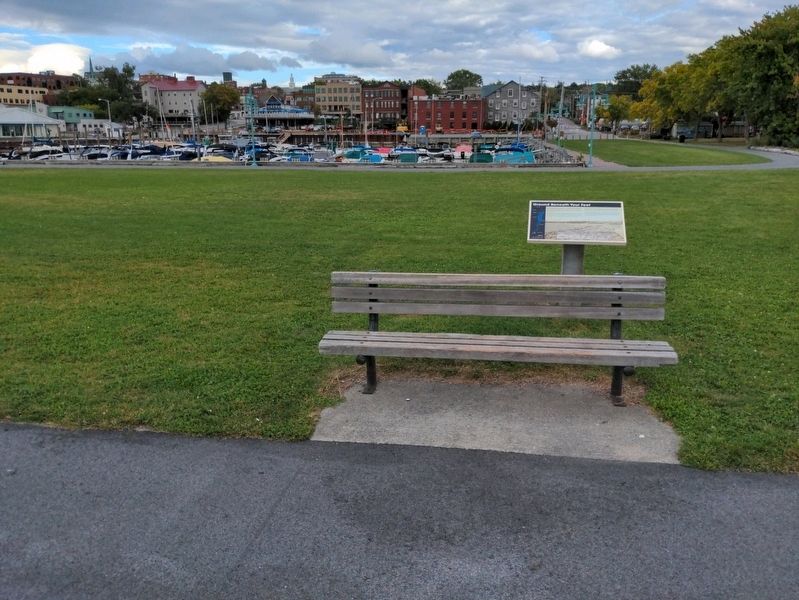
If you were standing here 200 years ago, you'd be all wet. The natural shoreline ends about 500 feet behind you. Burlington's first dock was built here in 1810. Before that the waterfront consisted of raft logs tied to the shore. Cargo delivery was . . . — — Map (db m183081) HM
Honor and Tradition
Name Comm Decomm
USS Vermont (BB 20) 1907 1920
USS Plattsburg (SP 1645) 1918 1919
USS Converse (DD 291) 1920 1930
USS Dewey (DD 349) 1934 1945
USS Clark (DD 361) 1936 1945
USS Mayo (DD 422) 1940 1946 . . . — — Map (db m115267) HM WM
Born here on Oct. 20, 1859, John Dewey attended local schools and in 1879 graduated from the University of Vermont. Dewey was world-renowned as a philosopher and author of many books. Ideas drawn from his educational doctrines profoundly influenced . . . — — Map (db m75558) HM
Honoring Robert T. Stafford
Vermont Governor-Congressman-United States Senator
Captain United States Navy
First Commanding Officer- Naval Reserve Center, Burlington
Established in 1946, the Naval Reserve Center occupied this site in . . . — — Map (db m115269) HM
Imagine the year is 1870. You’re standing amongst acres of stacked, milled lumber that crowd the waterfront, destined for ports all over the world. Countless band saws screech and dust fills the air as mills and factories churn out their wooden . . . — — Map (db m176982) HM
Founder of New France. Dedicated July 2, 2009 in celebration of the 400th anniversary of his trip down the lake in the summer of 1609. Champlain College is forever grateful to Trustee Emeritus and friend John W. Heisse Jr., M.D. for commissioning . . . — — Map (db m87969)
During the War of 1812, the British again attempted to use Lake Champlain as an invasion route into the United States. Both American and British naval commands constructed large vessels in an effort to gain superiority for the impending battle. . . . — — Map (db m116682) HM
The Battle of Valcour Island
11-13 October 1776
In the fall of 1776 a British Naval force left Canada and embarked onto Lake Champlain in an effort to divide and conquer the rebelling thirteen colonies. Positioned off Valcour Island was a . . . — — Map (db m115264) WM
The Lone Sailor
The original bronze sculpture stands at the center of the United States Navy Memorial in Washington DC. In honor of the historical naval actions on Lake Champlain, the Navy Memorial Foundation approved placing The Lone Sailor at . . . — — Map (db m115263) WM
Grand Central Station in miniature! That’s how proud Burlingtonians described their new train station in 1915. Like other public buildings across the country, Union Station was built to show travelers how sophisticated, wealthy, and up-to-date . . . — — Map (db m186489) HM
Vermont. Major Cross-State Route to the Connecticut River. From this point, where the Winans launched their steamer "Vermont" in 1808, travelers drive eastward on Route US 2, cutting through the Green Mountain Range at Bolton to . . . — — Map (db m75561) HM
The Holmes Creek Bridge, built circa 1870, is 41 feet long
and 12 feet wide, a width specified by the selectmen of the
day to allow passage of a “load of hay, high and wide.” There
may have been an 1840 bridge at this site but town . . . — — Map (db m261865) HM
The Ouinian Bridge, built circa 1850, is 88 feet long and is
of Kingpost Burr Arch construction. The builder is unknown.
Also called the Sower bridge, it is downstream on Lewis
Creek from the Seguin covered bridge. The Quinlan Bridge
spans what . . . — — Map (db m261867) HM
This school was one of thirteen one-room schoolhouses in Charlotte. It was built around 1850 and was in use until 1950. One-room schoolhouses were built throughout the town in order to educate the children of nearby farm families. Children between . . . — — Map (db m108961) HM
In 1849 an 11,000 year old Beluga Whale was found north of this site in what had been the Champlain Sea. Resident J.G. Thorp collected the bones, and naturalist Zadock Thompson assembled the skeleton now displayed in the Perkins Museum of Geology . . . — — Map (db m75963) HM
Charlotte Honor Roll
[Died in service]
William M. St.George • Romeo LeClair
George Sturgeon • Parker D. Leonard
[Roll of Veterans] — — Map (db m108963) WM
The Roll of Honor
of
Charlotte, Vermont
[Died in service]
Harry Hanks • DeLial W. Magee • Julius S. Munnette
[Veterans]
William F. Abare • Donald Aunchman • Edward J. Bessette, Jr.
Harold H. Bessette • Moses Booska • Roy C. Busier . . . — — Map (db m108960) WM
The First Special Service Force was formed in July
1942 as the only joint U.S.-Canadian unit in World War II.
Many Vermonters volunteered to serve. Led by
U.S. Army Col. Robert T. Frederick, the Force
trained rigorously in Montana, Virginia, and . . . — — Map (db m261839) HM
In July 1909, the 10th U.S. Cavalry arrived at Fort Ethan Allen for a four-year assignment. Nicknamed the "Buffalo Soldiers" during the American Indian Wars, the 10th Cavalry was one of the first peacetime all-black regiments established in the . . . — — Map (db m104074) HM
By 1763, the English had driven the French armies from Canada making the Champlain Valley safe for settlement. In the same year, King George III chartered Colchester Township on the Onion River - now known as the Winooski. In 1773, Ira Allen's . . . — — Map (db m86658) HM
A descendant of one of Burlington’s original settlers, Ray Williston Collins was born on this farm on February 11, 1887. After graduating from Burlington High School and the University of Vermont, Collins joined the Boston Red Sox in 1909 and soon . . . — — Map (db m86646) HM
If you travel a mile north along the bike path, you’ll find a lake crossing with stunning views: a 3.5-mile causeway connecting Colchester Point to Allen’s Point in South Hero, Vermont. While thousands of bicyclists and walkers use this marble . . . — — Map (db m201383) HM
In 1810, Vermont State Law required towns to raise a minimum of 1 cent on the dollar in property taxes for support of town schools. The one room schoolhouse before you was built between 1815 and 1827 to serve students on the area once known as South . . . — — Map (db m88739) HM
In July 1909, the 10th U.S. Cavalry arrived at Fort Ethan Allen for a four-year assignment. Nicknamed the “Buffalo Soldiers” during the American Indian Wars, the 10th Cavalry was one of the first peacetime all-black regiments . . . — — Map (db m104492) HM
What's in a Name?
This village was originally known as Hubbel's Falls after an early settler who built a mill in Essex on the Winooski River. During the autumn of 1849 the Vermont Central's owner, Charles Paine, (who had served . . . — — Map (db m92207) HM
On this hill from 1795 to 1865 thrived an African American farming community. The first settlers at the bottom of this road in 1798, from MA, were Samuel Peters, Hannah Lensemen & husband Prince Peters. Prince served in Captain Silas Pierce's MA . . . — — Map (db m304252) HM
Named for Thomas Chittenden, first governor of Vermont and great-great grandfather of Frank Howe. Frank and his father Lucian rebuilt this mill in 1885 changing from grinding with millstones to the new gradual reduction roller process. Grain was . . . — — Map (db m97753) HM
For fifty years Wilson A. Bentley, a farmer and self taught scientist, developed his technique of photomicrography to reveal to the world the grandeur and mystery of the snowflake — its universal hexagonal shape and its infinite number of . . . — — Map (db m74314) HM
The 1960s through the 1980s were an exciting time for racing fans in Chittenden County. In 1964, a plan was made to build a paved 1/3-mile NASCAR-sanctioned oval track in Milton. The newly built I-89 allowed easy access for traveling racers and . . . — — Map (db m121198) HM
George Jerrison Stannard
On July 3, 1863, Brigadier General George Stannard ordered 900 men of his Second Vermont Brigade to attack the right flank of the final Confederate assault at the Battle of Gettysburg. That decisive blow to Pickett's . . . — — Map (db m201070) HM
This flag is a memorial to those who lost their lives in the attacks of September 11, 2001. It was erected by Grand Isle County residents during the 24 hours following the event. Flying from a birch pole set on a sand bar in the lake, it was later . . . — — Map (db m195441) WM
On June 23, 1963, Maurice Bousquet and Hubert “Bud” McCormick of Milton’s B&M Motors, with top Vermont driver Jack DuBrul of Burlington, opened Vermont’s first drag strip here before a capacity crowd. Known by the locals as Milton Drag . . . — — Map (db m151134) HM
These islands were first seen by a European in 1609, when Samuel De Champlain explored the Lake which bears his name and claimed them for the King of France. Ceded in 1763 to Britain, they became part of the Royal Colony of New York. After 1776, . . . — — Map (db m74516) HM
A skiing family....whose combined efforts as members of U.S. ski teams in Olympic and world competition have brought fame and recognition to themselves, their nation and to this Vermont ...Community Gold Medal Winner Barbara Cochran . . . — — Map (db m76392) HM
George F. Edmunds, one of this nation’s foremost legislators, was born on this farm, Feb. 1, 1828. After serving at Montpelier as Speaker, he represented Vermont in Washington as Senator for 25 years, and presided over the Senate when Arthur was . . . — — Map (db m86661) HM
In memory of America's men and women
who, since 1776, answered the call to duty
in defending freedom and justice, in
peacetime and in war, in this land
and across the oceans.
War for Independence • War of 1812
Mexican War • The . . . — — Map (db m281200) WM
Huntington Gorge By 1802, John Preston had built a grist mill here at Richmond’s best water-power site. It was operated continuously for a century, last of all by the Robinson family. The Richmond Light and Power Co. converted the mill in 1903 . . . — — Map (db m86802) HM
10th Mountain Division Richmond's Fallen Son PFC Adam J. Muller US Army Gunner HHC, 1st BSTB -Team Iroquois Killed serving our country in Iraq 11/5/07 — — Map (db m76391) HM
In Memoriam erected by The Citizens of Richmond in honor of her patriotic men and women who served their country in the World War 1917 - 1919 — — Map (db m76390) WM
The Round Church, was built in 1812-13 under the direction of local craftsman William Rhodes to be the Town Meetinghouse and place of worship for members of five Protestant denominations. Significant for its rare design and well-preserved . . . — — Map (db m281196) HM
The Round Church. This 16-sided church, Richmond's first meeting house, was built by a group led by William Rhodes in 1812-12 on land donated by Issac Gleason & Thomas Whitcomb. The first Proprietors were members of five denominations: Baptist, . . . — — Map (db m76387) HM
1911
Danby, Vermont
In commemoration of charter granted
August 27, 1761
——————————————
Gift of Danby-Mount Tabor Fire District No. 1,
1953-332 — — Map (db m109169) HM
Aaron T Stephan believes that most world globes are relics of the past, arguing that they "fail to represent the complexities of globalization, world growth, and the interrelations of cultures and peoples." Comprised of twenty cast iron triangular . . . — — Map (db m109011) HM
History
The steamboat Ticonderoga is America's last remaining side paddlewheel passenger steamer with a vertical beam engine. Commissioned by the Champlain Transportation Company, the Ticonderoga was built in 1906 at the . . . — — Map (db m109149) HM
Shelburne Museum's gardens and grounds, like its other collections, are designed to offer enjoyment, information, and an opportunity for relaxation and reflection. Museum founder Electra Havemeyer Webb (1888-1960) worked with Long Island landscape . . . — — Map (db m109492) HM
The Apothecary Shop represents a late 19th-century druggist's shop. Prior to the Civil War, druggists gathered and dried herbs, grinding, distilling, and mixing them with a variety of substances to create medicinal remedies. By 1900, . . . — — Map (db m109129) HM
Beach Gallery and Beach Lodge are designed to resemble an Adirondack camp. Named for William and Marie Beach, longtime hunting companions of J. Watson Webb (1884-1960) and Electra Havemeyer Webb (1888-1960), the log buildings were constructed . . . — — Map (db m109383) HM
Beach Gallery and Beach Lodge are designed to resemble an Adirondack camp. Named for William and Marie Beach, longtime hunting companions of Electra and J. Watson Webb, the log buildings were constructed on-site using timber from Nehasane, the . . . — — Map (db m109430) HM
In the 18th and 19th centuries communities depended heavily on the village blacksmith as the primary source for tools, utensils, hardware, vehicle parts, and many other items. Many blacksmiths also served as farriers, . . . — — Map (db m109099) HM
Constructed on-site 1960
This fanciful horseshoe-shaped structure is designed to showcase the
4000 piece, hand-carved miniature Amold Circus Parade, which stretches
nearly the full length of the building's 38 feet, and the intricate, 3500 . . . — — Map (db m259036) HM
Mrs. Webb exhibited true showmanship when designing the circus building to enliven the presentation of its main attraction—Roy Amold's miniature model circus parade. She felt that because no one ever sees the beginning and end of a parade . . . — — Map (db m258288) HM
Mrs. Webbs was captivated by this Lake Cham-
plain structure thanks to the influence of Vermont
writer, historian and preservationist Ralph Nading Hill. Ralph Nading Hill...loved this lighthouse, and he came to me one day and he said," You know . . . — — Map (db m258876) HM
In testimony to the
courage and ability of
Robert Francis, Foreman
Donald Francis • Wayne Spear • Nathan Johnson
Clifford Francis • Forrest Emmons
This lighthouse was dismantled
on Colchester Reef, transported . . . — — Map (db m109472) HM
Measuring 168 feet in length with two vehicle lanes and a footpath, the Covered Bridge spanned the Lamoille River for more than one hundred years. The bridge's system of parallel-chord trusses and arches, which act in concert to support both the . . . — — Map (db m109489) HM
The distinctive diamond-shaped interior framing of this structure gives Diamond Barn its name. The building has housed a variety of exhibits, from brass foundry patterns to folk art. Today, the lower level of the building serves as a seasonal . . . — — Map (db m109442) HM
This classic example of Greek Revival architecture originally served as a two-family house for the children of Welcome Allen. The Allens, who owned an iron foundry, built their home in the latest fashion, utilizing stoves for heat rather than . . . — — Map (db m109484) HM
Built in 1782 by Salmon Dutton, this house—the first dwelling brought to the Museum—was dismantled and moved from Cavendish, Vermont, in 1950. Dutton, who emigrated from Massachusetts, was a surveyor, town official, and toll road owner. His . . . — — Map (db m109159) HM
This Greek Revival-styled structure was designed to resemble an Orwell, Vermont, farmhouse admired by Museum founder Electra Webb (1888-1960). The interior recreates six rooms from Electra and J. Watson Webb's 1930s Park Avenue, New York City, . . . — — Map (db m109474) HM
The original concept for what would become the Electra /Havemeyer Webb Memorial Building came from correspondence between Mrs. Webb and her friend Katharine Prentis Murphy a fellow collector and collaborator on Shelburne Museum's Prentis House . In . . . — — Map (db m259878) HM
For many years, this building served as the Shelburne village post office before it was moved to the Museum intact, on a specially designed railroad track running down Route 7. The ground floor re-creates a late 19th-century general store, post . . . — — Map (db m109124) HM
The earliest portion of this building was constructed by Captain Benjamin Harrington as a distillery, used to provide alcohol for the Captain's nearby inn. Constructed of hand-hewn timbers and rough planks, the building later served as Shelburne's . . . — — Map (db m109082) HM
This building was modeled after a unique horseshoe-shaped dairy barn near Georgia, Vermont. It is constructed of hand-hewn beams salvages from twelve barns and stones from two gristmills. The massive structure incorporates 745 timbers, posts, and . . . — — Map (db m109208) HM
The Museum's collection of 19th- and early 20th-century horse-drawn vehicles was initially displayed in Horseshoe Barn. With the addition of more than 150 wagons, sleighs, coaches, and fire equipment, the collection outgrew its original home. The . . . — — Map (db m109215) HM
The active slate-quarrying industry of Castleton, Vermont, provided ample raw materials for the construction of this holding structure, which houses two cells and a jailer's anteroom. A single barred window admits light into the building, which is . . . — — Map (db m109228) HM
The Lighthouse was located a mile off Colchester Point in Lake Champlain, marking the location of three reefs: Colchester Reef, Colchester Shoals, and Hogback Reef. The building was designed in 1869 by Albert Dow, a Burlington, Vermont, resident, . . . — — Map (db m109444) HM
Locomotive 220 was the last coal-burning steam ten-wheeler used on the Central Vermont Railway. As a medium-sized engine it moved both freight and passenger trains and became known as the [sic] "The Locomotive of Presidents" for its use on special . . . — — Map (db m109152) HM
The Rail Locomotive No. 220, built in 1915 by the American Locomotive [C]ompany of Schenectady, New York, was the last coal-burning, steam ten-wheeler used on the Central Vermont Railway. As a medium-sized 4-6-0 engine (4 leading wheels, 6 driving . . . — — Map (db m109153) HM
Charlotte Meeting House was built by the community's Methodist congregation. The building's architectural details reflect Greek design influences, including the triangular pediment created by cornice moldings. During the building's 112-year history . . . — — Map (db m109101) HM
Northwest of this site in 1770
Moses Pierson
who owned the surrounding thousand
acres built his home.
On March 12, 1778 it was attacked by sixty British and Indians but was defended by the Piersons, Colonel Thomas Sawyer, Lieutenant . . . — — Map (db m247335) HM
Originally used for ticketing, information, and the museum store, Owl Cottage today is a lively center for hands-on experiences for children. Toys, books, games, and craft activities engage visitors of all ages. — — Map (db m109438) HM
The Pleissner Gallery was built to honor Brooklyn-born artist Ogden Minton Pleissner (1905-1983), a close friend of the Webb family who earned national recognition for his work as a war artist, landscape painter, and talented chronicler of sporting . . . — — Map (db m109432) HM
This two-story saltbox home is built around a massive central chimney with seven flues that meet on the second floor in a beehive-shaped form. John Dickinson built Prentis House on four acres where he and his family farmed broomcorn.
Prentis . . . — — Map (db m109157) HM
The Prentis House was discovered in Hay Massachusetts in a regional quest for architectural parts, in the search for large floorboards with which to finish off the Stencil House. Hugh Sloan, a sell described "real estate dealer and a dabbler in . . . — — Map (db m259176) HM
Preservation of the Colchester Reef Lighthouse for future generations was made possible by a gift from Frederick A. McCarthy in loving memory of his mother Myrtle Button who was born in the Lighthouse in 1888 — — Map (db m109471) HM
Constructed from historic timbers, the Print Shop exhibits a range of printing equipment that might have been found in an early 20th-century small-town print shop, from an 1820s handpress to a 1950 high-speed Heidelberg press. Late 19th-century . . . — — Map (db m109207) HM
Dr. William Seward Webb (1851-1926), president of the Rutland Railroad and the Wagner Palace Car Company, lived for part of the year in Shelburne, commuting to New York City in his own private car, the Ellesmere, which was similar to the . . . — — Map (db m109371) HM
Built in 1890 by Rutland Railroad President Dr. William Seward Webb (1851-1926), the Railroad Station was originally located near the center of Shelburne to serve passengers of the Central Vermont and Rutland Railroads. Designed by architect Robert . . . — — Map (db m109368) HM
The three-story Round Barn was built in 1901 to improve agricultural efficiency on the farm. Hay from the top floor and silage from the central silo dropped through feed chutes to the middle level, where up to sixty cows could be stanchioned around . . . — — Map (db m109520) HM
The Sawmill building houses the Trescott-Shepard sawmill originally located in South Royalton, Vermont. The water-powered mill was built in the late 1700s on Mill Brook by Jeremiah Trescott and his partner, Captain Stevens. Trescott's descendants, . . . — — Map (db m109483) HM
The one-room Schoolhouse was the first structure moved to the Museum. The building has several distinct classical architectural features, including a projecting bell tower, arched door opening, and sash windows. The structure originally stood on . . . — — Map (db m109087) HM
The Settlers' House is constructed of hand-hewn beech and pine timbers. In the 18th and early 19th centuries, Vermont settlers, loggers, and trappers often built similar temporary log homes. Research suggests that this particular example was . . . — — Map (db m109479) HM
This building originally served a large Shaker community in Canterbury, New Hampshire, as a one-story horse and carriage stand. The simple, unadorned commercial structure was expanded in 1850 to provide storage space for brooms made and sold by . . . — — Map (db m109172) HM
Scripture
1800 • The First Society
Tradition
1834 • The Brick Church
Experience
1872 • The Stone Church
Reason
2000 • The Bicentennial Addition — — Map (db m109237) HM
Smokehouses are small, airtight stone structures where meat was preserved. Traditionally, butchered cuts were salted and then hung in a smokehouse above a smoldering fire of corn cobs and hickory wood. Meats remained in place for several days, or . . . — — Map (db m109223) HM
Hezekiah Barnes, a U.S. militia captain turned road surveyor, strategically located his inn and trading post in Charlotte on opposite sides of the main stage route from Montreal. Built in the Georgian style, the exterior of the inn features . . . — — Map (db m109219) HM
The Stencil House is typical of small side-gabled homes common in New York and New England. The floor plan groups four rooms around a central chimney. A central front door, flanked by pairs of double-hung windows, opens into a small entrance hall. . . . — — Map (db m109132) HM
Stone Cottage is constructed of limestone laid in straight courses rather than in the more common scatterstone technique. It was originally built as a farmhand's house; the first tenants were a family of five, including husband and wife, two . . . — — Map (db m109083) HM
Begun in 1957, Beach Lodge was one of the final
construction projects completed before Electra
Webb's death in 1960. She celebrated the gift of
paintings artifacts, and hunting trophies from
her friends and hunting companions. William
and Marie . . . — — Map (db m259866) HM
The Rail Car Grand Isle (1899) was one of the last private cars built by the Wagner Palace Car Co. before Pullman took control of the company at the end of 1899. The car was used by Dr. William Seward Webb and the Rutland Railroad until 1914, when . . . — — Map (db m109379) HM
1906•Shelburne, Vermont•Original owner: Champlain Transportation Company •Moved to museum: 1955 The 220-foot Ticonderoga is America's last remaining walking beam side-wheel passenger steamer, and a National Historic Landmark. Serving a . . . — — Map (db m97385) HM
Built adjacent to the Variety Unit to reflect the "continuous architecture" building style common throughout New England, the Toy Shop displays an array of children's playthings: transportation toys, mechanical banks, an operating model train, dolls . . . — — Map (db m109085) HM
This brick farmhouse is the only historic structure at the Museum original to the site. A rambling building, its complex structure consists of a series of one- and two-room additions to the original farmhouse in the New England "continuous . . . — — Map (db m109086) HM
This intimate stone structure is a conjectural restoration and reconstruction of an original log framed house built in Shelburne in the late 18th century.
Vermont House features Something Old, Something New: Continuity & Change, American . . . — — Map (db m109158) HM
Constructed using historic building materials, the Weaving Shop exhibits a variety of hand-spinning and weaving equipment and interprets American textile traditions practiced in a 19th-century weaving shop.
On view are processing . . . — — Map (db m109174) HM
This building was designed to complement neighboring historic structures. The main block, flanked by matched wings, echoes the symmetry and scale of nearby Dorset House, and the brick façade reflects the construction materials of the Schoolhouse . . . — — Map (db m109476) HM