Indiana Racing Memorial Association Historical Markers
The Indiana Racing Memorial Association, Inc. recognizes historically significant individuals, events, businesses and auto race tracks that have made Indiana “The Racing Capital Of The World.”
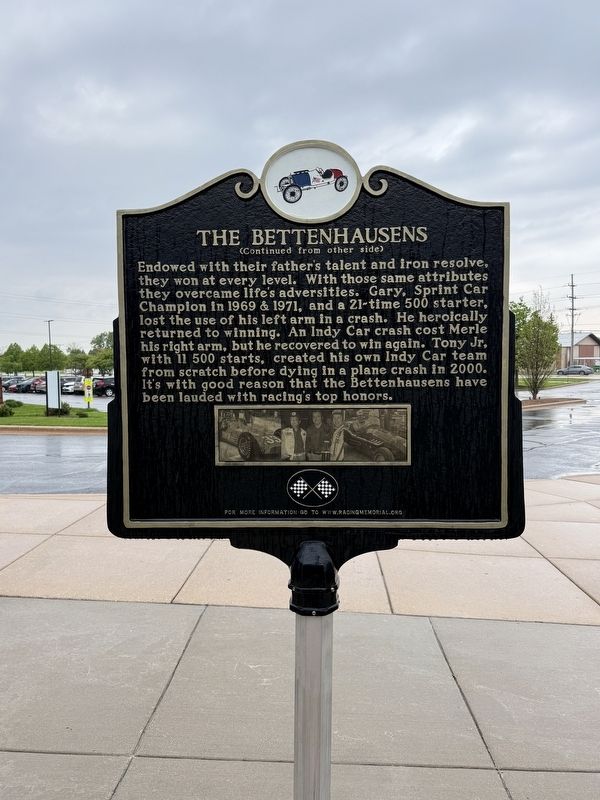
On this site in the late 1800s, Christian Bettenhausen founded a family farm. In 1937 his youngest son Tony left that farm to go racing. From dusty short tracks to the hallowed Indianapolis Motor Speedway Tony clawed his way to the . . . — — Map (db m298986) HM
Maybe it was foretold that Pennsylvanian born John Lingenfelter would become one of racing's most legendary engine builders. The gifted son of a mechanic, John began working on cars almost as soon as he could hold a wrench. A move to Indiana to . . . — — Map (db m168283) HM
Brothers Mel and Don Kenyon impacted American open wheel racing in a way which, perhaps, will never be duplicated. Mel began his career in 1954, driving stock cars. When Don left the Air Force, in 1958, they bought a midget with his mustering out . . . — — Map (db m265556) HM
Born in Odon, on July 17, 1889, Joseph Crook Dawson was one of the most acclaimed “Daredevils of The Speedways”, during the formative years of auto racing in this country. His most memorable accomplishment came in 1912, when he gained . . . — — Map (db m176080) HM
The name Duesenberg is forever linked with early motorsports. In 1913, German immigrant brothers Fred and Augie Duesenberg founded the company that bore their name in St. Paul, Minn., to produce the best high-performance custom engines and . . . — — Map (db m185841) HM
One of the most iconic brand names in the world of sports has its origins here in the town of Veedersburg. The famed Indianapolis Motor Speedway is known the world over as “The Brickyard”, because the track surface was once composed entirely of . . . — — Map (db m175835) HM
Known internationally as one of America’s most popular and successful short-track racers, Bryan Clauson was also a proud Noblesville Miller. Despite his passing in 2016, at only age 27, his mark was already indelible. 112 USAC wins ranks him in . . . — — Map (db m175607) HM
The course of Bill Marvel’s life was set in motion when his father attended the 1914 Indianapolis 500. Clem acquired a passion for racing that his son soon embraced. Born in 1930, Bill first journeyed to the Speedway in 1935. But, it was 1941, at . . . — — Map (db m304261) HM
Born December 2, 1944, Dick Jordan’s life has always been about auto racing. His earliest memories are of attending races with his parents. Then in 1968, a milestone event occurred; USAC hired him to do media relations. In over 50 years there, . . . — — Map (db m304259) HM
Raided on Indianapolis’ North Side, Howard Billeisen Jr. aspired to follow his father in operating the family pharmacy. And though being shot in a robbery attempt didn’t dissuade him, a difficult Butler University chemistry course did. Then fate . . . — — Map (db m304258) HM
Larry Rice lived a life full of accomplishment, reaching the pinnacle of success in the sport he was passionate about, auto racing. A two-time starter in the Indianapolis 500, he won Co-Rookie Of The Year honors in 1978. He was twice the USAC . . . — — Map (db m174976) HM
Considered one of America’s greatest race drivers, Rodger Ward’s career began in earnest after his stint as a P-38 pilot in WWII. Racing midgets throughout his California home state, his success secured him rides with the prestigious AAA. In . . . — — Map (db m304262) HM
Born here in Brownsburg. Robbie Stanley wanted nothing more than to drive race cars, and drive them well. In his brief life, he far exceeded those expectations. At only 6, he was 69 racing quarter midgets. He was spectacular, winning over 200 . . . — — Map (db m304255) HM
There's little doubt that Paul Hazen
ranks as one of the most prolific sprint
car owners in American racing history.
From his start in 1957, he's won hundreds
of features, numerous track championships,
including many here at Kokomo . . . — — Map (db m230060) HM
No sport could ask for a better representative than auto racing had in North Vernon's, Pat O'Connor. Handsome, articulate, and talented, he rose from dirt tracks and bullrings around his Southern Indiana home, to national and international . . . — — Map (db m176135) HM
Tony Elliott, born in Warsaw, Indiana 0n January 24, 1961, was an “Indiana Short Track icon”. For good reason. Following in his father’s racing footsteps Tony immersed himself in sprint car racing, competing on local tracks in Warsaw, Gas City . . . — — Map (db m207694) HM
Racing Hall of Famer Ray Nichels attended Franklin School, which now houses the Griffith Historical Society. In 1954 Ray and his wife Eleanor established Nichels Engineering, eventually becoming one of auto racing's elite race car building and . . . — — Map (db m226579) HM
1932 National Racing Champion, Bob Carey, was born in Anderson on September 28, 1904. While working at Robert Roof's race shop here in town, young Carey developed a passion for speed and competition, and pleaded for an opportunity to drive. Once . . . — — Map (db m168898) HM
By the early 20th century automobile racing had captured the imagination of the country. At thousands of county fair dirt tracks young drivers, in home built cars, battled weekly for fame and glory. Robert M. Roof was one such youngster. Roof's . . . — — Map (db m175556) HM
Ray Harroun will be remembered always as the winner of the first Indianapolis 500 in 1911. But, despite the acclaim that historic victory brought, he considered himself first and foremost, an engineer. He raced simply to prove his ideas practical . . . — — Map (db m168873) HM
Nationally Known for its tranquil charm and peaceful elegance, its ironic that many from the roaring, raucous, boisterous world of motorsporting have chosen the serenity of Crown Hill as their final resting place. Some of racing’s most iconic . . . — — Map (db m174868) HM
The Indiana State Fairgrounds Mile is often lauded for the significant part it has played in Indiana racing history, as well as the nation’s. One of America’s earliest auto racing sites, it gained world renown on June 29th, 1903 when Barney . . . — — Map (db m175593) HM
Pioneering motorcyclist and racecar driver Erwin G. Baker (born 1882) moved to Indianapolis circa 1893. He won one of the first motorcycle races at the newly opened Speedway, 1909, and raced in 1922 Indy 500. Baker set numerous speed and distance . . . — — Map (db m128028) HM
This area of the Marian University campus was once known as “Millionaire Row” as some of Indianapolis’ wealthiest men resided here. Perhaps the better label would’ve been, “Founder’s Row”, for three of the four founders of the famed Indianapolis . . . — — Map (db m174886) HM
The Boyle Racing Headquarters housed one of the most significant teams in open wheel racing history. One of the first dedicated race shops in an era when most teams worked from small garages. It was built in 1930 and subsequently rented by Mike . . . — — Map (db m277530) HM
The “Wizard of Indy” is an apt title for master car builder, A.J. Watson. He arrived at the Indianapolis Motor Speedway in 1948 and in 1950 qualified the low budget “Pots and Pans Special”, built by a group of fellow Glendale, California . . . — — Map (db m174964) HM
Few in motorsports history have impacted as many forms of racing as Floyd “Pop” Dreyer. His creativity influenced disciplines as diverse as motorcycles, sprint cars and Indianapolis cars. After riding his brother’s Pope motorcycle for a year, . . . — — Map (db m174956) HM
Howard Samuel “Howdy” Willcox, the winner of the 1919 Indianapolis 500, was born in Crawfordsville on June 24, 1889. Drawn to auto racing, “Howdy” became one of the brightest stars of the dynamic new sport. His intense talent, charismatic charm, . . . — — Map (db m304268) HM
Few race tracks in America possessed the
renown, mystique, and sense of awe as Jungle
Park Speedway. Carved from the dense Indiana
woods in 1926, by Earl Padgett, the half mile
track soon became a hotbed for Midwest racing,
attracting . . . — — Map (db m161462) HM
Side A
Winchester Speedway is one of the most significant, historic short tracks in the United States. It opened in 1914 under the name Funk’s Speedway, and has held races continuously since. Known as the “World’s Fastest ½ . . . — — Map (db m138726) HM
Wilbur Shaw was born in Shelbyville on October 31, 1902, and reared here. He went on to become one of the most iconic figures in all of American sports. A household name because of his racing exploits, he loved to talk about his first race here . . . — — Map (db m169310) HM
Driving a Duesenberg, George Souders
handily won the 1927 Indy 500 as a
rookie. Souders finished third at the
500 in 1928 but retired soon after
following a crash in a Detroit race. He
is among a handful of Americans to compete in the Italian . . . — — Map (db m266437) HM
Charles Edwin Wiggins, born in Evansville on July 15, 1897, would become America’s most acclaimed African American racing driver. Charlie grew up poor. His father was a coal mi er, and after his mother died when he was nine, Charlie shined shoes . . . — — Map (db m175997) HM
During a brief heyday in the early 20th century, hill climb races captured the imagination of automobile enthusiasts across America. A multitude of auto manufacturers, anxious to prove their cars, enlisted motorsports’ best drivers to compete in . . . — — Map (db m175840) HM
Few race car drivers represented their sport like Wabash, Indiana's Jimmy Daywalt, born here on August 28th, 1924. Handsome, articulate, and talented, he raced his way from the rough, dangerous dirt tracks and bullrings to the top echelon of auto . . . — — Map (db m168223) HM
Few race tracks in the nation carry the legacy, prestige and renown as Salem Speedway. Built in 1947 with intention of all out speed, the .555 mile oval with its daunting high banked turns, has produced dramatic, legendary, thrilling racing for . . . — — Map (db m176103) HM