284 entries match your criteria. The first 100 are listed. Next 100 ⊳
Illinois, Chicago Landmarks Commission Historical Markers
Scores of markers sponsored by the Commission on Chicago Landmarks, whose members are appointed by the Mayor and City Council. Established in 1968 by City Ordinance, the Commission is responsible for recommending individual buildings, sites, objects, or entire districts be designated as Chicago Landmarks, thereby providing legal protection.
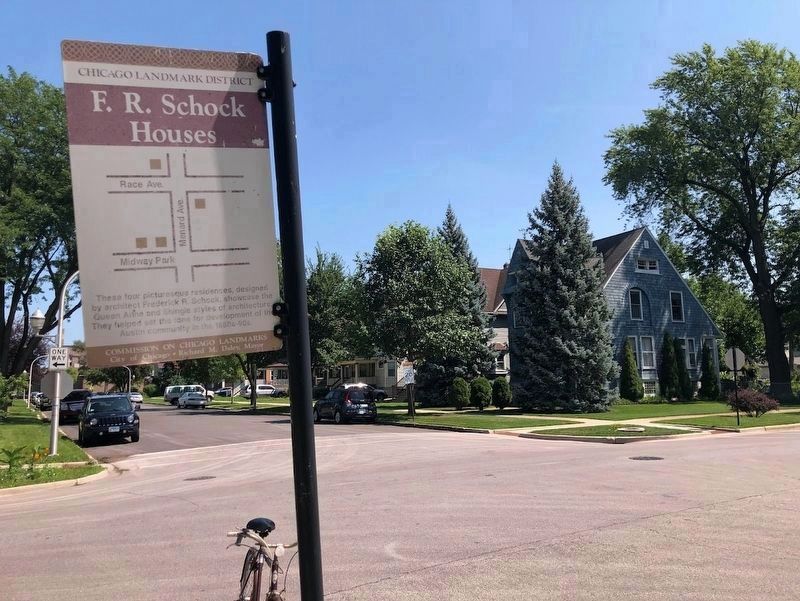
On West Race Avenue at Menard Avenue, on the right when traveling west on West Race Avenue.
These four picturesque residences, designed by architect Frederick R. Schock, showcase the Queen Anne and Shingle styles of architecture. They helped set the tone for development of the Austin community in the 1880s-90s. — — Map (db m237403) HM
On West Ohio Street at North Waller Avenue, on the left when traveling east on West Ohio Street. Reported missing.
When this house was built, Austin was an independent suburb, accessed from Chicago by commuter railroad. One of the oldest houses in the community, it was built for Charles Hitchcock, an executive of a railroad parts manufacturing company. Its tall . . . — — Map (db m271638) HM
On North Central Avenue 0.1 miles north of West Madison Street, on the right when traveling south.
Built four years after the suburb of Austin was annexed to Chicago, this house is among the best of Wright's experiments with inexpensive residences. Within a narrow lot, the house has all the features of his mature Prairie style, characterized by a . . . — — Map (db m235806) HM
On West Race Avenue at North Menard Avenue, on the left when traveling west on West Race Avenue.
This rare example of a small-scale Shingle Style residence was built for the architect's mother. It combines many features of the style, including exaggerated gables, broad surfaces of shingle cladding, and minimal trim. It reportedly influenced the . . . — — Map (db m271636) HM
On Mayfield Avenue north of Fulton Street, on the left when traveling south.
The Commission on Chicago Architectural Landmarks, by authority of the City Council of the City of Chicago, has designated this building as an architectural landmark
City of Chicago
Richard J. Daley, Mayor
February 11, 1960 — — Map (db m259562) HM
On Belmont Avenue at Pulaski Road, on the left when traveling west on Belmont Avenue.
This building is a significant early 20th-century industrial building built for one of Chicago's best-known manufacturers. Founded and headquartered in the city for many years, the Florsheim Shoe Company was one of the nation's leading shoe . . . — — Map (db m94316) HM
On West Exchange Avenue east of Peoria Street, on the left when traveling west.
At one time sprawling over 475 acres, the Union Stock Yard thrived for more than a century, then closed entirely. This rugged gate, erected in 1875, survives as one of the few visual reminders of Chicago's past supremacy in the livestock and . . . — — Map (db m244150) HM
On 99th Street at South Walden Parkway, on the right when traveling east on 99th Street.
This is a rare surviving example of a nineteenth-century commuter railroad station in Chicago, one of six in a landmark district stretching from 91st to 115th streets. Stations such as these helped promote the development of many of the city's, . . . — — Map (db m248805) HM
On South Pleasant Avenue south of 93rd Street, on the right when traveling south.
This building represents an important period of experimentation in the career of one of the world's best-known architects. Its horizontal massing, broad porch, and decorative treatment prefigure Wright's later work, demonstrating the evolving form . . . — — Map (db m248804) HM
On South State Street north of East 41st Street, on the right when traveling north.
This church building was the location, in early September 1955, of the open-casket visitation and funeral for Emmett Till, an African-American teenager from Chicago who was murdered while visiting relatives in Mississippi. His brutal, . . . — — Map (db m312330) HM
On West Armitage Avenue at North Oakley Avenue, on the right when traveling east on West Armitage Avenue.
From the 1890s up to Prohibition, brewing companies built and operated their own taverns, or "tied-houses," throughout Chicago's neighborhoods. This building is designed in the German Renaissance Revival-style of architecture which was used in the . . . — — Map (db m284976) HM
On Irving Park Road (Illinois Route 19) 0.1 miles west of DuSable Lake Shore Drive (U.S. 41).
Barry Byrne began his architectural career with Frank Lloyd Wright. Using Wright's teachings as the basis for developing a personal style, Byrne set new precedents in modern ecclesiastical architecture, creating original expressions in a genre . . . — — Map (db m261345) HM
On South Western Avenue south of 63rd Street, on the right when traveling south.
Built during a period of economic prosperity in the 1920s, the former Marquette Park State Bank represents the "golden age" of bank architecture. It is a fine example of Classical Revival architecture, with its monumental limestone columns and . . . — — Map (db m277605) HM
These nine structures are what remains of "The Metropolis," one of the nation's most significant landmarks of African-American urban history. Developed during the first decades of the 20th century, this "city-within-a-city was home to numerous . . . — — Map (db m270515) HM
On South Giles Avenue north of 35th Street, on the right when traveling south.
One of the few surviving collections of rowhouses on the South Side, dating from the late-19th and early-20th centuries and including early works by famed architects Louis H. Sullivan and Frank Lloyd Wright. — — Map (db m270289) HM
On South State Street, on the right when traveling north.
Chicago Bee Building
Z. Erol Smith, architect
1929-31
This Art Deco-style building was constructed as
the headquarters for the Chicago Bee newspaper,
which was founded by noted African American
entrepreneur Anthony Overton. It also . . . — — Map (db m188754) HM
On South Indiana Avenue, on the right when traveling north.
Chicago Defender Building
Built 1899; remodeled 1915
This former Jewish synagogue was home to the
Chicago Defender from 1920 until 1960. Founded
by Robert S. Abbott in 1905, the newspaper
became nationally known for its . . . — — Map (db m188261) HM
Near South State Street 0.1 miles north of 35th Street, on the right when traveling south.
This defining structure of 20th-century architecture is one of the masterpieces of this world reknowned architect. Designed to house the Illinois Institute of Technology's departments of architecture, planning, and design, the building's dramatic . . . — — Map (db m270262) HM
On South Giles Avenue at 38th Street, on the right on South Giles Avenue.
The District's five groups of masonry row houses, built between 1886 and 1892, are designed in architectural styles ranging from Italianate, Queen Anne, Romanesque, and Classical Revival to the unusual Flemish Revival style. The house at 3800 S. . . . — — Map (db m299691) HM
On East 39th Street east of South Giles Avenue, on the right when traveling west.
The District's five groups of masonry row houses, built between 1886 and 1892, are designed in architectural styles ranging from Italianate, Queen Anne, Romanesque, and Classical Revival to the unusual Flemish Revival style. The house at 3800 S. . . . — — Map (db m299692) HM
On South Calumet Avenue at East 38th Street, on the right when traveling south on South Calumet Avenue.
The District's five groups of masonry row houses, built between 1886 and 1892, are designed in architectural styles ranging from Italianate, Queen Anne, Romanesque, and Classical Revival to the unusual Flemish Revival style. The house at 3800 S. . . . — — Map (db m299693) HM
On South Calumet Avenue south of 38th Street, on the right when traveling south.
The District's five groups of masonry row houses, built between 1886 and 1892, are designed in architectural styles ranging from Italianate, Queen Anne, Romanesque, and Classical Revival to the unusual Flemish Revival style. The house at 3800 S. . . . — — Map (db m299694) HM
On South Calumet Avenue north of Pershing Road, on the right when traveling north.
The District's five groups of masonry row houses, built between 1886 and 1892, are designed in architectural styles ranging from Italianate, Queen Anne, Romanesque, and Classical Revival to the unusual Flemish Revival style. The house at 3800 S. . . . — — Map (db m299699) HM
On South State Street south of East 35th Street, on the right when traveling north.
Overton Hygienic Building
Built 1922-23
Built as the headquarters for the Overton
Hygienic Co., one of the nation's foremost
producers of African-American cosmetics, this
structure also housed the Victory Life Insurance
Company and . . . — — Map (db m180693) HM
Near South Indiana Avenue near East 33rd Boulevard.
Pilgrim Baptist Church
Adler and Sullivan, Architects
1891
The decorative and planning skills of Sullivan and the engineering ability of Adler are embodied in the strong masonry forms of this building, embellished with terra-cotta . . . — — Map (db m189477) HM
On Calumet Avenue 0.1 miles north of 33rd Street, on the right when traveling north.
These are the only row houses designed by Wright that were actually built. The facades display the steeply pitched triangular gables and rectangular bands of windows characteristic of the English Tudor style. Sullivanesque terracotta ornament . . . — — Map (db m262319) HM
On South Michigan Avenue 0.1 miles north of 31st Street, on the right when traveling south.
The generous window openings and the sculpted qualities of the materials are a precursor to the firm's later works, such as the Rookery and Monadnock Building. Built for one of the founders of the Chicago Union Stock Yard Company, this is one of the . . . — — Map (db m286360) HM
On South Calumet Avenue at East 35th Street, on the right when traveling south on South Calumet Avenue.
Sunset Cafe
Built 1909
Following a 1921 remodeling, this simple
automobile garage was transformed into one
of the city's earliest and most legendary jazz
venues. Its house orchestra featured such
famed musicians as Louis . . . — — Map (db m189053) HM
On South Martin Luther King Drive at East 35th Street, on the right when traveling north on South Martin Luther King Drive.
This was the longtime headquarters of the Supreme Life Insurance Co., the first African-American owned and operated insurance company in the northern United States. The firm was founded in 1919 by Frank L. Gillespie, and moved into this building in . . . — — Map (db m188528) HM
On South Indiana Avenue, on the right when traveling south.
Unity Hall
L. B. Dixon, architect
1887
Originally built as the Lakeside Club, a Jewish
social organization, this structure was renamed
in 1917 when it became the headquarters of the
Peoples Movement Club, a political . . . — — Map (db m189249) HM
On East Pershing Road west of South Giles Avenue, on the right when traveling west.
Named for a prominent 19th-century abolitionist, this Classical Revival-style school was Chicago's first predominantly African-American high school. It is noteworthy for its many distinguished alumni and faculty, including Chicago's first . . . — — Map (db m299662) HM
Near East 35th Street at South Lake Park Avenue, on the left when traveling east.
United States Senator Stephen Douglas, who died in 1861 at the age of forty-eight, was a firm believer in the future of Chicago. He held states offices and became nationally known for his debating skill in the Senate and in his campaign against . . . — — Map (db m120728) HM
On West Walnut Street east of North Francisco Avenue, on the left when traveling east.
Commissioned by prominent real estate developer Edward Carson Waller to meet the demand for affordable housing, these apartments are considered among the earliest examples of subsidized housing in Chicago. The simplified design of the facade . . . — — Map (db m294369) HM
On South Avenue G at South Crilly Drive on South Avenue G.
This cast-concrete park fieldhouse is an excellent example of the Classical Revival architectural style and is comprised of a large central pavilion, flanked by two gymnasium wings. Its design elements feature eyebrow dormers, large-scale . . . — — Map (db m252550) HM
On North Sheridan Road 0.1 miles north of Rosemont Avenue.
This Prairie-style house was designed by one of the finest progressive Chicago architects of the early 20th century and is one of the finest remaining mansions on North Sheridan Road. Roughly rectangular in form, the house has both foliate and . . . — — Map (db m287281) HM
When it opened in 1930, this Art Deco-style bank building projected a stylish image to what was one of the busiest commercial districts in Chicago. Characteristics of the Art Deco include the building's sleek limestone façade, geometric ornament, . . . — — Map (db m314337) HM
On South Harvard Avenue at West Marquette Road, on the left when traveling south on South Harvard Avenue.
This light-brown brick church, built as the Fourth Church of Christ, Scientist, is an architecturally significant religious building designed in the Classical Revival style. It was designed by one of Chicago's most significant late 19th-century . . . — — Map (db m314343) HM
On South Stewart Avenue north of West Normal Parkway, on the right when traveling south.
This handsome church is a Gothic Revival-style building clad in yellow-hued Joliet limestone with handsome exterior detailing including its steeply-pitched, cross-gable root and pointed-arch windows and doors, and a distinctive interior with an . . . — — Map (db m314338) HM
On South Yale Avenue at West 66th Avenue on South Yale Avenue.
This building, an excellent "first-generation" tall apartment building, is designed in the Richardsonian Romanesque style with Classical-style details. It has a rare enclosed interior atrium, topped by a glass-and-iron skylight, off of which open . . . — — Map (db m314341) HM
Near North Forest Glen Avenue south of North Latham Avenue, on the right when traveling north.
This vernacular carpenter-builder house is one of the oldest-surviving buildings in the Forest Glen neighborhood. It has Queen Anne-style wood details typical of the carpenter guides popular at the time and is remarkably intact. It was built by . . . — — Map (db m248200) HM
On North Prescott Avenue at North Livermore Avenue, on the right when traveling west on North Prescott Avenue.
This distinctive example of a railroad suburb, platted in 1894, was built near the Chicago, Milwaukee & St. Paul Railroad, and many early residents were company officials. — — Map (db m242955) HM
On West Armitage Avenue east of North Nordica Avenue, on the right when traveling west.
The genesis of the house is perhaps unlike any other in Chicago for it was built as a grand prize for a raffle sponsored by the St. William Catholic parish located nearby. The name Miracle House first appeared on the raffle tickets, and it has . . . — — Map (db m268952) HM
On North Central Park Avenue 0.1 miles south of West Washington Boulevard, on the right when traveling south.
Built to serve as the headquarters of the West Park Commission, this building was converted into a fieldhouse with the formation of the Chicago Park District in 1934. It is a fine example of Spanish Baroque Revival style of architecture, with its . . . — — Map (db m313746) HM
The clarity, simplicity, and order of the Madlener House make it an outstanding residence in the tradition of the Chicago and Prairie schools of architecture. It has the massing, logic, and dignity of a Renaissance palace, yet is a thoroughly modern . . . — — Map (db m261352) HM
On East Bellevue Place east of North State Street, on the left when traveling east.
Bryan Lathrop House
McKim, Mead and White, architects
1892
Drawing inspiration from the neo-classical styles of
the eighteenth century, Charles Follen McKim here
created a residence of great dignity and elegance.
The clarity and . . . — — Map (db m180726) HM
This rare Art Moderne-style design is also one of the city's best examples of pre-World War II modernism. Further distinguishing the building is its handcrafted ornamentation by prominent artist Edgar Miller. The 12 residential units front on a . . . — — Map (db m235355) HM
On North Dearborn Street north of Goethe Street, on the right when traveling south.
Built to provide a safe, supportive, and economical residence for young women studying the arts, this was one of a number of structures designed for artists around the turn of the century, indicative of a growing appreciation for the arts in urban . . . — — Map (db m242449) HM
On South Vincennes Avenue near East 45th Street, on the right when traveling north.
Ebenezer Missionary Baptist Church
(Originally, Isaiah Temple)
Dankmar Adler, architect
1898-99
Built as one of Chicago's early Reform Judaism synagogues, this
Classical Revivial-style building is the last building designed by
famed . . . — — Map (db m188631) HM
On South King Drive, on the right when traveling south.
Melissia Ann Elam Home
Henry L. Newhouse, Architect
1903
This Chateauesque mansion was purchased in the 1920s by Melissia Ann Elam, who [illegible] in Chicago. — — Map (db m181855) HM
On South Vincennes Avenue at East 48th Place, on the right when traveling north on South Vincennes Avenue.
Richard Wright House
architect unknown
1893
While residing, in the second-floor apartment of this building
from 1929 to 1932, celebrated author Richard. Wright effectively
began his professional literary career writing his first . . . — — Map (db m188618) HM
On South Greenwood Avenue at East 53rd Street, on the right when traveling south on South Greenwood Avenue.
This group of 20 visually distinctive row houses
was built in 1903 by one of Chicago's most prolific
early developers, Samuel E. Gross. The fine detailing
and craftsmanship used for building entrances and
cornices reflect the influence of the . . . — — Map (db m188627) HM
On 57th Drive near DuSable Lake Shore Drive (U.S. 41), on the right. Reported missing.
Originally built as the Palace of Fine Arts for the World's Columbian Exposition, this plaster-clad structure later became the first home of the Field Museum of Natural History. After the museum left in the 1920s, the decayed building was . . . — — Map (db m238465) HM
On North Avers Avenue 0.1 miles north of West Addison Street, in the median.
Attracted by landscaped parkways and a requirement that all houses be in the bungalow mode, buyers in this development built residences, largely between 1907 and 1922, that show the influence of the Prairie and Craftsman styles and also the . . . — — Map (db m294846) HM
On South Ellis Avenue at East 49th Street on South Ellis Avenue.
Once referred to as the "Lake Forest of the South,"
this residential suburb was annexed to Chicago in 1889.
It was home to many of the city's leading industrialists,
who built residences designed by such notable architects
as George Maher, . . . — — Map (db m188828) HM
On South Greenwood Avenue near East 46th Street, on the right when traveling south.
Kenwood United Church of Christ
William. W. Boyington and Henry B. Wheelock,
architects
1887-88
This Richardsonian Romanesque-style church building is
a textbook example of this medieval-influenced style, popular in
the late nineteenth . . . — — Map (db m188566) HM
On North Lincoln Boulevard near North Marshfield Avenue.
This terra-cotta-clad flat-iron building makes the most of its triangular building lot. Like many neighborhood banks from the 1920s, the Marshfield Trust and Savings Bank employed the Classical Revival style of architecture to convey a sense of . . . — — Map (db m208809) HM
On North Pine Grove Avenue at West Diversey Parkway, on the right when traveling south on North Pine Grove Avenue.
Brewster Apartments
Enoch H. Turnock, architect
1893
The principles of skeleton-frame construction
that made possible tall commercial buildings
were used here for an early highrise apartment
building, originally known as the . . . — — Map (db m187901) HM
On Addison Street west of Halsted Street, on the right.
The 42nd/Town Hall Police Station is one of the oldest police staions in the City and represents a rare, remaining example of this building type. The building was built in 1907 on the site of the demolished Lake View Township Town Hall, . . . — — Map (db m261281) HM
On Byron Street at Alta Vista Terrace, on the right when traveling west on Byron Street.
Alta Vista Terrace displays a lively variety of architectural styles and detail, yet every townhouse on one side is duplicated with only minor variations at the diagonally opposite end of the block. The distinctly human scale creates a unity and . . . — — Map (db m261324) HM
On Alta Vista Terrace at Grace Street on Alta Vista Terrace.
Alta Vista Terrace displays a lively variety of architectural styles and detail, yet every townhouse on one side is duplicated with only minor variations at the diagonally opposite end of the block. The distinctly human scale creates a unity and . . . — — Map (db m261326) HM
On Newport Avenue 0.1 miles east of Sheffield Avenue, on the left when traveling east.
This distinctive and highly intact ensemble of buildings exemplifies the high-quality working-class residential architecture constructed in Chicago's neighborhoods during the late 19th and early 20th centuries as the city expanded outward into . . . — — Map (db m261279) HM
On Newport Avenue west of Halsted Street, on the left when traveling east.
This distinctive and highly intact ensemble of buildings exemplifies the high-quality working-class residential architecture constructed in Chicago's neighborhoods during the late 19th and early 20th centuries as the city expanded outward into . . . — — Map (db m261280) HM
Near West LaSalle Drive 0.1 miles east of North Stockton Drive, on the right when traveling east.
One of the oldest and most important public sculptures in Chicago, this monument to America’s sixteenth president influenced a generation of sculptors due to its innovative combination of a natural-looking Lincoln-–depicted deep in thought as . . . — — Map (db m47815) HM
On West Fullerton Parkway at North Cannon Drive, on the right when traveling east on West Fullerton Parkway.
One of the most important historic landscapes in Chicago, this “hidden garden” in Lincoln Park was designed by note landscape architect Alfred Caldwell in the Prairie style. Inspired by his mentor Jens Jensen and the work of architect . . . — — Map (db m47845) HM
On Orchard Street south of Deming Place, on the left when traveling north.
These streets in the Lincoln Park neighborhood are lined with visually-distinctive single-family houses, apartment buildings, and institutional buildings that exemplify the high-style architecture historically built in Chicago's fashionable . . . — — Map (db m261232) HM
On Arlington Place west of Geneva Terrace when traveling east.
These streets in the Lincoln Park neighborhood are lined with visually-distinctive single-family houses, apartment buildings, and institutional buildings that exemplify the high-style architecture historically built in Chicago's fashionable . . . — — Map (db m261233) HM
On Arlington Place west of Clark Street, on the left when traveling east.
These streets in the Lincoln Park neighborhood are lined with visually-distinctive single-family houses, apartment buildings, and institutional buildings that exemplify the high-style architecture historically built in Chicago's fashionable . . . — — Map (db m261234) HM
On Armitage Avenue west of Halsted Street. Reported unreadable.
These streets form one of the most picturesque and intact 19th-century neighborhood commercial streetscapes remaining in Chicago. Ornamented with a profusion of pressed-metal bays, cornices, and corner turrets, these Victorian-era buildings display . . . — — Map (db m261189) HM
On West Wrightwood Avenue at North Hampden Court on West Wrightwood Avenue.
The August Dewes House is one of a pair of architecturally complimentary houses built by two German-born brothers who were executives of the Standard Brewery in Chicago. With its handsomely-detailed stone facades and distinctive mansard root, the . . . — — Map (db m261270) HM
This unique ensemble of residential flats was intended to resemble an elite street of mansions. Because it was financed, designed, and built as a single development, it possesses a unified layout that is unusual among Chicago residential blocks. . . . — — Map (db m261202) HM
On W south of Webster Avenue, on the left when traveling north.
This unique ensemble of residential flats was intended to resemble an elite street of mansions. Because it was financed, designed, and built as a single development, it possesses a unified layout that is unusual among Chicago residential blocks. . . . — — Map (db m261203) HM
On North Lakeview Avenue, on the right when traveling south.
Elks National Memorial Headquarters Building
Egerton Swartwout, architect
1924-26
This building was constructed by the Benevolent and Protective
Order of Elks, an American fraternal organization, in tribute to
the 1,037 Elks who died . . . — — Map (db m188338) HM WM
On Wrightwood Avenue at Hampden Court on Wrightwood Avenue.
The exuberant baroque detailing of the Dewes House reflects the European background of the original owner and his two architects. The house is a monument to old-world splendor, an example of the eclectic architecture popular in Chicago after the . . . — — Map (db m261265) HM
On North Fremont Street at Dickens Avenue, on the right when traveling south on North Fremont Street.
This rare grouping of twenty 1870s Italianate-style row houses was designed by Edward J. Burling, one of Chicago's earliest and important architects. They were conceived as a unified composition with similar incised window hoods and a common wood . . . — — Map (db m261200) HM
This rare grouping of twenty 1870s Italianate-style row houses was designed by Edward J. Burling, one of Chicago's earliest and important architects. They were conceived as a unified composition with similar incised window hoods and a common wood . . . — — Map (db m261207) HM
One of the oldest surviving buildings designed by Dankmar Adler and Louis Sullivan, an architectural partnership that helped transform modern architecture. It illustrates the type of design innovations and distinctive ornamentation that Sullivan . . . — — Map (db m261226) HM
Located in one of the country's oldest municipal zoological parks, the Lion House blends both the grandly-scaled public architecture of the Classical style with the innovative Prarie style developed by Chicago architects in the early 20th century. . . . — — Map (db m10653) HM
These row houses were built as an investment by the McCormick Theological Seminary which was located here from 1863 to 1975. Designed in a simplified Queen Anne style, with a private street and park in the center of the development, these houses are . . . — — Map (db m261213) HM
Near North Stockton Drive 0.4 miles north of LaSalle Drive ( Route 64), on the right when traveling north.
This comfort station, commonly known as the Carlson Cottage, exemplifies Victorian-era picturesque architecture and reflects a commitment to constructing high quality buildings in the park even for the most mundane functions. Trained at MIT and . . . — — Map (db m293430) HM
On West Dickens Street at North Sedgwick Street, on the right when traveling west on West Dickens Street.
These streets feature a cross-section of architectural styles and building types from the late-19th century, including pre-Fire of 1871 wood cottages, Italianate style rowhouses, and masonry residences designed in the Queen Anne and Richardsonian . . . — — Map (db m289975) HM
On North Sedgwick Street north of Dickens Street, on the right when traveling south.
These streets feature a cross-section of architectural styles and building types from the late-19th century, including pre-Fire of 1871 wood cottages, Italianate style rowhouses, and masonry residences designed in the Queen Anne and Richardsonian . . . — — Map (db m289988) HM
On West Fullerton Parkway at Cleveland Street on West Fullerton Parkway.
These streets feature a cross-section of architectural styles and building types from the late-19th century, including pre-Fire of 1871 wood cottages, Italianate style rowhouses, and masonry residences designed in the Queen Anne and Richardsonian . . . — — Map (db m289992) HM
On North Sedgwick Street at North Clark Street, on the right when traveling south on North Sedgwick Street.
This area, with its concentration of brick row houses,
is typical of urban residential communities developed
during the last three decades of the nineteenth
century. The high quality of its architecture, well-
preserved and well-maintained, . . . — — Map (db m185766) HM
On North Clark Street south of West Wrightwood Avenue, on the left when traveling south.
North Chicago Hospital Building
Meyer J. Sturm, architect;
M. Louis Kroman, associated architect
1928-29
This building is a handsome example of a neighborhood hospital
building, built when Chicago was dotted with small . . . — — Map (db m180732) HM
On North Clark Street north of West Belden Avenue.
Noted for its highly accurate use of ancient Egyptian imagery and hieroglyphics, this building represents one of the nation's best examples of pure academic-style Egyptian Revival architecture. It was built by a storage and moving company founded by . . . — — Map (db m289990) HM
Built by brewer Joseph Theurer and sold in 1911 to chewing gum manufacturer William Wrigley, Jr., this is an early design by Richard Schmidt and possibly Hugh Garden, who were part of the Prairie school movement but whose first designs were in a . . . — — Map (db m261236) HM
On Ravenswood Avenue at Rosehill Drive, on the left when traveling north on Ravenswood Avenue.
Designed by the architect of the Old Chicago Water Tower and predating it by five years, the Rosehill Cemetery Entrance is a rare Midwestern example of castellated Gothic architecture. Many prominent Chicagoans are buried here in plots marked by . . . — — Map (db m94331) HM
On South Halsted Street at West Polk Street, on the right when traveling south on South Halsted Street.
Here, in 1899, Jane Addams and Ellen Gates Starr started what became the most influential social settlement in America. It eventually consisted of several buildings around this house which had been built in 1856 by Charles Hull. The Dining Hall . . . — — Map (db m61819) HM
On 26th Street east of Troy Street, on the right when traveling west.
This Arch marks the eastern gateway to West 26th Street, Little Village's vibrant retail corridor which has been referred to as the "Mexican capital of the Midwest." The Arch is unique in Chicago as the only example of a street gateway inspired . . . — — Map (db m258347) HM
On West Fullerton Avenue at Central Park Avenue, on the right when traveling west on West Fullerton Avenue.
This building is a fine example of the impressive bank buildings constructed in Chicago's neighborhoods during a period of national prosperity in the 1920s. Like many banks from that time, it uses the Classical Revival style of architecture to . . . — — Map (db m273130) HM
On West Logan Boulevard west of North Washtenaw Avenue, on the right when traveling east.
Like his contemporary Frank Lloyd Wright, Maher attempted to redefine American residential architecture. This building's traditional boxlike form is updated by a broad hipped roof and stark window and door openings. John Rath, who commissioned the . . . — — Map (db m273133) HM
On West Cortland Street at North Humboldt Boulevard, on the right when traveling west on West Cortland Street.
Featuring streetscapes of handsome mansions, apartment buildings, and institutional and commercial buildings from the 1880s through the 1930s, the District is one of the best-preserved portions of Chicago's extensive park boulevards system. — — Map (db m234590) HM
On West Shakespeare Avenue at North Humboldt Avenue on West Shakespeare Avenue.
Featuring streetscapes of handsome mansions, apartment buildings, and institutional and commercial buildings from the 1880s through the 1930s, the District is one of the best-preserved portions of Chicago's extensive park boulevards system. — — Map (db m234591) HM
On West Armitage Avenue at North Humboldt Boulevard, on the left when traveling east on West Armitage Avenue.
Featuring streetscapes of handsome mansions, apartment buildings, and institutional and commercial buildings from the 1880s through the 1930s, the District is one of the best-preserved portions of Chicago's extensive park boulevards system. — — Map (db m234592) HM
On West Palmer Square at North Whipple Street on West Palmer Square.
Featuring streetscapes of handsome mansions, apartment buildings, and institutional and commercial buildings from the 1880s through the 1930s, the District is one of the best-preserved portions of Chicago's extensive park boulevards system. — — Map (db m234593) HM
On West Palmer Street near North Humboldt Boulevard, on the right when traveling east.
Featuring streetscapes of handsome mansions, apartment buildings, and institutional and commercial buildings from the 1880s through the 1930s, the District is one of the best-preserved portions of Chicago's extensive park boulevards system. — — Map (db m234594) HM
On West Logan Boulevard at North Albany Avenue, in the median on West Logan Boulevard.
Featuring streetscapes of handsome mansions, apartment buildings, and institutional and commercial buildings from the 1880s through the 1930s, the District is one of the best-preserved portions of Chicago's extensive park boulevards system. — — Map (db m273206) HM
On West Logan Boulevard near North Francisco Avenue, in the median.
Featuring streetscapes of handsome mansions, apartment buildings, and institutional and commercial buildings from the 1880s through the 1930s, the District is one of the best-preserved portions of Chicago's extensive park boulevards system. — — Map (db m273209) HM
On West Logan Boulevard at North California Avenue, in the median on West Logan Boulevard.
Featuring streetscapes of handsome mansions, apartment buildings, and institutional and commercial buildings from the 1880s through the 1930s, the District is one of the best-preserved portions of Chicago's extensive park boulevards system. — — Map (db m273211) HM
On West Logan Boulevard at North Campbell Avenue, in the median on West Logan Boulevard.
Featuring streetscapes of handsome mansions, apartment buildings, and institutional and commercial buildings from the 1880s through the 1930s, the District is one of the best-preserved portions of Chicago's extensive park boulevards system. — — Map (db m273212) HM
284 entries matched your criteria. The first 100 are listed above. Next 100 ⊳