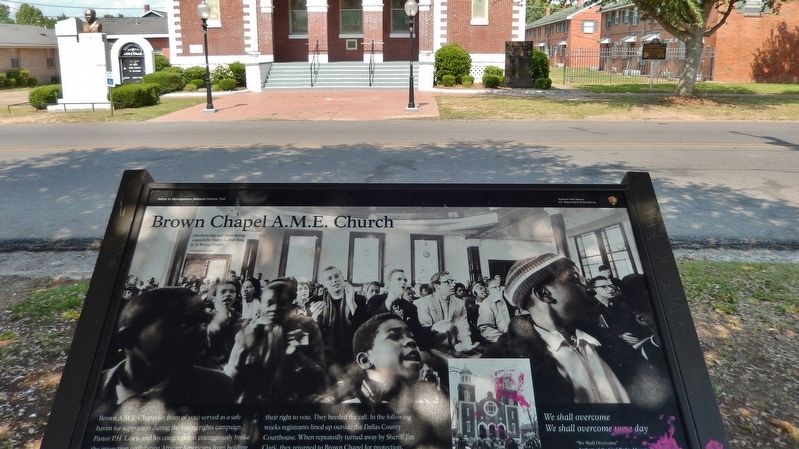
On Martin Luther King Street 0.1 miles south of Clark Avenue, on the right when traveling south.
Brown A.M.E. Chapel (in front of you) served as a safe haven for supporters during the voting rights campaign. Pastor P.H. Lewis and his congregation courageously broke the injunction prohibiting African Americans from holding mass meetings, making . . . — — Map (db m131995) HM
On Martin Luther King Street north of Selma Avenue, on the right when traveling north.
The demonstration that led to the most important advance in civil rights for millions of Black Americans began here March 21, 1965. It was the 50-mile march from Selma to Montgomery, Alabama, the State Capital.
Defying threats of death, Dr. . . . — — Map (db m83578) HM
On Palm Sunday, 1963 Rev. N. H. Smith, Rev. John T. Porter and Rev. A. D. King led a sympathy march from St. Paul United Methodist Church down 6th Avenue North in support of Rev. Martin Luther King, Jr., Rev. Fred Shuttlesworth and Rev. Ralph . . . — — Map (db m73023) HM
Born Jan. 15, 1929 Assassinated Apr. 4. 1968 "...yes, if you want to say that I was a drum major, say that I was a drum major for justice; say that I was a drum major for peace..." His dream liberated Birmingham from itself and began a . . . — — Map (db m73007) HM
Rev. Fred Shuttlesworth invited Dr. Martin Luther King, Jr. to Birmingham in 1962. Shuttlesworth saw potential in the young minister, and their combined efforts were instrumental in Birmingham's desegregation. The campaign catapulted King into the . . . — — Map (db m73031) HM
Responsible for much planning and leadership, the clergy played a central role in the Birmingham Campaign--like the famous Palm Sunday incident in 1963 (see nearby plaque). Local clergy like Rev. Fred Shuttlesworth worked with out-of-town ministers, . . . — — Map (db m73080) HM
Near Myron Massey Boulevard north of 55th Street, on the left when traveling north.
Miles College Leaders. Students Active During Civil Rights Era
The Colored Methodist Episcopal Church founded Miles College in
Fairfield in 1898. During the 1960s, President Lucius Pitts
encouraged students, faculty and staff to become . . . — — Map (db m153232) HM
. . . I always make it a rule to read a chapter [in the Bible] or a portion of a chapter in the morning, before beginning the work of the day.
—Booker T. Washington, Up From Slavery
The chapel, designed by Paul . . . — — Map (db m100162) HM
On Dexter Avenue at S Decatur Street, on the left when traveling west on Dexter Avenue.
The second black Baptist Church in Montgomery. First pastor was Rev. C. O. Boothe. Present structure built 1885. Designed by Pelham J. Anderson; built by William Watkins, a member of the congregation.
Many prominent black citizens of Montgomery . . . — — Map (db m25128) HM
On South Jackson Street, on the left when traveling south.
Side A House built circa 1912. It has been the home of the ministers of Dexter Avenue Baptist Church since 1919. Its most famous occupant, Dr. Martin Luther King, lived here from Sept. 1954-Feb. 1960. During this time he led the Bus Boycott . . . — — Map (db m86132) HM
On N Bainbridge Street north of Dexter Avenue, on the right when traveling north.
Side A The Selma-to-Montgomery March ended here on March 25, 1965, when 25,000 civil rights marchers arrived at the Alabama State Capitol to demand the right to vote for African Americans. Dr. Martin Luther King Jr. and other civil rights . . . — — Map (db m62747) HM
On Lee Street at Montgomery Street, on the right when traveling north on Lee Street.
This mural depicts the 54-mile march from the Edmund Pettus Bridge in Selma, Alabama to the State Capitol in Montgomery in March 1965. Demonstrators along the bottom march with leaders of the Civil Rights Movement in the center, including Martin . . . — — Map (db m153061) HM
On Claiborne Street (Alabama Route 28/41) 0.2 miles west of Firehouse Road, on the right when traveling west.
[side 1 • faces east] In 1886, William Henderson, a Scottish immigrant, former Union Army Officer, and United Presbyterian moved from New York to Wilcox County. He saw the plight of freed slaves and urged his children to begin schools in the . . . — — Map (db m228693) HM
Near Campanile Drive north of Montezuma Road, on the right when traveling north.
Open Air Theatre - San Diego State College
May 29th, 1964
"We must learn to live together as brothers or we will perish together as fools."
On May 29th, 1964, the Reverend Martin Luther King, Jr. visited San Diego State . . . — — Map (db m286139) HM
On April 23, 1964 and April 14, 1967, The Reverend Dr. Martin Luther King, Jr. addressed the Stanford community and local citizens in this Auditorium.
“It may well be that we will have to repeat in this generation, not merely for the . . . — — Map (db m115849) HM
On Martin Luther King Drive at North Street, on the right when traveling north on Martin Luther King Drive.
I Have A Dream
Doctor
Martin Luther
King, Jr.
1929 - 1968
We have inherited a large house, a great world house in which we have to live together – black and white, easterner and westener, gentile and Jew, Catholic and Protestant, Moslem . . . — — Map (db m202466) HM
Near Gales Street Northeast west of 18th Street Northeast, on the right when traveling east.
"I have a dream that my four little children will one day live in a nation where they will not be judged by the color of their skin but by the content of their character."
Do you recognize that quote? It is from a . . . — — Map (db m315962) HM
On E Street Northwest at 13th Street Northwest, on the right when traveling west on E Street Northwest. Reported permanently removed.
“I have a dream.”
Martin Luther King, Jr. August 1963
The block-long plaza at 13th and Pennsylvania Avenue just ahead to your left honors civil rights leader Martin Luther King with the . . . — — Map (db m28528) HM
On G Street Northwest east of 15th Street Northwest, on the right when traveling west.
In founding the Southern Christian Leadership Conference, Dr. Martin Luther King, Jr. gave momentum to the civil rights movement. Dr. King’s persistent efforts, inspiring oratory and non-violent protests, despite physical attacks, death threats and . . . — — Map (db m91920) HM
On 14th Street Northwest at Pennsylvania Avenue Northwest, on the right when traveling south on 14th Street Northwest.
"This hotel, in fact, may be much more justly called the center of Washington and the Union than either the Capitol, the White House, or the State Department...."
Nathaniel Hawthorne, Civil War reporter for The Atlantic . . . — — Map (db m211824) HM
On 14th Street Northwest (U.S. 1) at Pennsylvania Avenue Northwest, on the right when traveling south on 14th Street Northwest. Reported permanently removed.
"This hotel, in fact, may be much more justly called the center of Washington and the Union than either the Capitol, the White House, or the State Department...."
Nathaniel Hawthorne, Civil War reporter for the Atlantic . . . — — Map (db m10905) HM
On 7th Street Northwest north of P Street Northwest, on the right when traveling north. Reported permanently removed.
The assassination of the Rev. Dr. Martin Luther King, Jr. on Thursday, April 4, 1968, changed this neighborhood forever.
When word of Dr. King’s murder spread that evening, Washingtonians gathered along busy 14th and U streets, NW; H . . . — — Map (db m130892) HM
Near Lincoln Memorial Circle Northwest south of Constitution Avenue Northwest (U.S. 50), on the left when traveling north.
[Dedication by Royal Cortissoz, above the statue by sculptor Daniel Chester French:]
"In this temple as in the hearts of the people for whom he saved the Union the memory of Abraham Lincoln is enshrined forever."
[Inscription . . . — — Map (db m28607) HM
On Independence Avenue Southwest at West Basin Drive Southwest, on the left when traveling east on Independence Avenue Southwest. Reported permanently removed.
“With this faith we will be able to hew out of the mountain of despair a stone of hope. With this faith, we will be able to transform the jangling discords of our nation into a beautiful symphony of brotherhood. With this faith, we will be able . . . — — Map (db m46398) HM
Near West Basin Drive Southwest at Independence Avenue Southwest. Reported permanently removed.
At this site will be erected the Martin Luther King, Jr .Memorial. The memorial will embody the man, the movement and the message. It will honor this 20th century visionary who brought about change through the principles of nonviolence and . . . — — Map (db m208) HM
On South Tampa Avenue at West South Street, on the right when traveling north on South Tampa Avenue.
Orlando's Rev. Curtis Jackson invited Rev. Martin Luther King, Jr., to Orlando in 1962. Rev. King was unable to attend at the time, but he did come to Orlando in the Spring of 1964 after leading the 10,000-person March for Freedom in Philadelphia . . . — — Map (db m189260) HM
On North Flagler Drive north of Butler Street, on the right when traveling north.
The Dr. Martin Luther King Jr. landmark Memorial was completed in 2004, commemorating his life, work and civil rights activism. The largest of its kind in Florida and southern parts of the United States, the landmark embodies his fight to bring . . . — — Map (db m180056) HM
On South Elm Avenue just south of West 6th Street, on the left when traveling south.
1 • Helen Keller Southern Magnolia Planted on July 9, 2000 by family in honor of Venus Guess a devoted mother and grandmother. The towering Helen Keller Southern Magnolia may have been one of the trees Helen Keller climbed in the yard . . . — — Map (db m214868) HM
On Myrtle Avenue just south of West 6th Street, on the left when traveling north.
1 • Martin Luther King, Jr. Sycamore Planted on March 4, 2000 by family in memory of Ethel Mae Monroe. The Martin Luther King, Jr. Sycamore stands in front of Brown Chapel AME, a church in Selma, Alabama, where the dedicated young . . . — — Map (db m214872) HM
Zion Baptist Church, with its distinctive double towers, was built in 1921 to house a congregation originally organized in 1886. It is the last house of worship passed by many funerals on their way to several nearby cemeteries, including the one . . . — — Map (db m7803) HM
This building, designed by architect F. A. Hollingsworth, opened in 1953 as the St. Johns County Jail, replacing an earlier jail building on San Marco Avenue that subsequently became a tourist attraction. A decade later, this building played a . . . — — Map (db m40728) HM
Some of the most widely-publicized events of the civil rights movement took place at St. Augustine Beach in the summer of 1964, when wade-ins were conducted at what had historically been a beach reserved for “Whites Only”. Many . . . — — Map (db m40727) HM
The house at 156 Central Avenue was built in the 1950's for Mrs. Janie Price, a nurse at Flagler Hospital. She had taken her nurse's training at Grady Hospital in Atlanta in the 1940s and while there had attended dances with students from Morehouse . . . — — Map (db m7627) HM
64 Washington Street was the Florida State Headquarters of the Southern Christian Leadership Conference (SCLC) during and after the civil rights demonstrations of 1964. SCLC was founded in 1957 by Dr. Martin Luther King, Jr. after the successful . . . — — Map (db m7607) HM
On Bridge Street at Oneida Street, on the right when traveling east on Bridge Street.
The Rudcarlie Building at 79 Bridge Street was built in the 1950's by Dr. Rudolph N. Gordon (1901-1959) and named for the members of his family. Rudolph, Carlotta, and Rosalie. It was the first medical/dental office constructed in St. Augustine . . . — — Map (db m240831) HM
This Victorian house in the historic Lincolnville neighborhood (founded by freed slaves after the Civil War) became a civil rights landmark in 1964. It was a gathering place for people in the movement, where they could meet, rest, seek solace, and . . . — — Map (db m40729) HM
On McDonough Street at Trinity Place, on the right when traveling south on McDonough Street.
Dr. Martin Luther King, Jr. was sentenced here, at the site of the former DeKalb
Building, on October 25, 1960, to four months of hard labor for protesting segregation
with the Atlanta Student Movement at a Rich's Department Store dining room. . . . — — Map (db m173323) HM
On Auburn Avenue NE at Hogue Street NE, on the right when traveling east on Auburn Avenue NE.
Built 1895. Purchased 1909 by Dr. King's maternal grandfather, Dr. A. D. Williams. Birthplace of Dr. King 1929. Acquired with assistance of Alpha Kappa Alpha Sorority 1974. Designated as part of the National Historic Site 1980. Dedicated as part of . . . — — Map (db m73422) HM
On Auburn Avenue NE east of Bouvelard NE, on the left when traveling east.
For his first 12 years Martin Luther King, Jr., lived in the comfortable middle-class home across from you. Two cultural values distinguished the King household: a strong sense of family and the ever-presence of religion. Bad behavior often met . . . — — Map (db m64772) HM
Young Martin Luther King. Jr.'s, childhood here was entirely normal. He did his chores and received his allowance. Neighbors often saw him bouncing a ball off the side of the house or riding his bike along the street. He fought with his brother (he . . . — — Map (db m73182) HM
"Our Stone of Help."
"Then Samuel took a stone and named it Ebenezer for he said, 'Thus far the Lord has helped us.'"
(I Samuel 7:12.)
The Rev. John A. Parker,
Pastor 1886-1894.
The Rev. Dr. Alfred Daniel Williams,
Pastor . . . — — Map (db m5481) HM
Freedom Park celebrates the lives and work of two renowned Georgians and Nobel Peace Prize winners, the Rev. Martin Luther King, Jr., and President Jimmy Carter.
Beginning at the far end of the parking lot, a gentle paved trail extends through . . . — — Map (db m73173) HM
On Irwin Street NE west of Boulevard NE, on the left when traveling west.
I have a dream that my four little children will one day live in a nation where they will not be judged by the color of their skin but by the content of their character.
Dr. Martin Luther King, Jr.
[Photo 1 caption reads]
King and daughter . . . — — Map (db m64767) HM
The Eternal Flame symbolizes the continuing effort to realize Dr. King's ideals for the "Beloved Community" which requires lasting personal commitment that cannot weaken when faced with obstacles. — — Map (db m73174) HM
On Telfair Street (U.S. 441) at Church Street, on the left when traveling north on Telfair Street.
On April 17, 1944, in the 1st A.B. Church of Dublin, Georgia, fourteen year old Martin Luther King, Jr. delivered his first public speech “The Negro and the Constitution.” At this site, a seed was planted in his heart that would grow into his life’s . . . — — Map (db m184511) HM
On Telfair Street (U.S. 441) at Church Street, on the left when traveling north on Telfair Street.
“The Negro and the Constitution” Martin Luther King, Jr. Negroes were first brought to America in 1620 when England legalized slavery both in England and the colonies and America; the institution grew and thrived for about 150 years upon the backs . . . — — Map (db m184525) HM
On Cicero Avenue (Illinois Route 50) at West Chicago Avenue, on the left when traveling north on Cicero Avenue.
Locally famous sculptor Geraldine McCullough's impressive 7 foot tall bronze casting portrays Dr. Martin Luther King, Jr. as an African 15th Century Benin chieftain. The casting was commissioned to create a symbol of peace following the . . . — — Map (db m247476) HM
On Laramie Avenue at Jackson Boulevard, on the right when traveling south on Laramie Avenue.
Pastor of "THE" Friendship Baptist Church - 1955-2006
Builder of this "African Hut" inspired church edifice - 1983
Married to First Lady Mrs. Lucy Mae Lewis Hall for 62 years - 1944-2007
President, Baptist General State Convention of Illinois . . . — — Map (db m261139) HM
On West Marquette Road at South Kedzie Avenue, on the right when traveling east on West Marquette Road.
[Text on the right pillar:]
On Friday, August 5, 1966, Dr. Martin Luther King, Jr. and 700 other people marched into Marquette Park, confronting bigotry, demanding equal housing opportunities and challenging the neighborhood and the City of . . . — — Map (db m285435) HM
On Mann Drive west of South Kedzie Avenue, on the right when traveling west.
Marquette Park is of great significance to America's Civil Rights Movement. Dr. Martin Luther King, Jr. (1929-1968) came to Chicago in 1965 at the invitation of the Chicago Freedom Movement, a coalition of 44 organizations devoted to reforming . . . — — Map (db m285442) HM
On Stony Island Avenue south of Midway Plaisance North, on the right when traveling south.
Chicago’s Boulevards are one of the city’s most overlooked treasures, and one of the largest and oldest boulevard systems in the nation. The 28-mile system contains 540 acres of green space, and provides a link between seven inland parks and . . . — — Map (db m314155) HM
On Midway Plaisance near South Cottage Grove Avenue, in the median.
Chicago’s Boulevards are one of the city’s most overlooked treasures, and one of the largest and oldest boulevard systems in the nation. The 28-mile system contains 540 acres of green space, and provides a link between seven inland parks and . . . — — Map (db m314205) HM
On South Stony Island Avenue south of East 60th Street, on the right when traveling north.
"We shall overcome because the arc of the moral universe is long, but it bends toward justice."
Dr. Martin Luther King Jr.
1965
Martin Puryear's monumental sculpture is inspired by the "long arc," an anchoring image of the Civil Rights . . . — — Map (db m314508) HM
Near South Stony Island Avenue near East 60th Street, on the right when traveling north.
Look up—along the upper south and west sides of the Museum, you can see what President Obama has called some of the most significant words of his presidency.
"You are America. Unconstrained by habit and convention. Unencumbered by what is, and . . . — — Map (db m314509) HM
On North Kedzie Boulevard near West Palmer Square.
Chicago’s Boulevards are one of the city’s most overlooked treasures, and one of the largest and oldest boulevard systems in the nation. The 28-mile system contains 540 acres of green space, and provides a link between seven inland parks and . . . — — Map (db m273249) HM
Untitled (Circulation) is a new work by Kerry James Marshall (MacArthur Fellow, 1997) designed specifically for the BBF Family Services building. The work is composed of photographs taken by the artist over the past four decades of the Bud . . . — — Map (db m258511) HM
On West Douglas Boulevard east of South Millard Avenue, on the right when traveling west.
This monumental brick and stone edifice was built in 1926 as a synagogue for Jewish immigrants who came to the U.S. to escape anti-Semitism in Romania. In 1954 the building was bought by an African-American Baptist congregation under the leadership . . . — — Map (db m249361) HM
Near Carroll Avenue south of Lucinda Avenue, on the left when traveling north.
With the support of NIU's governing board, the Dr. Martin Luther King, Jr. Memorial Commons was commissioned December 8, 1983, and completed in 1992.
This bust of Dr. Martin Luther King, Jr, was created by Peter Fagan, and installed in . . . — — Map (db m309151) HM
On Brainard Street 0.3 miles south of Chicago Avenue.
The Rev. George St. Angelo, Class of 1943, returned to his alma mater in 1955 to serve as the College's first chaplain. In this role, he opened students' eyes to concepts of social justice by bringing prominent national speakers, such as Dr. Martin . . . — — Map (db m257223) HM
On South 2nd Street at East Capitol Avenue, on the right when traveling north on South 2nd Street.
Rev. Dr. King was not only a civil rights reform activist, he stood for equality among all peoples. His dream for the equal rights of all mankind has left our society a better place for all people.
His dream lives on even after his . . . — — Map (db m268976) HM
On West Michigan Street at North Senate Avenue, on the right when traveling east on West Michigan Street. Reported missing.
African-American leaders formed the Young Men’s Prayer Band in 1900. It became a branch of the city YMCA by 1910. Black and white leaders helped raise funds for a new building here, which opened as the Senate Avenue YMCA in 1913. Booker T. . . . — — Map (db m127963) HM
Here on the evening of April 4, 1968, Kennedy came to address a large crowd of mostly African Americans in his bid for Democratic Party nomination for president of U.S. Instead, visibly shaken, he gave an impromptu speech about the assassination of . . . — — Map (db m236) HM
On West 7th Street at Walnut Street, on the right when traveling west on West 7th Street.
Moneta J. Sleet, Jr.
Born in Owensboro. Sleet was a graduate of Ky. State College and New York Univ. Beginning in 1955, he worked as photojournalist for Jet and Ebony magazines for 41 yrs. During the 1950s-60s, his photos . . . — — Map (db m159338) HM
On Third Street south of Lasalle Street, on the left when traveling south.
Founded in 1921 by R.C. Matthews and 45 members, New Zion Baptist Church moved to 2319 Third Street in 1949. Here, under the leadership of Rev. A.L. Davis, Jr., the Southern Christian Leadership Conference (SCLC) became a permanent organization . . . — — Map (db m95835) HM
On State Circle east of School Street, on the left when traveling east.
This tree is dedicated to the memory of
Dr. Martin Luther King, Jr.
1929 - 1968
"Freedom must ring from every mountainside…and when this happens, all…will be able to stand together…and sing a new song… Free at last, free . . . — — Map (db m295710) HM
The Dr. Martin Luther King, Jr. Memorial was given to Anne Arundel Community College by the Citizens of Maryland. May this memorial remind all that visit this site, that an individual can make a difference.
In the 1930s, Old West Baltimore matured into a self-sustaining, thriving community that nurtured the mind, body and spirit. Old West Baltimore was home to many churches, shops, professional offices, banks and financial institutions, educational . . . — — Map (db m168766) HM
Hear!
Dr. Martin Luther King
at
First Baptist Church
Central Square, Cambridge, Massachsuetts
Sunday, January 10, 1960 -- 7:30 P.M.
Special music by the Boston University Seminary Singers
Sponsored by the Cambridge . . . — — Map (db m215277) HM
On Garden Street west of Massachusetts Avenue (Massachusetts Route 2A), on the right when traveling east.
The thirteen tower bells, known as The Harvard Chime, were given in 1860 by Richard Henry Dana, Jr., author of Two Years Before the Mast, with other Harvard alumni and citizens of Cambridge.
Theodore Roosevelt taught Sunday School . . . — — Map (db m215347) HM
Near Tremont Street south of West Street, on the right when traveling south.
The Embrace | 2022
Hank Willis Thomas and MASS Design Group
Commissioned by Embrace Boston, the Boston Foundation, and the City of Boston
Sculpture: Patinated bronze
Plaza: Granite with bronze inlay
From the . . . — — Map (db m231892) HM
Near W. Elm Avenue west of North Monroe Street (Michigan Route 125).
“If you are cut down in a movement that is designed to save the soul of a nation, then no other death could be more redemptive. We must somehow believe that unearned suffering is redemptive. We must work passionately and indefatigably to bridge . . . — — Map (db m72501) HM
Near Scholars Walk 0.1 miles west of Church Street SE, on the right when traveling west.
Founding Principles
The University of Minnesota was chartered in 1851 on the principle of broad access to education. Yet, for much of the University's history the advantages of higher education were out of reach for many. Economic, . . . — — Map (db m156522) HM
On Spencer Street at Milton Barnes Avenue, on the right when traveling north on Spencer Street.
On this site stood the old Mount
Zion Baptist Church, demolished in
1993. Known locally as "The Cvil
Rights Church", the church hosted
a "Freedom School” in 1964 and
many mass meetings during the
Civil Rights Movement. Dr. . . . — — Map (db m118478) HM
On Hoskins Road at Panola Avenue, on the right when traveling north on Hoskins Road.
On Tuesday, March 19, 1968, Dr. Martin Luther King Jr. and a number of his aides came to Batesville to enlist participants in a planned Washington camp-in. While in Batesville, Dr. King spoke at Mt. Zion Missionary Baptist Church to explain how the . . . — — Map (db m85264) HM
On 3rd Street at Cotton Street, on the right when traveling south on 3rd Street.
During one of his visits to Marks, Dr. Martin Luther King, Jr. visited families who lived on Cotton Street and Sims Street. Dr. King was overcome with emotion and wept after seeing the poor conditions in which the families lived. Many believe that . . . — — Map (db m253738) HM
On Martin Luther King Junior Drive south of Humphrey Avenue, on the left when traveling north.
Dr. Martin Luther King, Jr. spoke at Eudora A.M.E. Zion Church on March 18, 1968 to rally support for the Poor People's Campaign. Two months later, Southern Christian Leadership Conference (SCLC) president Ralph Abernathy met with community members . . . — — Map (db m253733) HM
On 3rd Street at Denton Street, on the right when traveling north on 3rd Street.
In March 1968, Dr. Martin Luther King, Jr. returned to Marks and began organizing the Poor People's Campaign. Dr. King met with members of the Southern Christian Leadership Conference (SCLC) and other local leaders at the local SCLC office, which . . . — — Map (db m253739) HM
On 1st Street north of Catching Avenue, on the right when traveling south.
Dr. Martin Luther King, Jr. spoke to a group of people at Silent Grove Baptist Church in March of 1968 to rally local support for the Poor People's Campaign. The original church building where Dr. King spoke was destroyed by fire and was rebuilt on . . . — — Map (db m253737) HM
On Boardwalk just west of South Mississippi Avenue, on the left when traveling west.
"this is not the fight of the Negro members of this Union; this is the fight of the whole UAW and we are all going to be involved in it, because we believe that it is not a political question; it is a moral question" . . . — — Map (db m190916) HM
Near Lackawanna Avenue (County Route 632) at Westerholt.
On September 11, 1966, Rev. Dr. Martin Luther King, Jr. visited this site, the home of Rev. Dr. and Mrs. Deual Rice, after speaking at the celebration of Dr. Rice's retirement as Pastor of Union Baptist Church in Montclair. — — Map (db m78669) HM
On Malcolm X Boulevard north of West 113th Street, on the right when traveling north.
Reverend Dr. Martin Luther King Jr. (1929-1968) was a pivotal figure in the civil rights movement of the 1950s and 1960s, famous for his fearless advocacy of nonviolent, direct action in the struggle against racism. King was a child prodigy who . . . — — Map (db m242843) HM
On West 114th Street east of Malcolm X Boulevard, on the left when traveling west.
Reverend Dr. Martin Luther King Jr. (1929-1968) was a pivotal figure in the civil rights movement of the 1950s and 1960s, famous for his fearless advocacy of nonviolent, direct action in the struggle against racism. King was a child prodigy who . . . — — Map (db m242845) HM
On West 81st Street at Columbus Avenue, on the left when traveling west on West 81st Street.
Founder of
the Nobel Prize
Swedish Inventor
Industrialist
Philanthropist
and Humanist
American Recipients of the Nobel Prize
1906 Theodore Roosevelt Peace •
1907 A.A. Michelson Physics . . . — — Map (db m226314) HM
On North Broad Street (North Carolina Route 32) just south of Park Avenue, on the left when traveling south.
In December 1962, Dr. Martin Luther King, Jr. visited northeastern North Carolina. Arriving in Elizabeth City, the president of the Southern Christian Leadership Conference spoke at African American churches there and in Hertford en route to Chowan . . . — — Map (db m224286) HM
On Atlantic Avenue (State Highway 97) near Spruce Street, on the right when traveling north.
In his speech, Nov. 27, 1962, in gym 200 yards S.E., civil rights leader delivered refrain "I have a dream," used in Lincoln Memorial address, 1963. — — Map (db m225619) HM
On Martin Luther King Junior Drive at E Bragg Street, on the right when traveling north on Martin Luther King Junior Drive.
[ Upper Marker ]
Dr. Martin Luther King, Jr.
by Wilbur Lee Mapp
1994
[ Main Marker ]
Dr. Martin Luther King, Jr., planned to speak at Trinity AME Zion Church in Greensboro (a few blocks from here) on April 4, 1968. He canceled his . . . — — Map (db m219603) HM
Susan Brownell Anthony
Woman Suffrage Leader
Visited October 19, 1878
"To secure both national and 'domestic tranquility,' to 'establish justice,' to carry out the spirit of our Constitution, put into the hands of all women....the . . . — — Map (db m53838) HM
On Diamond Street (Ohio Route 13) at Park Street North, on the left when traveling north on Diamond Street.
Memorial Reverse:
“Now it doesn't matter.
(go ahead! go ahead! Sounding from the audience.)
It really doesn't matter what happens now.
I don't know what will happen now.
We've got some difficult days ahead, (yeah! oh yes!)
But it . . . — — Map (db m20859) HM
Dr. Martin Luther King, Jr., minister and civil rights
activist, was a powerful orator and prominent leader
in the African-American Civil Rights Movement.
He had a significant impact on race relations in the
United States. In 1964, Dr. King . . . — — Map (db m157462) HM
On Herron Avenue at Milwaukee Street, on the right when traveling north on Herron Avenue.
Limestone, Brick
1987
Mountaintop is dedicated to Martin Luther King, Jr., with the title referencing King's last speech, "I've Been to the Mountaintop". King was assassinated on April 4, 1968, the day after he delivered this speech to . . . — — Map (db m259261) HM
On Curtin Road at North Borrowes Street, on the right when traveling north on Curtin Road.
On Jan. 21, 1965, Dr. Martin Luther King Jr. spoke to a crowd of 8,000 in Rec Hall as part of his efforts to draw national attention to the need for voting rights reforms that would prevent discrimination against African Americans. Dr. King's . . . — — Map (db m65596) HM
On North 2nd Street, on the right when traveling north.
This building, the only municipal headquarters building in the world to be named after the civil rights leader, was built for and has served as Harrisburg's City Hall since June, 1982. As part of its efforts to revitalize Center City Harrisburg, . . . — — Map (db m6605) HM
On 2nd Street at Baker Street, on the right when traveling south on 2nd Street.
King lived three years in this community and ministered under the mentorship of J. Pius Barbour. He graduated from Crozer Theological Seminary, 1951. A leader of the 1963 March on Washington, King won a Nobel Peace Prize, 1964. — — Map (db m14784) HM
Minister & civil rights leader. Nobel Peace Prize laureate, 1964. At Crozer Theological Seminary here, earned his Bachelor of Divinity, 1951. King's three years at Crozer were a key period in shaping his philosophy of nonviolent social change. — — Map (db m14970) HM
Near North Spring Mill Road (Pennsylvania Route 320) 0.1 miles west of County Line Road, on the right when traveling west.
This residence hall was named for Reverend John A. Klekotka, O.S.A., president of Villanova from 1959-1965. It was during his tenure that Villanova heard Reverend Doctor Martin Luther King, Jr., speak on 20 January 1965. — — Map (db m146316) HM
On 40th Street at Lancaster Ave and Haverford Ave on 40th Street.
On August 3, 1965, Dr. Martin Luther King addressed a crowd of 10,000 at this intersection. His “Freedom Now” tour to Philadelphia, Chicago, Cleveland, and Boston was in gratitude for support given to his Southern Christian Leadership Conference. . . . — — Map (db m82485) HM
138 entries matched your criteria. The first 100 are listed above. The final 38 ⊳