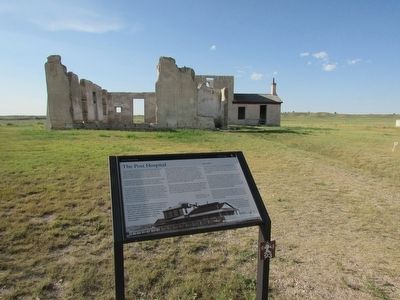
A succession of three hospitals served Fort Laramie from 1849 to 1890. The first hospital was located in the old adobe trading post (Fort John) at the south end of the parade ground. Suffering from structural failure and a serious vermin . . . — — Map (db m87085) HM
With reddened knuckles and rolled up sleeves, an obscure corps served the 19th century army. Beginning in 1802, the army enlisted women aged 13 and older to wash soldiers’ laundry. Laundresses received a wage, quarters, fuel, rations, and medical . . . — — Map (db m86993) HM
The Rustic Hotel opened in 1876. During that year it probably provided the best accommodations for travelers between Cheyenne and the Black Hills. It also served as a station for the Cheyenne-Black Hills Stage and Express Line. By 1883, when this . . . — — Map (db m71020) HM
As the nation prepared to celebrate its centennial in 1876, electrifying news of a gold rush in the Black Hills flashed across the country. A new bridge over the North Platte River guaranteed that the preferred route to the gold fields passed . . . — — Map (db m87095) HM
The Victorian-style cottage, built in 1863 and shown in this 1868 photograph, must have been a strange sight on the untamed Northern Plains. Sometime between 1875 and 1882, the cottage was replaced by a much larger lime-grout structure, used by . . . — — Map (db m87046) HM
Parts of this building date from the earliest periods at Fort Laramie. The adobe portion on the left, built in 1849, housed the Post Sutler’s Store. In 1852, the right section was added and used at various times as the Sutler’s office, the . . . — — Map (db m87035) HM
Electrical Engineering Milestone Transcontinental Telegraph Between July 4 and October 24, 1861, a telegraph line was constructed by the Western Union Telegraph Co. between St. Joseph, Missouri, and Sacramento, California, thereby completing the . . . — — Map (db m87102) HM
In remembrance of the hardy pioneer stockmen and cowboys who drove their Texas herds across this spot into central and northern Wyoming — — Map (db m98347) HM
Many emigrants journals and diaries from the 1840s to 1860s mention experiences such as; “nooning,” camping for the night, crossing over, or burying a loved one on the banks of Rawhide Creek. Of these experiences, death and disease were . . . — — Map (db m79704) HM
1336 miles - Nauvoo, Illinois to the Salt Lake Valley (Second plaque below:)
"Whether I live or whether I die all is well, all is well"
Elizabeth Rutledge 1806 - 1852 — — Map (db m98358) HM
Over this trail, from distant Texas, passed the greatest migration of men and cattle in the history of America.
(second plaque at the base:)
In Memory
of the pioneer cattlemen who passed this way on the Old Texas Trail . . . — — Map (db m98349) HM
Sioux Indians massacred
29 Soldiers with their
Officer
Brevet 2nd Lt. L. Grattan,
on Aug. 19, 1854. Site is
½ mile north-west.
An Indian killed a cow from a Mormon caravan. The detachment of soldiers was sent to receive . . . — — Map (db m79706) HM
This is an ORIGINAL HOMESTEAD SHACK built in 1909 about 28 miles south of Torrington on land which is now near the center of Hawk Spring Irrigation Reservoir. The house is 12' 7" x 12' 6" square and was home for the Trouts for 13 years. Here they . . . — — Map (db m164151) HM
Cold Springs was a popular camping ground on the Overland Trail to California, Oregon, Utah and other points in the far west. It was a stage station along the Overland Stage Route 1854 - 1862 and also a Pony Express relay stop 1860 - 1861. . . . — — Map (db m79702) HM
In the 1870s, thousands of African Americans fled the poverty and racial unrest that followed the American Civil War to homestead on the plains of Kansas. These migrants were known as the Exodusters. Some intended to create separate, . . . — — Map (db m292793) HM
With the faith and courage of their forefathers who made possible the freedom of these United States The Boy Scouts of America dedicate this replica of the Statue of Liberty as a pledge of everlasting fidelity and loyalty 40th Anniversary . . . — — Map (db m203177) HM
Following the Lewis and Clark Expedition, much of the interior of the western United States remained a mystery and most people traveling to the west coast went by ship. By 1811, at the height of the fur trade, John Jacob Astor, owner of the . . . — — Map (db m79700) HM
right side
In 1866, following the American Civil War, Congress created six all African American Army units which later merged into four (9th and 10th Cavalry - 24th and 25th Infantry Regiments). Composed of former slaves, freemen, and . . . — — Map (db m95173) HM
The 4004 is one of eight surviving examples of the world's largest steam locomotives. The Union Pacific Railroad had 25 of these goliath built, at a cost of over a quarter million dollars each. The 4004 ran primarily between Cheyenne and Ogden, . . . — — Map (db m95202) HM
Although Cheyenne was originally established in the 1857, much of the early town had been destroyed by fires over the years and it was not until the late 1800s that masonry structures were introduced. The current Downtown District of Cheyenne was . . . — — Map (db m47184) HM
The Capitol North Historic District of Cheyenne was built between 1905-1930 and was added to the National Register of Historic Places in 1980. This district presents a good blend of middle to upper income housing for the period. Many of the home . . . — — Map (db m95257) HM
Gifted to the citizens of Cheyenne, WY
in recognition of the role of women in settling the West, and Wyoming being the first state to grant women the right to vote. — — Map (db m249898) HM
Front From 1920 to 1926, pilots braved the toughest conditions on the Transcontinental Airmail Route contending with Wyoming's high altitude, unpredictable weather and severe winds. Pilots such as Slim Lewis, Hal Collison, Frank Yager, Harry . . . — — Map (db m95464) HM
Front It was at Cheyenne's airport facility that the first de-icing equipment was installed on aircraft. It was also where wide-scale installation of variable-pitch propellers, cabin heaters, and on-board air to ground capable radios was . . . — — Map (db m95463) HM
"Cowboys of the Sky"
Commemorating the first pilots of
transcontinental airmail service
who made aviation history and
called Wyoming home. — — Map (db m249853) HM
Built by Colonel A.T. Babbitt in 1882, his wife Louise designed the home in the Queen Anne style. Babbitt, a former Army doctor, encouraged eastern investment in Wyoming Territory and acquired many property interests. He served briefly as the . . . — — Map (db m287173) HM
This Property Contributes to the
Downtown Historic District
Barkwell House
Built in 1883 by the Union Pacific Railroad as a home, office, and clinic for its company doctor, Dr. Major C. Barkwell. Barkwell moved to Cheyenne in the . . . — — Map (db m287137) HM
Camp Carlin or Cheyenne Depot, 1867-1890, was 2nd largest quartermaster depot in the United States. In Wyoming it supplied Forts Russell, Sanders, Steele, Bridger, Washakie, Fetterman, Laramie, McKinney and Phil Kearny; in Nebraska, Forts Sidney, . . . — — Map (db m92156) HM
Many of Cheyenne's most famous and outstanding historic structures were designed and built by local architects and builders. During the city's early years, structures built by merchants were generally temporary in nature. Canvas tents or simple . . . — — Map (db m95524) HM
S.W. corner of site chosen by General Grenville Dodge in 1867 for the division point of the U.P.R.R. and for the location of Cheyenne City. The original 4 sq miles were laid at an angle to give "all houses maximum sunshine throughout the year." This . . . — — Map (db m68053) HM
The year was 1897, Wyoming was still a young new State and the economy was still reeling from the Panic of 1993. The town's new Mayor and leading business men were looking for something to bring in outside business. The names of those involved reads . . . — — Map (db m95344) HM
Cheyenne Frontier Days (CFD) Old West Museum (OWM) possesses a collection of Daily Programs that list contestants and events and the Ladies Cowpony Races were first run in 1899. Proud of their skills as horsewomen, young cowgirls used the . . . — — Map (db m95378) HM
Twenty-five Big Boys, the world's largest steam engines, were built exclusively for Union Pacific by the American Locomotive Company in Schenectady, New York between 1941 and 1944. Each locomotive was 132 feet long and weighed 1.2 million pounds. . . . — — Map (db m95200) HM
From the beginning Cheyenne, like many other towns along the newly constructed Union Pacific Railroad had problems with fires. The primarily wood and wood shingle buildings that made up the downtown area were especially subject to fire created by . . . — — Map (db m95229) HM
There are six plaques on this rather large monument. Prehistoric Cheyenne
Those First to Life Here
There is evidence of prehistoric man living in Wyoming more than 12,000 years ago before present (YBP). These early . . . — — Map (db m96408) HM
Chief Washakie
By Guadalupe Barajas
In celebration of the leadership
and life of Chief Washakie and
his impact on the people of
Wyoming. We are especially
grateful for his relationship
with the Episcopal Church . . . — — Map (db m249886) HM
Chief Yellow Calf
By Tanner Loren
In honor of Chief Yellow Calf,
who was a Northern Arapaho
religious leader and member
of the Arapaho-Shoshone Joint
Business Council. He is
remembered for his preservation
of . . . — — Map (db m249885) HM
Railroad employees were required to have a
reliable railroad-grade watch, that must not vary more than 30 seconds from correct time. Trains operated on schedules.
Standard Time
Adopted on November 18, 1883
Prior to standard time, a lot of . . . — — Map (db m249910) HM
This reproduction of the Liberty Bell was presented to the people of
Wyoming
by direction of The Honorable John W. Snyder
Secretary of the Treasury.
As the inspirational symbol of the
United States Savings Bonds Independence Drive . . . — — Map (db m249777) HM WM
The Durant Hose Co., and J.T. Clark Co., each purchased huge bells, and boasted the first fire engines in Cheyenne.
Both companies used the fire bells as long as their organizations existed.
The J.T. Clark Bell may be seen at the old Johnson . . . — — Map (db m95203) HM
The exposed rock wall in front of you once formed part of an early Cheyenne Reservoir constructed in the mid 1880's. Water came by wooden pipe across the USDA Agriculture Research Station, Warren Air Force Base and Frontier Park. From here it was . . . — — Map (db m95212) HM
Bill Gollings was a Wyoming working cowboy and renowned artist. Four of Golling's large oil paintings, from 1918, hang in the Wyoming State Capitol building:
Indian Attack on the Overland State,
Immigrants on the Platte,
The Smoke Signal . . . — — Map (db m95275) HM
Proponent of the Legislative Act Which in 1869 gave distinction to the Territory of Wyoming as the 1st government in the world to grant Women Equal Rights — — Map (db m47185) HM
Esther Hobart Morris
by Joel Turner
In honor of the Wyoming
woman who was the
first woman in the United
States of America to hold
judicial office. — — Map (db m249848) HM
Floyd and Edna Young, residents of Wyoming for over 65 years, created the inner fence that surrounds Engine No. 1242. Floyd was a Union Pacific Engineer of this locomotive, Engine No. 1242, prior to its retirement and final move to Cheyenne in 1954. . . . — — Map (db m95213) HM
This stone marks that road of romance and adventure traveled by trappers, traders and troops to Fort Laramie, the most historic spot in the west.
1867 - 1887 — — Map (db m95230) HM
Erected in honor of
Veterans of Laramie County
by the American Legion posts
on the American Legion
50th anniversary
March 15, 1969 — — Map (db m250031) WM
Justice Willis Van Devanter
by Joel Turner
First person from Wyoming to sit on the
United States Supreme Court.
In honor of
William H. Vines, pillar of our strength.
Donated by his daughters
Kimberly, Hillary, Jennifer, and . . . — — Map (db m249846) HM
Cheyenne was founded in 1867 as a terminal for the Union Pacific's transcontinental railway through southern Wyoming. The city grew bigger and faster than most rail towns, in part due to nearby U.S. Army Fort D.A. Russell, established in 1867, and a . . . — — Map (db m92203) HM
The first Permanent Jewish Synagogue in Wyoming was erected in 1915 by Cheyenne’s Mt. Sinai Congregation. German Jewish merchants came to Cheyenne starting in 1867, organized but were unable to build a Synagogue. After 1900, with the arrival of . . . — — Map (db m27087) HM
During the early days of Wyoming Territory and State, outlaws flourished in the lawless frontier. From cattle rustling to stagecoach robbing to bank heists to holding up trains, individuals and gangs of thugs found Wyoming a land of plenty: plenty . . . — — Map (db m165020) HM
In 2000, a group of concerned and preservation minded citizens formed to preserve one of Wyoming's premier historic sites. Over the next five years, the Historic Governor's Mansion Foundation, the Wyoming State Legislature, the First Families of . . . — — Map (db m95246) HM
Princess Blue Waters
(Rose Nelson Ecoffey)
1880-1972
by Joey Bainer
Venerable Oglala Lakota elder,
advocate of women's and native
rights, member of Buffalo Bill Cody's
Wild West Show, Lakota liaison with
Cheyenne . . . — — Map (db m250033) HM
New York, Dec. 27, 1899
Robert C. Morris, Esq.,
Dear Sir: Your favor of the 16th instant received. When the city of Cheyenne is willing to furnish a proper site for a free public library and maintain it at a cost of not less than $3,000 a . . . — — Map (db m95259) HM
Finding "the wickedness unimaginable and appalling," the Rev. Joseph Cook organized St. Mark's Parish Jan. 27, 1868, in Cheyenne, Dakota Territory, then a railroad winter camp. The first church at 18th and Carey Avenue was dedicated in August 1868 . . . — — Map (db m95258) HM
Born July 19, 1924
Died October 4, 2005
Husband of Roberta "Bobby" Harley Hathaway
World War II veteran
Army Air Corps - Eighth Air Force
401st Heavy Bombardment group
Radio operator-gunner
French Croix de Guerre recipient
U.S. Presidential . . . — — Map (db m249845) HM
This tablet marks the site where the council of the first Territorial Legislature of Wyoming convened which legislature enacted the first woman suffrage law passed in the United States.
Approved by
John Allen Campbell
First Governor of . . . — — Map (db m249982) HM
Side A Incorporated as the Cheyenne & Burlington Railroad in March 1887, the 30-mile long Wyoming segment was a part of the larger 145-mile long Chicago, Burlington & Quincy (CB&Q) Railroad line that ran from Midland, Nebraska, westward to . . . — — Map (db m47181) HM
With the coming of the transcontinental railroad and with settlers and ranchers moving into the greater Cheyenne area, it was quickly apparent that 180 acre land grants were insufficient to sustain a livelihood. Shrewd businessmen, many foreign born . . . — — Map (db m95210) HM
started from the corner of Capitol Ave. & 16th Street and ran 88 miles north to Ft. Laramie, the most historic Fort in the Rocky Mountain west. In 1876 it was extended to Deadwood and the Black Hills gold fields 266 miles from Cheyenne. Indians, . . . — — Map (db m95261) HM
The Cheyenne Club was built on this site in 1882. Most of the members were wealthy cattle barons from the East and Europe. The club gained world wide fame. After the Blizzard of 1886-1887 the cattle business was ruined and the club lost its glamour. . . . — — Map (db m95187) HM
The Cheyenne Club - 120 East 17th Street
1880-1936
The Cheyenne Club, first known as the "Cactus Club," was organized in 1880 by several wealthy stockmen. It gained worldwide fame because of the European Cattle Barons who spent . . . — — Map (db m95188) HM
was erected on this site in 1882. For twenty years, it was the center of civic and cultural activity. In 1902, a fire destroyed the auditorium and stage of the building. In 1905, the annex was built on the site adjoining the remaining portion of the . . . — — Map (db m95198) HM
Side A By 1868 the community boasted 3,000 to 4,000 residents, plus business, schools, churches and newspapers. The UP's stone roundhouse was the first permanent structure (non-wood) built in town. The City's phenomenal growth produced its . . . — — Map (db m47182) HM
The U.S. Post Office Department authorized the first experimental mail flight in 1911 at an aviation meet on Long Island, New York. By 1912 it had authorized 52 flights at fairs, carnivals and air meets in more than 25 states. From 1912 to 1916 they . . . — — Map (db m95465) HM
The Lincoln Highway was America's first transcontinental highway, conceived in 1912 specifically with the automobile in mind. Although parts of the Lincoln Highway were first used in 1908 for the famous New York to Paris automobile "Great Race", . . . — — Map (db m95580) HM
The first woman voter
September 6th, 1870
Laramie, Wyoming Territory
A gift to Cheyenne and The Equality State
from GFWC Womens Civic League of Cheyenne — — Map (db m250035) HM
The scene depicts a typical meeting of the Indian and the Mountain Man on the open plains of Wyoming during the time of western discovery and exploration in the early 1800’s.
At such meeting the offering of friendship would take place. The . . . — — Map (db m94225) HM
The second of the original military facilities to be located in Cheyenne was officially established in August 1867 and was named Cheyenne Depot; however, it later took the name of its first Quartermaster Commander, Brevet Lieutenant Colonel Elias B. . . . — — Map (db m95175) HM
The United States Army came to Cheyenne in 1867 on the heels of the Union Pacific Railroad's westward expansion and established two separated military operations: Camp Carlin just west of Cheyenne and Fort D.A. Russell adjacent to Camp Carlin and . . . — — Map (db m95171) HM
In 1949, more than eighty years after it was founded, Fort Warren and the City of Cheyenne joined forces shortly after the new year to battle the "Blizzard of 49." Personnel and equipment from the 3450th Technical Training Wing cleared the City's . . . — — Map (db m95177) HM
was established by the Richardson Brothers in 1892. The Tivoli has been a landmark since Cheyenne's early days when the town was known as the "Paris of the West." It was a regular hangout for visiting cowboys during Cheyenne Frontier Days.
In . . . — — Map (db m95189) HM
Long before the railroad, airplane, and automobile; the desire to develop the West brought explores, mountain men, fur trappers and a few brave settlers into Wyoming. Later this would be followed by miners, farmers and ranchers, and hundreds of . . . — — Map (db m95197) HM
By 1859 there was daily mail and overland stagecoach service to California. The trip took approximately 27 days for coaches to make the journey. Although trips were originally made across the southern Santa Fe route this practice was abandoned at . . . — — Map (db m95310) HM
The Cattle Trails
The cattle drives and the trails that they followed were designed to move large numbers of Texas and Mexican cattle to Cheyenne to meet the railroad or further north into Montana for summer grazing. The trails were . . . — — Map (db m113831) HM
The Trolleys The railway included a connector past the Fairgrounds to Fort S.A. Russell. Although 1890 drawings show a fail line going up over the wooden viaduct to South Cheyenne, it was never completed and no trolley service went south of the . . . — — Map (db m47159) HM
Part 1
Side A
The story of the Union Pacific Railroad is also a story of Wyoming and particularly Cheyenne. One cannot be told without the telling of the other. It is no exaggeration to say that Cheyenne, Fort D.A. Russell (now F.E. . . . — — Map (db m47178) HM
Born in Madison, Wisconsin, May 1, 1853 Arrived in Cheyenne 1877
Orator at Statehood Ceremony 1890
First woman delegate to a Republican National Convention 1892
Died February 28, 1936 Interred at Lakeview Cemetery, Cheyenne
Family . . . — — Map (db m249851) HM
This Property Contributes to the
Rainsford Historic District
Thomas & Ruie Hunter Home
In 1915, Thomas & Ruie bought the Lawrence & Sarah Malloy home, built in 1892. He served in the WY House 14th, 15th, 17th & WY Senate 18th, 19th . . . — — Map (db m287135) HM
At this site on January 12, 1902, Cattle Detective Tom Horn was tricked into making a series of incriminating statements that were used as a "confession" to the July 18, 1901, murder of 14-year-old Willie Nickell at Iron Mountain, west of Chugwater . . . — — Map (db m95190) HM
Interstate 25 serves as a primary north-south corridor for the western states. Skirting the eastern edge of the Rocky Mountains, it stretches 1,059 miles from southern New Mexico to northern Wyoming. A vital junction with east-west interstates, it . . . — — Map (db m239725) HM
The Union Pacific Depot was built in 1886 and given to the community of Cheyenne in April 1993 by the Union Pacific Railroad Company.
Union Pacific Railroad Depot has been designated a National Historic Landmark.
This building, designed . . . — — Map (db m47157) HM
Union Pacific Steam Engine #1242 is the oldest coal burning steam locomotive in Wyoming. Union Pacific Railroad (UP) donated "Old Sadie," as she was nicknamed, to the City of Cheyenne in 1955 after being retired from the Walcott-Saratoga-Encampment . . . — — Map (db m95216) HM
Verne Elliot
1890 1962
By: Joel Turner
Riding a wild buffalo before President
Teddy Roosevelt at the 1910 Cheyenne
Frontier Days. Champion saddle bronc
rider and roper, innovative rodeo
director and stock . . . — — Map (db m249979) HM