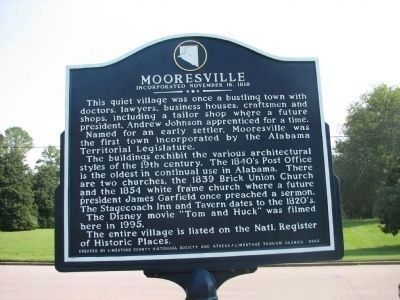
Cottonport
The town of Cottonport flourished in the early years of Limestone County. It was settled in 1818 and chartered in 1824. It was located approx. 1½ miles S.E. near the point where Limestone Creek flowed into the Tennessee River and . . . — — Map (db m256322) HM
Post office contains original call boxes
Old tavern, 1817 used as stagecoach stop
Red Brick Methodist church 1817
U.S. Gen. James A Garfield was stationed here 1862
White frame church is more than a century old
Andrew Johnson was . . . — — Map (db m256323) HM
[Written on the initial marker, provided for context]
Our Constitution names the President of the United States the Commander in Chief of all the Armed Forces. Presidents who have served in our military are displayed on the following plaques. . . . — — Map (db m92389) HM WM
The Fort Smith Council was held in this building in September 1865. To establish relations following the Civil War, delegates of twelve Indian nations met with President Andrew Johnson’s representatives. Bitterly divided, Indians had fought for . . . — — Map (db m59025) HM
Spanish explorers and later New England hide and tallow traders found the Big Sur coastline a great hazard. Heavy fogs and extreme winds caused the wreck of many vessels on this coast. The Gold Rush of 1849 dramatically increased coastal shipping. A . . . — — Map (db m68643) HM
In 1870, the year in which the Groezinger Winery (now Vintage 1870) was built, these flags: the California Bear flag (note how much more primitive in design it is in contrast with the present day version) and the American flag (then with 37 . . . — — Map (db m103540) HM
Indian Days
Most of the Indian activity of the Central California Ohlone Tribe took place in the canyon or valley to the north, Waddell Creek. which runs east and west and has a greater beach area. Some evidence such as shell piles and . . . — — Map (db m106636) HM
This Greco-Italianate residence was constructed by Thomas B. Elder in the 1870s on this site which John B. Frisbie obtained by patent from President Andrew Johnson. The home was restored in the 1970s by John and Ruth Derry.
Plaque . . . — — Map (db m100467) HM
On March 3, 1869, President Andrew Johnson signed the Congressional Act chartering The Masonic Mutual Relief Association that became Acacia Life Insurance Company
Built as its headquarters and occupied by Acacia until 1997, the building . . . — — Map (db m186817) HM
Declared a National Historic Landmark in 1972, the US Treasury Building is the oldest departmental building in Washington. The building serves as the headquarters of the Treasury Department. Treasury's responsibilities encompass revenue collection, . . . — — Map (db m100443) HM
Fire Fact, November 28, 1911
DC's first motorized fire engine was placed in service at Engine Company 24. Its engine house was the first to be built without a stable and manure pit.
Caption: Fire Department information and images . . . — — Map (db m112658) HM
Old North was the University's main building from 1795 until the completion of the Healy building in 1879. During this period, it was not uncommon for the President of the United States to visit the University for commencement exercises, or for . . . — — Map (db m255242) HM
Long a Georgetown landmark, this building was occupied from 1826 by Miss Lydia English's Georgetown Female Seminary, whose patrons and frequent visitors included Martin Van Buren, James Buchanan, Daniel Webster, Henry Clay, Andrew Johnson, . . . — — Map (db m97727) HM
The Colonial, a historic building in Georgetown, was occupied from 1826 to 1861 by Miss Lydia English's Georgetown Female Seminary. After the Union Forces' defeat at the First Battle of Bull Run, the building was repurposed as an Army general . . . — — Map (db m248779) HM
“...upon occasion of the prevalence of the yellow fever...Samuel A. Mudd devoted himself to the care and cure of the sick and interposed his courage and skill to protect the garrison...from peril and alarm, and thus...saved many valuable lives and . . . — — Map (db m9305) HM
This Classical Revival style residence, built by Dr. John F. Lesesne circa 1860, is one of the oldest homes in Fernandina Beach. Lesesene left Fernandina during the Civil War and did not return. In 1868 the house became the property of the family of . . . — — Map (db m58467) HM
Construction of this Executive Mansion was authorized in 1835 and completed in 1839. The governor's earlier residence, Government House, just to the south on the corner of Clarke and Greene Streets, had fallen into disrepair. The Mansion is . . . — — Map (db m103230) HM
On January 12, 1865, U.S. Secretary of War Edwin Stanton and General Wm. T. Sherman met here at the home of Charles Green with 20 leaders from Savannah’s African-American churches, including Garrison Frazier, Ulysses L. Houston, and William . . . — — Map (db m40696) HM
On this site stood the house of Orville Hickman Browning (1806-1881)
Illinois State Senator and Representative
Senator, Secretary of the Interior, and Attorney General of the United States
Friend and adviser of Presidents Abraham . . . — — Map (db m150022) HM
William Tecumseh Sherman
Thomas Ewing Jr.
Hugh Boyle Ewing
Daniel McCook Jr.
All four members of the law firm served with distinction as general officers in the Union Army in the Civil War.
Thomas Ewing Jr. was the first Chief Justice . . . — — Map (db m42111) HM WM
Site of his home, 1857 to 1881. Attorney-General of U.S., 1866-68. Resigned to become one of counsel for President Andrew Johnson in impeachment trial by U.S. Senate, 1868. Johnson reappointed him, but Senate refused to confirm. Resumed practice of . . . — — Map (db m175081) HM
(First Panel): Camp Andy Johnson Established August 1861 Camp Andy Johnson was named for Senator Andrew Johnson of Greenville, Tennessee, the only senator from a seceding state who remained loyal. The camp was a refuge for the loyal men . . . — — Map (db m294355) HM
Charlotte Holand Vance Morrill could hold a grudge. When in 1869, her husband Lot lost his seat in the U.S. Senate to Hannibal Hamlin, she blamed James G. Blaine, who from then on she refused to allow in her house. Lot Morrill served . . . — — Map (db m186078) HM
The Hugh McCulloch home was actually built in 1787 for Tomas Wiswell. The home ha a massive center chimney and three upstairs bedrooms have hinged walls which can be swung upward and secured to the ceiling to create a large ballroom. . . . — — Map (db m186345) HM
Port Tobacco was the home and place of business of George Atzerodt. Although he failed to murder Vice President Andrew Johnson, he was convicted and executed for his role in the plot to assassinate President Abraham Lincoln.
Part . . . — — Map (db m128954) HM
This house was the home of Dr. Samuel Alexander Mudd and his wife, Sarah Frances Dyer. Early on the morning of April 15, 1865, John Wilkes Booth arrived here with a companion, David E. Herold, and asked Mudd to set Booth’s broken leg. Afterward, . . . — — Map (db m921) HM
At the outbreak of the Civil War in 1861, George Vickers opposed secession and used his influence to keep Maryland in the Union. He became a major general of the 2nd Division, Maryland Militia, and helped form the 2nd Regiment Eastern Shore . . . — — Map (db m156850) HM
The mural scene depicts various time periods in Leonardtown’s history.
In general, the left side of the painting presents an older time period,
around the turn of the century. As you move to the right, the chronology
advances to a point in the . . . — — Map (db m957) HM
After the battle over 4,000 bodies were buried in mass graves, along rock outcroppings, and in farmers' fields. Many more soldiers died of wounds or disease. The peaceful village of Sharpsburg was turned into a huge hospital and burial ground, an . . . — — Map (db m157772) HM
John Brooks Henderson was born in Virginia and moved with his family to Lincoln County, Missouri when he was six years old. By age 10, he was an orphan.
Henderson overcame what could have been a life of obscurity to be a Pike County teacher, . . . — — Map (db m141281) HM
Established as a military post August 27, 1867 by order of
President Andrew Johnson and General U.S. Grant
the post was abandoned in December 1886
Captain Wm. Clark
of the Lewis and Clark Expedition
encamped here July 14, 1806 with his . . . — — Map (db m98279) HM
William H. Seward Born 1801 — Died 1872 Resided in This House 1824-1872 New York Governor, United States Senator, Secretary of State in Cabinets of Presidents Abraham Lincoln and Andrew Johnson. The leading figure in the purchase of . . . — — Map (db m88368) HM
The Fenian Brotherhood was a group of Irish Nationalists founded in the United States in 1858 with the goal of creating an Irish Republic. In this vicinity, from the docks of the Pratt Iron Works, on the night of June 1st, 1866, the Fenians . . . — — Map (db m140705) HM
Underground Railroad Sites
Rochester's proximity to Lake Ontario afforded runaway slaves a direct route to freedom in Canada. Hundreds of runaway slaves were "conducted" from one "station" to another along this secret network of escape routes . . . — — Map (db m65156) HM
Carl Schurz (1829-1906) was born in Liblar, Prussia (near what is now Cologne, Germany). In 1848, while a doctoral candidate at the University of Bonn, he joined the democratic revolt opposing the autocratic German government. After participating in . . . — — Map (db m98463) HM
One hundred feet east of this spot in the Bennett House General Joseph E. Johnston and Major General William T. Sherman met at noon, April 17, 1865, to discuss terms of a proposed surrender. They met in this house again on April 18 and wrote and . . . — — Map (db m58396) HM
Confederate Col. William H. Thomas organized Thomas’s Legion of Cherokee Indians and Mountaineers is western North Carolina in September 1862. The people of this area were sometime referred to as highlanders, and local residents called Thomas’s unit . . . — — Map (db m75455) HM
Erected by the citizens of Moore County
In honor of
Andrew Johnson
Seventeenth President
of the United States
One time resident of Carthage
A stalwart union man, yet he threw himself
into the breach as a bulwark, in . . . — — Map (db m268583) HM
1795 - 1849
James Knox Polk
of Mecklenburg County
President 1845 - 1849
He enlarged our national boundaries
1767 - 1845
Andrew Jackson
of Union County
President 1829 - 1837
He revitalized American Democracy
1808 - . . . — — Map (db m40797) HM
Here James A. Garfield, Abraham Lincoln and Andrew Johnson spoke. Gen. Lewis Cass, U.S. Sec'y of State, was a guest, and Gen. John H. Morgan, C.S.A., "The Raider", was a prisoner of war. — — Map (db m156051) HM
Camp Chase was named in honor of Salmon P. Chase, former governor of Ohio and Secretary of the Treasury in President Abraham Lincoln’s Cabinet.
In July 1861, a small prison was erected at Camp Chase to handle the influx of political prisoners . . . — — Map (db m135244) HM
Salmon Portland Chase, a renowned lawyer and statesman, was born in Cornish, New Hampshire, on January 13, 1808. He came to Ohio in 1820 and attended Cincinnati College (1822-23). Chase returned to New Hampshire and graduated from Dartmouth . . . — — Map (db m24621) HM
Born in Steubenville in 1814, Edwin McMasters Stanton studied at Kenyon College and opened his law practice in Cadiz in 1836. The grandson of North Carolina slaveholders, Stanton opposed slavery. A successful railroad attorney and War Democrat at . . . — — Map (db m33906) HM
Lewis Davis Campbell. Two leading figures in nineteenth century national and state politics were born in log cabins located near this spot. Lewis Davis Campbell (1811-1882) served in the U.S. House of Representatives from 1849 to 1858, rising . . . — — Map (db m81184) HM
The Grand Review for Union armies took place in Washington, D.C., in late May 1865. The veterans marched down Pennsylvania Avenue past President Andrew Johnson amid the cheers of thousands of grateful citizens. Conspicuously absent, however, were . . . — — Map (db m121992) HM
By the 1860s, many railroad lines met in Harrisburg. Agricultural products, industrial raw materials, and factory-finished goods moved through Harrisburg on the way to every part of the nation. Throughout the Civil War, the Union army depended on . . . — — Map (db m102324) HM
Stevens Grave & Memorial Burial place of a true American hero ---------------- Thaddeus StevensLancaster County’s U.S. Representative was the most powerful congressman during the Civil War and early Reconstruction. He was a master . . . — — Map (db m177436) HM
Philanthropy
An important part of Thaddeus Stevens' legacy is his philanthropy. Throughout his life he could never recall the poverty and discrimination of his childhood without great pain. Its effect was to sensitize him to the oppression . . . — — Map (db m189120) HM
This early twentieth century suburb takes its name from Sans Souci, the nearby house and estate of Gov. Benjamin F. Perry (1805-1886). Perry, a prominent Unionist before the Civil War, was appointed provisional governor of S.C. by President . . . — — Map (db m15920) HM
Laurens County. Laurens County was one of six counties created from Ninety - Six District March 12, 1785. The courthouse here, built in 1838 by Dr. John W. Simpson, and remodeled and enlarged in 1858, 1911, 1940, and in 1973, was entered in . . . — — Map (db m10133) HM
Cultural conflicts erupted across the western Great Plains during the 1860s. Expanding railroads and frontier posts located in traditional hunting grounds impacted the various tribes in the northern plains. Restrictions on westward settlement . . . — — Map (db m121397) HM
Some of the lesser known battles and incidents of wars have afforded drama and have portrayed characteristics of the participants far beyond those of usual recorded history. Such was the Battle of Johnsonville, fought between Maj. Gen. N. B. . . . — — Map (db m146444) HM
Take Exit 133, State Route 191, and drive north to visit two state parks associated with the struggle to control the Tennessee River during the Civil War.
In 1861, the Confederates built Fort Donelson on the Cumberland River and Fort Henry . . . — — Map (db m96639) HM
About 1 mile S.W., at the home of a daughter, Mary Johnson Stover, Andrew Johnson died in 1875. He had been a senator from Tennessee; governor of Tennessee; military governor under Federal occupation; vice-president of the United States and 17th . . . — — Map (db m157912) HM
Although Tennessee voted to secede from the Union in June 1861, East Tennessee remained staunchly loyal. The residents of Carter County voted against secession, 1,343 to 86.
One of those residents, Admiral and General Samuel P. Carter (born . . . — — Map (db m293369) HM
In 1842, state senator Andrew Johnson, a resident of neighboring Greene County, purchased his first slave here in Parrottsville. Her name was Dolly, and she was fourteen. Her son claimed that she approached Johnson and asked him to buy her because . . . — — Map (db m92476) HM
No sooner did the North begin its invasion than slaves fled to Union lines seeking freedom. This presented problems for military commanders and President Lincoln. The political aims of the war did not initially include emancipation. Before Lincoln’s . . . — — Map (db m75324) HM
William Giles Harding, the owner of Belle Meade Plantation, was an ardent Confederate supporter who provided thousands of dollars to help arm Tennessee’s Confederate forces. He served on the state’s Military Armaments Committee. In March 1862, he . . . — — Map (db m81481) HM
On this site stood the Maxwell House Hotel built by John Overton in 1859. It was destroyed by fire on Christmas Day, 1961. After wartime use as a barracks, hospital and prison, it was formally opened as a hotel in 1869. Presidents Andrew Johnson, . . . — — Map (db m24145) HM
First hortelry on this spot was established by Maj. William T. Lewis, 1796. It became Winn's Inn in 1808, the Nashville Inn a few years later. Among its many distinguished guests were the three sons of the Duke of Orleans. Andrew Johnson, then . . . — — Map (db m147737) HM
With the re-election of President Lincoln in 1864, Tennessee's governor,
Andrew Johnson, was elected Vice-President on November 4. — — Map (db m215627) HM
Within the walls of this magnificent Greek Revival-style capitol, designed by famed American architect William Strickland, a Confederate governor and a Federal military governor each administered the state during the Civil War.
Governor Isham . . . — — Map (db m166572) HM
In September 1864, after Union Gen. William T. Sherman defeated Confederate Gen. John Bell Hood at Atlanta, Hood led the Army of Tennessee northwest against Sherman’s supply lines. Rather than contest Sherman’s “March to the Sea,” Hood moved . . . — — Map (db m246963) HM
During the Civil War, Confederate Capt. John H. Earthman (a descendant of one of the earliest Whites Creek settlers) raised a company of soldiers. Accepted into service at Whites Creek on April 25, 1861, the company mustered in at Nashville on May 6 . . . — — Map (db m112077) HM
In 1860, 300 people lived in Charlotte, the Dickson County seat. During the war, the residents witnessed considerable military activity, beginning February 17, 1862, when Confederate Col. Nathan Bedford Forrest, arrived here to reequip his men and . . . — — Map (db m68958) HM
The Gibson County Courthouse, built in 1899, is the fourth one to have occupied this site. The first courthouse was a log structure built in 1824, the year following the organization of the county, a process commenced by David Crockett, who was then . . . — — Map (db m55188) HM
Thomas Jones was born in Peron County, North Carolina on December 12, 1816 and moved to Giles County with his family in 1817. Jones received his early education at Wurtemburg Academy and studied at the University of Alabama and University of . . . — — Map (db m75174) HM
This was one of the first settlements in Tennessee. William Bean and Daniel Boone camped here in 1775. Indians massacred the first settler, a farmer named English. Permanently settled by William II, Robert, George and Jessie Bean, who were granted . . . — — Map (db m69549) HM
One of Tennessee's earliest settlements. The valley you see was a warpath for the Cherokees, led Daniel Boone to Cumberland Gap and was traveled by Davy Crockett. Across Highway 11W to the right stood Bean Fort, built by William Bean, first . . . — — Map (db m80338) HM
Andrew Johnson was born in 1808 to poor, uneducated parents in a small building that served as a kitchen to Casso's Inn in Raleigh, North Carolina. When Andrew was three, his father died after saving two of his wealthy employers from drowning in an . . . — — Map (db m86608) HM
Andrew Johnson and his family lived in this two-story brick house from some time in the 1830s until 1851. During these years, Johnson’s life changed drastically as he ventured from the tailoring trade into politics. After being elected alderman of . . . — — Map (db m58426) HM
Welcome to the Andrew Johnson National Historic Site. This site commemorates the life and work of the seventeenth president of the United States, Andrew Johnson. Born in poverty, Johnson rose from Greeneville tailor to the nation's highest office. . . . — — Map (db m23680) HM
Located on the corner of Main and Summer Streets is the mural of President Andrew Johnson looking out of a window of his Land Office building. He is wearing his Masonic uniform and the Masonic Lodge was located inside a building on this site. . . . — — Map (db m109303) HM
Champion of Public Education in Tennessee “Can there be nothing done to advance the great cause of education?” Governor Andrew Johnson, 1853 ----------Throughout his legislative and gubernatorial careers, Andrew Johnson advocated . . . — — Map (db m58222) HM
Andrew Johnson Seventeenth President of the United States. Born Dec. 29, 1808, died July 31, 1875. His faith in the people never wavered. Eliza Johnson, born Oct. 4, 1810, died Jan. 15, 1876. In memory of our father and mother. — — Map (db m93079) HM
This silhouette created by local artist, Joe Kilday, on the side of a Summer Street building depicts the arrival of youthful future President Andrew Johnson leading a blind pony which pulled a small wagon. The young girl, Eliza McCardle, is shown . . . — — Map (db m109311) HM
The Andrew Johnson Homestead was the last home of Andrew Johnson (1808-1875), 17th President of the United States (1865-1869). Congressman Andrew Johnson purchased the house and half-acre lot from James Brannan in September 1851. Built directly upon . . . — — Map (db m23679) HM
Andrew Johnson chose to be buried atop this hill, then known as “Signal Hill,” which he owned. His family members continued to be buried here in the family plot until his great-granddaughter’s interment in 1992. The cemetery became part of Andrew . . . — — Map (db m81607) HM
Welcome to the Andrew Johnson National Historic Site. This site commemorates the life and work of the seventeenth president of the United States, Andrew Johnson. Born in poverty, Johnson rose from Greeneville tailor to the nation’s highest office. . . . — — Map (db m93078) HM
Three miles west is the central unit of the Andrew Johnson National Historic Site which includes the 17th president’s small tailor shop, the home in which he lived from 1838 to 1851, a museum, and administrative offices. Other units are the . . . — — Map (db m58152) HM
After Unionists burned several East Tennessee railroad bridges on November 9, 1861, Confederate engineer Colonel Danville Leadbetter soon arrived to rebuild the brides and capture the perpetrators. Later that month, his forces captured Henry Fry, . . . — — Map (db m58073) HM
Front Ellen "Nelly" VanVactor was one of the first free women of color to own real estate in Greeneville. Throughout Tennessee, there were few landowners of her race and gender prior to 1830. Born a slave in Virginia in 1780, Nelly arrived . . . — — Map (db m58278) HM
On June 17, 1861, delegates from every East
Tennessee county except Rhea convened here
for four days. The purpose was to keep East
Tennessee in the Union after secession of
the state. Leaders of the movement were
Thomas D. Arnold, William G. . . . — — Map (db m81612) HM
Home of Andrew Johnson – 17th President of U.S. Tailor Shop corner Depot & College Sts. Residence - - 217 So. Main St. Monument – So. Main & Monument Avenue — — Map (db m61946) HM
Home of Andrew Johnson – 17th President of U.S. Tailor Shop corner Depot & College Sts. Residence - - 217 So. Main St. Monument – So. Main & Monument Avenue — — Map (db m61960) HM
the original log church on Irish Street served until 1860 when the present structure was begun on land purchased from Andrew Johnson.
The War Between the States saw the church used as a hospital and stable.
The cannon ball in the front . . . — — Map (db m58423) HM