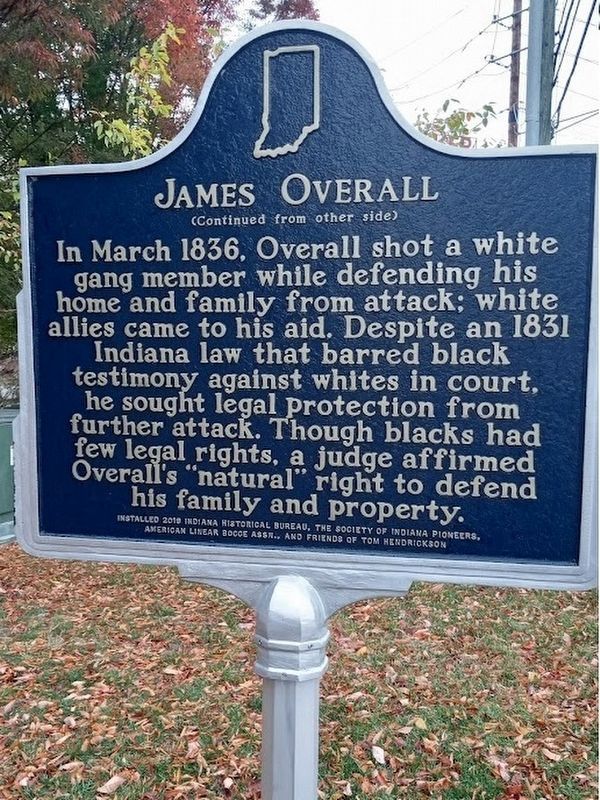
On North West Street just south of Indiana Avenue, on the right when traveling south. Reported damaged.
Overall, a free African American, sold his properties in Corydon, moved with his family to Indianapolis by 1830, and bought land near here 1832. He became a leader in small black community and played active role in growth of AME Church. Overall’s . . . — — Map (db m127962) HM
On East Wabash Avenue, on the left when traveling east.
Small Upper Brass Plaque - by Front Door:
This property is listed in the National Register of Historic Places. United States Department of Interior.
Large Middle - Brass Plaque
In Memory of the Soldiers of the . . . — — Map (db m9396) HM
Site of house reputed to be a stop on the "Underground Railroad." Reconstructed cabin, which was portion of house owned by John Allen Speed, now located on grounds of Lane mansion. Speed, active in abolitionist movement, was Mayor of Crawfordsville, . . . — — Map (db m3870) HM
On State Road 42 just west of Northwest Union Road, on the right when traveling west.
The West Union Friends Meeting was established in 1832 by Quakers from North Carolina. It was the first church and school in Monrovia which was established in 1834 by Quakers Gideon Johnson and George Hubbard. Members of the West Union Friends . . . — — Map (db m233821) HM
On Fourth Street at North Poplar Street, on the left when traveling east on Fourth Street.
African American Samuel Barkshire was freed from slavery in Boone County, Kentucky in 1833. He and his family moved here in 1836. The Barkshires defied fugitive slave laws to provide aid and comfort to those escaping bondage in the South. Their . . . — — Map (db m180716) HM
On U.S. 41 0.1 miles County Road 500N, on the left when traveling north.
A memorial to
Alfred & Rhoda Hadley
and others of Bloomindale
who maintained an
Underground Railroad Station
to assist fugitive
slaves to Freedom. — — Map (db m59730) HM
On Stingley Rd (County Route 600 S) at South Arba Pike (County Route 850 E), on the right when traveling east on Stingley Rd.
Union Literary Institute was one of the first schools to offer higher education without regard to color or sex before the Civil War. It was established in 1846 by a biracial board, including free blacks from nearby settlements. At the . . . — — Map (db m139553) HM
On E. Washington Street (State Road 32) at S. East Street, on the right when traveling east on E. Washington Street.
(Side One)
When this meeting house was dedicated 1898, membership in Quarterly Meeting of Friends at Winchester was largest in the world. Migration of the Religious Society of Friends (Quakers) into this area began 1814 with the arrival . . . — — Map (db m69283) HM
On West Franklin Street at South Main Street, on the right when traveling west on West Franklin Street.
Randolph County's religious roots reveal a deeply tolerant and progressive community. Beginning in 1814, members of the Society of Friends (Quakers) first worshiped collectively in the area. Other frontier believers worshiped before the preaching of . . . — — Map (db m222248) HM
On County Road N 975W at W. Flatrock Road, on the right when traveling north on County Road N 975W.
(Side One)
August 12, 1843 Union Church organized as Freewill Baptist church at home of Harvey Marshall. Church covenant states: “We cannot receive slaveholders into the church nor those who believe that slavery is right.” . . . — — Map (db m73987) HM
On Madison Street (U.S. 421) north of Main Street, on the left when traveling north.
Napoleon, the site of many political conventions, in 1851 hosted the Free Soil Convention represented by abolitionist
Johnson Watts, joined by James H. Cravens and J. Cady, called for repeal of the Fugitive Slave Act of 1850. This inn, owned . . . — — Map (db m262102) HM
On East Fairground Avenue east of East Beech Street (State Road 350), on the left when traveling east.
A network of anti-slavery leaders involved families of Isaac Levi, a Revolutionary War veteran. He came to Claytown (Osgood) in 1832 from Vevay where he apparently was part of the Underground Railroad; his brother-in-law, John Ewing of Ohio joined . . . — — Map (db m45940) HM
On East Fairground Avenue east of East Beech Street (State Road 350), on the left when traveling east.
One of the main Underground Railroad routes came from Madison to the Ohio River north to Holton, Otter Village, and east to Osgood. It then followed the rail line east to Laughery switch, then turned north to Napoleon. So many fugitive slaves . . . — — Map (db m45938) HM
On East Tyson Street at North Washington Street, on the left when traveling east on East Tyson Street.
Side One
Born 1808 Ontario County, New York. Moved with family to Ripley County, 1820. Prominent abolitionist and orator, delivering powerful anti-slavery speeches throughout the area, often against public sentiment. Was active in . . . — — Map (db m45873) HM
On South Public Square at Wayne Street, on the right when traveling north on South Public Square.
Who has been a slave in the State of New York, and who has been a Lecturer for the last twenty-three years, whose characteristics have been so vividly portrayed by Mrs. Harriet Beecher Stowe, as the African Sybil, will deliver a lecture upon the . . . — — Map (db m254896) HM
On Wayne Street at East Maumee Street when traveling south on Wayne Street.
Abolitionist, evangelist, author and women's rights activist Sojourner Truth spoke on our courthouse steps in the spring of 1861 during her stay in Steuben County, Indiana.
This sculpture by artist Jim Haire is a tribute to the Indiana Women's . . . — — Map (db m254894) HM
On West Swager Drive at South Wayne Street (Indiana Road 827), on the left when traveling west on West Swager Drive.
Built in 1847-1849 by Erastus Farnham. A Staunch
abolitionist and one of the local Underground
Railroad leaders, Farnham designed this
home in part to be used as a stop on
the Underground Railroad.
National Register of Historic Places — — Map (db m241159) HM
On West Cora Lane (Local Road N700E) near Local Road E750N, on the right when traveling south.
The Potawatomis' met the Scottish Covenanters on these lands in the
middle 1830's. The northeast Indiana Covenanters and Potawatomis were
extremely good friends. The Covenanter religion did not acknowledge the
U.S. Constituton at the time due . . . — — Map (db m222030) HM
On West Main Street west of Liberty Street, on the right when traveling west.
Top
Martha A. Graham
( Drawing of the River Paddle-wheeler. )
Lower Section
Designed in the Greek Classic style by David Dubach, Architect, and built by John Haley c. 1864, with restoration completed c. 1992. It is . . . — — Map (db m46132) HM
On West Main Street west of Liberty Street, on the right when traveling west.
A stop on the underground
railroad bringing slaves
to freedom
1862 - 1864
commemorated 1976
Vevay, Indiana
This memorial placed in honor of the
descendants of the Rayls and Pickett
families in the Bicentennial . . . — — Map (db m45896) HM
On West 700 South at South 550 West, on the right when traveling east on West 700 South.
Buddell Sleeper (1806-1888) and his wife, Elizabeth Welch (1802-1889), arrived in Tippecanoe County in the Fall of 1835. The Sleepers would become prominent members of the Farmers Institute Quaker Community and the Greenfield Monthly Meeting of . . . — — Map (db m175614) HM
On County Road W 700 S east of Road S 550 W, on the right when traveling east. Reported permanently removed.
Site of station of Underground Railway used by Quakers during pre-Civil War days in smuggling slaves to Canada. Leader of the enterprise was Buddell Sleeper. — — Map (db m34871) HM
On Carpenter Street at NW 3rd Street, on the right when traveling west on Carpenter Street.
This is a site of an Underground Railway Station during the Civil War period. Runaway slaves were secretly hidden until they could be relayed to similar stations further north. — — Map (db m176049) HM
On North Hunt Street at Debney Road, on the right when traveling north on North Hunt Street.
Lost Creek AME
Church 1840
African Methodist
Episcopal Church
Historic Site
The Underground Railroad
Lost Creek, Indiana, prior to the Civil War was a junction of an important line of the Underground Railroad. Slaves fleeing from North . . . — — Map (db m175916) HM
On E. Main Street (U.S. 40) at N. Third Street, on the left when traveling east on E. Main Street.
(Side One)
A political leader defined by his moral convictions, Julian (1817-1899) advocated for abolition, equal rights and land reform, during a period marked by slavery, Civil War, monopolies, and discrimination against blacks, . . . — — Map (db m69282) HM
On Cumberland Street (U.S. 40) west of Davis Street, on the right when traveling west.
A convention was called for by reform-minded Congregational Friends meeting at Greensboro, Henry County, January 1851. Convention held October 14-15, 1851 at Dublin adopted resolutions for political, social, and financial rights for women. Women and . . . — — Map (db m270) HM
On Cross Street (U.S. 27) at South Water Street, on the right when traveling north on Cross Street.
1827 1847 This house was called the "Union Depot of the Underground Railroad," and more than 2000 escaped slaves were cared for here. Tablet placed by Wayne Co. Society of Indianapolis — — Map (db m4482) HM
On Cross Street (U.S. 27) at South Water Street, on the right when traveling north on Cross Street.
Levi Coffin (1798-1877), a Quaker abolitionist, lived in Newport (now Fountain City) with his family 1826-1847. Moved from North Carolina because he and his wife, Catharine, opposed slavery. Advocated, and sold in his store, free-labor products . . . — — Map (db m4480) HM
On South 6th street at South B Street, on the right when traveling south on South 6th street.
As a traveling missionary and
preacher, Quinn helped establish
the African Methodist Episcopal
Church (AME) in free and slave states
before the Civil War. He
influenced the faith, community, and
education of thousands of black . . . — — Map (db m120251) HM
On N A Street (U.S. 40) at 7th Street, on the right when traveling west on N A Street.
On October First, 1842, in what was then an open tract in this city square. Henry Clay, the leader of the Whig Party, delivered an address to an immense multitude and Hiram Mendenhall, a Quaker
abolitionist, presented to him on behalf of the . . . — — Map (db m138953) HM
Iowa assumed an important place in America’s Underground Railroad history when Missourians closed off the Missouri River to Kansas bound settlers. For Iowa residents involved in helping runaways, the work was a dangerous and illegal business. Most . . . — — Map (db m93885) HM
Rev. George B. Hitchcock House
has been designated a
National Historic Landmark
This site possesses national significance
in commemorating the history of the
United States of America
This property is listed in the
National . . . — — Map (db m93862) HM
On First Street north of Omaha Street, on the right when traveling north.
John Brown's Last Iowa Trip 1859
On February 16, 1859 John Brown, with twelve men, women, and children escaping slavery from Missouri, plus his own men, stopped near here at the farm of Jonathan M. Murray.
Murray, a fifty-five . . . — — Map (db m236587) HM
Near Interstate 80 at milepost 208, 3.6 miles west of County Highway V52, on the right when traveling west.
Josiah Bushnell Grinnell, a native of Vermont, was the person to whom Horace Greeley gave his famous advice “Go West, young man, go West.” Grinnell took that advice and in 1854 founded the city that now bears his name. A leader in state government, . . . — — Map (db m224360) HM
Former slave and celebrated abolitionist, Charlotta Pyles
was an outspoken critic of slavery. She was born a slave in
Kentucky in 1804. Her father was a mixture of German and
African American while her mother was a full-blooded
Seminole Indian. . . . — — Map (db m229420) HM
On C Street Southwest at A Street Southwest, on the right when traveling west on C Street Southwest.
In the decades after the Civil War, many Americans commemorated the end of slavery and the Union (northern) military victory in that war. African Americans were especially influential in organizing celebrations of Union soldiers, emancipation, . . . — — Map (db m279077) HM
On 4th Street NW near Market Street NW, on the right when traveling west.
This church was built by Thomas Mitchell. Thomas Mitchell was born in New Hampshire in 1816. he came to Iowa Territory in 1840, and in 1844 became the first white settler of Polk County. He built cabins and later inns to feed and shelter the . . . — — Map (db m44833) HM
On Northwest Madrid Drive at Northwest Nissen Drive, on the right when traveling south on Northwest Madrid Drive.
The Josiah & Mahala Hopkins House (1848) served the community as a post office and early stagecoach stop on the route from Fort Des Moines to Fort Dodge. It was dubbed 20-Mile House for its location 20 miles from Fort Des Moines. Locally, the . . . — — Map (db m285152) HM
Near Fuller Road west of South 19th Street, on the right when traveling west.
Pioneers for Emancipation
The man who built this house was James Cunningham Jordan (1813–1891). He and his wife Melinda were the earliest settlers in Walnut Township, Iowa (now West Des Moines). When he was thirty-three Mr. Jordan built a . . . — — Map (db m236559) HM
On Railroad Place east of 5th Street, on the right when traveling east.
October 1842 – Land is transferred to the United States
1845 - Iowa opened for homesteaders
Spring of 1846 - First settlers moved into Walnut Township, future site of West Des Moines
1849 - Church services began in the Jordan log cabin . . . — — Map (db m236554) HM
On 3rd Avenue at Park Street, on the left when traveling east on 3rd Avenue.
During his lifetime, J.B. Grinnell was a minister, lawyer, sheep farmer, banker, railroad builder, state senator and member of the U.S. Congress. From the beginning, he was driven by opposition to slavery, a passion for education, and a yearning . . . — — Map (db m293695) HM
On the East Bank [of the Neosho River], escaped slaves traveled through caves and tunnels to secret Underground Railroad stations. — — Map (db m57486) HM
On Skyway Highway (U.S. 59) 0.2 miles west of Rawlins Road, on the right when traveling west.
On July 4, 1804, Lewis and Clark exploring the new Louisiana Purchase, camped near this site. Fifty years later the town was founded by Proslavery men and named for Sen. D. R. Atchison. The Squatter Sovereign, Atchison's first newspaper, was an . . . — — Map (db m77888) HM
"But remember this, I am a girl, but I can fire a pistol and if ever the time comes I will send some of you to the place where there is 'weeping and knashing of teeth'...."
Gene Campbell, in a letter to James . . . — — Map (db m54075) HM
After the army sold Fort Scott in 1855, the infantry barracks located here (reconstructed in front of you) became the pro-slavery Western Hotel. The building across the parade ground directly behind you became the anti-slavery Free State Hotel. . . . — — Map (db m36272) HM
Between Lawrence and Topeka, the Kansas turnpike passes near the route of the old Oregon-California Trail, traveled in the 1800s by explorers, missionaries, soldiers, emigrants in search of land, and forty-niners in search of gold. Fifteen miles . . . — — Map (db m103242) HM
On Massachusetts Street south of 6th Street, on the left when traveling south.
On the afternoon of September 14th, 1856, the Free State settlement of Lawrence, Kansas Territory was threatened with invasion by an army of 2700 Pro-slavery Missourians under the command of Generals David R. Atchison and John W. Reid. Encamping . . . — — Map (db m76325) HM
On Massachusetts Street at 7th Street, on the left when traveling south on Massachusetts Street.
The Herald of Freedom,
Abolitionist Newspaper
published on this site 1855-56
Site of Liberty Hall,
Lawrence's first opera house 1870-1911
The Bowersock Opera House
(Liberty Hall), built in 1912
Designed by Samuel B. Tarbet & Co. . . . — — Map (db m54573) HM
On Elmore Street 0.1 miles south of East 3rd Street, on the right when traveling south.
Samuel Jones was an entrepreneur. He constructed Constitution Hall in 1856 and it is now a National Landmark. He was appointed Sheriff of Douglas County, Kansas, in 1856 by Territorial Governor Daniel Woodson. Sheriff Jones enforced the laws of the . . . — — Map (db m119138) HM
On Elmore Street south of East 3rd Street, on the left when traveling north.
In 1855 the new town of Lecompton became the capital of Kansas Territory. President James Buchanan appointed a governor and officials to establish government offices in Lecompton, and construction began on an elegant capitol building. In the fall . . . — — Map (db m287506) HM
On U.S. 160 at Osage Street, on the right when traveling east on U.S. 160.
The State of Connecticut proudly joins the State of Kansas in honoring the lifetime achievements of Prudence Crandall, educator and champion of human rights. Crandall’s courage and determination serve as examples of all who face seemingly . . . — — Map (db m57961) HM
On U.S. 160 at Osage Street, on the right when traveling east on U.S. 160.
In 1831, Prudence Crandall, educator, emancipator, and human rights advocate, established a school which in 1833, became the first Black female academy in New England at Canterbury, Connecticut. This later action resulted in her arrest and . . . — — Map (db m57960) HM
On U.S. 75 at 286th Road, on the left when traveling south on U.S. 75. Reported permanently removed.
Just before Christmas, 1858, John Brown "liberated" eleven slaves in Missouri. He hid them in a covered wagon and circled north on the underground railway toward Nebraska and freedom. En route a Negro baby was born. Late in January they reached . . . — — Map (db m228347) HM
On 286th Road at U.S. 75, on the right when traveling west on 286th Road.
One witness to this event later wrote that it was “no joke” to attack old John Brown. The abolitionist inspired such terror that in January 1859, about 1.5 miles north of here, a U.S. marshal fled at the mere sight of him. Brown, escorting 11 slaves . . . — — Map (db m262990) HM
On U.S. 59 at 142nd Street, on the left when traveling north on U.S. 59.
In September, 1856, a band of Proslavery men sacked Grasshopper Falls (Valley Falls) and terrorized the vicinity. On the 13th, the Free-State leader James H. Lane with a small company besieged a party of raiders in log buildings at Hickory Point, . . . — — Map (db m55362) HM
On Esplanade Street near Miami Street, on the left when traveling south.
"Each man carried a bowie-knife, a revolver, a pair of breeches, a shirt and a very don't-care a damn expression...The stews and brothels, the hospitals and poorhouses of the East can furnish thousands more of just such scabby, scurvy, scapegoats, . . . — — Map (db m46709) HM
On 5th Street north of Shawnee Street, on the right when traveling north.
Leavenworth was founded in June, 1854, although it was not incorporated until the following summer. During the territorial struggle which flared between proslavery and Free-State forces, the city was the scene of many incidents which contributed . . . — — Map (db m71724) HM
On Esplanade Street at Shawnee Street, on the right when traveling north on Esplanade Street.
In 1859, Charles Fisher (aka Peter and Charley Fisher), an African American barber, was
kidnapped from his place of employment at the Planters Hotel. Fisher's choice to work at the
Planters Hotel was an interesting one as it was "a recognized . . . — — Map (db m286947) HM
On Main Street (State Highway 52) west of 7th Street, on the right when traveling west.
Original cabin/fort built in 1855 five miles west of Mound City. The original building was the second cabin owned by James Montgomery as the first one was burned by proslavery Missouri Border Ruffians.
The logs were placed vertically on the . . . — — Map (db m93375) HM
Nothing in the struggle over slavery in Kansas did more to inflame the nation than the mass killing which took place May 19, 1858, about four miles northeast of this marker. Charles Hamelton who had been driven from the territory by Free-State men, . . . — — Map (db m4359) HM
A Nation at Odds
The mid 1800s were a time of turmoil and tragedy in the U.S. The issue of slavery polarized the nation. It created a moral, political, and economic dilemma. The struggle over slavery ultimately led to the Civil War, splitting . . . — — Map (db m39862) HM
The bloodiest single incident in the Kansas-Missouri border struggles, 1854-1861, occurred May 19, 1858, when about 30 Proslavery Missourians seized 11 Kansas Free-State men near Trading Post and marched them to a ravine 225 yards northwest of this . . . — — Map (db m39861) HM
Pro- and anti-slavery forces made their way to this area on horseback and on foot in the fight over whether Kansas would be a free state or a slave state. Skirmishes, scuffles and screams could be heard in the woodlands nearby.
The Marias des . . . — — Map (db m33944) HM
On 6th Street at Lincoln Avenue, on the left when traveling north on 6th Street.
Osawatomie - the name derives from a combination of Osage and Pottawatomie - was settled in 1854 by Free-State families from the Ohio Valley and New England. John Brown, soon to become famous for his militant abolitionism, joined five of his . . . — — Map (db m69325) HM
On 6th Street north of Parker Avenue, on the right when traveling north.
One of the first churches in Kansas, this church was built by a Congregationalist group and is typical of the church structures built during pioneering days in Kansas. It was dedicated to public worship in 1861, and its first pastor was the Reverend . . . — — Map (db m69319) HM
On Main Street at 9th Street, on the right when traveling west on Main Street.
Erected to honor the 5 men killed in the Battle of Osawatomie on August 30, 1856.
Dedicated August 30, 1877
——————————
[Monument inscription reads]
In commemoration of those who . . . — — Map (db m69304) HM
On Acorn Road (U.S. 75) 0.8 miles 280th Road (State Highway 246), on the right when traveling south.
Near here the towns of Plymouth and Lexington once stood as outposts on the Lane Trail, approximated today by US-75. Named for abolitionist James H. Lane, the trail was established in 1856 to bypass proslavery strongholds in Missouri and provide . . . — — Map (db m52952) HM
August Bondi was born July 21, 1831, in Vienna, Austria. The Bondis, Jewish European refugees, fled the Austrian Empire after the failed revolutions of 1848 and settled in St. Louis, Missouri. August Bondi moved to Pottawatomie Creek in Franklin . . . — — Map (db m134060) HM
On SE Monroe Street south of SE 15th Street, on the left when traveling south.
Across the field in front of you stands the former Monroe Elementary School. Parents of six students that attended this school in 1949 participated in the Brown v. Board of Education lawsuit. On May 17, 1954, the US Supreme Court issued a . . . — — Map (db m81395) HM
On 37th Street at Topeka Boulevard, on the right when traveling west on 37th Street. Reported permanently removed.
Topeka was founded in 1854 at the site of Papan's Ferry where a branch of the Oregon Trail crossed the Kansas river as early as 1842. Anti-slavery leaders framed the Topeka Constitution, 1855, in the first attempt to organize a state government. . . . — — Map (db m20479) HM
On Kansas Avenue near SW 5th Street, on the right when traveling south.
Free State Capitol of Kansas Territory, 1855-1861
Used as the Kansas Capitol, 1864-1869
Constitution Hall is Topeka's oldest building. In October 1855, Free Staters held Topeka's first convention here, to organize a free state government . . . — — Map (db m47297) HM
Innovative businessman, fervent Congregationalist, abolitionist and philanthropist, Ichobad Washburn is the generous benefactor from Massachusetts after whom Washburn University is named. — — Map (db m119078) HM
West Inscription:
Many battles punctuated the movement to establish and maintain Kansas as a free state during the Civil War period. The quest for freedom exacted a heavy toll and caused many the ultimate sacrifice including John Brown the . . . — — Map (db m86331) HM
On 27th Street at Sewell Avenue, on the left when traveling north on 27th Street.
Near this site was located the historic town of Quindaro, founded in 1856 as a port-of-entry for free-soil immigrants into Kansas. The principal founder was Abelard Guthrie, who named the town for his Wyandotte Indian wife, Nancy Quindaro Brown. . . . — — Map (db m69458) HM
In memory of all the slaves in Boone County,
those who helped them, and the slaves’ descendants
who remember & honor them and their legacy.
Dedicated 21 March, 2005 by the Problem Solving Team, a diverse
group of students, grades five . . . — — Map (db m79290) HM
Born in Boyle Co. and a graduate of Centre College, 1850, Harlan practiced law in central Ky. after 1853. Although against Lincoln and abolition in 1860, he was a strong Unionist during Civil War; recruited 10th Ky. Infantry. Elected Attorney . . . — — Map (db m121559) HM
On Bridgeville Road (Kentucky Route 875) south of Brooksville-Germantown Road ( Route 10), on the right when traveling south.
John Gregg Fee. Fee received degree from Augusta
College; went to Lane Theological
Seminary. Had spiritual experience
which began career as nationally
known and determined abolitionist.
A founder of Berea College who
wanted low-cost . . . — — Map (db m136344) HM
On Fairfield Avenue (Kentucky Route 8) near Patchen Avenue, on the right when traveling east.
Incorporated March 15, 1870, on part of original land grant to Gen. James Taylor, pioneer, for whose farm this city was named. A general in War of 1812, banker, and statesman, whose farm was an underground railroad station.
President of the first . . . — — Map (db m49115) HM
On East Third Street at Overton Street, on the right when traveling west on East Third Street.
Underground Railroad station. Mansion built by General Taylor, pioneer, banker, statesman. General in the War of 1812. Original house designed by H.B. Latrobe. Present house build, 1837. — — Map (db m135084) HM
On U.S. 60 1.2 miles east of Kelly Cemetery Road, on the right when traveling east.
Site of Riley family homeplace, owners of Josiah Henson, one of the characters on which Harriet Beecher Stowe based her 1852 novel Uncle Tom's Cabin. Henson served as overseer of Amos Riley's farms, 1825-29. On learning owner planned to sell . . . — — Map (db m160204) HM
On East Main Street (Business U.S. 25) at Ransom Avenue, on the right when traveling south on East Main Street.
Second Presbyterian Church was founded on July 30, 1815, and was first led by Rev. James McChord. Originally located on Market St., it was moved here in 1924. Founding members included Robert S. Todd, father of Mary Todd Lincoln, and Joseph C. . . . — — Map (db m169741) HM
On South Limestone north of West Maxwell Street, on the left when traveling north.
This sign sits in the South Hill neighborhood, where five homes still stand with roots to Lexington's freed-black community. In this neighborhood. African Americans once lived alongside whites.
Although restricted in their rights, freedmen . . . — — Map (db m202850) HM
On Washington Street south of West Broadway Street, on the right when traveling south.
Summer home of Emily Thomas Tubman, philanthropist and emancipator. Born in Virginia in 1794, she was reared in Kentucky as ward of Henry Clay. She married Georgia merchant Richard Tubman in 1818. A widow after 1836, she gave to many Kentucky . . . — — Map (db m85105) HM
On S. Main Street (U.S. 68) south of W. Columbia Avenue, on the right when traveling south.
Birthplace of William H. Herndon, 1818. Family moved to Illinois, 1820. An anti-slavery advocate and partner with Abraham Lincoln in practice of law, 1844-61. Herndon, Mayor of Springfield; State Bank Examiner. After Lincoln’s death, devoted life to . . . — — Map (db m96932) HM
On Hudgins Highway (State Highway 569) at Hodgenville Road (State Highway 61), on the right when traveling west on Hudgins Highway.
Three miles west, birthplace of Mentor Graham, 1800-86, “The Man Who Taught Lincoln”. Sixty years a teacher. Green County 1818-26. After Illinois voted down slavery, moved to New Salem, 1826. There, from 1831-37, as tutor and friend, he . . . — — Map (db m124186) HM
On East River Road at E Witherspoon Street, on the right when traveling east on East River Road.
( first panel )
Abraham Lincoln, his hand and pen He will be good but God knows when. Abraham Lincoln, ca. 1826-26
Abraham Lincoln was born February 12, 1809, near Hodgenville, Kentucky. The Commonwealth of Kentucky dedicates this . . . — — Map (db m139475) HM
On W. Main Street (U.S. 31W) at N. 4th Street, on the right when traveling west on W. Main Street.
Thornton and Lucie (also called Ruthy) Blackburn were slaves in Louisville, 1830-31. Thornton was hired out to Wurts and Reinhard's store at 4th and Main. When Lucie was sold to Virgil McKnight, the two escaped by steamboat. They were claimed two . . . — — Map (db m178310) HM
On S 2nd Street at W Main Street, on the right when traveling north on S 2nd Street.
Slave Trading In Louisville. By the 1850s, Kentucky was annually exporting between 2500 and 4000 of its slaves down river to the large plantations further south. To prevent runaways, traders operating near the Ohio River kept slaves shackled . . . — — Map (db m104173) HM
On South 3rd Street south of West Cardinal Boulevard, on the left when traveling south.
Enslaved African Americans could not free themselves under American law. An African American might be set free by his or her owner, or might be emancipated by governmental action, neither of which was likely—or, an enslaved African American might . . . — — Map (db m245717) HM
On West Cardinal Boulevard at South 3rd Street ( Route 1020), on the right when traveling east on West Cardinal Boulevard.
Through the colonial period, a small minority of the African American population was nominally free. This minority grew dramatically when, consistent with the stated principles of the American Revolution, slavery was abolished in New England and . . . — — Map (db m245718) HM
Near Danville Road Loop 2 0.4 miles south of Fitch Road.
President Abraham Lincoln and Congress resisted the enlistment of African Americans into the military during the early stages of the Civil War despite intense pressure from abolitionists. This changed in July 1862, when Congress passed the Second . . . — — Map (db m169974) HM
2030 entries matched your criteria. Entries 301 through 400 are listed above. ⊲ Previous 100 — Next 100 ⊳