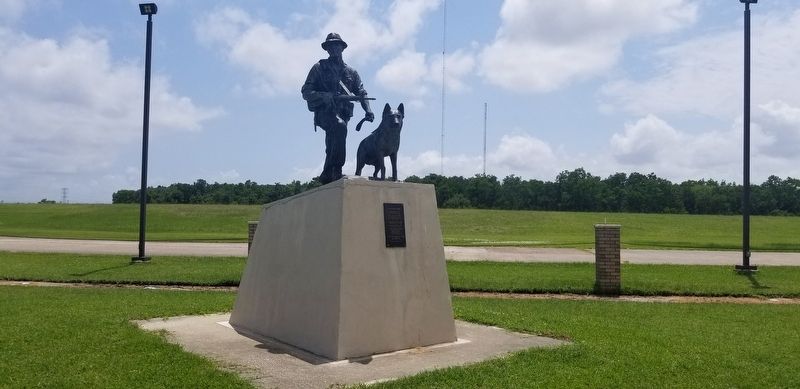
Some 30,000 dogs have
served America's military
in 20th century wars
They have served as guards,
scouts, trackers, messengers
or detectors of mines,
booby traps, explosives and
enemy soldiers
In Viet Nam 325 died in action
while . . . — — Map (db m150769) HM WM
This anchor is in recognition of, and a tribute to, those who served in the Merchant Marine of World War II, we salute the men and women who served aboard the ships of the following Merchant Marine fleets: Texaco Marine, Sabine Towing & . . . — — Map (db m150933) HM WM
The last remaining landmark of the "dream city" planned by the founder of Port Arthur, railroad magnate Arthur E. Stilwell (1859-1928). The house was built in 1900 as the winter resort home of Isaac L. Ellwood . . . — — Map (db m151004) HM
John W. Gates founded Port Arthur College in 1909 as a
nonprofit, non-sectarian, vocational school focusing
on stenography, accounting and communications. Gates,
one of the founders of the Texas Company (Texaco),
envisioned a school to . . . — — Map (db m150731) HM
Electric railways known as Interurbans existed in Texas from 1901 until the 1940s to provide frequent opportunities for the public to travel between urban centers. Interurban service between Beaumont and Port Arthur began on December 16, 1913, . . . — — Map (db m150381) HM
The rapid growth of the petrochemical industry in Jefferson and Orange counties in the early 20th century led to increased population in this area. In order to serve escalating transportation needs, plans began in the 1920s for the construction of . . . — — Map (db m150345) HM
Commemorating the lives of African Ancestors who perished during the Middle Passage and those who survived and were transported through Sabine Pass, Texas
1817 - 1837
Stony the road we trod,
Bitter the chastening rod,
Felt . . . — — Map (db m298162) HM
Rock Island Baptist Church in 1910, a small group of Christians (known as the Sixth Street Baptist Church) began worshiping in Port Arthur. The following year, in 1911, the Rock Island Baptist Church organized when eleven members from the Sixth . . . — — Map (db m171639) HM
This building was constructed in 1915 as the new home of Port Arthur's First United Methodist Church, which had organized in 1897. The building was designed by C.W. Ward, and church member Warren McDaniel served as the contractor. A special . . . — — Map (db m201906) HM
Situated between Port Arthur and Lake Sabine and drainages of the Sabine and Neches Rivers, the Sabine-Neches Canal is a vital route for commerce from the Gulf of Mexico to port facilities in Beaumont, Port Arthur, Orange and other areas. Interest . . . — — Map (db m151622) HM
Laid out in 1835 on land grant from government of Mexico to Horatio M. Hanks. At least 160 blocks were planned. After the Texas Revolution, Banks' partner and agent Alamazon Huston sold first 15 lots on Nov. 27, 1837. Deed records show town . . . — — Map (db m201856) HM
The growth of the petrochemical industry in the southern part of Jefferson County in the early 1930s resulted in the need for extended county government services. State legislation was required in order to enable the county to build a . . . — — Map (db m150436) HM
Marker 1
On April 20th 1898, congress adopted the
following resolution "first, that the people
of the Island of Cuba are and of right
ought to be free and independent "second,
that it is the duty of the United States to
demand, and the . . . — — Map (db m158104) HM
John and Melinda Sparks and their family came to southeast Texas from Tennessee in 1838. They settled on the Jeremiah Mixon headright on Lake Sabine and later set aside land for a family burial ground. The land was acquired by the Port Arthur Land . . . — — Map (db m151354) HM
In 1915, Reverend S.D. Hackett introduced Methodism to the
historic westside of Port Arthur, creating Hackett Chapel, a
black Methodist Church, with seventeen faithful members. The
"prayer band" began meeting at the Ila Hall on West 7th . . . — — Map (db m201976) HM
On February 3rd, 1943 as the American troopship Dorchester neared its destination,
Greenland, it was torpedoed at 12:55 A.M. by a German submarine. The old ship
immediately began to sink. As the men clamored to the deck, the four chaplains . . . — — Map (db m150369) HM WM
Since 1937, the Hughen School and other related facilities have provided assistance to individuals with disabilities. The school grew out of a vision by the Rotary Club of Port Arthur to start a movement in the interest of children with . . . — — Map (db m151940) HM
The city of Port Arthur was platted in 1895 as the terminus of a railroad envisioned by Arthur E. Stilwell as the shortest route from Kansas City, Missouri to the Gulf of Mexico. The Kansas City, Pittsburg and Gulf Railroad was completed in . . . — — Map (db m150352) HM
The eruption of the Lucas Gusher at the Spindletop oil field in January 1901 established Texas as a major oil source and signaled the beginning of a significant economic boom to the state. The new town of Port Arthur benefited tremendously from its . . . — — Map (db m118631) HM
In 1896 Arthur E. Stilwell, president of the Kansas
City Southern Railroad, organized a townsite company
to settle Port Arthur. Soon afterward, R.H. Woodworth
(d. 1923) moved here from Chicago with his bride Mary
(d. 1946). They erected their . . . — — Map (db m150713) HM
J.H. Baxter of the Griffing Lumber Company built this residence in 1906 for R.H. Woodworth (d.1923). Wide verandas extend beyond the impressive columned portico of the Classic Revival structure. Woodworth, a business and civic leader, and his wife . . . — — Map (db m150368) HM
The 36th was a dominant element of the Texas National Guard for many years. Born of the volunteers who fought
for Texas independence and nurtured through more than 150 years of local emergencies, border conflicts, Indian
raids and International . . . — — Map (db m158057) HM
Twelve people heard the Rev. C. G. Kuppler of Louisiana deliver the last German Lutheran sermon in this area in early 1899. The small group applied for a regular pastor; the Lutheran Mission Commission sent Dan Poelott, a theological student, who . . . — — Map (db m172269) HM
Born in Rotterdam, Holland, Adrianus Jacobus Maria Vuylsteke (1873-1912) immigrated to the U. S. in 1893. In 1894-96 he moved to Texas and helped plat the town of Port Arthur. Following his marriage to Nettie Minerva White in 1898, they settled in . . . — — Map (db m150654) HM
In Recognition of Women's peacetime and wartime service to our country
Civil War 6,000
Spanish-American War 1,500
World War I 34,000
World War II 400,000
Korea 22,000
Viet Nam 7,500
Grenada 116
Panama 1,200 . . . — — Map (db m150744) WM
In grateful recognition of the supporting roles performed by the 442nd Infantry and
517th Parachute Combat Teams. The 442nd suffered severe casualties in the successful
rescue of a 141st Infantry Battalion caught behind enemy lines in the . . . — — Map (db m158494) HM WM
Originally towering 180 feet above the campus of Port Arthur College, this radio tower was constructed in 1909. Due largely to the efforts of local community leader John W. Gates (1855-1911), the college offered instruction in wireless telegraphy. . . . — — Map (db m273315) HM
This Baptist church, the first in Port Neches, organized in October of 1910. Twelve charter members held Baptist services in a one-room schoolhouse. These church founders were Mr. & Mrs. John Livingston, Mr. Horace Livingston, Mr. & Mrs. R.E. . . . — — Map (db m170865) HM
Before 1881 Methodists in Port Neches, then known as Grigsby's Bluff, were served by occasional circuit Riders who preached in private homes. On Sept. 6, 1881, the Rev. W. H. Crawford conducted a meeting to organize the first local Methodist . . . — — Map (db m170582) HM
Joseph Grigsby (1771-1841) and family migrated from Kentucky to the Sabine area in 1827. He is said to have been the first grower of cotton in East Texas. In 1834 he received a grant of 17 labors (3,009 acres) of land on the Neches. Here he built a . . . — — Map (db m170581) HM
The late 1850s saw the arrival of the first Catholic families to
the area known as Port Neches. While no church would be
formally founded for many years, the area was frequently
visited by traveling missionaries known as "saddlebag . . . — — Map (db m292110) HM
Western singing star Woodward Maurice ("Tex") Ritter was born in Panola County, Texas. After attending college, he began singing cowboy ballads on a Houston radio station in 1928. He advanced to Broadway, where he was nicknamed "Tex", and in 1936 . . . — — Map (db m170515) HM
In October 1886, Sabine Pass was the second largest town in Jefferson County, boasting a new rail line and an optimistic outlook on continued growth as a major coastal port. On the afternoon of October 12, just two months after a hurricane had . . . — — Map (db m118670) HM
The Beach Road is the coastal section of the Texas Highway 87 system. Stretching along the Gulf of Mexico from Sabine Pass through Chambers County to Port Bolivar in Galveston County, it follows a historic route that proved vital to the early . . . — — Map (db m118676) HM
Born in Louisiana; settled in Texas in 1832. Fought in victorious Texas Army at Bexar, Dec. 1835; in Capt. James Gillaspie's company, 2nd Regiment, Battle of San Jacinto, April 21, 1836.
Married (1) 1838, Rachel Garner, who died 1856; (2) 1861, . . . — — Map (db m273325) HM
After Texas seceded from the Union at the onset of the Civil War, the state's ports were included in a Union blockade of the South. The proximity of Sabine Pass to Galveston made it a strategic point for both the Union and Confederacy. In January . . . — — Map (db m118789) HM
The first known settlers in this area were John McGaffey and Thomas Courts, who arrived in 1832. Sam Houston assisted Manuel de los Santos Coy in acquiring a land grant here in 1833. Two years later Houston and two partners purchased Coy's property . . . — — Map (db m118671) HM
Maine native Leonidas Smith (b. 1829) became a sailor as a youth and, by age 21 commanded the U.S. Mail Packet Pacific along the west coast. At the outbreak of the Civil War in 1861, he was sailing out of Galveston, Texas. He served as . . . — — Map (db m118780) HM
Commemorating
the feat of
Dick Dowling
and his forty two Irish patriots
Sabine Pass, Texas.
1861 C.S.A. 1865
"September the 8th 1863, an army of fifteen thousand Federals attacked the small fort at the Pass; the brave little garrison . . . — — Map (db m118815) HM WM
The Civil War battle at Sabine Pass on September 8, 1863 was a victory for Lieutenant Richard W. Dowling and his troops, which numbered fewer than 50. Dowling and his Davis Guards kept Union gunboats from advancing up the pass. The U.S.S. . . . — — Map (db m118791) HM
To protect Texas against Federal invasion during the Civil War, Confederate General John B. Magruder ordered the construction of a fort on September 4, 1863, four days before the famous Confederate victory won by Dick Dowling and his small company . . . — — Map (db m118775) HM
During the Civil War, the Sabine Pass Channel was a strategic gateway to the interior of eastern Texas and western Louisiana, control of which was vital. Fearing a possible Union invasion, the citizens of Sabine City (later Sabine Pass) formed a . . . — — Map (db m118674) HM
Louisiana native Jacob H. Garner, son of Bradley and Sarah Harmon Garner, settled in Jefferson, a village on Cow Bayou in present-day Orange County, Texas, in 1825. In 1835 he took part in the Grass Fight and Siege of Bexar while serving one of two . . . — — Map (db m273319) HM
Georgia native Kate Dorman and her husband, Arthur Magill, owned and operated the Catfish Hotel at Sabine Pass as early as 1847. Arthur Magill was killed in an accident in 1859, and the following year Kate, a widow with two young daughters, married . . . — — Map (db m273324) HM
Georgia native Kate Dorman and her husband Arthur McGill owned the Catfish Hotel at Sabine Pass as early as 1847. McGill died in an accident in 1858, and in 1859 Kate married John Dorman. In 1862 the Catfish Hotel became a temporary hospital, and . . . — — Map (db m273322) HM
Melvin was a past President and the
Secretary/Treasurer of the Dick Dowling
Lions Club of Sabine Pass, Texas. He led the
club with tireless enthusiasm, dedication and
vision. As a retired Coast Guardsman, he
had a keen interest in the two . . . — — Map (db m163960) HM
Niles F. Smith, a native of New York, came to Texas with Robertson's colony in 1834. He served as a soldier in the Texas Revolution. In 1839 he moved to Jefferson County, and settled in Sabine Pass in 1841. He held many official positions in the . . . — — Map (db m273321) HM
Center Front Panel
In memory of Lt. Richard W. Dowling and his men. Texas remembers the faithfulness and valor of her sons and commends their heroic example to future generations.
The Men Who Fought with Lt. Dowling Were:
Left Front Panel . . . — — Map (db m118792) HM WM
This lantern and watchroom once made up the top 20 feet of the Sabine Bank lighthouse, which originally towered 72 feet above the water in the Gulf of Mexico.
The lighthouse was fabricated in Detroit, Michigan and shipped to Sabine by railway in . . . — — Map (db m118814) HM
The oldest continually used cemetery in Jefferson County, this graveyard has served the citizens of the Sabine Pass area since the 1840s. The earliest documented grave is that of a 12-year-old John A. Dashiell, son of William V.C. and Mary Dashiell, . . . — — Map (db m273317) HM
In memory of those citizens of Sabine Pass who lost their lives in the service of their country.
Spc. Ryan Berg Died Jan. 9, 2007
Baquba, Iraq — — Map (db m163965) WM
In memory of those men from
Sabine Pass who lost their
lives in the service of
their country in World War II
Henry L. Cushion -
A. J. Comte -
Vollie Y. Fawvor -
Francis R. Fields -
Marcus A. Hanna -
Charlie L. Harris -
Wendell M. . . . — — Map (db m163963) WM
Renowned for brilliant Civil War victory, Sept. 8, 1863. Confederates in this fort repulsed a fleet seeking to land thousands of Federal soldiers.
Lt. Richard W. Dowling (1838-1867), in civilian life a Houston businessman, commanded fort during . . . — — Map (db m118779) HM
Commanded by Col. Ashley W. Spaight, the 11th Battalion of Texas Volunteers, Confederate States Army, was nicknamed the "Swamp Angels." Tracing its origins to the "Sabine Pass Guards" militia formed in 1861, the battalion served during the Civil War . . . — — Map (db m118675) HM
As tension mounted between the United States and Spain during the late 1890s, U. S. Representative Samuel Bronson Cooper of Texas recommended the War Department begin plans for the defense of the strategic Sabine Pass area. The Army Corps of . . . — — Map (db m118776) HM
Union Casualties at the Battle of Sabine Pass
September 8, 1863
USS Clifton
Killed
United States Navy
Exec. Officer Robert Rhodes
Michael Driscoll, Landsman
75th Regt. New York Volunteers
Pvt. Henry Raymond, Co. A . . . — — Map (db m118812) HM WM
Federal forces in the Civil War failed in most of their early efforts to capture Texas. In the fall of 1863, after taking New Orleans and Vicksburg, their leaders attacked Western Louisiana in a renewed effort. They wished to divert valuable stocks . . . — — Map (db m118790) HM
The natural coastal cut of Sabine Pass has long been an important military strategic point, as evidenced by the battle that took place here during the Civil War. It was no less significant in World War II, when it became one of the primary points of . . . — — Map (db m118778) HM
This center-bearing swing bridge, completed in 1940, is only one of a few such highway bridges remaining in Texas. The bridge was the last major component constructed along Texas Highway 87, which was known as the "Hug-The-Coast-Highway" running . . . — — Map (db m172233) HM
In 1940, 28 charter members organized a Baptist church to
meet the spiritual needs of the local community. Though
worshippers had met for services in the area since 1877, the
community, then known as Prairie View, had lacked an
organized . . . — — Map (db m171190) HM
The original charter for a rail line through the Orange area was granted to the Sabine and Galveston Railroad and Lumber Company in 1856. About the same time the New Orleans, Opelousas and Great Western Railroad Company was building a line west . . . — — Map (db m116867) HM
Born in Louisiana in 1812. Arrived in Texas, 1824. Served in the Army of Texas, 1836. Member of Captain Benjamin J. Harper's Company. Died 1878. His wife, Mary Arthur Jett. — — Map (db m290717) HM
A native of Ireland, Alexander "Sandy" Gilmer came to the United States in 1846 at the age of seventeen. Settling first in Georgia, he worked for his brother John, who had a contract to supply ship masts to the French government. Later the brothers . . . — — Map (db m141239) HM
The Atakapan Indians, a tribe associated with southeastern U. S. bands, lived in this area for centuries. Studies have suggested their presence covered a large region of southeast Texas. Their name comes from the Choctaw Indians, and means . . . — — Map (db m116693) HM
Schools for Orange County’s black children were held in churches and private homes as early as the 1870s. In 1887 a black school was opened in the Duncan Woods community, and another was soon established in Orange. Known as Orange Colored School, . . . — — Map (db m116259) HM
As early as the 1870s, Orange County's African American children attended school in private homes and churches. The Orange County commissioners established 17 school districts in 1887. Schools included the Duncan Woods No. 3, located in the Duncan . . . — — Map (db m116303) HM
John Horace Bland and his wife Edna built this home in 1902. In 1910 John Michael Dullahan bought it and lived here with his parents until 1917. Two years later it was sold to Louis Phillip Bazzano, a local cobbler, and his wife Annie Drucilla . . . — — Map (db m292167) HM
A licensed river captain and the son of a pioneer area shipbuilder, George M. Levingston was a leader in the development of Orange's shipbuilding industry. In 1933, after years of experience in the local shipyards, he formed the Levingston . . . — — Map (db m141637) HM
Well known for his expertise on the guitar and his multi-genre music, Clarence "Gatemouth" Brown had a recording career that spanned more than 50 years. Born in Vinton, Louisiana, he and his family moved to Orange when he was an infant. Here, Brown . . . — — Map (db m116271) HM
The town of Orange began as a settlement in the late 1820s on a bend in the Sabine River. By the Turn of the Century, the town had expanded north of the river bend. Thomas C.B. Cox (1856-1929), a civil engineer for the Lutcher and Moore Lumber . . . — — Map (db m116204) HM
In 1852 wealthy Mississippi sawmill owner David Robert Wingate moved his family to a large cotton plantation in Newton County. During the Civil War (1861-65), he donated lumber from his Sabine Pass sawmill to build Fort Sabine and other posts. . . . — — Map (db m141141) HM
South Carolina native Samuel M. Brown served with distinction as a surgeon in the Confederate army during the Civil War. He and his family settled in East Texas in 1866 and in 1871 moved to Orange. He was a respected local physician, often treating . . . — — Map (db m201930) HM
Two in a long line of physicians in their family, William and David Caldwell Hewson were significant figures in Orange County. William was born in Philadelphia in 1801. in 1821, he married Mary Ann Bankson and they moved their family several times . . . — — Map (db m116876) HM
A native of Waxahachie, Texas, Emma Shirley Henderson Wallace (1876-1968) attended school at Prairie View College before becoming a teacher in 1896. She taught in Tyler, Ellis and Jefferson Counties before moving to Orange in 1901 to become one of . . . — — Map (db m116194) HM
The grounds were very important to the Starks. Much as the home changed throughout their lives, the grounds also evolved.
Over the years, they added three greenhouses, or conservatories, a potting shed, lily pond, servants quarters, and more. . . . — — Map (db m118243) HM
Local lore places the first burial in this cemetery as early as 1840. When Robert Jackson purchased 35 acres of land including this site in 1853, at least one grave was already present. Jackson allowed that portion of his land to be used for . . . — — Map (db m140563) HM
In 1879 the Rev. Andrew Peddy helped organize this congregation with 18 charter members. They met in the frame Orange County courthouse and were served for a time by missionary preachers. Sarah A. Finch and Anna and L. L. Bettis deeded a lot in . . . — — Map (db m116190) HM
The First Christian Church of Orange began in 1885 when a group of residents started meeting for worship services. Some of these charter members were baptized in the Sabine River. The church officially organized under the Rev. J.C. Mason in 1894, . . . — — Map (db m140722) HM
Until the industrial revolution reached Orange in the late 1880s, most banking needs in the area were handled through Galveston.The growth of Orange as a lumber center and deep water port, however, necessitated the development of a local banking . . . — — Map (db m140866) HM
The first recorded Methodist activity in Orange was in 1859, when the Rev. Valerious C. Canon was sent here from the Woodville District. By 1871, Orange was on a circuit which included Hardin, Jefferson and Orange Counties. According to legend, one . . . — — Map (db m116208) HM
A veteran of the War of 1812, Georgia native George Alexander Pattillo (1796-1871) migrated to this area in the early 1830s. He served on the local Committee of Correspondence created by the Convention of 1832 and on the General Council of the . . . — — Map (db m116654) HM
The son of German immigrants, Henry Jacob Lutcher (1836-1912) became a successful lumberman in this home state of Pennsylvania. Attracted by the vast timberlands of Southeast Texas he and his partner G. Bedell Moore moved part of their operation to . . . — — Map (db m116245) HM
On December 8, 1887, Henry Jacob Lutcher Stark was born in Orange to William H. and Miriam H. (Lutcher) Stark. His maternal grandfather, Henry J. Lutcher, had amassed wealth as a co-founder of the Lutcher and Moore Lumber Company and as a landowner . . . — — Map (db m116270) HM
The history of Orange County is actually the story of utilization and development of the natural resources of this part of southeast Texas. For more than a century and a half, lumber, agriculture, shipbuilding, oil, and finally chemically related . . . — — Map (db m116339) HM
The Orange, Texas USA Rotary Club was admitted to Rotary International on 1 June 1919. Its first President was H.J.L. Stark. Mr. Stark, together with other influential members of the City of Orange, believed that the community would benefit from . . . — — Map (db m116336) HM
The world's first service club, the Rotary Club of Chicago, Illinois, USA, was formed on 23 February 1905 by Paul P. Harris, an attorney who wished to recapture in a professional club the same friendly spirit he had felt in the small towns of his . . . — — Map (db m116335) HM
Though rumors of slave cemeteries in Orange County abound, the burial ground on this site is the oldest known African American cemetery in the area. When Mary E. (Merriman) Boneville transferred 2.5 acres of land to William King, trustee of Mt. . . . — — Map (db m116196) HM
Following the example of his father Dr. Samuel M. Brown, Georgia native Edgar William Brown (1859-1917) became a practicing physician in Orange. In 1888 he married Carrie Launa Lutcher (1861-1941), daughter of the successful Orange lumberman Henry . . . — — Map (db m190732) HM
A native of North Carolina, Hugh Ochiltree migrated to Texas in 1840. Settling first in Nacogdoches, he studied law in the office of his cousin William Beck Ochiltree, who became a prominent Justice and Texas statesman. In 1843 he moved to San . . . — — Map (db m116641) HM
Henry B. Jackson, a prominent local banker and businessman, built this home soon after he purchased the property in 1902. In 1909 he sold it to Frank W. Hustmyre, Vice President of the Orange National Bank and manager and secretary-treasurer of the . . . — — Map (db m292127) HM
Born in Orange, J.O. Sims (1874-1961) rose from clerk to Board Chairman during his long career with the First National Bank. He married Mary Alberta Spooner (1879-1948) in 1899 and built this residence in 1902. Originally located one block from . . . — — Map (db m141276) HM
Prominent local jeweler Joe Lucas (1865-1944) and his wife Annie (1879-1978) built this home in 1907 as a modest 2-story vernacular structure. As a result of business success they improved their home by adding a Queen Anne style wraparound gallery . . . — — Map (db m292125) HM
Born in 1790 in St. Martin Parish, Louisiana, John Harmon lived at Poste de Attakapas, a Spanish fortification at the present site of St. Martinville. A veteran of the state's defensive actions during the War of 1812, he wed Elizabeth Compstock . . . — — Map (db m116875) HM
Patriarch of the Orange County Stark family, John T. Stark was born in Pebble [sic - Preble] County, Ohio, in 1821 and moved to East Texas in 1840. He settled in Newton County in the 1850s where he read law and ran a mercantile store. In 1861 . . . — — Map (db m141306) HM
This house stands on land purchased in 1900 by J. K. Jorgensen, a hardware store clerk. Construction began in 1907 when Jorgensen removed the front porch and two front rooms from a relative's house and moved them to this location on wooden rollers . . . — — Map (db m292126) HM
A millionaire by his early thirties, Leonard Frederick Benckenstein made his first fortune in Detroit, where he was involved in the insurance, stock, and bond business. His friendship with prominent East Texas lumberman John Henry Kirby led him to . . . — — Map (db m116209) HM
In 1859, three brothers, Samuel, David and John Levingston, arrived in Orange from Ireland and purchased an existing shipyard, where they built wooden ships for more than thirty years. The son of Samuel Levingston, "Captain" George Levingston, . . . — — Map (db m116219) HM
Founded in 1878, the First Presbyterian Church initially occupied a frame structure built in 1883 at Market and Polk Street. In 1912 the congregation moved to this church building which Frances Ann (Mrs. Henry Jacob) Lutcher (1841-1924) had erected . . . — — Map (db m142324) HM
James M. Chandler was a Confederate veteran who brought his family to Texas after the Civil War. About 1890 he built a residence and several outbuildings, including a stable, on this property. In 1896, Chandler's daughter Laura began holding school . . . — — Map (db m292128) HM