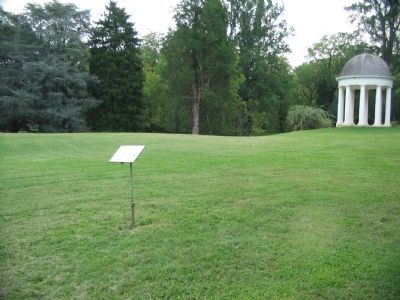
"And I desire my black Smith Moses, may belong to such of my children as he shall chose if they are willing to take him at a reasonable price." - Will of James Madison, Sr., 1787
A ringing anvil and glowing forge were signals that the blacksmith was working. The skill, stamina, and strength of the blacksmith played an important role in constructing machinery and maintaining the ironworkers' equipment. Using simple tools and . . . — — Map (db m86452) HM
This blacksmith shop was constructed using original logs from a two-story log home built on Beatty Road in the 1850s. The materials were donated by Roger and Jean Spillman.
Tools in the shop were used in "Augy's Blacksmith Shop," owned and . . . — — Map (db m141667) HM
To make repairs in the grist and saw mills, Wilson Morningstar had a blacksmith and carpentry shop located where the parking lot is now.
The "shop" was a two storey flat-roofed wooden structure clad in metal sheeting which looked like concrete . . . — — Map (db m280043) HM
This was the site of William Vosburgh's blacksmith shop from 1866 until the early 1900s. During that time of horses, carriages, machinery and constant repairs, a skilled blacksmith was critical to the farming community
and its success. Vosburgh, . . . — — Map (db m291436) HM
Blacksmith Shop
This Blacksmith Shop came from Lancaster Township in
Glengarry County, approximately 70 kilometers northeast from here.
While the exact date of construction is unknown, this shop was operated by blacksmith Ozias . . . — — Map (db m302014) HM
German:
Der Name ist auf die Tatsache zurückzuführen, dass zwischen 1642 und 1874 von den jeweiligen Besitzern das Schmiedehandwerk ausgeübt wurde.
1734 heißt der Besitzer Friedrich Kugler. Er ist der Schöpfer der . . . — — Map (db m294385) HM
The original Red Front Blacksmith Shop was located directly across the street from this mural. The workers pictured represent many local ranching families. The images in the ovals next to the buildings show scenes from Tehachapi's ranching history. . . . — — Map (db m53116) HM
A blacksmith's shop operated near the blacktop road until 1915. Many farmers, including Frank McWorter, had some blacksmithing tools and skills, but they also relied on professional smiths to make and repair iron objects for use on the farm and . . . — — Map (db m302354) HM
Virginia City boomed and land prices soared accordingly in 1863 and 1864, a trend well illustrated in the earliest ownership transactions of this choice commercial property. On May 13, 1864, George Parker paid $800 for the lot and sold it for $1400 . . . — — Map (db m49441) HM
Like the blacksmith shop next door, this early building was probably a dance hall or saloon in the mid-1860s run by owner John Trollman. In 1865 Trollman was one of Virginia City’s seventy-three licensed retail liquor dealers. By the 1870, a larger . . . — — Map (db m49410) HM
The clang of a hammer on iron and the acrid scent of coal smoke were commonplace at the Biltmore Forest School. Two blacksmiths, each with their own business 14 miles away in Brevard, took turns working here. Not only did the horses require shoes . . . — — Map (db m43798) HM
Famous golfer Ben Hogan spent his early years in Dublin, Texas, often at the side of his father and grandfather at the family-owned Hogan Blacksmith Shop at this location. The tools of blacksmithing were toys to the young Hogan who would later use . . . — — Map (db m264223) HM
Big Horn grew up as one of the main communities along the stage route in Sheridan County. The first Big Horn Post Office was established in 1879 at Thomas Creighton's ranch two miles northeast of Big Horn. In 1881, Creighton sold his ranch, and the . . . — — Map (db m91401) HM
The 1907 photograph to the left shows, from left to right, the boiler plant (foreground), broom factory, outhouse, blacksmith and candle shop, and kitchen extension.
Before shops were built inside the stockade, inmates worked outside cutting . . . — — Map (db m95327) HM
In 1898 John Corbett opened a blacksmith shop here. It was later purchased by Charles Archer. Two other shops were located nearby. — — Map (db m59054) HM
This is one of seven shops where the Blacksmith & Wainwright was an important part of the growth & development of Nauvoo. Here they made a variety of tools. The Webb Brothers, Shupe Brothers & many others worked together to accomplish the great task . . . — — Map (db m244072) HM
On February 16, 1852, Henry and Clement Studebaker opened the H&C Studebaker blacksmith shop on this site. In addition to blacksmithing, H&C Studebaker also built wagons and carriages.
The business grew rapidly and quickly outgrew . . . — — Map (db m213328) HM
John Froelich invented the very first successful gasoline powered tractor able to proplel itself backward and forward, in 1892, right here in this village named after the Froelich family. The blacksmith, William Mann, assisted with the creation of . . . — — Map (db m203106) HM
The Blacksmith Shop building is new (1983), but houses tools that were used in late 1800's and early 1900's. Many of the tools are from Archie Brown's shop in McLouth. — — Map (db m63732) HM
This historic property has served as a blacksmith shop, wagon making shop and general store. Begun by John and Barbara Bauer in 1870, their businesses flourished here, on a main turnpike to Louisville, and finally in 1918 evolved into the Bauer . . . — — Map (db m161988) HM
This building was originally a double-pen slave cabin from Welham Plantation built circa 1840. Upon relocation in 1871, it was converted to a blacksmith's shop. It retains its mortise-and-tenon construction, but has been modified with a new . . . — — Map (db m112712) HM
On this site in 1851 stood the blacksmith shop operated by Henry August Rasche, then in the employ of the Baltimore and Ohio Railroad. The B & O line was at the time being extended through Oakland, Allegany County, Maryland, westward into Preston . . . — — Map (db m68878) HM
Originally a blacksmith shop, this home was built in the middle of the eighteenth century. It stands on a tract once known as “Magruder’s Honesty.” Believed to have been built by Ninian Magruder, Senior (d. 1751), it is one of the oldest standing . . . — — Map (db m916) HM
This building, constructed about 1880, was home to dressmaker Sophia Wirth at the beginning of the 20th century. Bernard Wirth operated his blacksmith shop in a building on the adjacent, now-vacant lot. Later, that site, 1913 Cherokee, became home . . . — — Map (db m133197) HM
Bill and Mack Foster moved this building to here from Ellsworth. It was used as a blacksmith shop by them when they were prospecting in this area for about twenty years preceding the year 1954. — — Map (db m89579) HM
This fully functional shop is representative of the period from 1750 to 1900. Quarry operations required the skills of a blacksmith for the maintenance of equipment and livestock. — — Map (db m63103) HM
The Blacksmith Shop Built in the 1850's, it was originally operated by Peter Petz, and later by John Kratt. William Roloff purchased the Shop in 1921 and later passed in on to his son Kenneth. The shop became the last full time operating shop . . . — — Map (db m133184) HM
The last blacksmith shop in Orleans County stood near this site. It was owned by John W. Cielewich (1894-1977), in whose memory this plaque is dedicated. The property was presented to the Village of Medina by his family. — — Map (db m81967) HM
This shop was used by the farmer to make repairs to tools or to forge his own ironwork. Iron could be scarce, so a worn-out horseshoe might become part of a door hinge, as you can see here. This blacksmith shop was brought here from Cades Cove, . . . — — Map (db m12818) HM
Before there were hardware stores, every
town had one or two blacksmiths.
Blacksmiths made hinges, latches, tools,
horseshoes. The "smith” heated iron
objects red hot in his forge, hammered,
and shaped them by hand on his anvil. — — Map (db m204759) HM
Built in 1871, this 5-room house with native timbers and 18" thick sandstone walls was the first to be built in Pawhuska. When the Osages were moved from Kansas, Sid Delarue, a Swiss blacksmith, was promised the house if he would come to care for . . . — — Map (db m55655) HM
Carl Severin Schultz was born in Copenhagen, Denmark, in 1876. After marrying Nelsina Vestermann (b. 1871), he came to the United States and settled in Granbury. Schultz had several professions, including ownership of a soft drink factory. He later . . . — — Map (db m138191) HM
This Pioneer Blacksmith Shop
was originally located about two blocks
East of this site. The Blacksmith was
so important in Pioneer Life that many
Communities offered him a Parcel of Land
to set up Shop for an agreed length of time. — — Map (db m301544) HM
Rarely seen today, the blacksmith shop was a vital home industry in Ed Mabry’s time. Here “Uncle Ed” cleverly fashioned wagon tires, andirons, tools, and various other iron objects for himself and his neighbors. — — Map (db m174591) HM
Each CCC Camp had a blacksmith shop where they forged and repaired tools. Items such as fireplace tools, hinges or lantern poles were crafted for use in the camp. In 1940 the CCC printed an educational handbook called Blacksmithing. Unit No. 1 . . . — — Map (db m229308) HM
Martinus Nelson built a blacksmith shop here in 1888. The smithy serviced local horses and wagons that kept area dairy farms running. Danish immigrant Christian Lauritzen took over in 1898. Business was good in the growing community, and . . . — — Map (db m134477) HM
By the end of the Red River War in 1875, settlers began to move to this area. Stretching across five counties, the J.A. Ranch employed ranch hands and cowboys to care for over 100,000 cattle. The life of a rancher depended on tools of the trade. . . . — — Map (db m153249) HM
German:
Der Hufschmied war im Mittelalter wegen der kurzen Wege direkt am Stadttor angesiedelt. Wegen der hohen Brandgefahr lag die Schmiede nahe der hier fließenden Vils.
Die Schmiede wurde nachweislich durchgehend von 1629 bis . . . — — Map (db m275644) HM
Built in the mid 1850’s by John Fippin and John Single. Fippin married Single’s daughter, Julia, in 1867, and they raised 10 children. Local legend has it that one of Lotta Crabtree’s earliest performances was atop the anvil here. The building . . . — — Map (db m10561) HM
Theodore N. Thorpe, wife and
seven blacksmith sons settled
in Metamora, in 1858, attaching
a cottage to the rear of the
blacksmith shop, to live in.
He and his family left
Pennsylvania to go to the
California gold fields, but
never got any . . . — — Map (db m159970) HM
The Blacksmith Shop in Red
Oak II originally was Mr.
Lowell's great-grandfather
Weber's blacksmith shop in
Red Oak, Mo. Mr. Lowell's
great grandfather was one
of the first pioneers in this
area. This was the first
building to be . . . — — Map (db m251697) HM
School, Blacksmith's Shop and Firehouse
Opposite is the Fraser Free School built in 1863 for the elementary grades (high school students journeyed to Yonkers) and later used as a library, civic center and, now a volunteer fire . . . — — Map (db m193456) HM
These log structures built by Thompson, a Danish convert to Mormonism, are Round Valley's oldest surviving buildings (1879). The cabin hosted the first Mormon services in Springerville. — — Map (db m36385) HM
Lawrence Alf
1931 - 2013
This blacksmith shop stands here today
because of your life of devotion to its security.
You have been its faithful guardian and
protector for over 22 years.
Your diligence allows future generations
to . . . — — Map (db m284792) HM
Blacksmith Shop
Inside, this functional blacksmith shop periodically provides
educational demonstrations using a working forge and early 20th
century tools. The building was once owned by the Asmus family
as a granary, or storage building . . . — — Map (db m185795) HM
The blacksmith shop is in much the same condition as it was when found at the McDonald farm, located on the Service Road, east of the intersection of Highway 401 and McConnell Avenue, Cornwall.
Flora (Grant) Dumouchel, auctioneer, . . . — — Map (db m202392) HM
E. I. du Pont purchased the property for the Hagley Yard in 1813. This building was constructed as a blacksmith shop sometime between that year and 1834, when it appeared on a property survey. For nearly 60 years the shop produced the forged . . . — — Map (db m231907) HM
The hundreds of hand wrought metal items found at this site indicates that a blacksmith shop existed here in the 1800's.
Among the items found were parts of wagon wheels, cooking utensils, muskets, nails, scissors, grading tools, hammers, . . . — — Map (db m70539) HM
In Spring, 1988, as construction began on this
entry to Frenchman's Bend Subdivision, archaeologists unearthed the remains of the house and blacksmith shop of François Deloeuil who located here circa 1789. It was the region's most extensive . . . — — Map (db m169630) HM
A notorious dance hall was the original occupant of this 1863 building which encompasses a small cabin of V-notched logs, one of the first built in June of that year. Tall French doors and a few dentils clinging to the facade recall its former dance . . . — — Map (db m49407) HM
( east face )
Site of
Harmanus Bogardus
House
Built by Bogardus c.1803.
Adam A. Clark House 1822-1838.
John Crookes House 1864-1868.
Morgan E. Barber House 1882-1918.
Burned in Great Fire of 1918.
( west face . . . — — Map (db m142472) HM
Our blacksmith shop was a small building ... with... a dirt floor. The forge and anvil, drill press, and emery wheel were used daily to repair farm tools and sometimes to make them. Our horses and mules were shod there, and our plow points . . . — — Map (db m56777) HM
This building was originally George Kettler's Blacksmith shop, built in 1889 with ox and horse shoeing sheds on both sides. As the horse and buggy gave way to the automobile, it became an early garage. In 1947, it was acquired by Tom and Florence . . . — — Map (db m119110) HM
This marks the site of Meinard Rumely’s Blacksmith Shop where in 1853 he built his first threshing machine.
In the factory later erected here were produced pioneering steam engines and steam plowing engines, and in 1908 parts for the first . . . — — Map (db m43432) HM
Most necessary in
Colonial Times,
date erected unknown.
Blacksmiths were
Charles Kemble, Gilbert Knight,
Henry Allen, and William Cutts — — Map (db m35216) HM
In most cases a blacksmith would be hired from a nearby town or settlement. A skilled person would be able to forge or fashion various items of need for the fort and surrounding communities.
Hand forged items such as cut nails, hinges, . . . — — Map (db m164360) HM
[English] This building stands as a testament to the way frontier businesses changed and adapted to new realities. It began life in 1899 as the two storey Great Northern Hotel, to service the needs of a rapidly growing population. By 1907, as the . . . — — Map (db m49304) HM
Originally George Kettler’s Blacksmith Shop with ox and horseshoeing sheds on both sides.
In more recent years it was owned by Tom and Florence Adams.
From 1948 – 1975 they published the “Idaho Mountaineer” newspaper and . . . — — Map (db m110260) HM
In 1850, Albion Nevers built this workshop across the street
from his farm on the corner of Waterford and Hardscrabble
roads. He was a woodworker, cabinet maker, blacksmith, known
for his rattail hinges, repaired wagon wheels and would
hoist up . . . — — Map (db m267021) HM
This barn was generously donated to The Liberty Hyde Bailey Museum by Fred and Raphaella Amicarelli in 1996.
It was originally located in downtown South Haven on Broadway at School street, near the current location of the Amicarelli Vineyard . . . — — Map (db m205196) HM
This architecturally unremarkable building has a colorful history, having gone from an early-20th-century blacksmith shop to an early-21st-century liquor store, with several other incarnations along the way.
Built of locally manufactured . . . — — Map (db m160006) HM
Established on this corner in 1861 by Edward & Hughes, castings and mining equipment of all kinds were manufactured here. In 1869 the Transcontinental Railroad link would stimulate development and exploitation, changing the Western U.S. forever. . . . — — Map (db m226924) HM
It was on this site that Smith Riggs, 65, emerged into the
public eye in 1928, for his work on instruments of death – two
electric chairs. It took a great deal of persuading on the part
of Indianapolis hospital consultant, JF. Gregries to accept . . . — — Map (db m222408) HM
This shop was built by August William "Bill" Bolinder in the early 1940's
and used for 40 years. Bill learned smithing from his father, John Lars who is
credited with building the first "Mormon hay derrick".
In addition to shoeing horses and . . . — — Map (db m301520) HM
Presented to the city by J.B. Armstrong,
local manufacturer, as a symbol of
industry. Cast in zinc, mounted on a cast-
iron pedestal and red granite base. First
operated on Queen Victoria's birthday 1885.
Moved from St. George's Square 1922. . . . — — Map (db m307030) HM
John C Shay settled in Grub Gulch at the turn of the 20th century to mine gold. When his mining efforts failed he homesteaded the land, built this shop and started blacksmithing. He serviced the numerous wagons, stages and horse travelers that . . . — — Map (db m147957) HM
Beginning in the 1860s, foundries South of Market Street fabricated mining machinery, railroad cars, and ships. This 1912 machine shop is the last. Fred V. Wilbert forged fine tools here. Edwin A. Klockars (1898-1994), a native of Munsmo, Finland, . . . — — Map (db m110905) HM
Opened 1867 – Closed 1925
Founded by Stephen Farrington
Forging of tools for the miner and general blacksmithing was carried on in this shop — — Map (db m57895) HM
Established in 1877 for the manufacture & care of
carriages and wagons including Sanford's
early fire fighting equipment
Stood behind the Sanford Town Hall — — Map (db m276193) HM
This c.1900 replica building was constructed by village volunteers on site in 2011.
Materials from more than a dozen original area structures were reused. — — Map (db m216473) HM
The first smithy stood here. It burned in 1921. Neighbors diverted the brook so the new shop could be farther away from the house. In memory of Rene Schasel 1947 - 2019. Joseph & Nellie Vagg moved here with son & dau. in 1909. In 1929 they . . . — — Map (db m179176) HM
Built in 1917 on the site of an original shop in the Town of Herndon is dedicated to the memory of Hatcher H. Ankers--Granger--Churchman--Civic Leader--Chairman of the Frying Pan Park and Youth Center Advisory Board--whose leadership and devotion . . . — — Map (db m197031) HM
Upon his death in 1783, a set
of "Smith's Tools” were
listed in Col. WM. Preston's
estate. Blacksmithing
kept the plantation's horses,
mules & oxen shod and its
numerous farming "utensils"
in good working order. — — Map (db m162851) HM
Donated by Minnie Witzke
in honor
of her husband
Richard P. Witzke
Born - January 30, 1906
Deceased - August 2, 1981
A true village blacksmith . . . — — Map (db m157892) HM
A native of Missouri, Henry C. Luecke (1861-1937) came to Texas about 1890. He opened a blacksmith shop at this intersection in 1903. Here he developed and manufactured the Wichita Gang Plow, patented in 1905. His device was similar to other plows . . . — — Map (db m96799) HM
Philip Simmons is the most distinguished of Charleston ironworkers. Born on Daniel Island, Simmons began his eighty year career as a blacksmith at the age of thirteen under the apprenticeship of formerly enslaved Peter Simmons (no relation). Over . . . — — Map (db m134229) HM
Mechanical genius who made and flew first locally-owned aircraft. Born in Austria, Pliska came with parents to Texas, and after 1903 followed blacksmith trade in Midland. He built (1912) and flew at intervals up to 15 minutes an aeroplane of his own . . . — — Map (db m86497) HM
Born in Richmond, Virginia, in 1800, Lewis Temple established himself as a blacksmith on the New Bedford waterfront by 1836.
Temple manufactured his first toggle-iron in 1848. Its fastening power revolutionized the catching of whales. The . . . — — Map (db m1616) HM
This cabin was originally built at Lake Baldwin in the 1800's. It
was going to be demolished, so it was disassembled, pieces numbered,
trucked here and reassembled.
It is named in honor of Dr. Austin Arthur Gaddis, DVM, father . . . — — Map (db m263735) HM
2996 entries matched your criteria. Entries 101 through 200 are listed above. ⊲ Previous 100 — Next 100 ⊳
Thin black lines indicate changes in relevance. Between each pair of lines entries are ordered geographically but all have the same relevance.
* Inflectional forms of words are their plurals, singulars, and possessives as well as gramatical tenses and similar variations.