261 entries match your criteria. Entries 201 through 261 are listed.⊲ Previous 100
Rosenwald Schools Historical Markers
Julius Rosenwald, president of Sears Roebuck established a foundation that funded 4,977 schools for African Americans throughout the south from 1912 to 1932.
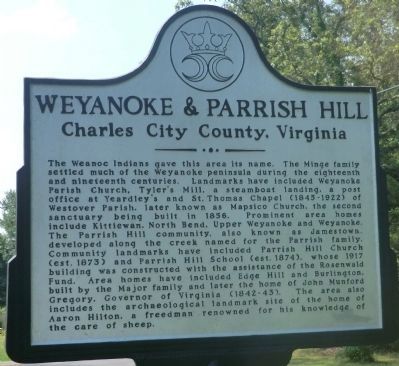
The Weanoc Indians gave this area its name. The Minge family settled much of the Weyanoke peninsula during the eighteenth and nineteenth centuries. Landmarks have included Weyanoke Parish Church, Tyler’s Mill, a steamboat landing, a post office at . . . — — Map (db m289015) HM
Central High School opened in 1939 as Charlotte County's first African American high school. Before its construction, African American students attended the Charlotte Training School, which had been built between 1928 and 1929 with . . . — — Map (db m182502) HM
After the Civil War, in the Red Oak area of Charlotte County, many freed slaves were welcomed to worship at Antioch Baptist Church, a traditionally white church. The Antioch congregation helped raise money to build Salem Baptist Church in . . . — — Map (db m30999) HM
After the Civil War, in the Red Oak area of Charlotte County, many freed slaves were welcomed to worship at Antioch Baptist Church, a traditionally white church. The Antioch congregation helped raise money to build Salem Baptist Church in . . . — — Map (db m182464) HM
First African Baptist Church of Coalfield, which stood about a mile southeast of here, opened a school for African Americans in 1866. After a fire in 1877, the congregation moved here and renamed itself First Baptist Church in Midlothian. Church . . . — — Map (db m180215) HM
Beulah Baptist Church, just across the road, housed a school for African American children in the Skinquarter community until about 1920, when the school moved into a new building on this site. Contributions for the one-teacher school came from . . . — — Map (db m314322) HM
Julius Rosenwald, a former president of Sears, Roebuck & Co., continued the efforts made by numerous philanthropists to bring education to African Americans in the South. During the early 1900s, funding for schools was scarce; the South had half . . . — — Map (db m21159) HM
The Greensville County Training School (GCTS) began sometime before 1912 as a small wood-frame building and went on to contribute to African American education in Emporia for more than 50 years. An addition in 1929 resulted in GCTS being one . . . — — Map (db m180459) HM
The Fairfax Rosenwald School or “Fairfax Colored School” was constructed in 1925–26 on this site. It replaced an earlier African-American school on Main Street east of the Fairfax Cemetery. In 1917, Julius Rosenwald, president of Sears, Roebuck & . . . — — Map (db m29482) HM
In 1912, Booker T. Washington, head of Tuskegee Institute in Alabama, asked Julius Rosenwald, a Jewish Philanthropist and President of Sears, Roebuck & Company, to serve on the Board of Directors at Tuskegee. Their unique partnership led . . . — — Map (db m160918) HM
In 1912, Booker T. Washington, head of Tuskegee Institute in Alabama, asked Julius Rosenwald, a Jewish Philanthropist and President of Sears, Roebuck & Company, to serve on the board of directors at Tuskegee. Their unique partnership led to the . . . — — Map (db m137506) HM
Built on this site in 1921 the Gloucester Training School became the first public high school for African Americans in Gloucester County. Thomas Calhoun Walker, Jr. and others constructed a wooden building with gifts from the Rosenwald Fund and . . . — — Map (db m30114) HM
① The honey-pod tree, which once stood near Gloucester Court House in the middle of Main Street, shaded the slave block where many of Walker's own relatives had been sold. Walker's autobiography, published in 1958, was titled "The Honey-Pod . . . — — Map (db m309520) HM
Woodville School is an important monument to Gloucester County and the African American community who strove to ensure quality education for their children in the early 20th century. Julius Rosenwald, president of Sears, Roebuck and Company, aided . . . — — Map (db m30122) HM
Thomas Calhoun Walker, community leader and advocate for African American education, led local efforts to secure support from the Julius Rosenwald Fund for the construction of six schools and one teacher's cottage in Gloucester County. Woodville . . . — — Map (db m265874) HM
Central High School, Goochland County's only high school for African American students, opened here in 1938. It replaced Fauquier Training School, which stood across the street from 1923, when construction was completed with support from the Julius . . . — — Map (db m272240) HM
Second Union School, which operated until 1959 is the oldest-surviving of the 10 Rosenwald schools built in Goochland County. The African American community and Goochland County contributed funds to the building. Constructed in 1918, the building is . . . — — Map (db m31607) HM
Chatsworth School was built circa 1915 as a one-room schoolhouse for the black children of the Antioch Community. Chatsworth was one of approximately twenty black schools in Henrico County supervised by the visionary educator, Virginia E. Randolph. . . . — — Map (db m25489) HM
African Americans prioritized education after Emancipation, and many attended one-or two-room schools built alongside churches in the late 19th and early 20th centuries. Christian Home School was built eight miles south of here, near Christian Home . . . — — Map (db m243623) HM
King William Training School was erected here in 1922-23 on the site of the King William Academy (1903-22). The Rosenwald Foundation, which built more than 5,300 black schools in the South, the African American community, and the county funded the . . . — — Map (db m47168) HM
Lylburn Downing School opened here in 1927 after
the Home and School League, an organization of
local Black parents and citizens. campaigned for
equitable schools. Built with financial support
from the Black community. Rockbridge County,
and . . . — — Map (db m207788) HM
African Americans in this area organized a patrons' league and campaigned in the 1920s for a new school to replace the inadequate facility then in use. Shady Grove School, built on a standard one-teacher architectural plan, opened here in 1925 for . . . — — Map (db m170106) HM
Louisa Training School, the county’s first high
school for African American students, was built
three miles northwest in 1926 with aid from the
Rosenwald Fund. In 1953, Archie Gibbs Richardson
High School replaced it here as part of an . . . — — Map (db m107854) HM
African American patrons, lacking facilities for secondary education, established Lunenburg Training School here about 1920. The school benefited from the support of the Jeanes Fund, which sponsored African American supervisors of education in rural . . . — — Map (db m182557) HM
The Megginson School was built here ca. 1923 for the African American students in the Pleasant Valley community, then part of Campbell County. Albert Megginson (1831-1923), formerly enslaved, purchased land in this area after the Civil War and later . . . — — Map (db m179861) HM
What does the local Black community have in common with a former President of Sears, Roebuck & Company? They worked together to build a new school for Black students in Manassas to replace an aging, outdated facility. The story began in 1926, . . . — — Map (db m305520) HM
Liberty Street. In the post-Civil War years, African-Americans who were bound by a strong sense of community settled near the Brown School and the Manassas Industrial School on what was then known as Liberty Avenue. As early as 1895, . . . — — Map (db m168231) HM
The earliest story on record of educating local African American students began ca. 1869, when the Manassas Village Colored School opened on the corner of Liberty and Prince William Streets. This two-room frame structure was a private school, . . . — — Map (db m214238) HM
The earliest story on record of educating local Black students began ca. 1869, when the Manassas Village Colored School opened on the corner of Liberty and Prince William Streets. This two-room frame stucture was a private school, offering . . . — — Map (db m305491) HM
Henry County opened a new Dry Bridge School just south of here in 1928 after the School Improvement League, an organization of African Americans living east of Martinsville, campaigned under the leadership of the Rev. W. F. Geter to replace the . . . — — Map (db m205807) HM
African Americans formed the Mathews Educational League in 1923 and raised $9,900 to build a four-room school here in 1926-1927. Donations came mainly from the black community, with additional contributions from white residents, the county school . . . — — Map (db m176022) HM
In 1915, four influential African American residents of South Hill—the Rev. J. H. Simmons,
Mary E. Simmons, Robert Walker, and James E.
Skipwith—established the Mecklenburg County
Training School for black students. The school
operated in the . . . — — Map (db m107443) HM
African American residents of Middlesex County established the Langston Training School (later the Middlesex Training School) in 1917 to serve elementary and high school students. The Rosenwald Fund supported construction of a new building ca. 1921. . . . — — Map (db m175980) HM
Recently emancipated African Americans yearned for education after the Civil War. They worked to build schools and educate themselves, often with assistance from the Freedmen's Bureau.
Freedmen's Bureau agent, Captain Charles Schaeffer, helped . . . — — Map (db m209264) HM
Constructed in 1928, this school opened about 1930 for African American children in Cape Charles during
legalized segregation. The building was constructed with contributions from the local African American
community, the State Literary Fund, . . . — — Map (db m51004) HM
The Rosenwald Schools
Following the Civil War, Jim Crow laws were passed to establish "separate but equal" schools for Black and White children. The few Black schools that were created proved woefully inadequate.
Julius Rosenwald and . . . — — Map (db m299464) HM
Originally known as Northumberland County Training School, this institution opened in 1917, under principal John M. Ellison. Local African Americans raised more than $7,000 to build the school and received additional funding from the Rosenwald Fund. . . . — — Map (db m22954) HM
Orange Graded School, built in 1925 to replace
the African American schoolhouse on West Main
Street, stood here. Of the several county schools
for black students, Orange Graded was the only
one built using the Julius Rosenwald Fund, which
was . . . — — Map (db m89880) HM
The Andrew Jackson School, named for a local Black entrepreneur, was built here in 1924-25 to serve African American students. The Black community raised half of the $5,467 cost of the three-classroom building. Additional support came from the . . . — — Map (db m225877) HM
Key Road School, which had opened by 1921 and served African American children in grades 1-7, moved into a new building here ca. 1926-27. Financial contributions for the two-teacher school came from the Black community, Norfolk County, and the . . . — — Map (db m301893) HM
Washington Graded School was built here ca. 1924 to serve African American students. The Parents' Civil League, a local organization of African Americans, conveyed the land to the district school board. Contributions for the two-teacher building . . . — — Map (db m171312) HM
The Newtown School, built here in 1921-1922,
served African American students during the
segregation era. Julius Rosenwald, president of
Sears, Roebuck and Co, collaborated with Booker
T. washington in a school-building campaign
beginning in . . . — — Map (db m254868) HM
Prospect School, for six decades Scott County's
only public school for African Americans, moved
into a new building 1.5 miles northwest of here
ca. 1919. Contributions for the two-room school
came from the black community ($1,200), the
county . . . — — Map (db m228718) HM
The Rev. Amos Carnegie came to Marion by 1927 as pastor of Mount Pleasant Methodist Church. Finding the town's school for African Americans “hardly fit for a stable,” he organized a campaign for a new building. When the school board delayed, . . . — — Map (db m209772) HM
Courtland School, which served African American
students during the segregation era, was erected
here in 1928-29 at a cost of $4,000. The local
African American community raised $1,000, while
the county contributed $2,500. The Julius
Rosenwald . . . — — Map (db m107407) HM
Between 1926 and 1927, African Americans raised $3,300 toward the East Suffolk School, which opened with T.J. Johnson as principal. In addition to public money, the Julius Rosenwald Fund also provided $1,500 to assist the effort. Rosenwald, . . . — — Map (db m76806) HM
Florence Graded School was named for Florence Bowser, a noted educator who was instrumental in having the school constructed. It was built here ca. 1920 with contributions from the local Black community, public funds, and a grant from the Julius . . . — — Map (db m234381) HM
Florence Graded School was named for Florence Bowser, a noted educator who was instrumental in having the school constructed. It was built in 1920 with state and local funds and a grant from the Julius Rosenwald Fund which had been created in 1922 . . . — — Map (db m234380) HM
Two miles south stood the Nansemond County Training School, the first high school in the county for African American students. It was constructed in 1924 with $5,000 contributed by African American families, $11,500 in public money, and $1,500 from . . . — — Map (db m22945) HM
The Huntersville School was built in 1930-31 as a Rosenwald School. The Julius Rosenwald fund provided $1,000 toward the construction, with contributions from African Americans and the local government provided the rest of its $7,000 cost. . . . — — Map (db m98267) HM
Glade Spring School was built here in 1921-22 to serve Black children in grades 1-7. This building replaced a deteriorated 19th-century structure. Support for its construction came in part from the Julius Rosenwald Fund, created in 1917 after . . . — — Map (db m304883) HM
261 entries matched your criteria. Entries 201 through 261 are listed above. ⊲ Previous 100