This smoothbore, muzzle-loading gun, along with six others (five shell guns and a 32-pounder), was mounted as part of an improved harbour defence battery at Fort York just west of here in 1862. An additional training battery of two 32-pounders was . . . — — Map (db m237590) HM
For 60 years, this site contained a Second Empire style home identical to the one located next doot. Built by the developer Jonathan Madell, the first resident of 19 Draper Street was George Hickey, a railway manager. In 1942, the house was . . . — — Map (db m277038) HM
For 60 years, this site contained a Second Empire style home identical to the one located next door. Built by the developer Jonathan Madell, the first residents of 21 Draper Street were Elspeth Jones and her family. In 1942, the house was demolished . . . — — Map (db m277042) HM
April 7, 1977 marked the introduction of Major League Baseball to Toronto when the Blue Jays Baseball Club played their first home game. They won that memorable opener, and have since brought great excitement and entertainment to the City. Playing . . . — — Map (db m199994) HM
1st Resident Charles Cluthe, machinist
Builder Richard Humphries
Designated under the
Ontario Heritage Act, 1999
Birthplace of the Honourable Lincoln M. Alexander (b. 1922)
First Black Member of Parliament in Canada, 1968
First Black . . . — — Map (db m277033) HM
35 Walmer Road was built in 1966 by architect Uno Prii, whose buildings were uniquely sculptural.
Sixteen of Uno Prii's buildings are listed on the City of Toronto's Inventory of Heritage Properties, including the recently renovated 35 Walmer . . . — — Map (db m274929) HM
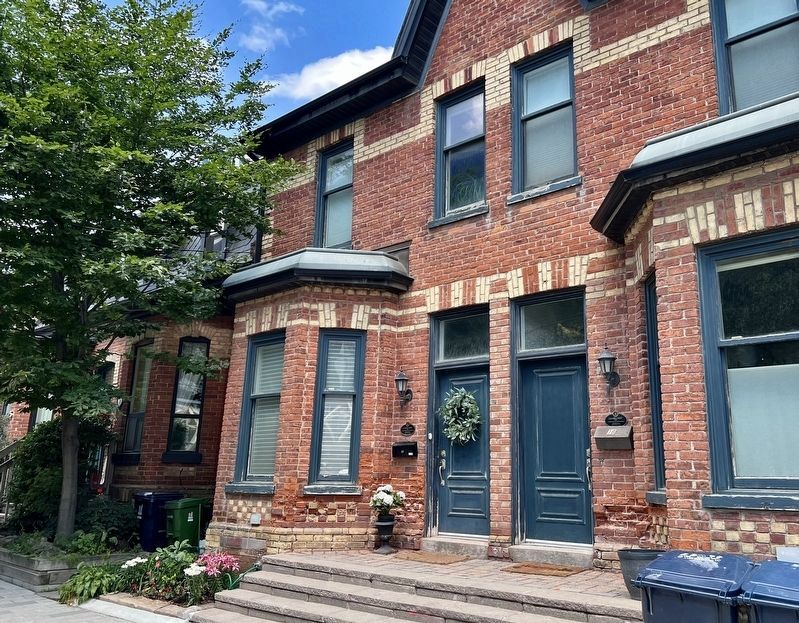
Constructed for John Irwin, this row of houses
reflects the working-class character of this area in
the late 19th century. Early tenants included
labourers, machinists, and a distiller. — — Map (db m272142) HM
Distinguished by buff brick detailing, this row of three-storey buildings was constructed for Clarkson Jones, a barrister living north on Jarvis Street. Early tenants included two fruiterers and a saddler. Designated under the Ontario . . . — — Map (db m217197) HM
Designed by the renowned Canadian firm
Moriyama & Teshima Architects, this mixed-use building
opened when the St. Lawrence area was undergoing
urban renewal. It features a large sunlit atrium
with a landscaped watercourse. — — Map (db m270264) HM
The Toronto Street Railway Company built this three storey Renaissance Revival style stable and car barn to designs by architect H. G. Salisbury in order to house its fleet of horse drawn streetcars. In 1891, when the Toronto Street Railway ceased . . . — — Map (db m270461) HM
Accented with buff coloured brick and round arched windows, this building was constructed for Martin Mckee, an ice dealer and landlord. It was first occupied by a cigar box manufacturer and a "shoddy woolens" company. — — Map (db m270469) HM
These two attached houses are rare examples of Georgian-style residences that used to be common in Toronto. They were built for Paul Bishop, a blacksmith and landlord whose shop stood across the street.
Designated under the Ontario Heritage . . . — — Map (db m272146) HM
Before it was named for Queen Victoria in the 1840s, Queen Street was known as Lot Street. Once lined with large family estates, by the late 19th century Queen Street was a major commercial street populated by blacksmiths, cabinetmakers, . . . — — Map (db m277268) HM
Lots 10 and 11 were purchased by James Beaty and William Armstrong in 1830. This row house with storefront was constructed for brothers Fredrick and Albert Wilkins, proprietors of a local real estate company. First tenant was John McKnight, grocer, . . . — — Map (db m272018) HM
1st Residents: Henry Winterbottom, printer
Arthur and Brierlay Winterbottom, fruiters
Builder: A. Weller and Co. Contractors
City of Toronto Inventory of
Heritage Properties — — Map (db m277779) HM
1st Resident: John D. Ferguson, carpenter
Builder: A. Weller and Co. Contractors
City of Toronto Inventory of
Heritage Properties — — Map (db m277783) HM
Designed by the Office of the City Architect under the management of Robert McCallum, this Edwardian Classical-style building was constructed as Police Station No. 11 serving the area bounded by St. George, Christie, and College Streets, and by St. . . . — — Map (db m297300) HM
This building was Toronto’s city and county courthouse for nearly 50 years. It was Toronto’s third courthouse, designed by Cumberland & Ridout in the Classical Revival style, inspired by historic Greek architecture. Many high-profile trials were . . . — — Map (db m217427) HM
The cancellation of the Spadina Expressway in 1971 left a section completed from Wilson Avenue in the north to Lawrence Avenue in the south. Now known as the William R. Allen Road, the expressway was opened to Eglinton Avenue in 1976, while the . . . — — Map (db m274829) HM
Agnes Macphail purchased this property in 1948.
She was the first woman elected to Canada's House of Commons in 1921 and won five successive election victories.
Agnes Macphail fought for health insurance, low-rental housing, . . . — — Map (db m309806) HM
Born into slavery in Delaware during the late 1850s, Albert Jackson became the first Black letter carrier in Toronto and one of the few people of colour to be appointed a civil servant in 19th-century Canada. Jackson's mother, Ann Maria, escaped . . . — — Map (db m217681) HM
Alice and Dan Heap were life-long community organizers, trade unionists, and socialists dedicated to providing
jobs and housing for all and to achieving peace in the world. Both were active in the Student Christian Movement
where Alice . . . — — Map (db m293662) HM
[English] This property was home to one family for two centuries. Sarah Ashbridge and her family moved here from Pennsylvania and began clearing land in 1794. Two years later they were granted 600 acres (243 hectares) between . . . — — Map (db m208200) HM
The Association of Provincial Land Surveyors
of Ontario
and its successor, incorporated in 1892 as
the Association of Ontario Land Surveyors
The provincial land surveyors, successors to the deputy provincial
surveyors of Canada West, . . . — — Map (db m281946) HM
Built for the Athenaeum Club, this façade was designed by the
architectural firm Denison and King in a Moorish Revival style, rare in
Toronto. It features intricate brickwork, several Moorish window arches, and
in the balcony, a cast-iron . . . — — Map (db m281948) HM
Designed with Art Deco ornamentation by architect Benjamin Brown, this building was commissioned by Jewish entrepreneurs and occupied by a number of notable clothing businesses over the years, including the Shiffer Hillman Clothing Co. Together with . . . — — Map (db m277242) HM
[English] Chartered in 1821, the Bank of Upper Canada, was until its demise in 1866, one of British North America's leading banks. It played a significant role in the development of Upper Canada — supplying currency, protecting . . . — — Map (db m199444) HM
English:
Loyal residents of York (Toronto) were encouraged by early British victories in the War of 1812, but in 1813, they experienced first-hand the hardships of war. On the morning of April 27th, an American fleet appeared . . . — — Map (db m83668) HM
[English] Department stores revolutionized shopping in the late nineteenth century by offering selection, low prices and money-back guarantees. In 1895, Robert Simpson commissioned architect Edmund Burke to design his new department . . . — — Map (db m208195) HM
This plaque was unveiled by
His Royal Highness The Duke of Edinburgh, K.G., K.T.
March 14, 1989
The world renowned star of English musical comedy, Beatrice Lillie, was born May 28, 1894 at 68 Dovercourt Road. She was educated at Alexander . . . — — Map (db m316007) HM
Designed in Edwardian Classical style by Montreal architect W. J. Carmichael, this building was constructed to accommodate the switching equipment, switchboard operators, and technicians needed for Bell Telephone's rapidly expanding service in this . . . — — Map (db m310664) HM
Ben Dunkelman was a distinguished military officer, entrepreneur, and president of Tip Top Tailors, the menswear company founded by his father, David. Born and raised in Toronto, Ben Dunkelman fought with the Queen's Own Rifles of Canada regiment . . . — — Map (db m211254) HM
This building was designed by architect A. Frank Wickson in the Edwardian Classical style to replace an earlier firehall on this site. Marked by arched gables, it also features rich contrasts in brick and stone, most visible around the grand . . . — — Map (db m272143) HM
Beverly Mascoll was a community advocate and the founder of Mascoll Beauty Supply Ltd., a distributor of beauty products for Black people and people of colour. Mascoll started the business out of her car in 1970 and grew it into a highly successful . . . — — Map (db m297302) HM
Billy Bishop Toronto City Airport
Opening in 1939 to take advantage of the rise in commercial aviation, Billy Bishop Toronto City Airport was built to integrate an aircraft terminal with a modern port.
The Advisory Airport . . . — — Map (db m299682) HM
On this site stood the "Bishop's Palace", residence of Bishop John Strachan (1778-1867), built in 1817-18 while he was the incumbent of St. James' Church. Born in Scotland, he came to Upper Canada in 1799 where he achieved prominence as an educator . . . — — Map (db m83662) HM
Black Life in St. John's Ward
Prior to the American Civil War (1861-64), Toronto was a beacon of light for hundreds of free Blacks and fugitive slaves fleeing oppression. Many came via the Underground Railroad, a network of secret . . . — — Map (db m288660) HM
In the late 1960s the Bloor-Jane-Runnymede Businessmen's Association concluded that the chief problem it faced was in the raising of funds to carry on its services to the local business community.
It developed a scheme whereby the business . . . — — Map (db m288919) HM
by Risto Turunen, October, 1992 Wrote Elizabeth Simcoe in 1793 “…After rowing a mile we came within sight of what is named, in the map, the Highlands of Toronto. The shore is extremely bold and has the appearance of chalk cliffs… We talked of . . . — — Map (db m236694) HM
Original use: coal-fired production of steam
for engine room and for distillation
Designated under the
Ontario Heritage Act, 1976 — — Map (db m270708) HM
Originally a one-storey gunpowder magazine, this building's walls could not support the weight of the bombproof roof. The army replaced the roof and added a second floor in 1824 to store weapons and equipment. In 1838, the upper floor housed 5,000 . . . — — Map (db m237597) HM
Survey posts bearing a "Broad Arrow" once stood at the four original corners of Victoria Square to mark it as British military property. They were placed there in 1853 by a young Sandford Fleming who surveyed the square as part of the military . . . — — Map (db m288815) HM
For several decades until the late 1980s, this site was a large coach yard where sleeping car porters working for the Canadian Pacific Railway (CPR) prepared passenger cars for travel to the United States and across Canada, which could take up to . . . — — Map (db m288790) HM
In 1874, Benjamin Hinchcliffe opened the first tavern on this site. It was a two storey, roughcast structure with a stable. In 1908, John Wilson Siddall designed the present building in the Edwardian Classical style.
After Albert, Molly, and Morris . . . — — Map (db m274902) HM
When this region was settled, at the start of the 19th century, a group of settlers came together with a
dream of creating a real community. The dream was realized, with the incorporation of the Village of
Yorkville, in 1853. One of those who . . . — — Map (db m274685) HM
Cabin D was an interlocking tower built by the Grand Trunk Railway in the 1890s It was one of five towers lettered from A to E that controlled the signal lights and track switches around Union Station The tower was originally located along the . . . — — Map (db m288536) HM
Originating in Ottawa, in 1868, with informal meetings of a few youthful patriots, "Canada First" was the name and slogan of a movement to promote nationalist sentiment. Its founding members were Charles Mair, Henry Morgan, William Foster, G. T. . . . — — Map (db m302061) HM
Canada’s First Air Mail
At 10:12 a.m. on June 24, 1918, Captain Brian Peck of the
Royal Air Force and mechanic Corporal C. W Mathers took
off from the Bois Franc Polo Grounds in Montreal in a JN-4 Curtiss two-seater airplane. . . . — — Map (db m309796) HM
19 December 1846 marked the inauguration of the telegraph in Canada.
This major development in communications was pioneered by the Toronto, Hamilton and Niagara Electro-Magnetic Telegraph Company whose line then being built between . . . — — Map (db m270362) HM
Born in 1833 a short distance north of this site, Alexander Dunn was educated at Upper Canada College and at Harrow, England. In 1853 he was commissioned Lieutenant in the 11th Hussars. A participant in the charge of the Light Brigade at Balaclava . . . — — Map (db m277026) HM
Panel 1:
Per Ardua Ad Astra
In Memory of our Canadian
Airmen who fought in the
Skies to preserve freedom
and order in the world.
Panel 2:
Canadian Airmen Awarded the Victoria Cross
World War I:
William . . . — — Map (db m57901) HM
Built for the Canadian Bank of Commerce, now the Canadian Imperial Bank of
Commerce (CIBC), the historic bank branch at 197 Yonge Street was designed
by architecture firm Darling and Pearson in the Beaux-Arts style. The building
has classical . . . — — Map (db m282016) HM
Upon completion, this 34-storey skyscraper was the tallest building in the British Empire and was praised as the “greatest addition to Toronto’s increasing, Manhattan-like skyline.” It was designed for The Canadian Bank of Commerce jointly by the . . . — — Map (db m217198) HM
Originally the head office of the Canadian General Electric Company, this building was designed in the Beaux-Arts Classical style by the noted Toronto architecture firm
of Darling and Pearson. It was the first of three adjacent buildings . . . — — Map (db m276923) HM
This steam locomotive is a U-2g class Northern 4-8-4 built by the Montreal Locomotive Works in 1942. 6213 was used in freight and passenger service for over a million miles ranging from Nova Scotia to Saskatchewan. When in Toronto, it would have . . . — — Map (db m288668) HM
Designed by architecture firm Darling & Pearson, the Toronto office of the Canadian Pacific Railway was one of the city's first skyscrapers, and briefly, the tallest building in the British Empire.
Designated under the Ontario Heritage Act, . . . — — Map (db m302058) HM
This car was built in 1929 as "River Liard" by National Steel Car in Hamilton and finished at Canadian Pacific's Angus Shops in Montreal. This luxurious first class car was exclusively for the comfort of sleeping car passengers and featured showers, . . . — — Map (db m288543) HM
The boxcar was the most common type of freight car ever used on the railways. This Fowler-design 36-foot wooden boxcar with steel framing was built in 1917. It was one of 33,000 owned by the CPR and used to transport packaged cargo as well as grain . . . — — Map (db m288620) HM
Built in 1927, the Canadian Westinghouse Building was a warehouse and district office for the Canadian Westinghouse Co. based in Hamilton, Ontario. American entrepreneur George Westinghouse (1846-1914) patented thousands of inventions, most . . . — — Map (db m276941) HM
The country home of Lieut.
Col. John Graves Simcoe
first Lieutenant Governor
of Upper Canada 1791-1796.
Stood on these heights
just south of this site
1794-1829. Named after
Francis Gwillim Simcoe,
son of Lieut. Governor
and Mrs. Simcoe, . . . — — Map (db m274492) HM
In 1796 the first Anglican priest arrived from England to minister to the citizens of York. The following year the province set aside this piece of land for the building of a church. The present cathedral, the fourth church erected on this site, . . . — — Map (db m217444) HM
Chapel of St. James-the-Less
In its vigorous, harmonious composition, this small funeral chapel is a splendid example of High Victorian Gothic design.
Its sense of strength and spirituality is derived from the subtle contrast of . . . — — Map (db m274524) HM
Born in Exeter, Huron County, this renowned archaeologist, teacher and administrator was educated locally and in Toronto. Completing his studies at Victoria College, he received his B.A. from the University of Toronto in 1898 and his M.A. in 1901. . . . — — Map (db m83666) HM
{Marker Text in English:}
Writer, artist, and illustrator of historical novels and textbooks, Charles Jefferys emigrated to Canada from England in 1879. After studying at the Toronto Art Students League, he joined the New York . . . — — Map (db m37092) HM
Presented to The King Edward Hotel to commemorate the Charter Meeting of The Rotary Club of Toronto held November 28, 1912 in celebration of the Club’s 100th Anniversary November, 2012 — — Map (db m217542) HM
Chief Wabakinine was Head Chief of the Mississaugas of western Lake Ontario, whose traditional territory includes the Toronto area. As Head Chief, he led by resolving issues through discussion until a consensus was reached.
While he was Chief, . . . — — Map (db m270447) HM
On June 21, 1832, the first cases of cholera, a highly contagious and deadly disease, appeared in the Town of York. Much feared, cholera first appeared in India in the 1770s, spreading along trade routes to Asia and Europe, and arriving in London, . . . — — Map (db m217097) HM
Architect Earle L. Sheppard designed this factory in a blend of Art Deco and Art Moderne styles for Chr. Hansen's Laboratory, a Danish maker of dairy products such as rennet, an enzyme used in cheese making, and powdered desserts. Essential oil . . . — — Map (db m259551) HM
Early on June 11, 1906, volunteers from
St. Barnabas Church (Chester), led by the
Rev. Frank Vipond, began construction here of a
wooden church. That evening, a service was held in
the new building. Named St. Andrew's for the
Anglican . . . — — Map (db m309816) HM
This building was designed by the architecture firm of Knox and Elliot as a
Romanesque Revival-style church for a congregation of the Disciples of Christ. Its subsequent uses tell the story of a changing neighbourhood. The church became the . . . — — Map (db m281515) HM
The Anglican Parish of St. Simon-the-Apostle was
founded in 1883. The congregation first worshipped in
the chapel of St. James-the-Less, Parliament Street, until
this church, by architects Strickland and Symons, was
completed in 1887. Five years . . . — — Map (db m274528) HM
A home for men founded in 1926 by the Rev. John Elias Rogers Gibson and originally known as
the Church of the Ascension.
In 1958 it was given by him to
the Anglican Diocese of Toronto
and in 1960 dedicated and renamed
the Church of the Good . . . — — Map (db m259715) HM
457 entries matched your criteria. The first 100 are listed above. Next 100 ⊳