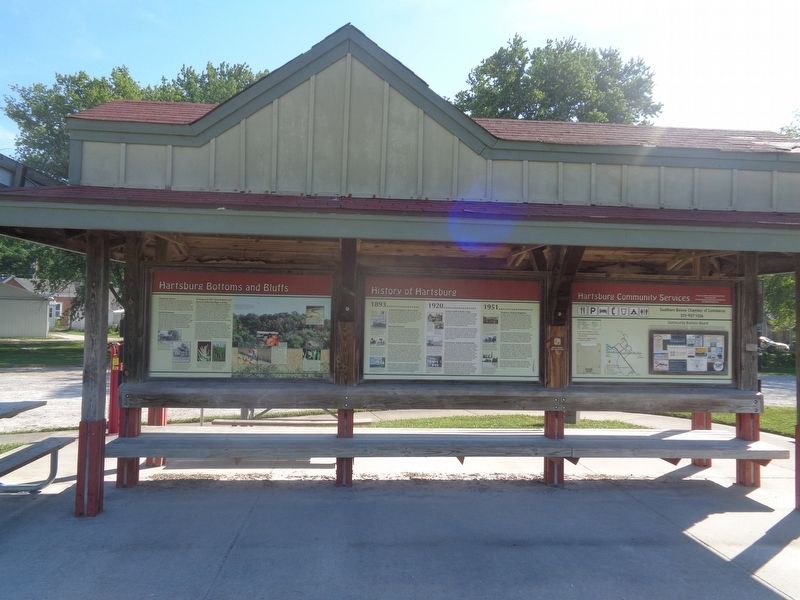
Markers associated with the 240-mile long linear state park that runs between St. Charles and Clinton, Missouri, along the former Missouri-Kansas-Texas ("Katy") Railroad trackbed. It is the longest rail-trail in the US.
On South 2nd Street, on the right when traveling east.
Stones for Homes
The people of Hartsburg cut blocks of limestone from the bluffs to make foundations for their homes. Clay, obtained by digging into the bluffs, was molded and baked into bricks. These bricks, made here in the early 1900s, . . . — — Map (db m250605) HM
On South 2nd Street, on the right when traveling south.
The distance from Hartsburg to North Jefferson is 10.4 miles. The trail passes through Claysville (milepost 149.8) and crosses Slate, Cedar and Turkey creeks. Bluffs are on the left and a wide variety of habitats including farms and wetlands are on . . . — — Map (db m250588) HM
On South 2nd Street, on the right when traveling east.
1893
A Railroad Station in Hart's Field
Sons of a pioneer family from Virginia, Luther D. Hart and Aurelias B. Hart began farming here in the 1870s. The town's first sign of life came when Luther granted a right-of-way 250 feet wide by . . . — — Map (db m250590) HM
Near Perche Avenue (Missouri Route K) east of Katy Street, on the left when traveling east.
1800........
Nashville Born, Destroyed …
McBaine's history begins with Nashville, five miles downriver.
Ira Nash received a Spanish land grant in 1800, before the
United States owned the Louisiana Territory. Nash, a Virginian
and one . . . — — Map (db m252679) HM
Near Perche Avenue (Missouri Route K) east of Katy Street, on the left when traveling east.
Traveling west in Katy Trail State Park, the
next trailhead is Rocheport, 8.8 miles away. After the
Perche Creek crossing, an 8.8-mile spur trail on the
right – the MKT Nature & Fitness Trail – leads to
Columbia. Trail users continuing to . . . — — Map (db m252667) HM
Near Perche Avenue (Missouri Route K) east of Katy Street, on the left when traveling east.
The Plank Road linking Columbia
to a river port at Providence reached its
peak of success when it opened in 1856.
By the next year, the road was a disaster.
River towns like Glasgow, Boonville
and Rocheport had boat landings, . . . — — Map (db m252674) HM
On 1st Street 0.1 miles east of Pike Street, on the right when traveling east.
From its inception and throughout its 25-year history, Katy Trail State Park
has been one of the most successful rails-to-trails conversions projects in the
United States. As the longest developed rail-trail in the United States, it
has been . . . — — Map (db m252641) HM
Katy Trail State Park is one of Missouri's premier attractions, drawing about 400,000 visitors from across the United States and other countries. Stretching 225 miles from St. Charles in the east to Clinton in the west, the trail is the longest . . . — — Map (db m46383) HM
1804...
Land Before the Town
Prior to its settlement, American Indians used the area we now call Rocheport. The closeness to the river, fertile soils, both salt and freshwater springs, and the protection given by the huge bluffs, rock . . . — — Map (db m46345) HM
From its inception and throughout its 20-year history, Katy Trail State Park has been one of the most successful rails-to-trail conversions projects in the United States. As the longest developed rail-trail in the United States, it has been . . . — — Map (db m46403) HM
On 1st Street east of South Pike Street, on the right when traveling east.
Traveling east along Katy Trail State Park, the next
trailhead is McBaine, 8.8 miles away. Beyond Rocheport depot,
the Manitou Bluffs tower above the trail to the left, while the
Missouri River runs to the right. Benches dot this section . . . — — Map (db m252651) HM
On 1st Street east of South Pike Street, on the right when traveling east.
The distance to New Franklin is 9.9 miles. This section of
trail is tree- or bluff-lined with views of the agricultural landscape.
Heading west from Rocheport, Katy Trail State Park users cross
Moniteau Creek at milepost 178.8. This bridge . . . — — Map (db m252649) HM
Near Katy Road 0.9 miles north of Oilwell Road, on the right when traveling north.
1826
Cedar City's Prosperity
The town Hibernia exists in post office records from 1825. A wilder and wider Missouri River was a half mile closer then, and many people arrived by steamboat. While laying out a new town in 1872, David Kenney . . . — — Map (db m169401) HM
Near Katy Road 0.9 miles north of Oilwell Road, on the right when traveling north.
Missouri State Capitol and Museum
The Missouri State Capitol, built in 1918 of Carthage marble and standing 262 feet high, is a majestic site. On the first floor is the Missouri State Museum with one wing dedicated to the history of . . . — — Map (db m169402) HM
On Katy Road 0.9 miles north of Oilwell Road, on the right when traveling north.
Here at the North Jefferson Trail Head, on Sept. 29, 1996, the east and west sections of the Katy Trail were joined, forging the final link uniting St. Charles and Sedalia via Katy Trail State Park. — — Map (db m169404) HM
Missouri was a beginning and end for the Lewis and Clark Expedition. Planned by President Thomas Jefferson and carried out by the two captains and a large crew, the expedition is a keystone American event. When the United States took ownership of . . . — — Map (db m169398) HM
Near Katy Road 0.9 miles north of Oilwell Road, on the right when traveling north.
From the time of the Louisiana Purchase and the expedition of Lewis and Clark, the 19th century saw Missouri and the nation journey from a rural frontier to an urban industrialized society. The dawn of the 20th century saw the recognition of a . . . — — Map (db m169403) HM
On Katy Road 0.9 miles north of Oilwell Road, on the right when traveling north.
The distance from North Jefferson to Hartsburg is 10.4 miles. The trail passes through Claysville (milepost 149.8) and crosses Turkey, Cedar and Slate creeks. Bluffs are on the right side and a wide variety of habitats including farms and . . . — — Map (db m169399) HM
On Katy Road 0.9 miles north of Oilwell Road, on the right when traveling north. Reported damaged.
The distance from North Jefferson to Tebbetts is 12 miles. The trail passes through Wainwright (milepost 137.6), which was named after a St. Louis financier who helped establish the Missouri, Kansas & Eastern Railroad, later part of the Katy. . . . — — Map (db m169400) HM
On Katy Road 0.9 miles north of Oilwell Road, on the right when traveling north.
The list of recorded floods on the Missouri River is long, but the most devastating in recent history was the Great Flood of 1993. The river at Jefferson City crested more than 15 feet above flood stage. Throughout the Midwest that year, two . . . — — Map (db m169406) HM
Near Fulton Avenue (County Route C) 0.1 miles west of Route 94, on the right when traveling west.
1818.........
Smith's Landing
Thomas Smith, a private with Callaway's Rangers, founded a
small town along the Missouri River in 1818. The town, dubbed
Smith's Landing, was based around steamboat commerce. In
addition to goods being . . . — — Map (db m252810) HM
Near Fulton Avenue (County Route C) 0.1 miles west of Route 94, on the right when traveling west.
The Missouri-Kansas-Texas
Early in 1870, Judge Levi Parsons, head of the Union Pacific
Southern Branch, called a meeting. He announced his
plans to be the first railroad to reach the Indian Territory
bordering Kansas. The “Missouri River, . . . — — Map (db m252799) HM
Near Fulton Avenue (County Route C) 0.1 miles west of Route 94, on the right when traveling west.
The distance from Mokane to Portland is 9.1 miles.
This segment of Katy Trail State Park has several outstanding
sights, including an impressive railroad bridge, close-up views of
the Missouri River and the geologic oddity of Standing Rock.
. . . — — Map (db m252797) HM
Near Fulton Avenue (County Route C) 0.1 miles west of Route 94, on the right when traveling west.
The 6.2 miles from Mokane to Tebbetts have
changed little since the early days of the Katy Railroad.
Like Tebbetts and many other towns along the trail,
Mokane was established as a railroad town. Its name
comes from this line's builder, the . . . — — Map (db m252735) HM
Near Katy Trail north of Fulton Avenue (County Highway C), on the left when traveling north.
Standing Rock looks like an isolated boulder that fell from above, but it is actually a remnant of the bluff that has resisted erosion. The rock is a fine-grained sandstone that may have formed when sand filled in a sinkhole or joint within . . . — — Map (db m272493) HM
Near Market Street at Main Street, on the left when traveling south.
The Portland-McKittrick segment is 15.1 miles long.
Bottomland forest, islands and channels of Tate Island
Conservation Area – which is accessible only by boat – can
be seen to the right of the Katy Trail between mileposts 114.5
and 112. A Lewis . . . — — Map (db m252816) HM
Near Market Street at Main Street, on the left when traveling south.
The distance from Portland to Mokane is 9.1 miles.
This segment of Katy Trail State Park has several outstanding
sights, including an impressive railroad bridge, close-up views
of the Missouri River and the geologic oddity of Standing Rock.
. . . — — Map (db m252820) HM
On Katy Trail east of Country View Drive, on the right when traveling east.
Attack on Côte Sans Dessein
A settlement on the Côte Sans Dessein hill weathered an attack by members of the Sac and Fox Nation on April 4, 1815. The battle was an extension of the War of 1812 (1812-1815), though a treaty to end the fighting . . . — — Map (db m272492) HM
On Olive Street (County Route 485) south of County Route 4011, on the left when traveling north.
Big Business on the Missouri River
The fur trade was a booming business in the wilderness west of St. Louis. Trapping primarily took place on the upper Missouri River in the Dakotas and Montana. Furs were then sent down the river to St. Louis . . . — — Map (db m121229) HM
On 1st Street north of Spring Street, on the right when traveling north.
Katy Caboose #134 & its tracks were donated to the city of Boonville, Mo., on Feb. 9, 1991 by the Union Pacific RR and located on this spot by volunteers under the direction of Wayne Lammers.
It is dedicated to the men and women who served the . . . — — Map (db m247429) HM
From its inception and throughout its 25-year history, Katy Trail State Park
has been one of the most successful rails-to-trails conversions projects in the
United States. As the longest developed rail-trail in the United States, it
has been . . . — — Map (db m247430) HM
On 1st Street north of Spring Street, on the right when traveling north. Reported unreadable.
When the tracks of the Missouri, Kansas & Texas Railway (known as the MKT of Katy) reached Boonville from Sedalia on May 31, 1873, no fancy passenger station stood here, and the bridge across the Missouri River was eight months from completion. . . . — — Map (db m247428) HM
The 3.6 miles of trail from Boonville to New Franklin cross the Missouri River into the river floodplain. Trail users pass farm fields, the 1816 townsite of Franklin and the once-important Franklin junction. The trail briefly leaves the railroad . . . — — Map (db m247350) HM
The Katy Trail leaves the Missouri River at Boonville and heads southwest into Cooper County for 11.5 miles to Pilot Grove. The 1912 Spanish Mission-style Boonville depot stands near the trail head. The depot now serves as home to the Boonville . . . — — Map (db m247349) HM
The Boonslick region has influenced Missouri history far out of proportion to its size. The rich land is an ecological intersection, where eastern forest and the Ozark Mountains meet prairie, and a large, navigable river runs through the middle. . . . — — Map (db m247352) HM
1790
Indians Along the Missouri
The Missouri River served as a boundary between Indian tribes in historic times. The Osage dominated a vast area south of the river. To the north, the loway, and later Sauk and Fox, held power. . . . — — Map (db m247363) HM
On 1st Street north of Spring Street, on the right when traveling north. Reported unreadable.
It has been said that a train without a caboose is like a sentence without a period. Kay Caboose #134, built by the Darby Corp. in Kansas City, served the Missouri Kansas Texas Railroad (known as the MKT or Katy) as a typical end car 1968 to . . . — — Map (db m247426) HM
Near Katy Trail west of County Highway BB, on the right when traveling west.
1830…
Mill on the Lamine River
Although Clifton City is a railroad town, the Lamine River is the original reason for the town's location. George Cranmer of Paris, Ky., settled on the Lamine in 1832, at what later became the Missouri, . . . — — Map (db m272505) HM
On Katy Trail west of County Highway BB, on the right when traveling west.
This border area between the Ozarks and Osage Plains once belonged to the Osage nation. Osage lands included southern Missouri, eastern Kansas, and northern Arkansas and Oklahoma.
The Osage maintained their stronghold for several centuries, . . . — — Map (db m272498) HM
On 2nd Street at Roe Street, on the right when traveling east on 2nd Street.
The Katy Railroad was not the first to use this route from Boonville to Sedalia. Founders named this place Pilot Grove in 1820 because a local grove of trees "piloted" travelers along the divide between the Lamine River and Petite Saline Creek. . . . — — Map (db m247229) HM
On 2nd Street at Roe Street, on the right when traveling east on 2nd Street.
1820
The Pilot Grove
A grove of trees visible on the rolling prairie for miles around gave the town its name. The grove "piloted" travelers southwest along the divide between the Lamine River and Petite Saline Creek. Later, this route . . . — — Map (db m247226) HM
On 1st Street at Roe Street ( Route M), on the left when traveling east on 1st Street.
Pilot Grove to Boonville, 11.50 miles, is considered by many Katy Trail users to be the most difficult stretch of the trail due to uphill grades. Over the first several miles, riders across a rolling landscape dominated by hay and crop fields. . . . — — Map (db m247109) HM
On 1st Street at Roe Street ( Route M), on the left when traveling east on 1st Street.
The 12.1-mile ride to Clifton City begins with a long and straight passage between farm fields, and trail users can expect gradual downhill grades to the Lamine River. Between mileposts 207 and 208, the elevated railroad bed over Taylor Branch, . . . — — Map (db m247116) HM
On Price Lane 0.1 miles State Route 7/13, on the right when traveling south.
From its inception and throughout its 25-year history, Katy Trail State Park
has been one of the most successful rails-to-trails conversions projects in the
United States. As the longest developed rail-trail in the United States, it
has been . . . — — Map (db m252517) HM
On Price Lane 0.1 miles south of State Route 7/13, on the right when traveling south.
Depending on your preference, you are either at the beginning or end of your journey in Katy Trail State Park. From this point, the state park and Katy right of way continue for 238 miles to Machens.
If you have just completed your journey . . . — — Map (db m252493) HM
Near Price Lane 0.1 miles south of State Route 7/13, on the right when traveling south.
The distance from Clinton to Calhoun is 9.4 miles. This section of trail generally traverses open pastures and reclaimed land from coal strip-mining operations from the 1950s to 1980s. Trail users encounter wide sweeping vistas with short . . . — — Map (db m252487) HM
Near Price Lane 0.1 miles south of State Route 7/13, on the right when traveling south.
1836........................
Largest City in Henry County
Welcome to Clinton, the largest city in Henry County. The city is named for DeWitt Clinton, governor of New York (1817-23) and primary advocate for the Erie Canal. Henry . . . — — Map (db m252501) HM
Near Price Lane 0.1 miles south of State Route 7/13, on the right when traveling south.
Welcome to Katy Trail State Park,
one of 87 state parks and historic sites managed by Missouri State Parks. Whether you are beginning or ending your journey, Clinton is the western terminus of the park. From this point, the Katy Trail . . . — — Map (db m252514) HM
New Franklin, known as the city where four trails meet, owes its place in history to the Lewis & Clark Expedition of 1803-1806; the blazing of the Boonslick Trail pioneered by Daniel Boone from Kentucky to the original historic rivertown of . . . — — Map (db m46460) HM
1816
A River Town Begins
Named for American statesman Benjamin Franklin, the frontier river town of Franklin was established in 1816. The following year, it was designated the county seat of Howard County. In the blink of an eye, Franklin's . . . — — Map (db m46950) HM
On Broadway at Missouri Street ( Route 5), on the right when traveling east on Broadway. Reported missing.
KATY CABOOSE #127 became a landmark in the City of New Franklin on January 3, 1992. The voluntary assistance of dedicated citizens and generous donations of friends across the country made this possible.
CABOOSE #127 was in the service of the . . . — — Map (db m44291) HM
As the first railroad to enter Texas from the North in 1872, the Missouri-Kansas-Texas Railroad Co. was an influential factor in the development of the Great Southwest. Soon after its construction began, the railroad became commonly known as the . . . — — Map (db m46517) HM
Near South Howard Street south of South Missouri Street, on the left when traveling south.
The distance to the next trailhead at Rocheport is
9.90 miles. Traveling east, the trail is tree or bluff-lined with
views of the agricultural landscape. Bonne Femme Creek at
milepost 183.8 is the first bridge crossing for Katy travelers
heading . . . — — Map (db m252627) HM
On Missouri Street (Missouri Route 5) at Katy Trail State Park, on the left when traveling south on Missouri Street.
The Need
When the Missouri, Kansas and Texas (MKT) Railroad established a division in Franklin, Mo., a switching yard was located south of New Franklin. This switching yard contained seven sets of tracks plus the through line. Missouri . . . — — Map (db m46930) HM
On Sterline Road 0.1 miles west of Walnut Street, on the right when traveling south.
From its inception and throughout its 25-year history, Katy Trail State Park
has been one of the most successful rails-to-trails conversions projects in the
United States. As the longest developed rail-trail in the United States, it
has been . . . — — Map (db m162217) HM
On Sterline Street 0.1 miles west of Walnut Street, on the left when traveling west.
The McKittrick-Portland segment is 15.10 miles long.
After leaving McKittrick, the trail goes under Highway 19 and crosses the Loutre River. Hermann is visible across the river valley from around milepost 102. Deutschheim State Historic Site . . . — — Map (db m162215) HM
On Sterline Road 0.1 miles west of Walnut Street, on the left when traveling west.
Katy Trail State Park users cover the longest
segment between trailheads on the entire trail from
McKittrick to Treloar: 16.10 miles. McKittrick is a former
Katy Railroad town, and remains of the depot foundation
and coal sheds are still . . . — — Map (db m162216) HM
Near Katy Trail 0.3 miles west of Oxline Road, on the right when traveling west.
You may not have noticed, but at 955 feet above sea level, you have reached the "summit" of Katy Trail State Park. You are standing on the Osage Plains, named after the Osage people who were once the dominant tribe in western Missouri. At . . . — — Map (db m272490) HM
On Thompson Avenue at 4th Street, on the left when traveling south on Thompson Avenue.
1860...
Vision of Prosperity
Welcome to Sedalia, Pettis County seat and home of the Missouri State Fair. Sedalia, originally named Sedville, began as a vision in the mind and on the farm of George R. Smith. "Sed" was the nickname of . . . — — Map (db m85305) HM
From its inception and throughout its 25-year history, Katy Trail State Park has been one of the most successful rails-to-trail conversions projects in the United States. As the longest developed rail-trail in the United States, it has been . . . — — Map (db m85301) HM
On Thompson Avenue at 4th Street, on the left when traveling south on Thompson Avenue.
The Sedalia Depot visitor center is the place to begin a Sedalia sightseeing tour. Building hours are posted on the door, and visitors are welcome to tour the historic building, discover the history of Sedalia's railroad culture and learn . . . — — Map (db m85311) HM
On Thompson Avenue at 4th Street, on the left when traveling south on Thompson Avenue.
Clifton City, the next trail head east, is 11.7 miles by way of the old rail corridor. Due to an undeveloped section of trail immediately east of here, some travel over city streets is required, adding slightly to that distance. The grade is . . . — — Map (db m85314) HM
On Limit Avenue (U.S. 65) south of 16th Street, on the left when traveling north.
The Trail's End Project is an historical, educational and artistic tribute to the American spirit of opportunity, adventure and perseverance staged in the 1860's era of dynamic western development. The times were turbulent with political[,] . . . — — Map (db m85134) HM
On Public Street south of Water Street, on the right when traveling south.
From Augusta to Dutzow along Katy Trail State Park is 7.70 miles. Augusta has a strong German heritage like many other lower Missouri River towns. This area has several wineries open to the public. Founded in 1836, Augusta has preserved . . . — — Map (db m133204) HM
On Public Street south of Water Street, on the right when traveling south.
Katy Trail State Park runs for 5.70 miles from Augusta to Matson. The first four miles are away from roads, and trail users can enjoy the farm landscape and bottomland forest of the Missouri River floodplain, lined by increasingly taller . . . — — Map (db m133202) HM
On Public Street south of Water Street, on the left when traveling north.
When we think of American wine, California comes to mind, and perhaps Oregon, Washington or New York. But Missouri? Ja, absolutely. German immigrants settling on the lower Missouri River, and later, Italians coming to the St. James area, brought . . . — — Map (db m133207) HM
On Machens Road 0.4 miles south of State Highway 94, on the left when traveling south.
Welcome to Katy Trail State Park, one of 87 state parks and historic sites managed by Missouri State Parks. Whether you are beginning or ending your journey, Machens is the eastern terminus of the park. From this point, the Katy Trail . . . — — Map (db m169575) HM
On Lucille Avenue east of Alice Avenue, on the left when traveling east.
Daniel Boone and his fellow travelers—his sons' and daughters' families, other relations, friends and family slaves—came to Missouri in 1799. Boone was 65 years old and already famous in America and Europe, thanks to his "autobiography" by John . . . — — Map (db m133211) HM
On Lucille Avenue west of Highway 94, on the right when traveling west.
Katy Trail State Park runs for 5.70 miles from Matson to Augusta, Tavern Bluffs, seen across the river, were the scene of a dramatic episode from the Lewis and Clark Expedition: on May 23, 1804, Capt. Meriwether Lewis fell 20 feet before . . . — — Map (db m133210) HM
Near Lucille Avenue west of Highway 94, on the right when traveling west.
From Matson to Weldon Spring is 4.6 miles, one of the shortest distances between trailheads in Katy Trail State Park. Defiance, at milepost 58.9, is less than two miles from Matson. It received its name after preventing Matson from having the . . . — — Map (db m133209) HM
On South Riverside Drive east of Boone's Lick Road, on the right when traveling south. Reported permanently removed.
From its inception and throughout its 25-year history, Katy Trail State Park has been one of the most successful rails-to-trails conversions projects in the United States. As the longest developed rail-trail in the United States, it has been . . . — — Map (db m163853) HM
Near Greens Bottom Road 1.3 miles west of Jungs Station Road, on the right when traveling west.
The distance from Greens Bottom to St. Charles is 6.20 miles. Traveling east toward St. Charles, the elevation remains almost constant. Greens Bottom (milepost 45.7) is named for the American Revolutionary War (1775-1783) veteran James Green, . . . — — Map (db m169568) HM
Near Greens Bottom Road 1.3 miles west of Jungs Station Road, on the right when traveling west.
The distance from Greens Bottom to Weldon Spring is 10.30 miles. Trail users heading west pass between bluffs and bottomland farm fields in this wide, flat inside bend of the Missouri River. Between milepost 49 and the Weldon Spring . . . — — Map (db m169567) HM
On South Riverside Drive at Madison Street, on the right when traveling north on South Riverside Drive.
1769
Les Petites Côtes, River Gateway
St. Charles stands on the banks of the Missouri River as the gateway to the Missouri River valley. First known as Les Petites Côtes (Little Hills), it was founded by Louis Blanchette in 1769 as a . . . — — Map (db m169194) HM
On South Riverside Drive at Madison Street, on the right when traveling north on South Riverside Drive.
Missouri was a beginning and end for the Lewis and Clark Expedition. Planned by President Thomas Jefferson and carried out by the two captains and a large crew, the expedition is a keystone American event. When the United States took ownership of . . . — — Map (db m169204) HM
On South Riverside Drive at Madison Street, on the right when traveling north on South Riverside Drive.
Picturesque St. Charles hugs the banks of the Missouri River. The mixture of French, early American and German influences and careful restoration to make this a unique historical town.
Main Street of St. Charles was recognized as a . . . — — Map (db m169202) HM
Near South Riverside Drive at Madison Street, on the right when traveling north.
The distance from St. Charles to Greens Bottoms is 6.20 miles. Traveling west toward Greens Bottom, the elevation remains almost constant. In St. Charles, the route of Katy Trail State Park runs beside the Missouri River bluffs. The . . . — — Map (db m169210) HM
Near South Riverside Drive at Madison Street, on the right when traveling north.
Via the Katy Trail, St. Charles to Machens is 12.6 miles. As you head east, the Missouri River emerges from its bluff-shrouded valley into the expansive bottomland of the Illinois-Missouri-Mississippi rivers. The bluffs around St. Charles . . . — — Map (db m169208) HM
On Busch Greenway near Katy Trail, on the right when traveling north. Reported unreadable.
Rolling Along the Katy Trail
• Where you now stand, shiny black steam locomotives and brightly painted diesel trains once rolled. From 1870 to 1988, the Missouri-Kansas-Texas (MKT) Railroad carried passengers and freight along this route, . . . — — Map (db m259757) HM
Near State Highway 94 2.1 miles east of State Highway DD, on the right when traveling east.
Many Missourians may not be aware of the history of Weldon Spring. It was the country's largest explosives plant during World War II and a uranium-processing facility for Cold War nuclear weapons. There are also long-term efforts to clean up the . . . — — Map (db m169488) HM
Near State Highway 94 2.1 miles east of State Highway DD, on the right when traveling east.
The distance from Weldon Spring to Greens Bottom is 10.30 miles. From the trailhead, Katy Trail State Park runs through the 8,000-acre Weldon Spring Conservation area for five miles until milepost 51.2. Besides providing a scenic background . . . — — Map (db m169486) HM
Near State Highway 94 2.1 miles east of State Highway DD, on the right when traveling east.
From Weldon Spring to Matson is 4.60 miles, one of the shortest distances between trailheads in Katy Trail State Park. At milepost 56.7, less than a mile from the Weldon Spring trailhead is a junction with the Hamburg Trail, a converted haul . . . — — Map (db m169484) HM
On Katy Trail north of Highway 94, on the right when traveling north.
From Dutzow to Augusta along Katy Trial State Park is 11.4 miles South from Dutzow trailhead, Katy visitors may take a side trip via highways 94 and 47 to the old German town of Washington, four miles one way. The bridge across the Missouri . . . — — Map (db m132891) HM
On Katy Trail north of Highway 94, on the right when traveling north.
One of the shortest distances between Katy Trail State Park trailheads is the 3.7 miles from Dutzow to Marthasville. Dutzow is located in a large gap in the line of Missouri River bluffs. The Katy Trail runs along the base of the bluffs, . . . — — Map (db m132892) HM
On Katy Trail north of Highway 94, on the left when traveling south.
Daniel Boone was legendary while he was alive, thanks to his exploits in leading American settlers to Kentucky and both fighting and befriending American Indians. Outwardly simple—an accomplished hunter and woodsman, conspicuously brave yet . . . — — Map (db m132894) HM
On Depot Street at 1st Street (State Highway D), on the left when traveling west on Depot Street.
From its inception and throughout its 25-year history, Katy Trail State Park
has been one of the most successful rails-to-trails conversions projects in the
United States. As the longest developed rail-trail in the United States, it
has been . . . — — Map (db m169253) HM
Near Depot Street at 1st Street (State Highway D), on the left when traveling west.
1799
The Village of La Charrette
Long before Europeans settled in this area, Native American tribes including the Missouria, Osage, Sac and Fox used this land as their home or hunting grounds. The French, followed by the Spanish, were . . . — — Map (db m169262) HM
On 1st Street south of Depot Street, on the left when traveling north. Reported permanently removed.
From its inception and throughout its 20-year history, Katy Trail State Park has been one of the most successful rails-to-trail conversions projects in the United States. As the longest developed rail-trail in the United States, it has been . . . — — Map (db m61695) HM
On 1st Street south of Depot Street, on the left when traveling north.
Missouri was a beginning and end for the Lewis and Clark Expedition. Planned by President Thomas Jefferson and carried out by the two captains and a large crew, the expedition is a keystone American event. When the United States took ownership of . . . — — Map (db m61691) HM
On 1st Street south of Depot Street, on the left when traveling north.
One of the shortest distances between Katy Trail State Park trailheads is the 3.7 miles from Marthasville to Dutzow. Shortly after leaving Marthasville, trail users cross Tuque Creek on a 190-foot-long through-truss bridge.
The Tuque Creek . . . — — Map (db m61698) HM
On 1st Street south of Depot Street, on the left when traveling north.
The distance along Katy Trail State Park from Marthasville to Treloar is seven miles. The old Marthasville depot is next to the grain elevators near the Marthasville trailhead. Before the Highway 47 underpass at milepost 78.1, look right . . . — — Map (db m61700) HM
On Market Street just west of Texas, on the left when traveling west.
The Advent of the Grain Elevator
An entrepreneur named Joseph Dart, aided by engineer Robert Dunbar, invented a device in 1842 to speed up the grain moving process. The elevator mechanically used a system of ropes and pulleys to scoop grain . . . — — Map (db m169245) HM
Near Market Street at Texas, on the left when traveling west.
1895
New Holstein
When a railroad passed through town, the community often adapted. Sometimes entire towns moved closer to the tracks or new towns grew around depots. At the railroad depot in the river bottoms south of Holstein, area . . . — — Map (db m169251) HM
Near Market Street at Texas, on the left when traveling west.
Farm to Market
Today's modern shopper can walk through a grocery store and have every type of commodity they want within arm's reach, thanks in part to the railroad. We have come a long way since the frontier days when produce such as . . . — — Map (db m169252) HM
On Market Street at Texas, on the left when traveling west on Market Street.
The distance along Katy Trail State Park from Treloar to Marthasville is seven miles. Peers, about halfway to Marthasville, was founded in 1893 when the railroad arrived. It was named for MKT attorney Charles Peers. The gap between the trail . . . — — Map (db m169247) HM
On Market Street at Texas, on the left when traveling west on Market Street.
Katy Trail State Park users cover the longest segment between trailheads on the entire trail from Treloar to McKittrick: 16.10 miles. Treloar, another railroad town founded with the arrival of the Katy in 1892, has two old grain elevators as . . . — — Map (db m169249) HM