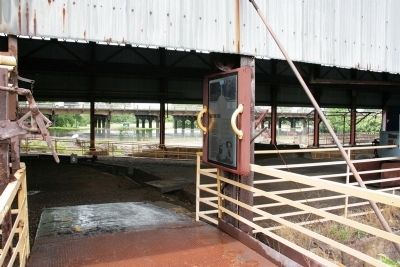
The Process
The technology of casting molten iron into bars called pigs changed dramatically over the years. Prior to 1931 casting at Sloss took place inside the cast shed. Men cut molds into the sand floor of the shed, allowing the . . . — — Map (db m69083) HM
Celebrities of all races - but particularly Black singers and actors such as
Harry Belafonte, Sammy Davis, Jr., Eartha Kitt, Lena Horne, and Ossie
Davis with wife Ruby Dee - played important roles in the Movement.
Some, including comedian Dick . . . — — Map (db m187822) HM
Birmingham's Black schoolchildren played an important role in moving the
city toward ending legal segregation. Under the leadership of SCLC field coordinators, thousands of children left their segregated schools to join the
marches in the downtown . . . — — Map (db m187682) HM
On Mother's Day, May 14, 1961, a group of black and white CORE youth on a "Freedom Ride" from Washington, D.C. to New Orleans arrived by bus at the Birmingham Greyhound terminal. They were riding through the deep south to test a court case, "Boynton . . . — — Map (db m83809) HM
This building was constructed in 1908 by Louis V. Clark (1862-1934), who also built the historic Lyric Theater located nearby on 18th Street. The Clark Theater on Caldwell Park is named in honor of Mr. Clark’s generosity to the Birmingham Little . . . — — Map (db m27515) HM
To Be Opened March 1, 2022
Dedicated at the construction completion March 1, 2002
Project Team
Owners - BLH Group, LLC
Brookmont Investors II, LLC
Spire Holdings, LLC
Developer - Brookmont Realty Group, LLC
General . . . — — Map (db m27010) HM
Many African Americans continued to push for the right to an equal
education that the 1954 Brown decision gave them. Despite angry
threats of violence and intense economic pressure, those first few African American families in Birmingham who chose . . . — — Map (db m187693) HM
Community civil rights leaders who helped organize the Movement and embraced the philosophy of nonviolence looked for well-disciplined children with good moral character who would at retaliate if they encountered bullying or violence by White . . . — — Map (db m187690) HM
The two commercial buildings on this corner lot are some of the earliest surviving business houses in Birmingham. The Dewberry building appeared on the corner about 1881, and it housed the first and longest surviving drug store in the city, starting . . . — — Map (db m36740) HM
The Duncan House was build in 1906 as a home place for James and Lelia Duncan and their eight children in what is now Tarrant City, Alabama. Duncan worked throughout his life in the nearby shops and yards of the L&N Railroad (know CSXI) as water . . . — — Map (db m86613) HM
Black leaders debated how best to educate their children to live in a racially segregated society. Former slave Booker T. Washington, founder
of Tuskegee Institute, was America's leading Black spokesman at the
turn of the 20th century and promoted . . . — — Map (db m187636) HM
Built 1939, 1901 3rd Ave. N.
The F. W. Woolworth department store was one of the first sites targeted for the ACMHR and SCLC's economic boycotts and lunch counter sit-ins of “Project C” during the April - May 1963 mass demonstrations in . . . — — Map (db m188183) HM
Despite being dominated by black labor the industrial workplace was rigidly segregated
until the 1960's. Men punched separate time clocks and bathed in separate bath houses. Following the implementation of desegregation laws in the 1960's the black . . . — — Map (db m173370) HM
[Note: a portion of the wording on the first panel of the marker has been torn away.(See photo #1)]Paired marker
September 9, 1957
In 1957, Rev. Fred Shuttlesworth and his followers in
the Alabama Christian Movement for . . . — — Map (db m187702) HM
The National Association for the Advancement of Colored People
(NAACP) used its Legal Defense and Educational Fund and its team of
skilled lawyers to attack the "separate but equal” education laws. Beginning in the 1930s, the NAACP filed lawsuits . . . — — Map (db m187658) HM
As Birmingham's civil rights leaders pushed to desegregate city schools, radical opponents in Birmingham pushed back, sometimes violently. Responses against school integration included death threats by telephone to parents who dared send their . . . — — Map (db m187686) HM
After White business leaders failed to remove segregation signs and
hire African Americans, by 1963 Birmingham Blacks felt betrayed by
broken promises. Many Whites wanted the change that Blacks
demanded to be gradual. Some Whites reasoned that . . . — — Map (db m187824) HM
The Industry That Built A City
The minerals needed to make iron-iron ore, coal, and limestone-are abundant in the Birmingham area, and for ninety years men turned these materials into pig iron at Sloss. Sloss pig iron was sold to foundries, . . . — — Map (db m43973) HM
The county seat of Jefferson County was moved from Elyton to Birmingham in 1873. On this site stood the first Courthouse in the City of Birmingham. The Italianate style structure was designed by architect W. K. Ball. Completed in 1875, the . . . — — Map (db m27095) HM
Territorial legislature designated home of Maj. Moses Kelly (in Jones Valley) as site of first court in this area of Alabama, 1818.
After creation of Jefferson County, 1819, court held at Carrollsville (Powderly) until county seat established . . . — — Map (db m25743) HM
Built 1926-27, 701 Richard Arrington Jr. Blvd. N.
The Birmingham Public Library was the city's main branch for
57 years. It was one of several protest target sites during the
1963 Birmingham Campaign. Like the city parks, Birmingham's
most . . . — — Map (db m187712) HM
Immediately after the Civil War, Northern church groups funded by
sympathetic Whites rushed to the South to start elementary schools
and colleges to educate freed slaves. Soon afterward, Blacks took the
lead in educating their own children. . . . — — Map (db m187635) HM
While working his first job after high school at the Southern Club in
Birmingham, he fell in love with a fellow co-worker, Ruby Lanette
Keeler (b. May 30, 1922). He was smitten with her beauty, complete
with dark brown skin and long wavy hair. . . . — — Map (db m187629) HM
Built 1934-35 (remodeled into science center 1997), 216 19th St. N.
The Loveman's Department Store (originally Loveman, Joseph, &
Loeb), was a high-and retail store targeted for economic boycotts, pickets. "Project C" coordinators . . . — — Map (db m188173) HM
National Register of Historic Places
In many ways, the 1954 Brown v. Board of Education decision fueled the modern Civil Rights Movement. The NAACP's legal team strategically chipped away at the “separate but equal" doctrine to end . . . — — Map (db m188205) HM
Created 1972 by the Jefferson County Historical Commission, the district is based on this avenue. Morris Avenue was named for one of the founders of Birmingham, Josiah Morris, who paid $100,000 for 4,157 acres of the original site of the city in . . . — — Map (db m27156) HM
Music was as much a tool in the Birmingham Movement as the marches
themselves. The Movement Choir organized by the ACMHR performed
regularly during the Monday night mass church meetings. The choir
sang songs such as "God Will Make a Way Some How" . . . — — Map (db m187820) HM
Built 1916, Remodeled as an IMAX Theater in 1997, 200 19th St. N.
The former Newberry's Department Store was also one of the
first major retail stores where "Project C" demonstrators staged
economic boycotts and lunch counter sit-ins to . . . — — Map (db m188072) HM
Built 1923, 2316 7th Ave N.
Phillips High School was the flagship school in the center of Birmingham. It was named for John Herbert Phillips, the city's highly-esteemed first school superintendent, who served from 1883 until his death in . . . — — Map (db m187704) HM
Birmingham's first public school was named for Colonel James R. Powell, the city's first elected Mayor. This energetic promoter also served as the first President of the Elyton Land Company (now Birmingham Realty), which founded the city in 1871. . . . — — Map (db m83835) HM
Some of the marchers in the Movement also went to the main Birmingham Public Library, where Blacks were not allowed to go. As always,
separate did not mean equal in Birmingham. Its Black citizens had a
small library located in rented space at the . . . — — Map (db m187830) HM
A grateful nation remembers Raymond Weeks, founder and director of National Veterans Day.
(Lower plaque)
November 11, 2007, commemorating the 60th Anniversary of America's first National Veterans Day, Birmingham, Alabama. . . . — — Map (db m188212) HM
Built in 1937, Birmingham’s S. H. Kress Five-and-Ten Cent Store was the second completed of the three great mercantile buildings on this intersection. Its construction reflected Kress’s confidence in Birmingham’s economy and marked a break by its . . . — — Map (db m38557) HM
Built 1937, 301 19th St. N.
The S. H. Kress store was another site of economic boycotts
and lunch counter sit-ins during the student-led protests of
Miles College students and their leader Frank Dukes in 1962 and
“Project C” in 1963. Retail . . . — — Map (db m188176) HM
Birmingham had the well-earned reputation of being America's deadliest
defender of segregation in the 1950s and 1960s. Civil rights leaders Rev.
Fred Shuttlesworth, head of the local Alabama Christian Movement for
Human Rights (ACMHR) and Dr. . . . — — Map (db m187681) HM
Many social scientists of the early 20th century promoted the false
belief that Blacks were intellectually and socially inferior to Whites and
fit only for service jobs. Blacks, therefore, did not deserve to be educated on the same level as . . . — — Map (db m187633) HM
The mass demonstrations of “Project C” forced White Birmingham's
elite business leaders and downtown merchants back to the bargaining
table in May 1963. Once again, leaders of Black Birmingham's power
structure presented a list of demands in . . . — — Map (db m187828) HM
1955
After arriving in Birmingham, Rev. Shuttlesworth
became active with the local NAACP and became its
membership chair. He organized 76 Birmingham
ministers to petition Birmingham's commissioners to
hire Black police officers. The petition . . . — — Map (db m187625) HM
By mid-1956, the Montgomery Bus Boycott was crippling that city's economic
base. To stop its success, pro-segregationists searched for a legal loophole to block the NAACP, one of the boycott organizers. That loophole was that it had failed to . . . — — Map (db m187605) HM
The newly formed ACMHR continued Rev. Shuttlesworth's battle to hire Black
Birmingham police officers, mainly as a way to stop White officers from
harassing, beating and, in some cases, even killing Black citizens. When the
city rejected the . . . — — Map (db m187602) HM
On February 1, 1960, four Black college students in Greensboro, North Carolina, sat down at Woolworth's "Whites Only" lunch counter. This started a national movement where Blacks used sit-ins as a direct, non-violent action to combat segregation . . . — — Map (db m187827) HM
Sloss Blast Furnaces has been designated a National Historic Landmark.
This site possesses national significance in commemorating the history of the United States of America.
1981.
ASM International has designated Sloss Furnaces an . . . — — Map (db m173375) HM
The crossing of railroads in 1872 adjacent to this site gave rise to the industrial city of Birmingham. In 1881 Alabama railroad magnate and entrepreneur James Withers Sloss, capitalizing on the unusual coincidence of coal, iron ore and limestone in . . . — — Map (db m23498) HM
In response to oppressive jobs and livelihoods such as sharecropping and tenant farming during post-Civil War Reconstruction, large numbers of African American and poor families from the Black Belt regions began to migrate towards northern, more . . . — — Map (db m220602) HM
The Birmingham Movement was a defining moment for African
Americans determined to win equal citizenship in their own country.
Pictures and stories from the Birmingham struggle touched the hearts of
the nation and the world. Often injured by . . . — — Map (db m188908) HM
In Alabama, White parents used the 1956 Alabama Pupil Placement Act that
let them “choose” which public schools their children would attend. When
Black parents in Birmingham tried to use the same law to send their children
to White schools, . . . — — Map (db m187685) HM
Temple Wilson Tutwiler, II
“Tutwiler Green”, this section of Birmingham Green was so named in a resolution passed by the Birmingham City Council to honor the life and work of Temple Tutwiler II, who contributed greatly to the . . . — — Map (db m27525) HM
This row of buildings from 2009 to 2017 Second Avenue dates from the early years of the 20th century and has undergone a variety of changes and modernizations over the years. Originally part of a larger building that burned in 1944 (now the site of . . . — — Map (db m38563) HM
Birmingham’s first library was organized in 1886 and in 1891 became a subscription library for the general public. In 1908 the Birmingham Public Library Association established a free public library, and the City created an independent Library Board . . . — — Map (db m83856) HM
In the blast furnace the combination of iron ore, flux (limestone and/or dolomite), coke, and hot air produced molten iron and two waste products: molten slag and blast furnace gas. The molten products collected in the bottom of the furnace and . . . — — Map (db m69078) HM
The blast furnace required a tremendous amount of air - about two tons for every ton of iron produced. These three rooms, known collectively as the blower building, house the equipment used to pump air to the furnaces. Workers called this blast of . . . — — Map (db m43628) HM
Young Fred loved pulling pranks with the aid of his younger siblings
and friends. He enjoyed going to church every Sunday and began
teaching Sunday School. Because he was so mischievous, his siblings
could hardly believe that his secret goal was . . . — — Map (db m187630) HM
has been entered in the
National Register of
Historic Places
by the National Park Service
United States
Department of Interior
1983 — — Map (db m216137) HM
At the turn of the 20th century, Birmingham was a small town of two and three story buildings with a few church steeples punctuating the skyline. During the industrial boom from 1902 to 1912 which made Birmingham the largest city in the state. Four . . . — — Map (db m27500) HM
Thirteen years after the American Civil War, the U.S. Supreme Court
began to uphold Jim Crow segregation laws that kept African Ameri-
cans from enjoying their 14th Amendment rights. Its famous Plessy v.
Ferguson decision in 1896 supported a . . . — — Map (db m187632) HM
On May 10, 1919, soon after its completion, this 21st Street Viaduct was named the Rainbow Viaduct in tribute to Alabama's famous 167th Infantry of the Rainbow Division, renowned for Bravery and Honor. The 167th was the Nation's only regiment in . . . — — Map (db m83860) HM
Another strategy of “Project C” was voter registration for Birmingham
Blacks. At the time, only 12,000 of 150,000 voting-age African-Americans
in Jefferson County could vote. White state and local officials used such
methods as reading tests and . . . — — Map (db m187708) HM
Southern governors, mayors and elected officials employed every means to
resist public school integration, even famously using armed state guards to
block Black students from entering. For example, Arkansas Gov. Orval Faubus
called the Arkansas . . . — — Map (db m187680) HM
"Bull” Connor's police force still tried in vain to stop the marches to
City-Hall. The number of well-organized protestors overwhelmed
the police. Some marchers actually made it to Woodrow Wilson
Park (now Linn Park) that connects City Hall and . . . — — Map (db m187706) HM
The Tutwiler Hotel
In 1913, George Gordon Crawford, President of Tennessee Coal, Iron and Railroad Company, complained to Robert Jemison Jr., that when friends and officers from U.S. Steel came to town they had no decent place to stay. . . . — — Map (db m99317) HM
Designed by William C. Weston and erected in 1902, the Title Building was the second skyscraper built in Birmingham. It was the first building to supply its tenants with electric power with its own power-generating plant and the water supply was . . . — — Map (db m27501) HM
1949
For four decades, Shores was deeply involved in civil
rights challenges handling dozens of cases primarily
for the Birmingham branch of the NAACP on behalf of
African Americans. In the 1940s, the Birmingham
NAACP had grown to more . . . — — Map (db m189188) HM
1937
Most of Birmingham's housing started as cheap,
poorly built living quarters that large coal and
mining companies created near their factories for
their workers. Living in camp town housing
carried a stigma that many Blacks and . . . — — Map (db m189162) HM
1955
By the 1950s, North Smithfield was the residential
area of choice for a new generation of Black
middle-class families, despite the terror bombings
meant to scare them away. This new generation of
African American leaders included A. . . . — — Map (db m189171) HM
As both a lawyer and Smithfield real estate developer,
Arthur Davis Shores' story is also the story of Dynamite
Hill. He played a central role in African Americans' legal
fight to build and buy houses where they wished,
including the “White . . . — — Map (db m189185) HM
On September 4, 1963, Graymont Elementary
School was the first public school in Birmingham
to be racially integrated. Two brothers, nine and
eleven years old, accompanied by their father,
James Armstrong, along with Reverend Fred . . . — — Map (db m153229) HM
The explosions in August and the deaths of the girls
and two boys in acts of violence on September 15,
all attached to school integration in 1963, deeply
shook Birmingham. The violence stoked deep
resentment and anger in the Black . . . — — Map (db m189191) HM
1953
During the early 1950s, moderate White business
leaders pressured city officials to find and prosecute
the Dynamite Hill bombers and explore racial
reforms. In April 1951, some worked with moderate
Blacks to form the Interracial . . . — — Map (db m189176) HM
August 1963
The Shores daughters said their father handled civil
rights cases across Alabama and across the South. As he
advanced the African American struggle against unfair
segregation through the courts, angry White militants
turned . . . — — Map (db m189189) HM
Rev. Shuttlesworth and his fellow ministers agreed to call the
replacement organization the Alabama Christian Movement for Human
Rights (ACMHR) so that its reach was both statewide and its aims wider
than the African American community. Adding . . . — — Map (db m188971) HM
The ACMHR used nonviolent direct action as its preferred method of
attacking racial segregation. This was a clear break from the tactics and
strategies of the traditional black middle-class leadership that focused
on petitions and lawsuits. Under . . . — — Map (db m188978) HM
Rev. Shuttlesworth returned frequently to Birmingham to lead the
ACMHR in a strategic alliance with the SCLC to bring national attention to
Birmingham and the need to end racial discrimination in America.
ACMHR staff worked with the SCLC's . . . — — Map (db m189139) HM
Because of his fearlessness, college student activists who staged
sit-ins and integrated bus rides in the 1960s knew they could depend
on support from Rey. Shuttlesworth and the ACMHR. He supported
Miles College student leader Frank Dukes and his . . . — — Map (db m189134) HM
Alabama's chapters of the National Association for the Advancement
of Colored People (NAACP) were particularly effective in filing federal
lawsuits that challenged racial segregation laws and advocating for
voting rights. NAACP members also . . . — — Map (db m188970) HM
In January 1957, Dr. Martin Luther King, Jr., called ministers of the
church-led movements in Southern cities, including Montgomery and
Birmingham, to a meeting in Atlanta to form a national organization to
help them all. Civil rights activist . . . — — Map (db m189109) HM
Birmingham's rise to national prominence in the modern American
Civil Rights Movement began several years after Rev. Fred L.
Shuttlesworth arrived in March 1953 to pastor Bethel Baptist Church,
founded in 1904. The church's prior pastors were . . . — — Map (db m188962) HM
A key reason for Rev. Shuttlesworth's success was that he led the ACMHR
by example. He was the first to put himself, even his family, in harm's
way for the sake of the Movement. He did not ask ACMHR members to
do anything he was not willing to do . . . — — Map (db m189112) HM
Another goal of the ACMHR was school desegregation. ACMHR members
like barber James Armstrong filed lawsuits to put their children in
better-funded all-White schools after the U.S. Supreme Court's
landmark 1954 decision in Brown v. Board of . . . — — Map (db m189114) HM
1962
Segregation was still a way of life despite the ACMHR's heroic and
dangerous direct action campaigns and its multiple lawsuits.
Rev. Shuttlesworth knew he needed to put more pressure on the
city. He and other ACMHR leaders spent . . . — — Map (db m189137) HM
Rev. Fred Shuttlesworth's tenure as pastor of Bethel Baptist Church (1953-1961) was marked by demonstrations, bombings and passionate sermons critical of segregation laws. His activism earned him a house bombing, frequent beatings, arrests, and . . . — — Map (db m83836) HM
In November 1956, the U.S. Supreme Court outlawed segregated buses
in Montgomery, handing the bus boycott and the growing Civil Rights
Movement a major victory. As a result, Rev. Shuttlesworth led the
ACMHR to target Birmingham's segregated . . . — — Map (db m189098) HM
The Christmas night bombing by White terrorists was intended to kill
Rev. Shuttlesworth, or at the very least, to scare him into leaving town
and his new organization. A police officer who came to the bornbed
house and church told Rev. . . . — — Map (db m189105) HM
In late 1958 and the summer of 1959, a series of articles in Time
magazine and the New York Times addressed the dangers Black
church leaders and others involved in the Movement faced as angry
pro-segregation Whites took more and more violent . . . — — Map (db m189131) HM
June 1958
Rev. Shuttlesworth called 1958 “a year of harassment” as terrorist
violence against the ACMHR's movement grew worse. Bethel
Baptist Deacon James Revis offered his home near the new
parsonage as a guardhouse. Other men from the . . . — — Map (db m189119) HM
The "sudden" emergence of the ACMHR ministers left White leaders
"dumbfounded” and deeply concerned about how they could be
controlled. At first, they called Rev. Shuttlesworth and his fellow
ministers “radicals” and “Communists," "outsiders” who . . . — — Map (db m189084) HM
The original log structure was built c. 1820 - 1830, with the board and batten addition dating to as late as the 1860s. The log cabin was at first one and one-half stories and is believed to be the oldest structure in Shades Valley. Members of the . . . — — Map (db m26697) HM
Although Rev. Shuttlesworth resigned from his positions within
the ACMHR and the SCLC in 1969, his dedication to the cause of
equality for African Americans continued for decades after the
height of the American Civil Rights Movement. A split . . . — — Map (db m187576) HM
"Project C” and the bombing of Sixteenth Street Baptist Church were
powerful motivators to end racial discrimination in America, but they
were not enough a year later. Even after the assassination of President
Kennedy on November 22, 1963, . . . — — Map (db m187591) HM
One of the last major battles in the struggle for African American civil
rights came in Selma, Alabama. Despite the new Civil Rights Act of
1964, African Americans still faced difficulty voting. Although they
had the right to vote under the . . . — — Map (db m187587) HM
Birmingham's new leaders were much kinder to Rev. Shuttlesworth than their
predecessors. In 1978, officials renamed one of the city's main roads in his
honor. The city's first African-American mayor, Richard Arrington, Jr.,
requested his return . . . — — Map (db m187573) HM
In 1961, Rev. Shuttlesworth finally gave in to his wife Ruby's wishes to leave
Birmingham to become pastor of Revelation Baptist Church in Cincinnati.
But he returned to Birmingham often to organize the Monday night mass
meetings and lead the . . . — — Map (db m187597) HM
Marker Front:
Founded in 1886 on 600 acres of land, East Birmingham was the agricultural area consisting primarily of dairy farms extending to the present Birmingham airport. The East Birmingham Land Company that developed the area was . . . — — Map (db m83827) HM
1961
Black middle-class families who moved to North
Smithfield included the Davises, the Coars, the
Monks, the Browns, the Coles, the Adamses, the
Wesleys, the Gaillards, the Powells, the Halls, the
Nalls, the Browns, the Nixons, the . . . — — Map (db m189181) HM
September 1963
The increasing number of new African American
families moving onto Dynamite Hill required the
building of a new school. The city's segregation
laws prevented their children from attending
all-White Graymont Elementary, even . . . — — Map (db m189184) HM
1960
This Center Street Historic District was carved from the
plantation of Joseph Riley Smith, who subdivided 600
acres that became Smithfield in 1886. In 1898, the
Smithfield community was home to many Whites,
including Italian and . . . — — Map (db m189177) HM
1946
This two-story Queen-Anne-style house at the
corner of Center Street and 11th Court North was built
around 1900 for the Hayes family. White neighbors
objected when they learned the Hayes family sold
their house to a Black couple, . . . — — Map (db m189180) HM
"Tuxedo Junction" was the street car crossing on the Ensley-Fairfield line at this corner in the Tuxedo Park residential area. It also refers to the fraternal dance hall operated in the 1920's and 1930s on the second floor of the adjacent building, . . . — — Map (db m25623) HM
566 entries matched your criteria. Entries 101 through 200 are listed above. ⊲ Previous 100 — Next 100 ⊳