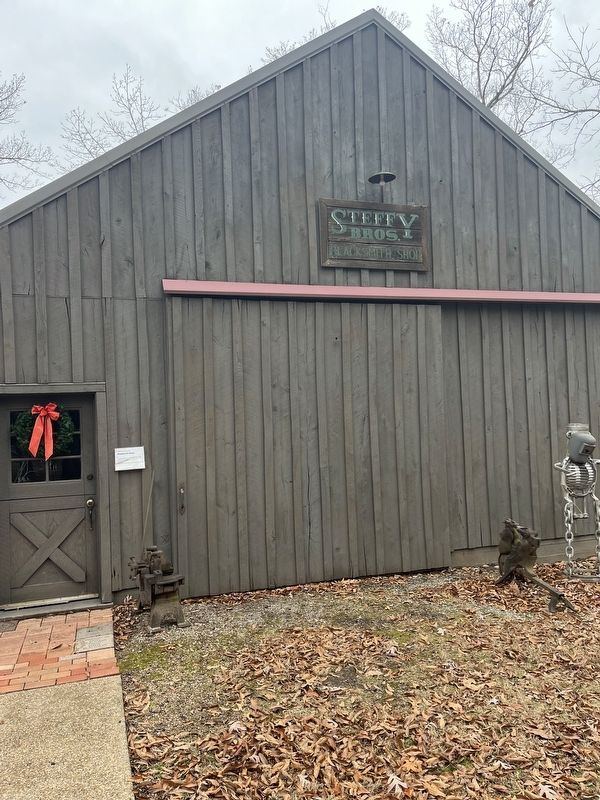
Mt. Vernon resident Bill Steffy constructed this replica of the Thomas Atkins Blacksmith Shop in 1993. The former Atkins Blacksmith Shop was located in Waltonville, Illinois. any of the contents of the Blacksmith Shop are original to the Thomas . . . — — Map (db m239808) HM
The Blacksmith Shop was built in 1979 on this site with a combination of logs from shops on the Old Oaks Ranch at the mouth of Troublesome Creek in west Grand County and from the Kinney Ranch four miles east of Hot Sulphur Springs. The forge, . . . — — Map (db m289181) HM
The blacksmith shop played an integral role in the community in it's early days. He made and repaired farming tools and equipment, wagons and their parts, horseshoes, and household items. The community's first blacksmith was Perkins White, who . . . — — Map (db m85676) HM
Dr. Donald S. Bickers, MD, donated the Blacksmith Shop in 2000. The building was built about 1910 by his grandfather, Alfred R. Clack, who used it into his old age, dying in 1948. The shop came from his farm off Fence Road in Dacula and Dr. Bickers . . . — — Map (db m242271) HM
In 1877 local masons built this shop in eight days. Its first owner, William F. Neebling, built wagons and followed the blacksmith trade until 1909, when he sold the business to Theodore Morschheuser. John F. Schneider apprenticed to Morschheuser in . . . — — Map (db m169280) HM
Working with Red Hot Metal A blacksmith is a metalsmith who creates objects from iron or steel by forging the metal, using tools to hammer, bend, and cut the metal. Blacksmiths produce a wide variety of objects such as gates, grilles, railings, . . . — — Map (db m299395) HM
In the 18th and 19th centuries communities depended heavily on the village blacksmith as the primary source for tools, utensils, hardware, vehicle parts, and many other items. Many blacksmiths also served as farriers, . . . — — Map (db m109099) HM
Henry Hopkins was born in 1845, the son of housewright Moses Hopkins Jr. He lived at 463 Long Pond Road. At the age of 22, he and his father, Moses, built a blacksmith shop on their property across the street at 4 Depot Road. Here he shod horses . . . — — Map (db m282265) HM
Many large farms and ranches throughout Kern County operated a blacksmith shop to make and repair tools.
This blacksmith shop was built at the Calloway Ranch around 1890. The Calloway Ranch was located near the Kern County Land . . . — — Map (db m26972) HM
Overview Mikkel and Hage Sennes emigrated from Norway with a variety of skills that helped them eventually thrive in America. They also learned new skills once they settled in the U.S. They built this blacksmith shop on their farm in Minnesota . . . — — Map (db m236609) HM
Originally located in Selden and moved to Huckabay, the Blacksmith Shop was donated by Nat Wofford and restored by Lance Trinque in 1994. — — Map (db m186593) HM
Joe Stroud (1877-1966) came here from Bigfoot in 1903, and established a blacksmith shop on this site, continuing in the craft learned from his father. Stroud soon became known throughout the southwest for his branding irons, and had a reputation . . . — — Map (db m162648) HM
Report from the Fort 21 January 1802 • Major J. J. Ulrich Rivardi The Blacksmith shop, a brick building, two fires, 20 feet by 19 – very good. In 1776 the Committee of Safety of the Delaware River ordered a “Smith Shop and Forge” to be . . . — — Map (db m192467) HM
The Blacksmith structure is new construction and not intended to be a reconstruction of the historic blacksmith shop at Fort Martin Scott. The original building was located at or near this site and was described in the 1853 inspection only as made . . . — — Map (db m251815) HM
John Hirsch shaped metal in his shop in downtown Northville. His tools and hot forge were vital to the community - crafting nails, repairing farm equipment, making horseshoes. His shop operated from the mid-1800's until the 1920s, and it was . . . — — Map (db m172124) HM
Henry Haus, a native of Switzerland, came to Pope Valley in 1889 at the age of 16. He opened his blacksmith shop in the adjacent wooden structure in 1897, caring for the needs of this valley until 1950.
In 1899 he married Regula Anna and they . . . — — Map (db m57623) HM
Blacksmithing is the working of iron. It dates back to around 1400 B.C. and by 1000 B.C. the use of iron had spread to the point that it surpassed copper and gave its name to the Iron Age. Blacksmithing reached its golden age during the High . . . — — Map (db m191898) HM
Village Blacksmith Mural
March 2003
Made possible by funds raised from the first West Texas Regional Domino Tournament.
Originated, organized and chaired by
Dal De Wees
[Historical nature of mural is understood, however, it's . . . — — Map (db m71927) HM
Building donated by Rensselaer Trinity United Methodist Church & moved to this location in 2003 by the Historical Society & Retired Iron Club of Jasper County. Converted to a blacksmith shop & dedicated to all the oldtime blacksmiths & welders of . . . — — Map (db m240752) HM
A small building that housed a blacksmith shop stood in this area at the time of the Battle of Mill Springs. According to local tradition, the blacksmith who worked there mined shale, low grade coal, from the ground near his shop. There are several . . . — — Map (db m63097) HM
Built in 1920, the Ambroz Blacksmith Shop is the oldest, fully furnished blacksmith shop in Saskatchewan still on its original site. Frank Ambroz, a local blacksmith, purchased the business in 1928 and operated it for the next sixty years. Like . . . — — Map (db m204884) HM
What if you could not go online or to the store to buy tools and appliances?
Local craftspeople kept communities functioning with their custom handiwork. The blacksmith was especially vital to people settling in the Lisle area during the . . . — — Map (db m304926) HM
Elijah Stanton Adkins, the donor of the original 154 acres of Furnace Town, also donated this barn to Furnace Town in 1980. Constructed about 1890, the building shows signs of expansion and changes during its life, including an addition in 2001. . . . — — Map (db m286608) HM
Although Pete Pierson was the original blacksmith, he soon sold his business to Joe Egg, who ran the business for fifty years. As late as 1973, Egg was well-known in Bend and Redmond as an ace blacksmith. In that year, Egg told The Bulletin . . . — — Map (db m157708) HM
The blacksmith shop was one of the most important areas of the ranch. Built in 1911, the blacksmith shop on the ranch was used to produce objects from the mundane to decorative. On the ranch, blacksmiths were responsible for shoeing horses, . . . — — Map (db m266198) HM
Essential to settlers in the 19th and early 20th centuries, many small farm blacksmith shops dotted the landscape in these hills and valleys. Larger industrial foundries and commercial blacksmith shops were located at intersections of commerce, . . . — — Map (db m173157) HM
This shop has sheltered many types of work over the years.
Built on its original South Bailey Street site in 1864, its owners included a tinsmith and a furniture upholsterer. Later, blacksmith Clyde Craig worked in the building for 50 . . . — — Map (db m123327) HM
Here at early valley crossroads in 1851 or 1852, 36-year-old David Brinton established Holladay's first business enterprise, a blacksmith shop, causing this locale to be known as Brinton's Corner. North of Big Cottonwood Creek (today rerouted . . . — — Map (db m254943) HM
Founded by Nels Rasmussen in 1892. Operated by him and his sons, Alva and Don, until the death of Don, the last surviving partner in Jan. 1969. The first acquisition of the Lewistown Society for Historical Preservation, the building contents are . . . — — Map (db m267252) HM
All that remains of the Highland community is this corner post from Uncle Charlie Wysong's blacksmith shop and Highland Cemetery. From 1851-1884, the Wysong blacksmith shop was located on the Wysong's "Old Highland Farm", a "Texas Century Farm". . . . — — Map (db m194677) HM
This log building was originally used as a barn. At the Heritage Center, it is being used as a combination blacksmith and carpenter shop. The log barn was donated to the Center by Agnes and Anthony Tamoshaitis in memory of Agnes' parents, Albert . . . — — Map (db m158097) HM
Backsmithing was one of the most important professions in an early
settler village. The blacksmith would make tools, horse shoes, and
other metal materials as needed.
The first recorded blacksmith in the village of Glen Elgin was Ira C. . . . — — Map (db m278448) HM
The Wheelwright's and Blacksmith's shop stood on this site for many years.
James Reynolds, whose sign designating himself as wheelwright and shoeing smith can be seen on the side wall of Number 1 to the left, had established himself as a . . . — — Map (db m274377) HM
In the early days of Grand Canyon Village, the blacksmith shop served as a focal point of activity. The blacksmith was a highly skilled craftsman who welded the machinery, sharpened the tools, built water tanks, repaired the wagon wheels and shod . . . — — Map (db m39582) HM
A blacksmith was one of the most important tradesmen in any community in the 1800s. In addition to making tools, cookware, weapons, farm implements and building materials, the blacksmith was also called upon to repair many critical farm and . . . — — Map (db m197621) HM
This log building depicts a small blacksmith shop in the 1800's. A blacksmith created tools, railings, fences, horseshoes, weapons and cooking utensils and was an important and necessary part of pioneer life. Anthony Ward was a wheelwright and . . . — — Map (db m65028) HM
About 1840, Philo Alanson Pritchard settled on 10 acres of land north of Morgan Road and about 1/4 mile west of this intersection. Here, he constructed a house as well as a blacksmith shop, which he operated for more than 10 years. Good . . . — — Map (db m236170) HM
This large building was the transportation hub of the Furnace Community This large building was built about 1867 to house the blacksmith shop and wagon shop. The company owned over 140 horses and mules, which were brought here to be shoed. The . . . — — Map (db m90973) HM
The J.M. Wilbur Company Blacksmith Shop, built in 1895 by Jesse Wilbur and restored 2011-2014, is a brick, one-part block commercial building with a stepped gable parapet and Late Victorian Commercial details. The building is historically . . . — — Map (db m277876) HM
The Moffett family operated a blacksmith shop on this site from 1906 to 1955. William Henry Moffett, a fifth-generation blacksmith, took the shop over from his father after it was burned and rebuilt in 1917. Fairfax County Park Authority bought the . . . — — Map (db m133076) HM
The Blacksmith Shop had 13 forges.
The railroad complex needed blacksmiths to forge iron locomotive and rolling stock parts, hinges and other hardware for buildings and also tools and equipment. Some of the forged parts were sent to the . . . — — Map (db m70283) HM
One of the most important people in all of our pioneer communities was the blacksmith. Most early settlers came to this area by horse and oxen-drawn wagons and their need for the services of a blacksmith was universal. Shoeing horses and oxen was . . . — — Map (db m274558) HM
Français: Il y a à peine soixante ans, Montebello comptait trois boutiques de forge en pleine activité. Les familles Bourgeois, Cadieux, et Périard exerçaient ce métier à peu près complètement disparu des activités artisanales de . . . — — Map (db m151448) HM
Robin was an enslaved man who was the blacksmith and a domestic on the plantation, serving three generations of the Haydel family. He was born around 1791 on the east coast of the United States. All of the metal work on the plantation would have . . . — — Map (db m297799) HM
The Mt. Pleasant blacksmith shop is the only working blacksmith shop in Howard County and contains a forge, bellows, anvil, vise, tongs and tools. Blacksmith create and repair objects made of iron and steel, such as horseshoes, tools, and wagon . . . — — Map (db m168885) HM
Blacksmith Shop
But 1826, the Harmony Society's blacksmith shop stood across the street from here on the west side of Merchant Street near Street. The building, valued at $400, contained five forges. One feature of the Society's first . . . — — Map (db m206147) HM
This building exemplifies the blacksmith shops that existed in all early communities. These shops were always an important part of local agricultural and community development. This shop is built in the exact dimensions of what is known as the . . . — — Map (db m67149) HM
The Fiddlers Grove Blacksmith Association was organized in 1992 and held their first meetings in Mr. Luther's Blacksmith Shop. However, the old shop was not adequate to teach and demonstrate to the large number of applicants wanting to learn the . . . — — Map (db m249044) HM
“Under the spreading chestnut tree, the village smithy stands…”
—The Village Blacksmith by Henry Wildsworth Longfellow
This poem was memorized by American school children into the 1950’s and reminds us that rural villages throughout . . . — — Map (db m308416) HM
Although researchers found no architectural features, there is abundant evidence that this area was the location of the smithy. They uncovered layers (or “strata”) of iron-stained soil in this area, as well as pieces of iron “slag” (a waste product . . . — — Map (db m274543) HM
Farm and ranch work have always been hard on machinery, making frequent repairs necessary. Throughout Sahuaro Ranch's history, most of these repairs were made here by the ranch's own employees.
This building, which is believed to have been . . . — — Map (db m40676) HM
Years ago, the blacksmith was an essential person in the community because they made and fit horseshoes. A blacksmith works with metal, heats it up and bends it to whatever shape is needed. This 24 ft. x 24 ft. building was constructed in 2010 and . . . — — Map (db m181153) HM
William Alexander Hogan, a former C.S.A. Cavalry Blacksmith, brought his family from Mississippi to Dublin after 1870. With railroads drawing cattle ranchers and cotton farmers in growing numbers, William opened a blacksmith shop on Elm Street. His . . . — — Map (db m264215) HM
A blacksmith shop with a skilled blacksmith was a necessity. Amasa Barton (Joseph Barton's brother) was kept busy fitting horseshoes, repairing wagons and making , sharpening and repairing everything from farming implement to carpentry tools.
In . . . — — Map (db m95040) HM
In the 1800's, a blacksmith shop was of utmost importance to farms and communities. The “smith” was a skilled craftsman producing necessary iron tools and implements, such as door handles and hinges, nails, and horseshoes, for daily living. The . . . — — Map (db m267831) HM
Blacksmithing is an ancient profession which began over six thousand years ago. It is the craft of forging and shaping iron with a hammer and anvil. The work of the blacksmith allowed for advances in transportation and industry by providing the . . . — — Map (db m80576) HM
Mr. Luther's Blacksmith Shop and Broom Factory sat on the bank of Cedar Creek in the heart of the village of Taylorsville. The blacksmith shop was built c. 1836. Mr. Luther Piercey became the proprietor in the early 1900's and served the . . . — — Map (db m248701) HM
Near here emigrants traversed the Bozeman Trail, 1864-68 to Virginia City, Montana gold mines. Confronted with hostile Indians unwilling to share their hunting grounds, the trail became known as the "Bloody Bozeman" and was discontinued. . . . — — Map (db m91423) HM
The Blacksmith Shop is a small frame building with a slate roof as was the case with most of the buildings that stood close to the Furnace Stack. This slate roof protected the building from the spewing of hot sparks from the Furnace Stack. . . . — — Map (db m158374) HM
Blacksmith Shop, Replica Building
Built: 1958
Representative of an 1860s Shop
This replica shop was designed by Upper Thames River Conservation Authority Park Superintendent
Rex H. Bishop, and constructed in 1958 by the Conservation . . . — — Map (db m285196) HM
This functional structure exhibits
architectural elements which evoke
a nostalgic tribute to the large, ORIGINAL
BLACKSMITH SHOP which occupied this site until
1961 was bustling hub of activity
for a sawmill, HAWKESBURY MILLS, which . . . — — Map (db m203199) HM
Early transportation methods consisted primarily of horse, mule, and ox power. These animals all had to be shod to protect their hooves. Consequently, the Blacksmith was an important figure in the Old West. He not only made the shoes for the . . . — — Map (db m192483) HM
In competition with Henry Ford’s Blacksmith Shop which had 4 sides and 4 corners, David Boothe designed this Blacksmith Shop with 44 sides and 44 corners. He offered $5.00 to anyone who found something missing and he never had to pay up. It houses . . . — — Map (db m25910) HM
Westover School located across from the Green was once the location of the original Blacksmith Shop. It was later relocated to Store Rd. near the spot where the old trolley waiting room was once located. The blacksmith shop has a long history dating . . . — — Map (db m29530) HM
The difficult work of mining required the use of many rugged and reliable tools that could stand up to the physical demands of day-to-day use. It was also a necessity to have equipment that was simple enough to be repaired and maintained on site. . . . — — Map (db m109868) HM
This was the site of a blacksmith ship for shoeing horses and servicing stagecoaches, freighters and Conestogas on the National Road. Up to fourteen coaches per day, each way, passed here during the peak season. Traffic was often so heavy that the . . . — — Map (db m137552) HM
A Blacksmith Shop has been a feature of the West Orange laboratory complex since it was built in 1887. The first shop was located in the back of Building 4. It moved to an unknown location in 1900 and burned down in 1911. The current Blacksmith . . . — — Map (db m91908) HM
A blacksmith shop and house were built here on Lot 47 in 1768. Though other houses built in Salem at this time were half-timbered structures, this one was built of logs, which were eventually covered with clapboards. The house as one-and-a-half . . . — — Map (db m172146) HM
At one time there were three blacksmith and horseshoeing shops in Minster, including Busse & Berning. One gentleman recalled Joe Busse having a special rack for mean horses that needed shoeing. The horses were hoisted off the floor so they could not . . . — — Map (db m238591) HM
The Goshenville Blacksmith Shop is in its original location and was the center of village life for nearly 200 years. It has a working forge and a display of an early l800's Conestoga farm Wagon along with a collection of historic tools. The . . . — — Map (db m77078) HM
Blacksmith shops were important businesses that provided tools and supplies to communities, such as farming equipment, cooking pots, and horseshoes.
In 1825, the Cherokee Council passed a law permitting
Cherokees to hire American . . . — — Map (db m296824) HM
From 1882-1908, Fairvue Plantation was owned by Charles Reed who produced a long list of champion racehorses including Sir Francis, Mr. Pickwick, Rossifer and Yorkville Belle. He also purchased the most famous stallion of the time, St. Blaise, an . . . — — Map (db m198973) HM
The blacksmith shop was a vital place for the early 19th century community. The shop was needed at Jackson's Mill not only to shoe horses, but to make repairs in the gristmill. A blacksmith's work included the maintenance of wagons, carriages and . . . — — Map (db m197617) HM
Dedicated to all of the blacksmiths of the Grape Vine Prairie, especially Bill Millican and "Mr. Charlie"
In 1909, Charles Marion Millican "Mr. Charlie" opened his smithy on the north side of present day Texas Street in Grapevine. The property . . . — — Map (db m304514) HM
A Piece of History of Orange County, California, constructed 1915-1916
Orange County was once covered in orange groves and fields. The blacksmith shop supported the Irvine Ranch, the Irvine Bean and Grain Growers Association, and the . . . — — Map (db m188946) HM
Crescent Street Factories
Crescent Street, located just beyond the buildings to the north, was the principal industrial street in the village during the 1800s. In addition to a cheese factory and creamery, a number of other factories produced . . . — — Map (db m90072) HM
The stone walls of this old building have withstood the adversities of time and people to stand in mute testament of historical events that helped shape a nation. Built in 1837, partners John Paxton and Thaddeus Stevens erected a blacksmith . . . — — Map (db m201760) HM
The Toppenish area around the 1890’s had 4 blacksmith shops. These shops were the hub of activity at that time. Rebuilding a wheel for a freight wagon, shoeing horses or making new parts for machinery the “smithy” was there. These were . . . — — Map (db m129766) HM
This wooden building, built by Pearley Monroe around 1928, is representative of the many blacksmith shops in Coloma during and after the gold rush period. It provided shade for the forge and protection from the weather. An essential member of the . . . — — Map (db m215366) HM
James E. Moore, the son of Irish immigrants, worked as a blacksmith in the logging camps of the late 1800's. It was there that he met his wife Mirah who was employed as a cook and laundress. In 1910 he founded Moore's Blacksmith Shop which served . . . — — Map (db m89148) HM
This blacksmith's shop was the place where many of the tools used on the farm were made and it was also the center for the maintenance and repair of farm equipment. Inside the shop the forge is located in the rear northwest corner leaving plenty of . . . — — Map (db m184344) HM
Two generations of Moehles shod horses and mules at this location. German immigrant Vollrath Moehle established a blacksmith shop after serving in the Civil War. His son, Walter Moehle, constructed this building in 1908 with a blacksmith shop on the . . . — — Map (db m262547) HM
The blacksmith shop was the first building constructed by Percy & Small after they purchased the old Blaisdell shipyard site from William Donnell in 1896. It was furnished with forges, bellows, and anvils for fabricating large quantities of . . . — — Map (db m52095) HM
Blacksmithing was one of the trades taught to prisoners at the Cherokee National Prison during their incarceration. The thought was to give men and women a skill set they could use upon their release to better their lives and not continue to commit . . . — — Map (db m259510) HM
The Blacksmith Shop was originally the Carriage House. The building dates back to the late 1830s. Inside you will find antique farm equipment including a wheelbarrow and several tools used by the blacksmith. — — Map (db m263421) HM
At this time not much is known about this building. A.U.S. government book done during the Depression lists it as the oldest standing frame blacksmith shop in the U.S.. Opposite the shop is one of the oldest cemeteries in the area. Several . . . — — Map (db m206211) HM
The town of Meadow developed in the early 20th century, moving to meet the railroad in this location in 1917. In 1922, O.L. Puthuff built a blacksmith shop on this site. By that time, brothers Leslie and Herschel F. Brooks, Alabama natives, had . . . — — Map (db m73522) HM
This restored log structure is a working blacksmith shop, equipped with tools and materials similar to those John Haley used in his trade. The shop was found in Davidson County and was relocated to this site in 1970 with funds from the Millis . . . — — Map (db m213712) HM
2978 entries matched your criteria. The first 100 are listed above. Next 100 ⊳
Thin black lines indicate changes in relevance. Between each pair of lines entries are ordered geographically but all have the same relevance.
* Inflectional forms of words are their plurals, singulars, and possessives as well as gramatical tenses and similar variations.