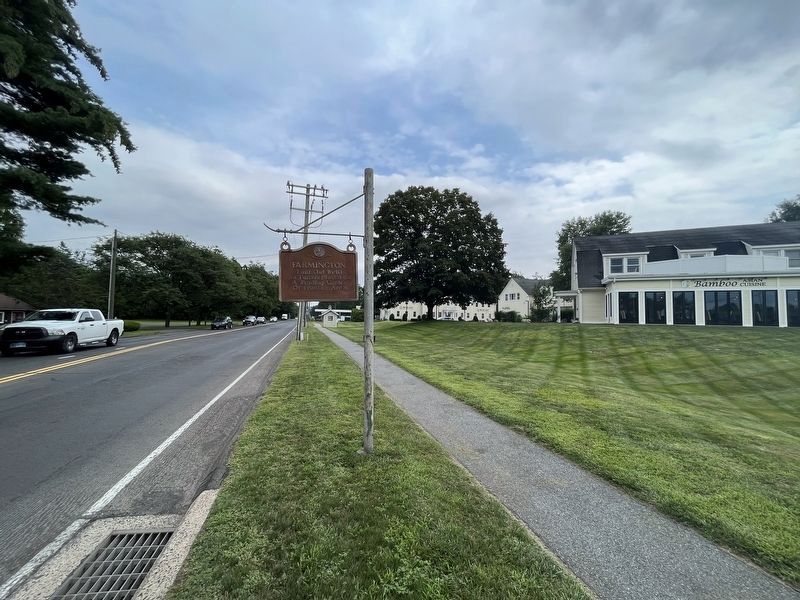
During the week of August 12, 1955, the Farmington Valley was hit by the edge of Hurricane Connie. The area received heavy rainfall that saturated beds of the Farmington River. The following week, Hurricane Diane swept through the Atlantic Coast, . . . — — Map (db m230293) HM
Between 1863 and 1865, nearly 1,700 men of color enlisted in the 29th Volunteer Infantry Regiment, Connecticut's first non-white military unit. The recruits came from a variety of racial and ethnic origins and professional backgrounds. A . . . — — Map (db m230467) HM
Reed moved to Hartford in 1916, where she would attend Hartford High School and Hartford Federal College.
She joined WPA's Negro Theatre Project in Hartford in her mid-twenties, and would appear in plays such as "Trilogy in Black," "Porgy," . . . — — Map (db m230471) HM
Johnson came to Hartford in 1916. She and her husband co-owned the only Black-owned funeral services company in the state of Connecticut at the time.
She co-founded the Colored Women's League in 1917 and was its president. Her organization . . . — — Map (db m230466) HM
In 1917, she hosted a small group gathering in her home to co-found the Hartford Branch of the NAACP.
By 1916, Townsend Seymour had already registered to vote and in 1920 went on the campaign trail to run for state representative, the first . . . — — Map (db m230469) HM
Reverend Battles moved to Hartford in 1961, where he would serve as Pastor at Mt. Olive Church and work with Dr. Martin Luther King Jr.
He swiftly rose to become a key figure in Hartford's civil rights movement. He was the Southern Christian . . . — — Map (db m230474) HM
The Corning Fountain was commissioned by John J. Corning as a tribute to his father, John B. Corning. It was designed by John Massey Rhind, a noted sculptor born in Scotland.
The fountain's location was chosen as part of a grand entranceway . . . — — Map (db m230328) HM
Dr. Horace Wells was a Hartford Dentist who is credited with the discovery of anesthesia in Hartford in 1844. Wells stated, "let anesthesia be as free as the air we breathe" and did not try to benefit commercially from his discovery. After his . . . — — Map (db m230389) HM
Israel Putnam (1718-1790), the legendary general of the French and Indian and Revolutionary Wars, is considered Connecticut's first authentic folk hero. At the outbreak of the Revolutionary War in 1775, at 57 years old, he is famous for riding 18 . . . — — Map (db m230347) HM
The City of Hartford commissioned the Soldiers and Sailors Memorial Arch to recognize the 4,000 Hartford residents who served in the Union Army from 1861-1865, including 400 who died during the war. It was designed by George Keller, who also . . . — — Map (db m230367) HM
Spirit of Victory is a war memorial honoring the Hartford men who fought in the Spanish-American War, 1898-1902. Its creator was Evelyn Longman Batchelder, the first woman sculptor elected as a full member of the Academy of Design, who . . . — — Map (db m230406) HM
Boxer, motorcyclist, wordsmith, cartoonist and entertainer, Bob Steel joined WTIC (Travelers Insurance Company) in 1936 when it operated from the 6th floor of this Grove Street building. From here until 1961, from Broadcast House in . . . — — Map (db m151923) HM
Reverend Horace Bushnell believed Prosperity was Our Duty and that civic improvement was critical to a prosperous Hartford. As a result of economic decline in the 1840s, Bushnell recognized Hartford's long want of "spacious . . . — — Map (db m230332) HM
Reverend Horace Bushnell believed Prosperity was Our Duty and that civic improvement was critical to a prosperous Hartford. As a result of economic decline in the 1840s, Bushnell recognized Hartford's long want of "spacious . . . — — Map (db m230390) HM
First speech in Hartford on the grounds of this Church May 18, 1843
"[We found several towns in which people closed their doors and refused to entertain the subject. Notably among those were Hartford, Conn., and Grafton, Mass. . . . — — Map (db m151933) HM
George Washington
was entertained by
Colonel Jeremiah Wadsworth in his home on this site on June 30, 1775 when on his way to Cambridge to assume command of the Army.
On September 21, 22, 23, 1780 with Lafayette, General Knox and Governor . . . — — Map (db m151930) HM
You are now standing where once stood a structure that was an important piece of Hartford history: The Isle of Safety. An exact outline of this iconic structure has been created on the paved walkway behind you.
When it was erected . . . — — Map (db m151922) HM
On Sept. 4, 1824, General Lafayette visited Hartford during his triumphal return to the U.S. He was addressed here by Governor Wolcott. — — Map (db m230408) HM
On June 5, 1798, Matthew Furlong was shot dead by Crown forces in New Ross as he approached the Three Bullet Gate carrying a flag of truce and a letter asking for the surrender of the town to the Rebel forces.
This monument serves to . . . — — Map (db m151919) HM
To commemorate the Sister City relationship between the peoples of Hartford, Connecticut and New Ross, County Wexford in the Republic of Ireland.
This relationship promotes economic educational and cultural exchanges; and perpetually fosters . . . — — Map (db m151920) HM
With trains arriving in Hartford and passing the western edge of the Park, Reverend Horace Bushnell wanted to provide an aesthetically pleasing first impression of the City. Bushnell envisioned the Park as an "outdoor parlor", a specialized room in . . . — — Map (db m230325) HM
Hartford suffered great floods in 1936 and 1938. This resulted in the City and Army Corps of Engineers designing an extensive flood control system that buried the Park River in a tunnel under the Park. In this location, you would have been . . . — — Map (db m230345) HM
The Pearl Street gate was designed by Olmsted Brothers Landscape Architects and added to the Park in the 1940s. The path Leads from the gateway to the Corning Fountain. Donated by John J. Corning in 1898, the fountain was installed in 1899 to honor . . . — — Map (db m230346) HM
Jacob Weidenmann's design of the Park utilized many of Frederick Law Olmsted's techniques, including curvilinear paths and the separation of uses. His design incorporated pedestrian use in the eastern section. Through the design of a carriage path . . . — — Map (db m230349) HM
Reverend Horace Bushnell preached Unconscious Influence (1842), the idea that we are "ever touching unconsciously the spring of motion in each other… we overrun the boundaries of personality -- we flow together… by a law of social contagion." . . . — — Map (db m230368) HM
As a result of severe flooding, the Army Corps of Engineers created the Park River relocation plan in 1941, placing the river in a concrete tunnel under Bushnell Park. As part of this plan, the firm of Olmsted Brothers landscape architects, . . . — — Map (db m230370) HM
The Park was first conceived of by Reverend Horace Bushnell in 1853. In 1860, the City hired Jacob Weidenmann, a Swiss-born landscape architect, to finalize the Park design and complete construction. Weidenmann's design incorporated the styles of . . . — — Map (db m230391) HM
Reverend Horace Bushnell believed Prosperity was Our Duty and that civic improvement was critical to a prosperous Hartford. As a result of economic decline in the 1840s, Bushnell recognized Hartford's long want of "spacious . . . — — Map (db m230394) HM
Jacob Weidenmann's design of Bushnell Park included a location for a statue of Reverend Horace Bushnell. Bushnell, however, did not want a statue of himself in what he viewed as Hartford's park, not his. On October 19, 1871, the First Company . . . — — Map (db m230395) HM
In memory
of the
Rev'd. John Brady,
who died
November 16, 1854,
aged 48.
He was Catholic Pastor
of this City from
1836 to 1854;
and through his Apostolic labors
this Cathedral was erected.
May his soul rest in . . . — — Map (db m151938) HM
Site of the first convent
Sisters of Mercy
arrival in Connecticut
St. Patrick Parish
May 11, 1852
to serve the poor, sick and ignorant
throughout the state — — Map (db m151939) HM
The Pump House was designed by Hartford architect, H. Hilliard Smith in 1940 and built in 1947 as part of the Connecticut River Flood Control Program. This project began after the downtown area suffered catastrophic floods in 1936 and 1938. The . . . — — Map (db m230393) HM
Jeremiah Wadsworth was Commissary-General in the Continental Army. His house which stood at the present site of the Wadsworth Atheneum was the meeting place for many leaders of the American Revolution, among them Washington, Lafayette, and . . . — — Map (db m151929) HM
Barlow completed his high school studies in Hartford in 1933. He continued on to Howard University, where he served as senior class president, and received his degree with honors in 1939.
He served in a segregated Army regiment in the . . . — — Map (db m230475) HM
A graduate of Hartford Public High School, where he won Gatorade's Connecticut Player of the Year.
Played for three seasons at the University of Massachusetts, where he broke the NCAA freshman record for blocked shots.
Was voted . . . — — Map (db m230477) HM
Goggins was born and raised in Hartford, where she would form the Black Magic Double Dutch Team with Lisa Butler, Shantell Smith, and Connie Williams.
Black Magic beat out all teams in a regional final at the Hartford Civic Center (now the . . . — — Map (db m230479) HM
Born in St. Andrew, Jamaica, he immigrated to Connecticut in 1951, where he opened a real estate and insurance company.
Elected to Hartford's city council in 1965, he battled to assist low-income families in purchasing homes for eight years. . . . — — Map (db m230481) HM
Born in Georgia, Hales moved to Hartford in the 1950s and opened a coin-operated laundry and electronics business on Albany Avenue. — — Map (db m230478) HM
Designed by George Keller, dedicated 1876. First building in the state built as a synagogue, it served Congregation Temple Beth Israel from 1876 to 1936 — — Map (db m230412) HM
Finding your way on foot in Connecticut's capital city
Downtown Hartford is filled with cultural, civic and commercial destinations, all in a compact district that can be easily traversed on foot in less than 20 minutes.
Hartford's . . . — — Map (db m230410) HM
Finding your way on foot in Connecticut's capital city
Downtown Hartford is filled with cultural, civic, and commercial destinations, all in a compact district that can be easily traversed on foot in less than 20 minutes.
Hartford's . . . — — Map (db m230413) HM
Barnard Park, commonly known as South Green, dates back to the original 1630's Hartford street plan. A triangular 13.5-acre parcel of land, South Green was originally a New England common used informally for the grazing of cattle. In 1816, the . . . — — Map (db m230414) HM
The site of this park was the entrance to the Estate of Solomon Porter, a 19th century industrialist and rival of Samuel Colt. In 1942, Porter's daughter, Henrietta Porter Lippincott, deeded this land to be held in trust and maintained as a park . . . — — Map (db m230462) HM
Barnard Park, commonly known as South Green, dates back to the original 1630's Hartford street plan. A triangular 13.5-acre parcel of land, South Green was originally a New England common used informally for the grazing of cattle. In 1816, the . . . — — Map (db m230417) HM
Buckingham Square occupies a central place in Hartford's history. Main and Buckingham Streets were laid out in the original settlement of the town; a map of 1640 shows a number of buildings in the area. It was at the intersection of these two . . . — — Map (db m230428) HM
This property has been
placed on the
National Register
of Historic Places
by the United States
Department of the Interior
South
Church
Congregational
Founded 1670 . . . — — Map (db m230421) HM
This mid-1800s photo is the earliest known picture of Academy Hall and the Congregational Church. Academy Hall is a federal style building that was built in a federal style building that was built in 1803 by Mr. Abraham Jagger and paid for by . . . — — Map (db m230821) HM
Elm Street Historic District has been placed on the National Register of Historic Places in 1998 by the United States Department of the Interior — — Map (db m230832) HM
The first farmers in this area were the Indigenous people who lived along the Connecticut River. Artifacts from this first farming community were uncovered at the Morgan Trench archaeological dig in the rock Hill Great Meadows. Surface finds, . . . — — Map (db m230804) HM
The history of Rocky Hill is entwined with the Connecticut River. Flowing past our 4 mile shoreline, on its 410 mile trip from northern New Hampshire to Long Island Sound, the river has been a major factor in our town's growth and development as . . . — — Map (db m230797) HM
Rocky Hill Center Historic District has been placed on the National Register of Historic Places in 2007 by the United States Department of the Interior. — — Map (db m230830) HM
Rocky Hill-Glastonbury Ferry Historic District has been placed on the National Register of Historic Places in 2005 by the United States Department of the Interior — — Map (db m230787) HM
Hilltop Farm has been placed on the National Register of Historic Places in 2005 by the United States Department of the Interior — — Map (db m230482) HM
These granite markers are a tribute to the courageous men and women who served in the Afghanistan and Iraq wars and all members of the US Armed Forces who keep our borders safe at home and abroad
Operation Enduring Freedom . . . — — Map (db m230438) WM
The American Mill was originally the site of a saw and grist mill owned by Rufus West and Horace Vinton. In 1846, Phineas Talcott purchased the site, and in 1847, he and Nelson Kingsbury organized the American Mills Company and constructed a new . . . — — Map (db m230439) HM
In grateful memory
of
★ General ★ Lafayette ★
whose love of liberty brought him to American shores and dedicate his life and fortune to the cause of the colonies, the Sabra Trumbull Chapter, Daughters of the American . . . — — Map (db m230443) HM WM
On Sept. 4, 1824, General Lafayette was received at King's Tavern by the 1st Co., Governor's Horse Guard and escorted to East Hartford. — — Map (db m230442) HM
This tablet commemorates
the founding of the
Baptist Church of Willington
by
Reverend Hubbel Loomis
A.D. 1828
Erected by the
Federated Churches of Willington
to perpetuate its own motto:- . . . — — Map (db m230459) HM
In 1851, P.T. Barnum and William Noble took the land that we now stand on and developed it. Lots were planned and streets were named after their own family members such as Caroline, Hallet, and of course Barnum. A firm was hired to design an English . . . — — Map (db m227305) HM
20628 entries matched your criteria. The first 100 are listed above. Next 100 ⊳