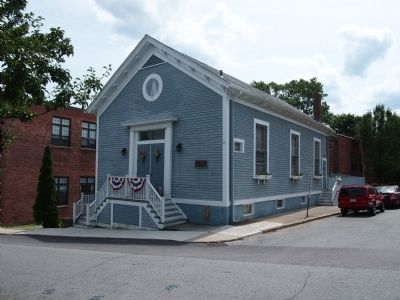
Built in 1872 by William Northup on the former site of Scalloptown. This chapel was the first fully integrated congregation in East Greenwich. — — Map (db m58389) HM
Founders
Oct. 1, 1907.
Howard V. Allen •
Benjamin H. Arnold •
D. Ray Arnold •
George E. Bailey* •
Henry D. Banks •
Walter O. Barber •
Albert S. Benson •
Thomas W. Black, Jr. •
Nathaniel H. Brown* •
William A. Browning* . . . — — Map (db m223030) HM WM
Erected by Varnum Continentals 1914 on the second site of Rhode Island Central Bank, first bank in East Greenwich 1840-1857
To the memory of
James Mitchell Varnum
of East Greenwich
Brig. Gen. Continental Army 1777-1779 • . . . — — Map (db m223025) HM WM
Location: Conimicut Shoal, entrance to Providence River, Narragansett Bay
41 43 01 N 71 20 42 W
Originally Established: 1868
Present Light House Established: 1882 / Automated: 1963
Construction Material: Cast iron / Present Optic: 250 mm . . . — — Map (db m198179) HM
The Conimicut Light, a symbolic Rhode Island's rich maritime heritage is associated with a long history of efforts to protect shipping in and out of the rocky waters of Narragansett Bay, and with the creation of transportation routes that have . . . — — Map (db m251141) HM
This building, erected in 1919, was a center of the early 20th century marine trade, which maintained small commerical and pleasure craft that called Pawtuxet Village their home port. In 1975, the old boat house was obtained by the City of . . . — — Map (db m251143) HM
This American Liberty Elm was named after "The Liberty Tree: Our Country's first Symbol of Freedom." On the morning of August 14, 1765, the people of Boston awakened to discover two effigies suspended from an elm tree in . . . — — Map (db m251144) HM WM
Only the bravest of Rhode Islanders would venture into the dark House of Horrors, steeling themselves against the frightening sight of the Giant Bat, the Torture Chamber, the Sawmill stunt, and the ride's most mysterious attraction, the Viking . . . — — Map (db m251135) HM
Rocky Point was traditionally accessed via Narragansett Bay. In 1860, the American Steamship Company ran ships to the park's pier several times a day. The pier, a constant fixture at the park, was not untouched by the ravages of nature, however. . . . — — Map (db m251125) HM
On the 29th of June, in the year 1877, the first Presidential phone call was made between Rutherford B. Hayes who was at Rocky Point and Alexander Graham Bell in Providence. Mr. Fred Gower, the managing agent of Professional Bell, moderated the . . . — — Map (db m251139) HM
Playing baseball is a national pastime and a favorite sport of the locals. However, at the turn of the 20th century the Puritan morality laws, also known as Blue Laws, prohibited the playing of baseball on Sundays. The Blue Law did not stop the . . . — — Map (db m251120) HM
This 60-foot arch is one of 11 "archways to understanding" sponsored by General Foods during the 1964-65 New York World's Fair. The original arch had an electronic message panel that would display Fair-related information such as weather . . . — — Map (db m251128) HM
On September 11, 1906, Harry G. Travor submitted a patent application for a roundabout that operated as a centrifugal swing with suspended seats. This patent detailed the historic Rocky Point ride known to generations of park enthusiasts as the . . . — — Map (db m251137) HM
Rocky Point was traditionally accessed via Narragansett Bay. In 1860, the American Steamship Company ran ships to the park's pier several times a day. The pier, a constant fixture at the park, was not untouched by the ravages of nature. In 1883, . . . — — Map (db m251124) HM
On any hot New England summer day, many Rhode Islanders could be found eagerly standing in line for a day pass to the inground pool. Not only was this pool a summertime favorite, but it was unique because it was filled using the salt water from . . . — — Map (db m251130) HM
In 1840, Captain William Winslow began to bring his Sunday school class to Rocky Point for weekend outings. These proved so popular, in 1847, he purchased 89 acres and began transporting people via steamboat to the site and serving a shore . . . — — Map (db m251122) HM
The Skyliner was considered a relaxing alternative to the park's more hair-raising rides. Similar to a ski lift, it carried passengers from one side of the park to the other, providing a bird's-eye view of the amusement park. After reaching a . . . — — Map (db m251132) HM
The Peter Freeman Lot (Warwick Historical Cemetery #26) is an historic cemetery protected by State and City regulations. The Lot is described as 100 feet by 75 feet in size, containing 22 individuals (with 20 inscribed headstones and one . . . — — Map (db m150256) HM
Conanicut Battery
A Revolutionary Fort
Built by Americans in 1776
Grounds cleared and tablet placed by the Daughters of the American Revolution of Rhode Island — — Map (db m56383) HM
In 1829, Congress appropriated $1,250 for a 600-pound fog bell for Beavertail. Prior to that time the keeper fired a cannon on foggy nights. That same year a fog bell house was built adjacent to the tower.
Beavertail has probably seen more . . . — — Map (db m88667) HM
Situated atop 50-70 foot high cliffs with clear views of the horizon and Block Island to the south. Fort Wetherill held an important strategic position within an extended harbor defense system of Narragansett Bay during World Wars I and II.
The . . . — — Map (db m189619) HM
The Harbor Mine or Torpedo Complex was constructed during the period of 1908 to 1911 as part of a comprehensive harbor defense system for Narragansett Bay. The two-story concrete structure served as a Mine Storage Warehouse in which the parts . . . — — Map (db m56683) HM
1678
Town of Jamestown is incorporated. There are about 150 residents.
1705
Jamestown Town Council orders that a Watch House be built at "Beaver Tail."
1712
Jamestown Town Council . . . — — Map (db m88673) HM
Memorial
To The Veterans
of
Jamestown, Rhode Island
Who Served In The
Spanish - American War
World War One
World War Two
The Korean War
The Vietnamese War — — Map (db m88699) WM
Beavertail Light was lit with whale oil for many decades. Whale oil was smoky, hard to light at cold temperatures, and the quality varied greatly. In addition, early lights were dim and burned twenty to thirty gallons of oil a month.
In the . . . — — Map (db m56679) HM
This area along the crest of Prospect Hill was an integral part of the Narragansett Bay coastal defense system from 1916 to 1945. From here, military observers had an unobstructed view of the approaches to the Bay, as well as East and West passages . . . — — Map (db m56678) HM
Below this concrete cap sits the stone foundation Beavertail's 1749 lighthouse.
Initially built to provide safe passage into Newport's colonial harbor, it was designed and built by Peter Harrison, "America's first architect," who later designed . . . — — Map (db m56457) HM
The first assistant keeper at Beavertail Light was hired about 1859. It appears that the early assistant keepers shared part of the keeper's quarters or lived in one of the outbuildings on site.
In 1898, the U.S. Lighthouse Board added this . . . — — Map (db m88631) HM
The current tower was built in 1856 to replace a deteriorating 1753 structure.
The granite tower rises to a height of 40.9 feet and measures 10 feet on each side. It is constructed of 27 rows of granite blocks, weighing a total of 180 tons. . . . — — Map (db m88666) HM
Although most lighthouse keepers were married, at many small lighthouses they lived a solitary life while their families remained on the mainland. Beavertail, being on Conanicut Island, allowed the keepers and their family to live at the site. . . . — — Map (db m88672) HM
You are looking at the West Passage, one of two entrances to Narragansett Bay, New England's largest estuary. There are over 30 islands in the bay. There is very little commercial shipping in the West Passage since it is much shallower than the . . . — — Map (db m88640) HM
What resembles a submarine on the surface just over a mile southwest of this point is all that remains of the Whale Rock Lighthouse.
Whale Rock is a flat ledge about a half acre in size, yet it claimed at least eight ships and six lives . . . — — Map (db m88648) HM
Historically, the rocky cliffs behind and above the buildings of the Harbor Mine Complex were of military significance to Rhode Island's earliest colonists, who built earthen fortifications on its headland and installed cannon to protect nearby . . . — — Map (db m242649) HM
13,000 YEARS
This sculpture shows the present-day
Sakonnet shoreline and an approximation
of the shoreline 13,000 years ago.
Archaeological evidence and Wampanoag tradition
tell us that people have lived at Sakonnet continuously
since the . . . — — Map (db m307031) HM
Ancient Connections
Roads and waterways connected Sakonnet to vast
social and trade networks.
To your left is an ancient road that follows a ridge
left by a retreating glacier about 13,000 years ago.
Together with local waterways, this . . . — — Map (db m307032) HM
Buying & Selling Acoaxet
After the war many Native people owned
land in Acoaxet with English-style deeds.
Mamanuah preserved his homelands by remaining
loyal to the English during King Philip's War and by selling
Awashonks' land instead . . . — — Map (db m307138) HM WM
This Tablet erected by the Rhode Island Society of Colonial Wars in recognition of the exceptional services rendered by Col. Benjamin Church. His fearless leadership and effective command during King Philip's War 1675-1676 — — Map (db m307061) WM
Distrust for the Newcomers
The Sakonnets and the English were not friends.
As many as 3,000 Sakonnets lived here in the 1600s.
They saw European ships sail by beginning in the 1500s.
European newcomers brought diseases but the
Sakonnets were . . . — — Map (db m307016) HM WM
Fal Solomon:
Indentured Here
Fal Solomon was a Sakonnet girl
ordered into indenture here
at the Wilbor House.
In 1757 an epidemic swept through Sakonnet. Fal
Solomon became ill, and her parents likely died. Dr.
William Wilbor brought . . . — — Map (db m307045) HM
Honoring Awashonks
The land you are standing on was once
reserved for Awashonks and her people.
Awashonks is the best known Sakonnet sachem. She
led her people during the 1660s and 70s. This was a
chaotic time when the English used trickery, . . . — — Map (db m306910) HM WM
Mishoon
Dugout canoes provided Wampanoag people with transportation throughout the Northeast.
Mishoon is the traditional term for dugout canoe in my Wampanoag language. The dugout canoe practice and tradition that existed here for thousands of . . . — — Map (db m307132) HM
Squant
Squant is the protector of
water voyages.
Squant features prominently in our stories. She is a great being that oversees the health of the plants. especially berries. Squant was said to be married to Moshop the great giant who dragged . . . — — Map (db m307124) HM
Stone Walls
Many of Little Compton's stone walls were built by Sakonnet men, sometimes under duress.
The Sakonnets did not fence their fields. English
settlers did. Many of the stone walls you see today
mark original English property . . . — — Map (db m306949) HM
SUMMER WEEKU FRAME Weekus are traditional Wampanoag homes.
A weeku (weety8) is a Wampanoag house. The Sakonnets, and other Wampanoag communities in Massachusetts and eastern Rhode Island, would live in different types of houses depending . . . — — Map (db m307133) HM
Take A Walk On Your Land
To forever protect and preserve this property as farmland, development rights were
purchased by the Little Compton Agricultural Trust ("Ag Trust") in partnership with the
RI Department of Environmental Management.
. . . — — Map (db m307051) HM
The Sakonnet Diaspora
The descendants of the
Sakonnets are a diaspora.
The Sakonnets began leaving their homelands in the
Late 1600s, driven away by war, European diseases
English encroachment, and fear. English neighbors
burned a Native . . . — — Map (db m307144) HM
Three Sisters: A Symbiotic Garden
Living things grow best in relationship with others.
Oral history is imperative in preserving the culture of
Indigenous communities. For thousands of years, our
stories have encapsulated the experiences of . . . — — Map (db m306944) HM
Welcome to Sakonnet
Sakonnet is the traditional homeland
of the Sakonnet Wampanoag people.
People have lived at Sakonnet for over 13,000 years.
This exhibit shares their story from the end of the
last ice age to the present day. . . . — — Map (db m306958) HM
Wilbor House
Built circa 1690 by Samuel & Mary Wilbor
Home of eight generations
East end, 17th century, West end, 18th century
Additions, 19th & 20th century
Little Compton Historical Society — — Map (db m306880) HM
To commemorate the birthplace of the Rhode Island Red breed of fowl which originated near this location Red fowls were bred extensively by the farmers of this district and later named "Rhode-Island-Reds" and brought into National prominence by the . . . — — Map (db m56093) HM
In this house the British General Prescott was taken prisoner on the night of July 9, 1777 by Lieutenant-Colonel Barton of the Rhode Island Line. — — Map (db m48060) HM
Built 1777 by the English for the defence of Newport The gift of ---------- W. W. Sherman J. N. Brown H. Brown F. S. Barker S. P. Barker — — Map (db m48062) HM
Imagine this twenty acre fort filled to capacity: 2,400 soldiers here to defend Newport with 468 cannon sited along the most probable attack routes. Though designed to house an imposing force, Fort Adams was normally garrisoned with several . . . — — Map (db m48125) HM
This was the home of Mr. Smith until his death in 1886. As a Real Estate Broker he helped to develop the land along Bellevue Avenue.
This property has been
placed on the
National Register
of Historic Places
by the United States . . . — — Map (db m223109) HM
Celebrating the founding of Newport, religious liberty and the separation of church and state 1639
It is agreed and ordered that…this south west end of the island, shall be called Newport…and that the towne shall be built upon . . . — — Map (db m251394) HM
In 1653 settler-colonists laid claim to "Sowams," the ancestral home of the Pokanoket. Though the Pokanoket never relinquished their claim, settler-colonists soon occupied the land, including modern-day Barrington. Among these settler-colonists were . . . — — Map (db m251357) HM
The Bay Islands Park, managed by the Rhode Island Department of Environmental Management, consists of nine sites that extend from Patience Island in the upper bay to Beavertail and Brenton Point overlooking Rhode Island Sound. Each of the nine . . . — — Map (db m48451) HM
In the 1840s, Alfred Smith from Middletown, working as a tailor in New York City, returned to Newport. His clients had been inquiring about real estate in Newport, and Smith intended to capitalize on their interest. He and farmer Joseph Bailey . . . — — Map (db m251311) HM
Bells have long been a symbol of significance in maritime history. They are used to note the arrival of notable guests, mark the daily routine aboard naval vessels, and serve as warning signals in the fog. — — Map (db m223194) HM
“Fort Adams … often was dubbed the country club of the army, especially by those officers and enlisted men who were assigned to it after duty in foreign areas. And its peacetime background was dotted with stories of high society . . . — — Map (db m48233) HM
1. Ferry Increasing numbers of Rhode Islanders board cruise boats and ferries to get out of the Bay. These ferries are reminiscent of the pleasure steamboats that were so common on Narragansett Bay one hundred years ago. 2. Fast . . . — — Map (db m56460) HM
In Honor of Ernest Coggeshall, Jr. 9/2/15 – 4/27/95 Capt. Joseph X. “Jay” O’Brien, Jr. 4/21/54 – 12/16/90 Dad, Mom and Family [ Right Side of Monument : ] James Wah Gin Wong 1918 – 1993 Stephen Joseph . . . — — Map (db m48922) HM
Governor Philip W. Noel Lt. Governor J. Joseph Garrahy Director Dennis J. Murphy, Jr. Sen. Erich A. O’D. Taylor, President Sen. Robert J. McKenna Mayor Humphrey J. Donnelly, III Committee Chairman James Thomson Douglas Agnes R. Curtis . . . — — Map (db m48973) HM
U.S. army officer, Joseph G. Totten superintended the construction of Fort Adams beginning in 1825. He oversaw all details of construction until 1838, when he was appointed as the first Chief Engineer of the newly created Army Corps of Engineers. [ . . . — — Map (db m48181) HM
This property has been
placed on the
National Register
of Historic Places
by the United States
Department of the Interior
Captain Phillips Hosue
Built cir 1730
Bought in 1806 by
Samuel Phillips, Mariner
Moved . . . — — Map (db m223237) HM
The late 19th century saw revolutionary changes in both weapons and strategies of defense. Steam powered ships with high velocity naval guns could now bring the walls down and rendered forts obsolete. To remedy the risk, Fort Adams expanded outside . . . — — Map (db m48230) HM
The buildings surrounding Chateau-sur-Mer capture the spirit of Newport in the High Victorian era. This block preserves one of the greatest concentrations of Victorian architecture and landscape design in Newport from the period 1850 to 1890. The . . . — — Map (db m48609) HM
Christopher Ellery House
has been placed on the
National Register
of Historic Places
by the United States
Department of the Interior
c 1750 — — Map (db m223142) HM
Clarke Cooke
House
circa 1780
This property has been
placed on the
National Register
of Historic Places
by the United States
Department of the Interior — — Map (db m223200) HM
Shore Restoration and Protection
Newport, Rhode Island
1984-1985
Funded by the National Park Service-
Land and Water Conservation Fund,
The State of Rhode Island and
The City of Newport
Patrick G. Kirby, Mayor
City Council Members . . . — — Map (db m115160) HM
Home of the artist Michel Felice Corne who introduced the tomato into this country.
Michele Felice Cornè House
2 Corne Street
has been placed on the
National Register
of Historic Places
by the United States
Department . . . — — Map (db m223150) HM
Think about how difficult a land attack against Fort Adams would be. First, you would have to capture the Redoubt, located a quarter mile to the south. You would then have to charge up the sloping glacis to the Southern front. Finally, you would . . . — — Map (db m48138) HM
During the 19th century, Newport was the only deep water harbor between New York and Boston which could serve as a base for a large fleet of warships. Fort Adams was located at a crucial point where it could prevent the entry of enemy warships into . . . — — Map (db m48129) HM
During the 19th century, Newport was the only deep water harbor between New York and Boston which could serve as a base for a large fleet of warships. Fort Adams was located at a crucial point where it could prevent the entry of enemy warships into . . . — — Map (db m48235) HM
878 entries matched your criteria. Entries 101 through 200 are listed above. ⊲ Previous 100 — Next 100 ⊳