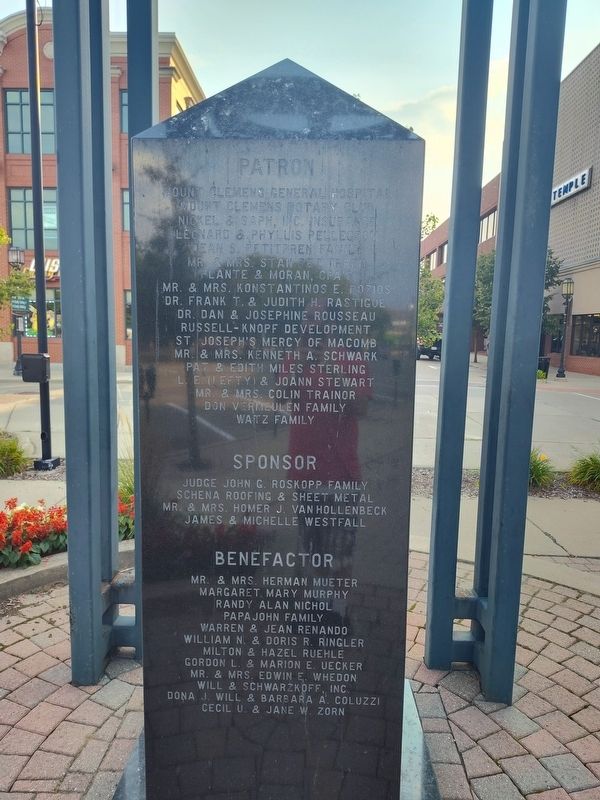
In observance of the 175th anniversary of the City of Mount Clemens, the citizens of this proud community dedicate this clock to all the individuals and families whose energies and sacrifices have made Mount Clemens one of our state's truly . . . — — Map (db m256908) HM
In 1818 Territorial Governor Lewis Cass proclaimed the third Michigan County to be called Macomb. At that time the young General was Commander of the Fifth Military Department in Detroit. Born in that city in 1782, son of prominent local . . . — — Map (db m146870) HM
In honoring the memory of General Alexander Macomb as a military hero of the War of 1812 and as a scholar and civil administrator of the Michigan Territory's largest county in 1818, may this statue serve as a reminder to future generations of the . . . — — Map (db m256903) HM
Mount Clemens Carnegie building was erected in 1904 and was the first Carnegie Library built in Macomb County. It is one out of 1,681 such libraries across the United States financed by Andrew Carnegie, the industrialist and philanthropist. The . . . — — Map (db m85696) HM
In memory of
the Eighth Mich. Vol. Cav.
Col John Stockton
1862 - 1865
Dedicated by the survivors
on
Memorial Day, May 30, 1914. — — Map (db m256906) WM
The first mayor of Mount Clemens, Josua Dickinson, built this Italianate house in 1869. His daughter Katherine (1849-1882), the great-granddaughter of city founder Christian Clemens, and his son-in-law, George M. Crocker (1848-1918), moved into it . . . — — Map (db m85660) HM
Mark A. Barbret • Shane H. Ahmed • Stephen M. Okray • Tarryl B. Hill • Gentian Marku • Donald L. Munn II • Jason R. Freiwald • Anthony A. Dilisio • Ergin V. Osman • In C. Kim • Allan Klein • Jason A. Lehto • Robert M. Friese • D. Alex Knapp • . . . — — Map (db m256907) WM
The Episcopal Diocese of Michigan sent Edward Magee to Mount Clemens in 1849. The interest generated by this missionary visit culminated a year later when the Grace Episcopal congregation was formed. In December of that year Michigan's first . . . — — Map (db m85763) HM
The only Macomb County Native to play in the National Basketball Association (as of 2012) and considered the county's best ever. Joe began his basketball career at Warren Fitzgerald High School, where he once scored 51 points in a single game, . . . — — Map (db m147028) HM
John DiGiorgio played high school football as a Linebacker and Running Back for Utica Eisenhower High school. He led Eisenhower to the state finals in 1999 and 2000 and was named to the All-State Team. As a senior, John was a "Dream Team Pick" . . . — — Map (db m147034) HM
When this Collegiate Gothic Church, designed by Cleveland architect Herman W. Maurer, was dedicated during the week of of January 3, 1926, the Mount Clemens Daily Leader called it a "Monument to Unity of Action." Over a century earlier, in . . . — — Map (db m263533) HM
For seven decades, Mount Clemens was internationally renowned as a mineral bath resort city. In 1865 the first well was sunk to obtain brine for salt production. Because of the high cost of separating the salt from the various other minerals and . . . — — Map (db m85658) HM
The Fair Labor Standards Act (the Act) was enacted by Congress in 1938 to regulate workers' hours and wages. The United States Supreme Court interpreted an important provision of the Act in 1946 in a case arising in Mount Clemens.
The Mount . . . — — Map (db m146845) HM
(Side 1)
Opened in 1899, the Saint Joseph Sanitarium and Bath House is the only building remaining from the Mount Clemens bath era. Beginning in 1870, people suffering from rheumatism, blood poisoning, diabetes and skin diseases, among . . . — — Map (db m85643) HM
(Side 1)
In 1870 Father Camillius Maes of Saint Peter Parish erected Saint Mary's School on this lot, adjacent to the church. When the grammar school opened in that year, it was the first Catholic school in the city and in Macomb . . . — — Map (db m85703) HM
This cannon is a replica of the six-pounders used by both the British and Americans in the War of 1812. It was at the Battle of Plattsburg at Lake Champlain, New York, where 3,500 American soldiers under the command of General Alexander Macomb . . . — — Map (db m256901) HM
1880 Mt. Clemens 2010
Old Crowd
Centitrigintennial
The Old Croud
Est. 1880
Mount Clemens, Michigan
The members of the "Old Crowd" have gathered here at the county seat on the third Thursday of August for a parade and a day of fun . . . — — Map (db m256900) HM
While working as a railway newsboy on the Detroit-Port Huron line, Tom Edison often stopped in Mount Clemens. He made friends with station agent J.U. Mackenzie and in 1862 saved Mackenzie's young son from death by a train. In gratitude Mr. Mackenzie . . . — — Map (db m143408) HM
Side 1
Organized on July 3, 1854, Zion Evangelical Lutheran Church was the first German Protestant congregation in Mount Clemens. Its founding trustees were John Rossow and Abraham Devantier from Prussia, John William Miller and Carsten . . . — — Map (db m85723) HM
Frederick Losh opened the Grand Pacific House in 1881, during New Baltimore's golden era. The Italiante hotel and saloon was built of bricks made locally at Streits's brickyard. Losh quickly profited from the city's popularity as a summer resort. . . . — — Map (db m152070) HM
New Baltimore
French explorers led by Pierre Yax first settled this area now known as New Baltimore in 1796. Chippewa Indians inhabited this vicinity then. Fabian Robertjean made the first government land purchase in 1820. Twenty-five years . . . — — Map (db m152837) HM
"Their sacrifice is futile, if peace is not made secure. Eternal vigilance is the price of liberty."
In Memoriam
World War I 1914 - 1918
William C. Ferris • Herbert J. Seifert
World War II 1941 - 1945
Reginald J. Bethuy • Frank A. . . . — — Map (db m217691) WM
The City of New Baltimore is greatly indebted to Nick Koenig and family of Lakeside Gardens. Nick always led the way to community betterment and civic pride. He was recognized as the city's "Good-Will Ambassador, as he cheerfully gave of his time, . . . — — Map (db m152838) HM
"The Dorr" was a 265 foot vessel that was traveling down the St. Clair River with a cargo of coal heading for its port in Detroit in 1927. The boiler overheated and exploded engulfing the stern of the vessel in flames. The captain's attempt to fight . . . — — Map (db m217690) HM
Lives lost in the Chesterfield Township tornado
May 8, 1964
Sancrant, Wanda 25 yrs. • Sancrant, Nanette 8 yrs. • Sancrant, Tina Marie 20 mos. • Sancrant, David Joseph 4 mos. • Forton, Barbara 29 yrs. • Rivard, James Anthony 79 yrs. • . . . — — Map (db m217689) HM
The Trinity Museum was originally established in 1964.
It was designed as a general store and its intent was to represent the general stores in Chesterfield Township during the period 1880 - 1930.
With time, the historical vision of . . . — — Map (db m124376) HM
Father Joseph Wuest established the Detroit Chapter of the Catholic Kolping Society in 1926. Wuest inscribed "Honor by means of untiring work," on a plaque for this chapel, which he built in 1932. Constructed of stones and shells sent from Kolping . . . — — Map (db m123236) HM
The log cabin was originally a weekend retreat for the Neilsen family and when they decided to sell the land the cabin was not included as the family wanted it kept intact. It was located on Campground and 29 Mile road in Washington Township and . . . — — Map (db m124453) HM
Elisha Weller owned the land on which the school was situated for many years. In May, 1831, Elisha purchased three 80 acre parcels of farm land in Chesterfield from the United States Government. To date, the earliest records which we have been able . . . — — Map (db m124292) HM
This table has been set in honor of the warriors of the 1st Battalion,
24th Marines and the sacrifices of their families, brother Marines
and communities.
The Memorial is taken from the time-honored United States Marine
Corps tradition of . . . — — Map (db m211472) WM
Welcome to Wetzel State Recreation Area
Wetzel State Recreation Area consists of approximately 900 acres. In 1968, The (then) Dept. of Conservation appropriated $250,000 for the acquisition of a new State Park in Macomb County, near Coon . . . — — Map (db m146894) HM WM
These stones were used in this mill from the time it opened in 1847 until 1890 when they were replaced by roller mills. These comprise one set, or "run", of stones with a bottom stationary stone ("bedstone") and a top, rotating stone ("runner"). At . . . — — Map (db m88051) HM
In 1863, Ray area farmers built what became known popularly as Mill School. Kindergarten through eighth grade students attended school here until 1953. That year the school district consolidated with Romeo School District and it transferred the . . . — — Map (db m34018) HM
The First Religious Society of Ray organized in 1869 and built this church on land donated by Arad Freeman, a member of Ray's founding families. Known for a time as the Ray Union Church, it originally had a steeple, and was similar in design to the . . . — — Map (db m34016) HM
Wolcott Mill is among the oldest mills in Michigan. Built in the mid-1840s by the Arad Freeman family, early Macomb County settlers. It passed through several owners before Frederick Wolcott purchased it in 1878. The Wolcott family upgraded the . . . — — Map (db m87660) HM
During the Irish potato famine in the 1840s, a million people fled their homeland. Most came to America. Among them was 22 year old John Donley of Ballyporeen, County Tipperary. He landed in New York City in 1848.
John leased and later . . . — — Map (db m123717) HM
Built in 1887, this structure formerly served as the First Congregational Church. When the congregation merged with St. Paul's Evangelical and Reformed Church in 1973, it sold the building to the Richmond Community Theatre. That group adapted the . . . — — Map (db m123721) HM
"All Gave Some, Some Gave All"
"It is foolish and wrong to mourn the men who died. Rather we should thank God that such men lived."
-George S. Patton
In Memoriam
WWI
Harry Ford • John Fraley • Leo Sullivan . . . — — Map (db m256911) WM
Sanford Stone
Sanford Stone (1828-1888) came to Richmond in 1843. In 1875 he platted "Sanford M. Stone's Addition to the village of Richmond," which included Jefferson and Washington Streets between Ferguson and Beebe. Stone held many . . . — — Map (db m123722) HM
Horse drawn steam fire engines first appeared in the United States in the early 1850's. The steamers pumped 500 to 1,000 gallons of water per minute. They weighed as much as ten tons using three horses to pull them.
Along with the steamers . . . — — Map (db m123720) HM
Dedicated to the men and women of the Richmond area who served their country in war and peace.....and in reverent memory of those who gave their lives — — Map (db m239291) WM
On November 18, 1899 the first electric streetcar arrived in Romeo.
It moved up a track in the center of Main Street, connected by long rods to overhead electrical lines. Later, it turned west on St. Clair Street to the new Detroit United . . . — — Map (db m123383) HM
Romeo's foundry industry was well-established
when Lyman Holmes contacted Ford Motor Company in 1907. Ford was having problems getting engine parts for the Model N automobile from foundries in Detroit. Holmes managed the Romeo Foundry, that . . . — — Map (db m123458) HM
A lifelong resident of the Village of Romeo and art instructor in our local schools, Helen bequeathed her home to the community to be used as an art and historical center "dedicated to promoting and fostering an appreciation of local art and . . . — — Map (db m123540) HM
This shop has sheltered many types of work over the years.
Built on its original South Bailey Street site in 1864, its owners included a tinsmith and a furniture upholsterer. Later, blacksmith Clyde Craig worked in the building for 50 . . . — — Map (db m123327) HM
Side 1
In the early nineteenth century Methodists began holding camp meetings, an outgrowth of their early revivals. Revival services were held during the winter months, and late summer was generally reserved for the district camp meeting. . . . — — Map (db m123303) HM
During the 1820's and 1830's pioneers from New York state and New England brought their cultural heritage to this community *** They and later settlers built homes and other structures of architectural distinction which qualified Romeo to be . . . — — Map (db m123471) HM
Originally known as Indian Village, Romeo was platted in 1830 on the former winter campgrounds of a band of Chippewa Indians. Nathaniel Taylor, Ashael Bailey and a Major Larned laid out the village, which was incorporated in 1838. Named Romeo by . . . — — Map (db m123372) HM
Romeo was a world of wheels, long before the automobile.
In the mid-1800s, a carriage industry developed here which was responsible for much of the prosperity of the Village of Romeo. This is still seen in the beautiful old homes built . . . — — Map (db m123364) HM
There had to be a better way to travel
through the countryside when Michigan was young. In the mid-1800s, the new Gratiot Turnpike between Detroit and Mt. Clemens was a swampy and rutted dirt road. To improve things, in 1846 the State of . . . — — Map (db m120549) HM
Under the leadership of the Reverend Harry N. Bissell of Mount Clemens, several families organized the First Presbyterian Church of Erin in 1860. The original thirteen members held their first services in a small schoolhouse. They were the first . . . — — Map (db m110738) HM
During World War II, new cars were not available
and people came to Frenchy's Auto Parts to keep their cars running. Owners Dumitru and Anna Simionescu experienced difficulties — rebuilding from a 1949 fire and financial struggles . . . — — Map (db m120723) HM
Ground was broken here in many ways.
At this site along Gratiot Avenue, Michigan's first commercial airport was established in 1919, and in 1954 Michigan's first shopping center opened here. Packard Motor Car Company, a leading American . . . — — Map (db m120651) HM
Interurban service became the most successful mode of transportation
through Roseville in the early 1900s. Starting in 1895, the Rapid Railway Company ran electric interurbans along Gratiot Avenue between Detroit and Mt. Clemens, a . . . — — Map (db m120631) HM
On June 1, 1861, the Reverend Amandus Van Den Driessche, from the Detroit Diocese, helped establish a Catholic mission at Utica Junction (now Roseville). The Sacred Heart mission, composed of Irish, German, Belgian and French families, completed its . . . — — Map (db m110679) HM
This plaque is issued by the
Historical Society of Michigan
in recognition of
St. Mark Lutheran Church
founded in 1850
for more than 150 years of
continuous operation in service
to the people of Michigan
and for . . . — — Map (db m133958) HM
In memory of
The Liberty Motor
and the site of the first commericial airport in Michigan
Packard Field
1914
Dedicated by the Studebaker-Packard Corporation
1955 — — Map (db m197661) HM
The outdoor theater was a delightful landmark in Roseville
and in the memories of people who enjoyed the Gratiot Drive-In for 36 years. It first opened in 1948 and offered entertainment until it closed in September 1984. People fondly . . . — — Map (db m120666) HM
Packard is remembered and celebrated
by people around the world. No company sold more luxury cars between 1925 and 1942, and the distinctive tombstone-shaped grill was a company trademark. The Packard Motor Car Company was originally . . . — — Map (db m137591) HM
The Lodge is a landmark, just north of the main gates
of the Packard Proving Grounds. Designed by famous architect Albert Kahn in the English Cotswold style, it opened in 1928 as the site's base of operations. The site manager and his . . . — — Map (db m137579) HM
Packard combined luxury and quality
like no other automobile. The Packard Motor Car Company continually tested its products, even under extreme conditions. Two 25,000-mile tests were run here on the Packard Proving Grounds track, one in . . . — — Map (db m137675) HM
Packard answered the call to arms,
turning its automotive expertise to the production of thousands of trucks and Liberty aircraft engines in World War I. The world again turned to Packard's "Master Motor Builders" during World War II, as . . . — — Map (db m137634) HM
The high-speed testing track was the key.
The 2 1/2-mile oval had 31-degree banked curves which allowed drivers to reach high speeds. On June 14, 1928, after winning that year's Indianapolis 500, race car driver Leon . . . — — Map (db m137683) HM
Packard Motor Car Company In 1899 brothers James Ward and William Doud Packard founded the Ohio Automobile Company in Warren, Ohio. In 1902 Detroiter Henry Joy and several other local investors purchased the company, moved it to Detroit, and . . . — — Map (db m135685) HM
There were wide open spaces here
when the Packard Motor Car Company purchased almost a full square mile of land to the west for a new testing facility. The site opened in 1928 with a high-speed 2 1/2-mile oval track . . . — — Map (db m137619) HM
Spring Hill Farm
Peter and Sarah Lerich established Spring Hill Farm in the 1830s. Their daughter Liberetta wrote in 1923 that her parents, opponents of slavery, had built a hiding place into a hillside as part of the Underground Railroad. . . . — — Map (db m137840) HM
It wasn't just an industrial testing facility.
The Proving Grounds was also home to superintendent Charles H. Vincent and his family, from its opening in 1928 to 1942. Charlie and his wife Lucille raised three daughters in the Lodge at the . . . — — Map (db m137605) HM
John and Mary Stead deeded 4.46 acres of land to the Utica Cemetery Association in 1863. Included in that parcel was a section referred to as the "Old Burying Ground" and a family plot called "Stead's Reserve." The first burial occurred in 1817 . . . — — Map (db m118901) HM
This outhouse came from the Kreager Farm that
was located on Schoenherr Road in Shelby
Township. The building was rescued by the
Shelby Township Historical Committee days
before the farmstead was demolished in 2009.
It was restored and placed . . . — — Map (db m216980) HM
The "Master Motor Builders" at Packard
made some of the world's best engines for both automobiles and aircraft. Packard first manufactured aircraft engines during World War I and continued after that war. Packard used the nearly mile-long . . . — — Map (db m137673) HM
"December 7th, 1941-- a date which will live in infamy -- the
United States of America was suddenly and deliberately
attacked."
--President Franklin D. Roosevelt
Dec. 8, 1941
"This is a day when all Americans from every walk of life
unite . . . — — Map (db m216992) WM
(front)
To the men and women of Shelby who helped preserve freedom for all ages to come let none forget they gave their all and faltered not when came the call
Forever serving shoulder to shoulder
In memory of all Shelby veterans
This . . . — — Map (db m216987) WM
Global War on Terror
Mark Barbret • Darryl Hill • Christopher Tube • D Alex Knapp • Todd Lambka • Kyle McClain
Iraq • Afghanistan — — Map (db m216990) WM
The Blossom Heath Inn was originally a roadhouse built in 1911 by Mathew Kramer and was known as the Kramerhof. On August 18, 1914, his only son, Mathew, decided to go for a swim before dinner. He dove into Lake St. Clair in water that was too . . . — — Map (db m313169) HM
Matthew Kramer, a hotelier and yachtsman, built this roadhouse in 1911, naming it the Kramerhof. In 1920 the building was sold to William McIntosh, who renamed it the Blossom Heath Inn and added two large wings, which included an ornate ballroom. . . . — — Map (db m102498) HM
The Turner Sommerheim Gesellschaft, or Turner Summer Home Society, was organized after the land, known today as 28404 Jefferson Avenue, was purchased in 1910. Built in 1924 to serve as a Turnverein, or German athletic club, it also served as . . . — — Map (db m279445) HM
The earliest settlers in St. Clair Shores, mostly of French descent, lived along the lake with the friendly Potawatomi and Chippewa Indians. They called the area L’Anse Creuse. Farmers settled on lots called strip or ribbon farms which were from two . . . — — Map (db m181449) HM
Lake Shore Church can trace its beginnings to 1922, when a group of visionary women, whose passionate desire to nurture children and embrace the community, formed as Ladies Aid Society on May 5, 1922. Soon thereafter, they started a Sunday . . . — — Map (db m279447) HM
French explorers discovered and named Lake Saint Clair on August 12, 1679. Among the party of 34 men were voyageur Rene-Robert Cavelier, Sieur de la Salle and Roman Catholic friar Father Louis Hennepin. Aboard the Griffon, the first sailing . . . — — Map (db m102458) HM
The strip of land at the mouth of the Milk River was named Pointe a Guignolet for a grape-link berry that the French fermented into brandy. It later became known as Gaukler Point. The 1702 map of Lac Sainte Claire, attributed to . . . — — Map (db m102506) HM
Originally part of a French
settlement, the earliest deed for this
property was recorded in 1809. It
was part of the land upon which
Gazet Tremble laid claim based on
improvements dating back to 1796.
In the early twentieth . . . — — Map (db m257427) HM
Roy Edwin O'Brien was born in Lisbon, Arkansas on August 8, 1895. On February 8, 1919, Roy married Clara Estelle Leslie, born on April 8, 1897, from Alpena, Michigan. They had three children — Mary, Gloria and Roy Jr.
In 1945, Roy O'Brien . . . — — Map (db m279326) HM
In 1868, when this area was covered with small farms, Prussian immigrants John and Mary Selinsky bought farm land in Erin Township and built this salt-box house using solid log construction covered with clapboard. The Selinskys gave the house to . . . — — Map (db m102473) HM
The Detroit, Lake Shore, and Mt. Clemens Railway, also known as the Shore Line, began interurban rail service on September 28, 1898. The twenty-six mile route from Detroit followed Jefferson Avenue through Grosse Pointe and St. Clair Shores to . . . — — Map (db m102489) HM
Officers Gordon McAllister and Harry Davis died at this location on May 20, 1945. The officers had attempted to stop a suspect for speeding around 6:10 a.m. The suspect driver forced their vehicle into a tree, causing both men to receive fatal . . . — — Map (db m279386) HM
The history of St. Gertrude Roman Catholic Church dates back to October 1826 when Father Pierre Dejean built a church for the families of the L'Anse Creuse area. The original log church, dedicated to St. Felicity, was forty feet long by thirty . . . — — Map (db m279410) HM
The Davis Block was located at the northeast corner of Eleven Mile Road and Harper Avenue. It was one of the city's bustling retail centers by the mid-1920s. Dan Davis, for whom the block was named, was a real-estate developer with a pioneering . . . — — Map (db m279448) HM
In 1957, Clarence and Vicki Monroe, along with sons Kyte (b. November 25, 1942, d. November 24, 1961) and Greg moved to a new home on Recreation Street; relocating from the eastside of Detroit. Both sons left Annunciation Catholic School to . . . — — Map (db m279389) HM
Trinity Episcopal Church had its beginnings in 1917. When Dr. and Mrs. Fred Thompson moved to Lake Township in June 1916, they found that there were no Protestant churches in the area.
On February 11, 1917, eighteen people met in the . . . — — Map (db m279443) HM
Maurice VanCoillie was born in Detroit, Michigan on February 19, 1925. His parents, Adiel and Rose, were immigrants from Belgium and he had two younger sisters, Alice and Margaret. In the 1930s and 1940s, his family farmed various locations in . . . — — Map (db m279379) HM
This Monument Is
"Dedicated To All"
By The
Members And Families
Of The
CPL Walter F. Bruce
Post 1146 VFW
"Lest We Forget"
Those Named Here
Will Never Be Forgotten — — Map (db m189336) WM
Near this site in 1961 archaeologists from the Aboriginal Research Club and the University of Michigan uncovered evidence of an early Paleo-Indian settlement. Here about 11,000 years ago these first prehistoric dwellers in the Great Lakes region . . . — — Map (db m234999) HM
More than 10,000 years ago, people began living on the land we now call Michigan. They arrived after the last glaciers retreated. Caribou, mastodons, mammoths and other animals roamed the plains and marshes in a cool, wet climate. Anishinaabek . . . — — Map (db m256480) HM
This sculpture memorializes Sterling Heights Firefighter James Nelson, last alarm March 26, 1983.
This sculpture, Lifetree, symbolizes changes and growth over time and how life can change in an instant. The warm colors of the glass represent . . . — — Map (db m271478) HM
1908 entries matched your criteria. Entries 101 through 200 are listed above. ⊲ Previous 100 — Next 100 ⊳