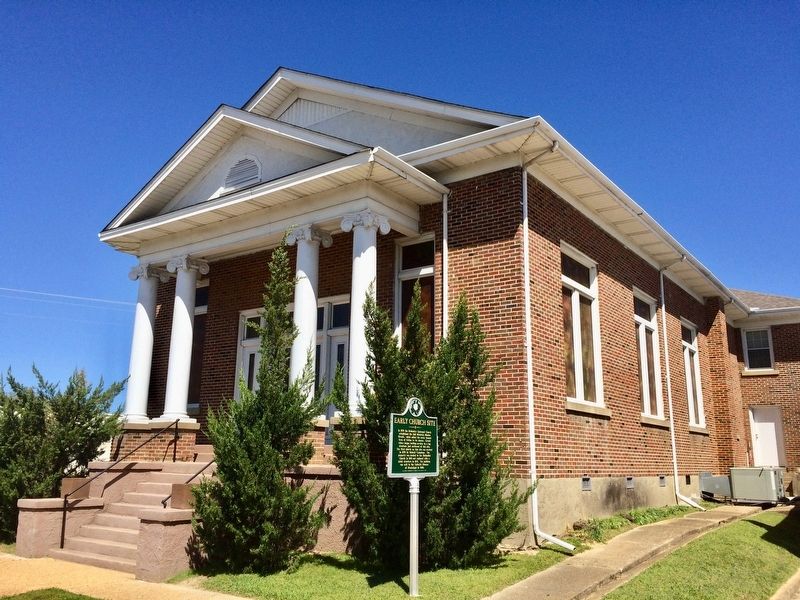
In 1838 the Methodist Episcopal Church established the Bull Mountain Mission Circuit, which added the newly formed town of Fulton to its charge. Circuit riders began holding services in a log structure just northwest of this site. The first church . . . — — Map (db m102621) HM
In the early 1800s the area known as Fulton was first settled near the banks of the Tombigbee River. In 1836 after Itawamba County was formed, Kenneth Clarke, John D. Miller, and Robert A. Miller gave fifty acres of land to the Board of Police, and . . . — — Map (db m98609) HM
Established after the incorporation of the town in 1837, the Fulton Cemetery was formally deeded to D.N. Cayce, president of the Fulton Male Academy by William P. Harrison in 1850. Originally situated on four acres adjacent to the school, the . . . — — Map (db m205426) HM
The Fulton Grammar School was designed by architect J.B. Lawson and built with Work Projects Administration assistance in 1939. This one-story brick building of nineteen rooms included a library, music room, kindergarten, office, and a 550-seat . . . — — Map (db m102622) HM
It is believed this site began as a burial ground for the enslaved well before the Civil War. On November 19, 1895, an official deed conveyed this section of ground from Pleasant Cates to "George Clifton and others" for the sum of four dollars as a . . . — — Map (db m205425) HM
In 1941 the Itawamba Agricultural High School board of trustees voted to expand the school's curriculum to include college-level courses. In 1948 the Itawamba Junior College opened its doors with an enrollment of 114 students from Itawamba, Lee, and . . . — — Map (db m102623) HM
Front
Jazz bandleader and saxophonist James Melvin “Jimmie” Lunceford was born just outside Fulton on June 6, 1902. He formed his first band, the Chickasaw Syncopators, while teaching at Manassas High School in Memphis in 1927, and by . . . — — Map (db m96781) HM
Also known as the Cates-Gaither House, this one-story Greek Revival-style planters cottage was built in ca. 1859 by ship builder and merchant Pleasant Cates. The heavy framing includes original pegged joints. Named for the cedar trees on the . . . — — Map (db m96773) HM
Front
The 2,006.5-mile Underground Railroad Bicycle Route (UGRR) was created by the nonprofit organization Adventure Cycling Association. From Mobile, Alabama, to Owen Sound, Ontario, the trail memorializes the Underground Railroad, a . . . — — Map (db m102972) HM
Non-extant town est. on the Tombigbee River in 1838 by Winfield Walker. Named for President Martin Van Buren. Flourished briefly in the 1840's. Declined between 1850-60 when the railroad was built W. of the town. — — Map (db m205432) HM
Vernon Presley, the father of Elvis Presley, was born on April 10, 1916, in a house that once sat on this site. In 1933, Vernon married Gladys Smith, and in 1935 Elvis Aron Presley was born. Vernon moved his family to Memphis, Tennessee, in 1948 in . . . — — Map (db m205423) HM
This sign is placed by the Itawamba County Historical Society in recognition of the historical significance of this location. Vernon Presley, father of Elvis Presley, was born here on April 10, 1916 to Jesse Dee Presley and Minnie Mae Hood. The . . . — — Map (db m205424) HM
A.J. Staub Jr. and W.G. Stewart opened Staub-Stewart Hardware Company on this site on July 18, 1924. Joseph Edwin Staub, a hardware clerk, convinced the owners in 1941 to allow him to form J. E. Staub & Company, a construction company. J. E. Staub . . . — — Map (db m205430) HM
This woodland trail takes you through a lowland where rich soil and abundant moisture support a variety of large, water-tolerant trees including tulip poplar, sycamore, and water oak.
Baldcypress thrive in the swampy backwaters of a . . . — — Map (db m84763)
Named after an early setter, Donivan Slough is fed by water runoff from the field in front of you. Although water levels fluctuate seasonally at this site, it remains wet year round. This moist environment allows unique growing opportunities for . . . — — Map (db m107283) HM
Established in 1909, the Fawn Grove School served the Fawn Grove community. After a new school house was constructed here in 1926, the Fawn Grove School recorded its highest enrollment, 162 students, in 1931. The Fawn Grove School closed its doors . . . — — Map (db m102975) HM
The Bankhead Highway, established in 1916, was the first all-weather, transcontinental highway in the United States. It spanned some 3,600 miles. In Mississippi, the northern route roughly follows Highway 178 and the southern route, US Highway 278. . . . — — Map (db m123260) HM
W. 1 mi. Here, 1887~1904, G.A. & J. T. Holley bridged gap between rural schools and colleges for many who distinguished themselves in law, education, & business. — — Map (db m117204) HM
Born Virginia Wyette Pugh and raised on her grandparents' farm near Tremont, Tammy Wynette (1942-1998) might have remained an unknown local hairdresser, but with fierce determination and a voice and resilient life story that touched millions, . . . — — Map (db m117206) HM
The territory of the Chickasaw Nation
once included north Mississippi, west
Tennessee, northwest Alabama, and western
Kentucky. Until removal from Mississippi,
the Chickasaw people defended their
homeland from native invaders and
Europeans, . . . — — Map (db m169990) HM
Once Indian village ruled by "Little Leader," Hopiah Iskitina. Named for Baron Johann DeKalb of American Revolution, who came to U.S. with Lafayette. Town chartered Dec. 23, 1833. — — Map (db m140657) HM
DeKalb is located where there was once a Choctaw
village led by Hopiah "Little Leader" Iskitima, who
fought with Andrew Jackson in the War of 1812 but
opposed Indian removal. The town is named for
Baron Johann de Kalb, who came to the U.S. . . . — — Map (db m284617) HM
John C. Stennis (1901-1995) was born in the Kipling community in Kemper County and lived in DeKalb. As a circuit judge, he heard many cases in this courthouse. Elected to the U.S. Senate in 1947 and reelected six times, Stennis served as president . . . — — Map (db m140654) HM
Born in 1771 in Virginia, Reuben Kemper moved to Spanish West Florida in 1800 and was active in the affairs of the Mississippi Territory. After several attempts to overthrow Spanish rule by force, Kemper's vision became reality in 1810 when the . . . — — Map (db m140652) HM
Established in 1913, the town of Electric Mills was built by the Sumter Lumber Company, which relocated to Kemper County from Alabama. Powered by electricity generated by the mill, the town was among the first in Mississippi with electric lights and . . . — — Map (db m140642) HM
Est.1874 as a community church called Narkeeta Chapel. Land and nearby spring donated by J. L. Parmer. Reorganized 1890 as Chapel Hill Methodist Church. Present building constructed 1891, remodeled 1976. — — Map (db m140641) HM
This cemetery is a part of the plantation established by Jacob Giles (1799-1860) a settler from N. Carolina. Adjacent to the cemetery stood Grace Chapel (Epis.). Giles' house, built ca. 1825, stands .3 miles west. — — Map (db m140649) HM
This cemetery was part of the William Cannon plantation dedicated prior to 1839. William Cannon 1779 - 1843 great-great-grandfather of Margaret Cannon Boyce Brown. — — Map (db m92650) HM
William “Bill” Buckner Memorial Drive celebrates the memory of No. 16, Bill Buckner,
who was the epitome of a "Bull" Sullivan era football player. A two-time All-American
quarterback, Bill threw 17 touchdown passes before an injury ended his EMJC . . . — — Map (db m284578) HM
Born in Collinsville, Ross Alexander Collins (1880 ~ 1968) served as Mississippi’s attorney general from 1912~1920 and was elected to Congress in 1920, where he served a total of ten terms until 1943. Collins led the effort to acquire the Otto . . . — — Map (db m179039) HM
Founded here in 1865 by Rev. J.L. Cooper as Spring Hill Male & Female Institute. Renamed Cooper Institute 1873. Among first coeducational schools in Miss. Rev. Cooper elected Miss. Hall of Fame. — — Map (db m179046) HM
Pioneer soldier & scout. Hero, War of 1812. Rode from Georgia to Battle of New Orleans, with news for Andrew Jackson. Died 1841. Buried at Old Daleville. Remains moved here in 1965. — — Map (db m179047) HM
(rear)
“There isn’t a man this side of hell who can stop Sam Dale. Sam, you have been true to your country.”
Andrew Jackson
(right)
“My trust has been in God, and the greater the peril, the firmer my faith.”
General Samuel . . . — — Map (db m179048) WM
Now Lizelia. Named for Sam Dale, famous scout & hero of “Canoe Fight”, War of 1812. Guided Choctaws to Oklahoma. Died here, 1841. Grave is 2 mi. west in Old Cochrane Cemetery. — — Map (db m179049) HM
S. E. 1.7 mi. is hospital site & burial spot of 1020 C.S.A. & 80 Union men wounded at Shiloh, Corinth, Iuka, Jackson, Bakers Creek, Vicksburg, & in Forrest's N. Miss. battles. — — Map (db m140639) HM
Once a popular resort, Lauderdale Springs became a Confederate hospital and cemetery. Markers pay tribute to 1,020 Confederate and 80 Union soldiers, although local historians believe no Union troops are actually buried here. — — Map (db m141012) HM
N.W. ¾ mi. Here are buried 170 unknown Confederate soldiers who died at field
hospital after various battles in 1862-63 from Shiloh to Vicksburg. — — Map (db m140985) HM
Marion CSA Cemetery and its surrounding area contain the remains of 170 Confederate soldiers who died at a nearby field hospital in 1862-64 following various battles, from Shiloh to Vicksburg. — — Map (db m141008) HM
Memorials at Old Marion Cemetery honor 11 unknown Confederate soldiers. A marker also memorializes Confederate Major Constantine Rea, a lawyer and politician. His wife, Margaret, and their daughters saved Old Marion Courthouse after Union troops set . . . — — Map (db m141009) HM
The Thomas J. Wilson and St. Luke's cemeteries were associated with the Masonic lodges that once stood on this city block. The cemeteries have over 100 extant formal markers on the graves of civilians and veterans from five American military . . . — — Map (db m111125) HM
The African-American Business District provided services that Meridian’s black community could not otherwise receive due to Jim Crow laws that kept the South segregated. It was the location of a hotel, restaurants, barber and beauty shops, a . . . — — Map (db m111048) HM
The portion of the Meridian Downtown Historic Preservation District centered on the intersection of 25th Avenue with 5th Street has a long historical association with the African-American community due to the concentration of black-owned businesses . . . — — Map (db m111039) HM
Born Sept. 8, 1897, at Meridian, Miss. Known as the “Singing Brakeman,” Rodger's recordings of Southern blues and ballads greatly contributed to the world-wide popularity of a distinctly American musical form. — — Map (db m77219) HM
The 13th Street Colored Branch Library, also known as the Carnegie Library for Blacks, opened in 1913 on a site donated by St. Paul Methodist Church. The library was one of twelve segregated libraries funded by Andrew Carnegie. The one-story, red . . . — — Map (db m140955) HM
Lieutenant Read, a native Mississippian, is buried here. He was an 1860 graduate of Annapolis. With a crew of 17, he captured 22 Union ships in 21 days and struck terror across the eastern seaboard. This adventure has been called the most brilliant, . . . — — Map (db m111135) HM
The Council of Organizations is a nonprofit association that promotes social, cultural and educational interests of the African-American community. The building was formerly an IGA grocery that was picketed during the Civil Rights movement. — — Map (db m111078) HM
Meridian's Jimmie Rodgers Day festivals of the 1950s, the first held May 26, 1953, became known as National Country Music Days, marking a turning point in the nation's enthusiasm for country music. Stars and fans from every country music style, . . . — — Map (db m77171) HM
Well-preserved industrial complex grouped about a railroad depot, center of railroad industry, the impetus to Meridian's growth after 1860. Included farm products processing businesses of inventor G.W. Soule. — — Map (db m60075) HM
Build ca. 1870 by industrialist J.R. Dial. His son, E.H. Dial, who served as mayor (1893-1901) also lived here. The city's code of ordinances was adopted during his term, and he was responsible for many civic improvements. In 1899, he wrote the . . . — — Map (db m77214) HM
This Tudor Revival home built in 1923, was the home of Dr. William Jefferson Anderson, founder of the Jeff Anderson Regional Medical Center. Remaining in family hands from his death in 1951 until 1992, the house was purchased in 2001 by the United . . . — — Map (db m111060) HM
The East Mississippi Female College was established here in 1869 by the Central Methodist Church and became recognized as one of the finest female colleges in the South under the leadership of John Wesley Beeson, President (1869-1903). The college . . . — — Map (db m111120) HM
Front
Elsie Williamson McWilliams (1896-1985), the sister of Jimmie Rodgers's second wife Carrie, wrote or contributed to music and lyrics for thirty-nine of the songs that Rodgers performed or recorded, although she never received . . . — — Map (db m77170) HM
The Federal Courthouse in Meridian was the site of two of the most significant legal actions in Civil Rights history: the filing of James Meredith's lawsuit to integrate the University of Mississippi in 1961 and the infamous "Mississippi Burning" . . . — — Map (db m111056) HM
Founded in 1891, First Union Missionary Baptist Church served as a meeting place for numerous Civil Rights activities. Dr. Martin Luther King, Jr., spoke here during the Freedom Summer of 1964. Weeks later, First Union was the site of activist James . . . — — Map (db m111084) HM
Freedom Riders traveled through the Meridian bus station without major incident, thanks to negotiation efforts by local Civil Rights activists and police. Their experience was unlike that in other cities, where they faced mob violence and arrests. — — Map (db m111066) HM
In the summer of 1964, dozens of Freedom Schools opened across Mississippi. The largest was located at Meridian Baptist Seminary. It provided additional education opportunities to the African-American community and hosted the statewide Freedom . . . — — Map (db m111077) HM
Buried just east of this site. “Sonny” Montgomery served in the Mississippi State Senate 1956-1966 and the U. S. House of Representatives 1967-1997. A retired Major General in the Mississippi National Guard, Montgomery championed . . . — — Map (db m76698) HM
Opened in 1909 as one of the South's premier streetcar pleasure parks, it consists of 32 informally landscaped acres and contains an 1890s Dentzel Carousel which is designated a National Historic Landmark. — — Map (db m77218) HM
Front
Singing winningly, with storytelling clarity and physicality, of the real lives and fondest dreams of his down home audience, with varied musical backing that ranged from his own solitary guitar to rural pickers, horns, and . . . — — Map (db m77176) HM
Jimmie Rodgers (1897 – 1933) is widely known as the "father of country music," but blues was a prominent element of his music. The influence of his famous "blue yodels" can be heard in the music of Mississippi blues artists including Howlin' . . . — — Map (db m59656) HM
The Lauderdale County Department of Archives and History was the state's first county archives department. Materials include the Civil War diary of James Palmer and more than 40 volumes on Civil War soldiers titled Confederate Deaths and . . . — — Map (db m141007) HM
1917 – 1918
To the glory
of God
and in honor of
those of
Lauderdale
County
who patriotically
answered the call
of our country
to uphold justice
and the rights
of humanity
and in loving
remembrance of
those . . . — — Map (db m77473) WM
A native of Meridian, Lewis Crook (1898-1967) moved to Atlanta, Georgia, in 1915 to attend Georgia Tech. Crook began his career with the architectural firm of Hentz, Reid and Adler. In 1923, Crook formed his own firm with business partner Daniel . . . — — Map (db m111123) HM
Charles William “Savez” Read (1840-1890) was an officer in the pre-Civil War U.S. Navy. Joining the Confederate navy, Read was nicknamed the “Seawolf of the Confederacy” for his daring exploits.
After serving on the CSS . . . — — Map (db m111031) HM
Built: 1889
Architect: Gustavus Maurice Torgenson
Constructor: C.M. Rubush
Architectural Style: Romanesque
Designated a Mississippi Landmark on June 12, 2002
Listed on the National Register of Historic Places as a contributing . . . — — Map (db m111176) HM
In the 1880s, Matty Hersee Wright and
other civic-minded women established a
hospital in Meridian and constructed a
building on Poplar Springs Drive in 1903.
In 1923, a new, 50,000-square-foot
hospital was built here. First known as
the East . . . — — Map (db m235055) HM
Earliest evidence of Meridian's settlement, containing burials of first settler Richard McLemore, victims of 1871 riot, and 1878 Yellow Fever epidemic. Listed in National Register of Historic Places. — — Map (db m111129) HM
Meridian's oldest cemetery was founded by Richard McLemore, Meridian's first permanent white settler, in 1839. Buried here are many of the approximately 30 victims who died during the Meridian Race Riot of 1871. The riot signaled the end of the . . . — — Map (db m111067) HM
Formerly Sowashee, it was chartered 1860, and throve as rail junction during the Civil War, serving in 1863 as temporary capital and as depository of the state's official records. — — Map (db m59695) HM
Meridian blues and jazz performers have played important roles in musical history, both locally and nationally, not only supplying a foundation for other genres but also propelling music in new directions. Notables with Meridian roots include . . . — — Map (db m111037) HM
Rhythm & blues and soul singers have been major contributors to Meridian’s deep African American musical heritage, extending the legacy molded by gospel, jazz and traditional blues artists. David Ruffin of the Temptations and his brother Jimmy . . . — — Map (db m77426) HM
Monday, September 4th, Labor Day, 1950 at 9:30 p.m. 125 local Marine Reserves of Meridian's "C" Battery, 4th 155mm Howitzer Battalion U.S.M.C.R. held their last local muster here at the old Union Station enroute to Camp Pendleton, California and . . . — — Map (db m60059) HM
A 20-room Neoclassical Revival mansion completed in 1904, the house began as a small cottage which served as headquarters for Confederate Gen. Joseph E. Johnston in 1863. Merrehope is now a museum of local history. — — Map (db m77216) HM
Merrehope, built by an early settler's daughter, was occupied by Confederate Generals Joseph E. Johnston (1863) and Leonidas Polk (1863-64), then by Union officers. It is one of six homes to survive the Battle of Meridian. — — Map (db m111095) HM
Opened in 1959, Middleton Attendance Center was
built for African American students in Lauderdale
County as part of Mississippi's school equalization
program. It housed grades one through twelve. The
largest school in the county, it was led . . . — — Map (db m259507) HM
One of the Battle of Meridian's few skirmishes occurred at Missouri Ridge, where Union troops from Missouri camped. For years, Confederate veterans held an annual mock battle here to commemorate the skirmish. — — Map (db m111096) HM
Born in Meridian and the grandson of the railway yard manager where Jimmie Rodgers
worked, Moe Bandy became one of country music’s most popular singers of the 1970s and ‘80s. A master of honky
tonk as well as cowboy songs that reflected . . . — — Map (db m60544) HM
Newell Chapel CME Church was involved in Civil Rights meetings and voter registration projects. It was one of three original locations of the Head Start program. The church parsonage was bombed by the Ku Klux Klan in 1968. — — Map (db m111068) HM
Folk singer and political activist Pete Seeger was performing for a large crowd of Freedom Summer volunteers when he received word that the bodies of Civil Rights workers James Chaney, Michael Schwerner and Andrew Goodman had been found. The crowd . . . — — Map (db m111081) HM
Front
The electronic amplification of vocals and musical instruments resulted in dramatic changes in the blues in the post-World War II era, notably the rise to prominence of the electric guitar. Peavey Electronics, founded in 1965 by . . . — — Map (db m77192) HM
In 1905, local lumber businessman M.R. Grant laid out a plan for the lots and streets along Poplar Springs Drive and named it Marion Park in honor of his daughter. By 1912 along this winding road, featuring large homes, a street car line and Matty . . . — — Map (db m93143) HM
Meridian was a Civil War railroad center with an arsenal, a military hospital, and state offices. On Feb, 14, 1865, General Sherman's troops reached town and began destroying track, cutting an essential Confederate supply line. — — Map (db m77472) HM
A burial mound at Rose Hill Cemetery contains the remains of more than 100 Confederate soldiers. Nebraska Carter Read also rests here alongside her husband, Lieutenant Charles W. Read, the "John Paul Jones of the Confederate Navy." — — Map (db m111089) HM
To prevent repair of rails, General Sherman's troops created “bow ties.” They burned crossties to heat rails, then twisted the rails around trees. Altogether they destroyed more than 100 miles of track around Meridian. — — Map (db m77469) HM
Founded by John Wesley Beeson in 1903 as the Meridian Woman's College to which was added the Conservatory of Music in 1904. The school merged with Beeson's Meridian Male College in 1914, becoming known as the Meridian College and Conservatory. . . . — — Map (db m140958) HM
Founded by John Wesley Beeson in 1902 on a campus originally developed by Rev. L. M. Stone as a college for women, the Meridian Male College was led by President Malcolm A. Beeson from 1903-1913, when it merged with John Beeson's Meridian Female . . . — — Map (db m140962) HM
Sit-ins, pickets and boycotts were used to persuade white-owned businesses to hire black employees and integrate lunch counters. The Meridian Action Committee (MAC) was formed in part to carry out these tasks. Kress, Woolworth's and Newberry . . . — — Map (db m111052) HM
St. John Baptist Church was one of two locations where Dr. Martin Luther King, Jr., was scheduled to speak in 1964, as well as the site of Polly Heidelberg's memorable confrontation of a former Klan member. "Miss Polly" was a mother figure to local . . . — — Map (db m111070) HM
St. Joseph Catholic Church operated a coeducational school that served young black students from 1910 to 1970. The school also offered adult education classes. Former students include James Chaney and Polly Heidelberg. — — Map (db m111069) HM
Erected 1923-27 by the Hamasa Shriners in Moorish Revival style, this theater was among the finest movie/vaudeville “palaces” of its day, having one of the largest stage facilities in the United States. — — Map (db m77217) HM
Dedicated to the memory of the men
from Texas who are known to be
buried here, and to all brave Texans
who passed this way
Nothing is ended until it is forgotten
Sgt. John L. Killough
Co. E. 2nd TX Infantry
Died 11 Jun . . . — — Map (db m287054) HM WM
Churches were the heart and soul of the Civil Rights movement. New Hope Missionary Baptist, founded in 1868, was Meridian's first black Baptist church. St. Paul United Methodist, founded in 1866, donated land for the Carnegie Branch Library, the . . . — — Map (db m111071) HM
Jewish merchants contributed greatly to Meridian's growth. The Grand Opera House (MSU Riley Center) and the Threefoot Building stand as evidence of their business success. Although Jews were well accepted in Meridian, their support of Civil Rights . . . — — Map (db m111054) HM
Charles Darden was president of the Mississippi
branch of the NAACP from 1955 to 1960 and one of
the founding fathers of the Meridian Freedom
Movement, which had its first headquarters in a
building on this site. Under Darden's leadership, . . . — — Map (db m312327) HM
The Civil Rights movement in Meridian has a tumultuous history strongly linked to this area of downtown. From the 1871 Race Riot beginning at Con Sheehan Hall to the Freedom Summer activities of workers at the Council of Federated Organizations . . . — — Map (db m111051) HM
Voter registration was one of the goals of the Civil Rights movement. In the South, poll taxes and literacy exams like the one given here at the Lauderdale County Courthouse were used to prevent African-Americans from registering. These practices . . . — — Map (db m111058) HM
Built in 1894, this was the first brick public school building in east Mississippi for African American children. The school was named for Rabbi Jacob Wechsler, who led the drive to build it. Founded in 1871, the school was initially housed in St. . . . — — Map (db m111035) HM
513 entries matched your criteria. Entries 101 through 200 are listed above. ⊲ Previous 100 — Next 100 ⊳