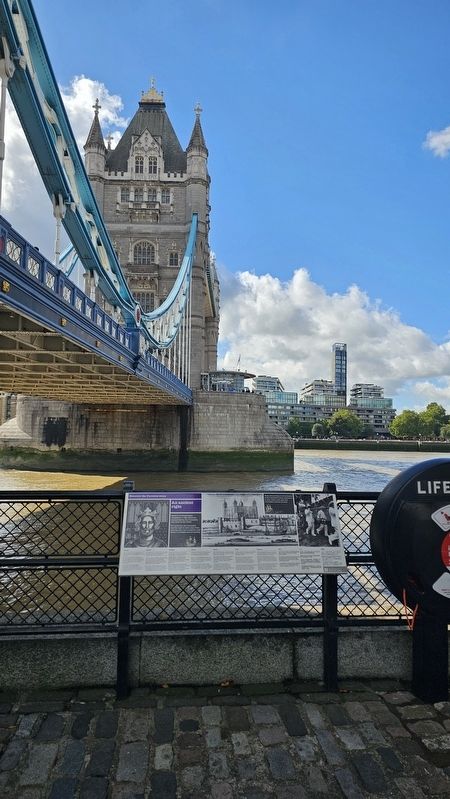
[English:] Henry III received angry complaints in 1261 about his representative, the Constable, who lived at the Tower. For centuries, the Constable had the right to take cargo from passing ships, but Londoners said Henry’s . . . — — Map (db m312714) HM
For centuries, the Ordnance Office stored weapons and military supplies in the Tower. Many Ordnance buildings have gone, but the New Armouries store from 1664 and these houses from 1719 survive. Wounded soldiers were cared for in the . . . — — Map (db m312199) HM
The curfew bell has rung from this tower for centuries; the current bell dates from 1651. The tower, and the wall next to it, were built during the reign of Richard I (1189-99) and once stood on the edge of the river. It is thought that Sir Thomas . . . — — Map (db m312103) HM
Borough of Bethnal Green
Memorial
Alice Maud Denman
and
Peter Regelous
Who lost their lives in attempting
to save others
at a fire at 423 Hackney Road
on the 20th April 1902
Erected by public subscription
C.E. Fox Mayor
R. . . . — — Map (db m121667) HM
Site of the Worst Civilian Disaster
of the Second World War
in Memory of
173 Men, Women and Children
Who Lost Their Lives on the
Evening of Wednesday 3rd March 1943
Descending These Steps to Bethnal Green
Underground Air Raid Shelter . . . — — Map (db m121670) HM WM
Introduced in 1939, the 25 Pounder was the most numerous and famous British artillery gun of the Second World War. A 25 Pounder last fired on active service with the Special Air Service at Mirbat, Oman in 1972. The example displayed here was a . . . — — Map (db m117668) HM
Weighing 5 ¾ tons (5842 kg), this gun was commissioned by order of St John. Its decoration includes heraldic devices, bands of cupids and vines, and St Michael overthrowing Satan. Brought from Malta to England around 1800, it was transferred from . . . — — Map (db m117699) HM
This is engraved with the monogram of King George III and that of Charles, 1st Marquess Cornwallis, Master General of the Ordnance 1795-1801.
British, Woolwich, dated 1798, cast by John & Henry King. Carriage later — — Map (db m168238) HM
This massive fortress gun is believed to have been captured by British forces from the forts guarding Canton during the Second China War (1856-61). It was brought to Britain as a trophy by HMS Nankin. It was formerly displayed at Upnor Castle, . . . — — Map (db m117424) HM
Cast by the founder Mohammed ibn Hamza for the Sultan Sulaiman ibn Salim Khan, this gun was intended for a Turkish expedition to India to expel the Portuguese colonists. Captured at Aden in 1839 by Captain H Smith of HMS Volage and displayed at . . . — — Map (db m117423) HM
This area is a gateway that links the tower to the Thames waterfront on the wharf. It was a private entrance where important people and goods were brought into the Tower. Coins and bullion would also have been brought through here and into the . . . — — Map (db m312087) HM
These bronze muzzle-loading guns form part of the Waterloo Battery, a set of eight guns captured and brought to the Tower by the Duke of Wellington after the battle of Waterloo in 1815. They fired a solid iron cannonball propelled by the . . . — — Map (db m117667)
[English:] There has been a chapel on the spot to your left for a thousand years. King Henry VIII built the current chapel in 1520 after the original burnt down. It is still a working chapel with regular services. Many of the . . . — — Map (db m312184) HM
City of London
Tower Bridge
The main towers, high level walkways and the machine rooms under the southern approach of this bridge were opened to the public on 30th June 1982 by the Rt. Hon. The Lord Mayor Sir Christopher Leaver, G.B.E., D. Mus., . . . — — Map (db m117758) HM
City of London
Tower Bridge
Constructed and maintained by the Corporation of London from the Bridge House Estates Trust without charge upon Public Funds. The installation of the electrical machinery for raising the bascules replacing the original . . . — — Map (db m117759) HM
The Coldharbour Gate foundations and this ruined wall are all that survive of the formidable late-1230s defences built by Henry III to protect his royal palace. Coldharbour was later used as a prison, though it wasn't escape-proof. Alice . . . — — Map (db m312148) HM
Between 1238-40 Henry III expanded the castle beyond the Roman city boundary, ringing it with a new wall and whitewashing the Norman tower. He also built a magnificent western entrance which unfortunately collapsed the following year. . . . — — Map (db m311667) HM
Dockland Heritage
The Colour Makers
You are standing on the Wharf of what was once a colour factory, where the raw materials of chemical colours were manufactured for use in the making of paints, printing inks, plastics, rubber and paper. . . . — — Map (db m121716) HM
[English:] Kings and queens used the Tower of London to control the river, which was vital for trade and defence. King Henry III added a strong outer wall in the 1240s on the line of the battlements where you are standing. The Tower . . . — — Map (db m312159) HM
[English:] For hundreds of years, kings, queens and governments controlled river traffic and shipped military supplies from this wharf. In the 1800s this end of Tower Wharf was crowded with factories assembling weapons. Tower . . . — — Map (db m312716) HM
On 20 February 1547, the 9 year old son of Henry VIII rode out from the Tower in a grand procession. Cheering crowds lined the route to Westminster Abbey where he was crowned Edward VI.
Young Edward VI was following a tradition . . . — — Map (db m312767) HM
Corporation of London
Tower Bridge
This Plaque Records the Visit on the Centenary
Of Tower Bridge
Thursday 30th June 1994
By His Royal Highness
The Prince of Wales, K.G., K.T., G.C.B., A.K., Q.S.O.A.D.C.
In the Presence Of
The Right . . . — — Map (db m117757) HM
[English:] King Edward III built the Cradle Tower in the 1350s as his private entrance to the palace from the river, called a watergate. Edward’s royal barge could moor here. The watergate was cut off from the river when Edward’s grandson . . . — — Map (db m312257) HM
[English:] King Edward III built the Cradle Tower in the 1300s as his private palace entrance. Battlements, arrow loops and two portcullises defended this important river gate from attack. The King arrived by boat onto a wooden . . . — — Map (db m312505) HM
Daniel Mendoza
Pugilist
1764 – 1836
English Champion who
proudly billed himself
as ‘Mendoza the Jew’,
lived here when writing
‘The Art of Boxing’. — — Map (db m121671) HM
Dietrich Bonhoeffer
1906-1945
German Theologian, Christian martyr. Pastor, 1933-5, of St Paul's German
Evangelical Reformed Church which stood on this site until 1941 — — Map (db m298630) HM
[English:] The Tower of London’s Ordnance Office stored and exported military equipment for centuries. Workers produced and tested weapons at the Tower. King Henry VIII reorganised the Ordnance Office in the 1540s to strengthen and . . . — — Map (db m312723) HM
By 1281 Edward I had swept aside his father Henry III's moat and entrance and replaced them with new, more sophisticated versions. He ringed Henry III's outer wall with another, making the Tower a concentric castle.
Begun in 1275, the moat . . . — — Map (db m312769) HM
By 1281 Edward I had completed the Tower's formidable new land entrance. Two huge stone gate towers and a semi-circular barbican (now demolished) were linked by causeways defended with drawbridges.
These massive fortifications, . . . — — Map (db m312766) HM
[English:] Escape from the Tower The Catholic priest John Gerard was imprisoned and tortured in the Tower for being a spy, on the orders of Queen Elizabeth I. He made a daring escape from this rooftop on the night of 4 October . . . — — Map (db m312508) HM
The Ferry House
Circa — 1722
Welcome to the oldest pub on the island plying its trade since 1722. The location is near the old ferry point across to Greenwich.
The ferry point had been around since at least 1330 known afterwards as . . . — — Map (db m121707) HM
Jewish war hero and Radar expert of 1942 WW2 Dieppe Raid
Fl. Sgt. Jack Nissenthall, RAF
attended the Cambridge and Bethnal Green Jewish Youth Club located at 4, Chance Street, E2
Be strong and of good courage (Joshua 1:9) . . . — — Map (db m220762) HM
Beneath your feet lie the ancient remains of Edward IV's bulwark. In 1480 he paid to construct this huge addition to the castle's defences which was designed to defend against artillery power.
In the 15th century, two rival dynasties fought . . . — — Map (db m312762) HM
Discover the Fortress story Gateway to the Sea This stretch of river is the Pool of London. It was the busiest port in the world by the 1700s. Ships landed cargoes here from around the world. Import taxes were valuable income for . . . — — Map (db m312726) HM
This tunnel constructed by the London County Council was opened in August 1902.
Sir John MacDougall chairman of the Council; Lord Monkswell vice chairman; Henry Clarke deputy chairman; Col F. Sheffield chairman bridges comm; J. E. Sears vice . . . — — Map (db m121706) HM
Discover the Palace Story Guarding the Tower [English:] Yeoman Warders have guarded the Tower of London since the 1500s. They were originally part of the personal bodyguard for the king or queen. Today’s Yeoman . . . — — Map (db m312147) HM
1. Spitalfields Market
In the Middle Ages, Spitalfields was outside the walls of London, a rural area of fields and hedgerows. It consisted mainly of small cottages with gardens and orchards where occupants grew fruit and vegetables. The . . . — — Map (db m299226) HM
Historic Royal Palaces
This Plaque Commemorates the Reopening of
Tower Hill
As a Place for Public Enjoyment by
Her Majesty The Queen
9 July 2004
The Project Was Supported By
The Heritage Lottery Fund
The Pool of London Partnership . . . — — Map (db m117326) HM
In 1389 Geoffrey Chaucer, poet and Royal Clerk of the Works, ordered the construction of this part of the Tower Wharf. 64 years later gun foundries and workshops were added. In 1803 a factory was built here to make hand-guns for the war . . . — — Map (db m312509) HM
This gun was cast by Samuel Walker & Company of Rotherham, Yorkshire, and it bears the monogram of King George III. For many years it was used in the Tower as a lamp post.
British, about 1800 — — Map (db m117679) HM
This [gun] was probably cast by in Sussex by John Fuller II or III and it bears the monogram of King George II.
British, about 1745 — — Map (db m117682) HM
Probably one of the large artillery pieces made in England for export to the Venetian Republic in 1684. In 1716 the Venetians used such mortars to defend the island of Corfu against Turkish attacks. The chase bears in relief the Lion of St. mark, . . . — — Map (db m117751) HM
Cast in one with its base, probably intended for sea service or coast defence.
Spanish or French, mid 18th century, and initialled GS. Possibly cast at the Saint Gervais foundry, France — — Map (db m117750) HM
These two guns were probably cast by John Fuller III at Heathfield, Sussex and proved at Woolwich in July 1747. They were part of a series of guns for the Irish Government and copied a much earlier design.
British, 1747 — — Map (db m117672) HM
This howitzer is mounted on its original iron garrison carriage. British about 1850, cast by Henckell & Company, Wandsworth, London — — Map (db m117695) HM
This gun bears the monogram of King George II. It was recovered by the divers John and Charles Anthony Dean in 1834 from the wreck of the flagship HMS Royal George, which sank at her moorings at Spithead, off Portsmouth, Hampshire in 1782. . . . — — Map (db m117675) HM WM
These two guns formed part of the armament of a French ship captured by Earl Howe’s fleet during his victory off Ushant, Holland on the ‘Glorious First of June’ 1794.
French, dated 1787 — — Map (db m117674) HM WM
A Crimean War trophy, captured at Sebastopol in 1855. This bears the Russian Imperial arms in relief and is mounted on a Venglov pattern 1853 carriage.
Russian, about 1840-50 — — Map (db m117696) HM WM
Formerly used as a bollard on Tower Hill, a practice that started as early as the seventeenth century.
England, about 1700, probably cast at the Ashburnham foundry, Sussex — — Map (db m117700) HM
Who was Jack the Ripper?
There have been numerous attempts to
uncover the identity of the man who
brutally murdered five East End women
between 31 August - 30 November 1888.
Amongst those suspected were
Queen Victoria's heir, . . . — — Map (db m298235) HM
[English:] Many extra layers of defence were added to the Tower over the centuries: high towers, a water-filled moat and thick walls. You can see the White Tower at the heart of the fortress, built by William the Conqueror after . . . — — Map (db m312730) HM
This is one of the most impressive surviving section of London's former city wall.
The lower part, with its characteristic tile bonding courses, was built by the Romans around 200 AD. Its purpose may have been as much to control passage of . . . — — Map (db m311853) HM
The London Wall Walk follows the original line of the City Wall for much of its length, from the royal fortress of the Tower of London to the Museum of London, situated in the modern high-rise development of the Barbican. Between these two landmarks . . . — — Map (db m312082) HM
[English:] Medieval Jews lived in England at the permission of the king. The Tower of London was used to protect as well as exploit the medieval Jewish community. During the Second Barons’ War many of London’s Jews sought safety in . . . — — Map (db m312182) HM
In the 13th century, the Medieval Palace consisted of much more than the two towers you have just visited. The empty area in front of the White Tower is known as the Inmost Ward. Henry III had the White Tower whitened for the first time in 1241, . . . — — Map (db m312156) HM
Mentioned in Despatches
lived at 66 Stepney Green Court/Buildings.
Killed in Action at Gallipoli, 1915, WWI,
refusing to abandon his cutter, gallantly rowing soldiers
ashore in full view of the enemy.
He has no known grave. . . . — — Map (db m211398) HM WM
Marine Police
Primus Omnium
Founded 1798
For Over 200 Years
Police Have Patrolled
The River Thames
From This Site
Stepney Historical Trust 1998 — — Map (db m128422) HM
[English:] Medieval Jews were frequently imprisoned at the Tower of London. England’s Jews were taxed very heavily, and many wealthy Jews were imprisoned while their finances were investigated by the Crown. There were mass . . . — — Map (db m312214) HM
This Memorial Stone
was laid by
H.R.H. Albert Edward, Prince of Wales. K.G.
On behalf of Her Majesty Queen Victoria.
Monday June 21st. 1886.
in the 50th Year of Her Majesty’s long happy and prosperous reign.
The Right Hon. John Staples. . . . — — Map (db m117754) HM
[English:] The Middle Drawbridge entrance was built in 1834 when the Duke of Wellington was in charge of the Tower. It was used to load military supplies onto ships from stores in the Tower. A huge fire destroyed the Tower’s Grand . . . — — Map (db m312486) HM
Begun in 1075-9, William the Conqueror's stone tower was so impressive that the castle is still called the Tower today. He built the fortress on the river in the south east of the ancient Roman city to control Londoners and deter invaders. . . . — — Map (db m311668) HM
The sentry is part of a military guard stationed here to provide protection for the Crown Jewels. The military guard comes from an operational unit of the Armed Forces that is currently employed on ceremonial duties.
On duty today The . . . — — Map (db m312193) HM
The Tower of London is almost 1000 years old. It is named after its oldest building, the White Tower. William the Conqueror built the White Tower after he invaded England from northern France in 1066. The Tower of London has been a secure fortress, . . . — — Map (db m311669) HM
Over 400 years, 112 people were executed on Tower Hill watched by crowds of eager spectators. The last execution was in 1747, when many spectators were injured in the crush to watch the beheading of the Scottish rebel Lord Lovat. . . . — — Map (db m312763) HM
From the 1100s, the Tower became an infamous prison. Between 1483 and 1941, 22 prisoners were executed inside the walls, including Queen Anne Boleyn, second wife of King Henry VIII, in 1536. Several hundred Tower prisoners were hanged or beheaded . . . — — Map (db m311665) HM
You are on a man-made wharf, extended in the 1390s to allow ships to dock next to the Tower. Geoffrey Chaucer, more famous as a poet, managed the wharf-building work at the Tower for King Richard II. This colourful illustration from around 1500 . . . — — Map (db m312511) HM
The Pool of London The Pool of London stretches from London Bridge to beyond Tower Bridge, and extends back from both the north and south banks of the River Thames to embrace some of Britain’s finest historical, architectural and cultural . . . — — Map (db m311844) HM
[English:] When Edward I became king in 1272, this spot was the riverbank and often under water. He reclaimed land from the river by sinking timber stakes into the mud to make foundations for new buildings. Archaeologists revealed . . . — — Map (db m312372) HM
Queen Anne Boleyn, second wife of King Henry VIII, was imprisoned, stood trial and was executed in the Tower of London in 1536. — — Map (db m312794) HM
Queen Eleanor of Provence probably used the Lanthorn Tower as part of her royal apartments. In 1240, the Queen’s Chamber was whitewashed and painted with roses. Queen Eleanor was the wife of King Henry III. She was intelligent and courageous and . . . — — Map (db m312180) HM
Important visitors would have entered the castle here, at one of its three riverside entrances. Kings, queens and high ranking state visitors would have stepped off their boats and climbed the Queen's Stairs in their finery on to the wharf. . . . — — Map (db m312747) HM
To Perpetuate on this Spot
The Memory of
Robert Milligan
A Merchant of London
To Whose Genius, Perseverance and Guardian Care
The Surrounding Great Work Principally Owes
It’s Design, Accomplishment and Regulation.
The Directors and . . . — — Map (db m121703) HM
[English:] Medieval kings gave and received wild animals as gifts. King Henry III received a polar bear from the King of Norway and an elephant from the King of France in the 1250s. This picture was drawn from life when the elephant arrived . . . — — Map (db m312264) HM
This plaque commemorates the departure, in December 1994, of the Royal Logistics corps. The last representative of the Military Branch of the Ordnance office, whose association with the fortress dates back to the early 15th century — — Map (db m168239) HM
Since the reign of King John (1199-1216) monarchs had kept exotic beasts at the Tower. However, by 1831-2 it had become impractical to keep the menagerie here and it was moved to Regent's Park to establish London Zoo.
The animals . . . — — Map (db m312765) HM
The 13th-century palace was built along the shore of the River Thames. Henry III and, later, his son Edward I would have been able to look out of their windows and see a fine river view. Between 1275 and 1285 Edward built the outer-curtain wall, . . . — — Map (db m312157) HM
John Gerard, a Jesuit priest, was a prisoner here in the 1590s. He was given only straw to sleep on and was hung in manacles as torture, but later escaped. High-status prisoners usually had more comfortable conditions. John Balliol, King of Scots, . . . — — Map (db m312226) HM
Cannon have been fired in celebration from Tower Wharf for centuries. Henry VIII marked the coronation of his second wife, Anne Boleyn, with a cannon salute. On your right is the battery where modern guns are fired today to commemorate royal . . . — — Map (db m312746) HM
[English:] King Edward I built St Thomas’s Tower as a grand river entrance and luxurious royal apartments in the late 1270s. The building work was partly funded by a heavy tax that Edward imposed on England’s Jewish community. . . . — — Map (db m312153) HM
[English:] King Edward I built St Thomas’s Tower as a grand river entrance and luxurious royal apartments in the 1200s. This tower was originally decorated with gold window bars and painted statues. Edward’s building was funded . . . — — Map (db m312741) HM
Bethnal Green Tube Shelter Disaster
On 3 March the air raid warning sounded at 8.17 pm. People made their way in the pitch dark of the blackout to file in an orderly manner down the steps of the single entrance to the unfinished Bethnal Green . . . — — Map (db m121668) HM WM
Stephen & Matilda
Tenants’ Co-operative
1878 – 2012
The first ever local authority
estate under tenants’
control in Britain
Homes for People not Profit — — Map (db m128429) HM
The Tower was often used as a refuge by kings in trouble and Henry III was no exception. He retreated here in 1238 and, horrified by the castle's out-of-date defences, ordered a mighty fortified gateway built.
The gateway was north of . . . — — Map (db m312770) HM
[English:] In the 1800s, the area around you would have been bustling with Ordnance Office workers and sailors, loading and unloading military supplies from ships. For centuries, weapon-making workshops and houses for armourers and Tower . . . — — Map (db m312503) HM
Conflict between a commercial need for tall buildings and the public desire to protect the Tower's views began in the 1860s. The multi-storey ‘Mazawattee’ tea warehouse was built on the edge of Tower Hill, controversially blocking the view
of the . . . — — Map (db m312764) HM
This Bridge was opened by
H.R.H., The Prince of Wales, K.G.
on behalf of
Her Majesty Queen Victoria,
on Saturday the 30th June 1894 in the presence of
H.R.H., The Princess of Wales,
H.R.H., The Duke of York, K.G.,
and other members . . . — — Map (db m117760) HM
The London Wall Walk follows the line of the City Wall from the Tower of London to the Museum of London. The Walk is 1¾ miles (2.8km) long and is marked by twenty-one panels which can be followed in either direction. The City Wall was built by the . . . — — Map (db m311846) HM
To Commemorate the tragic history and in many cases the martyrdom of those who for the sake of their faith country or ideals staked their lives and lost. On this site more than 125 were put to death. The names of some of whom are recorded here. . . . — — Map (db m78678) HM
[English:]Tower Hill Medieval Postern This medieval postern gate gave access to the City of London from the east. It is the only known surviving example of a large medieval gate tower in the City wall. The construction of the . . . — — Map (db m311857) HM
The Twenty Four Thousand of the Merchant Navy and Fishing Fleets Whose Names Are Honoured on the Walls of This Garden Gave Their Lives For Their Country and Have No Grave But the Sea — — Map (db m117320) WM
158 entries matched your criteria. The first 100 are listed above. The final 58 ⊳