Marker Logo
THE HISTORICAL
MARKER DATABASE
“Bite-Size Bits of Local, National, and Global History”


7572 entries match your criteria. Entries 101 through 200 are listed. ⊲ Previous 100 — Next 100 


Forts and Castles Topic

 
By TRCP Alliance, September 25, 2011
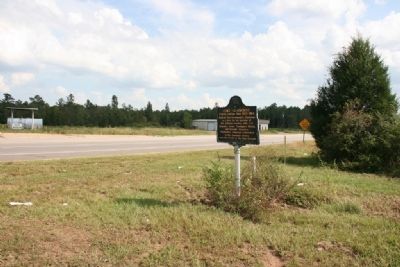
Fort Claiborne Marker (East View)
101 Alabama, Monroe County, Perdue Hill — Fort Claiborne — Creek Indian War 1813-1814
On U.S. 84 at Grain Elevator Road and Lena Landegger Highway, on the left when traveling west on U.S. 84.
Built by Gen. Ferdinand L. Claiborne as a base for his invasion of the Alabama country with U.S. Regulars, Lower Tombigbee Militia, and friendly Choctaws. Claiborne’s campaign culminated in the American victory over the Creeks at the Holy Ground.Map (db m47641) HM
102 Alabama, Monroe County, Perdue Hill — Piache
On U.S. 84 at Old Fort Claiborne Road, on the right when traveling west on U.S. 84.
Piache, an Indian town visited by DeSoto in 1540 was near here. DeLuna made a settlement here, Nanipacna in 1560. Fort Claiborne was erected on the south bluff, in 1813. LaFayette was entertained here, 1825. . . . Map (db m47639) HM
103 Alabama, Morgan County, Decatur — 2 — “A Hard Nut To Crack” - Federal Defenses at Decatur — “A Hard Nut To Crack” — The Battle For Decatur —
On Bank Street at Vine Street Northwest, on the right when traveling south on Bank Street.
Decatur played a key role in the Federal defenses of the vital rail lines in North Alabama. These defenses were configured in a three-tiered system. First, a number of lightly armored gunboats, constructed on the Tennessee River and nicknamed . . . Map (db m86476) HM
104 Alabama, Morgan County, Decatur — 4 — “An Affair Most Important to Us” - The Federal Right, October 27-28, 1864 — “A Hard Nut To Crack” — The Battle For Decatur —
On Lafayette Street Northwest at Railroad Street, on the right when traveling west on Lafayette Street Northwest.
As Hood’s Army of Tennessee encircled Decatur, sharpshooters advanced upon the Union defenses. Colonel Doolittle’s men responded with heavy artillery and musket fire. During the early afternoon of October 27, the Confederates approached the Federal . . . Map (db m28241) HM
105 Alabama, Russell County, Fort Mitchell — Fort Mitchell — <----- 5 miles -----
Near U.S. 165.
Built during Creek War 1813 by Georgia Militia on main Indian trade route to Tombigbee River U.S. Troops stationed here until 1837 1836 Lower Creeks corralled here for forced removal to the WestMap (db m26069) HM
106 Alabama, Russell County, Fort Mitchell — Fort Mitchell
On Unnamed road 0.2 miles east of Alabama Route 165, on the right when traveling east.
Fort Mitchell Fort Mitchell is located on the Federal Road on the West bank overlooking the Chattahoochee River. General John Floyd received orders from Governor David B. Mitchell to pick up supplies, cross the Chattahoochee River and . . . Map (db m120003) HM
107 Alabama, Russell County, Fort Mitchell — Fort Mitchell — Built 1813 By General John Floyd
Near Old Federal Road east of Alabama Route 165, on the left when traveling east.
Originally a major path Creek Indians and indigenous tribes who preceded them, the Federal Road became a postal route as a result of a treaty between the Creeks and the United States government in 1805. The widening of the Federal Road occurred . . . Map (db m241205) HM
108 Alabama, Russell County, Fort Mitchell — Fort Mitchell — National Historic Landmark
On Alabama Route 165, on the right when traveling north.
. . . Map (db m241212) HM
Paid Advertisement
109 Alabama, Russell County, Fort Mitchell — Fort Mitchell Military Cemetery
Near U.S. 165.
This military graveyard was established soon after Fort Mitchell was built by General John Floyd of the Georgia Militia. Located just south of the stockade, the cemetery was used between 1813 and 1840 during the fort's occupation by Georgia and . . . Map (db m26122) HM
110 Alabama, Russell County, Fort Mitchell — The Creek Trail of Tears
Near U.S. 165.
Approximately one mile due east of this marker, back down the Old Federal Road, called by frontiersmen and Indians the Three Notched Trail or the Three Chopped Way, stood Fort Mitchell, an early 19th century American fort that in 1836 was one of the . . . Map (db m26100) HM
111 Alabama, Russell County, Holy Trinity — Spanish Fort, 1689-1691
On Alabama Route 165 at Terminal Road (Route 54), on the right when traveling north on Alabama Route 165.
East of here, on the Chattahoochee River, was the "fort among the Apalachicolas," most northern of the Spanish settlements in eastern North America. A palisaded "strong house" built by Captain Enrique Primo de Rivera to check activities of English . . . Map (db m101252) HM
112 Alabama, Russell County, Phenix City — Fort Jabe Brassell — Alabama Army National Guard — Russell County —
On South Railroad Street west of Holland Court, on the right when traveling west.
Built in 1950, Fort Jabe Brassell has served as a hub for military training and arms storage for the local community by the Alabama Army National Guard and the Armory Commission of Alabama. Between July 1954 and January 1955, the Alabama Army . . . Map (db m165538) HM
113 Alabama, Russell County, Seale — Creek Settlements in Russell County — Creek Heritage Trail —
On Longview Street at Jackson Street, on the right when traveling north on Longview Street.
Russell County occupies land that once sat at the heart of the Creek Nation. Within the county's boundaries were several important Creek towns, many of which would figure prominently in the Creek and Seminole Wars era and the saga of Removal. . . . Map (db m111596) HM
114 Alabama, St. Clair County, Ohatchee — Fort Strother
On State Highway 144 at Valley Drive, on the right when traveling north on State Highway 144.
Creek Indian War Headquarters of Gen. Andrew Jackson 1813 - 1814Map (db m28144) HM
115 Alabama, Sumter County, Livingston — Sumter County
On Lafayette Street (U.S. 11) at Franklin Street, on the right when traveling south on Lafayette Street.
1736:   First settlement by French at Ft. Tombecbee. 1830:   U.S. got Choctaw Indian lands by Treaty of Dancing Rabbit Creek. 1832:   County created by Act of State Legislature -- named for Gen. Thomas Sumter, "The Gamecock," South . . . Map (db m92663) HM
116 Alabama, Talladega County, Sylacauga — Fort Williams — 12 miles west
On Fort Williams Street, on the right when traveling east.
Built by Andrew Jackson with U.S. Regulars, Tennessee Volunteers and friendly Cherokees and Creeks. Used as advance base during final phases of Creek Indian War, 1813-1814. Military cemetery nearby.Map (db m57761) HM
117 Alabama, Tallapoosa County, Jacksons' Gap — Fort Okfuskee — ←— 6 mi. west —«
On U.S. Highway 280, on the right when traveling north.
Built in 1735 by British from Carolina in futile attempt to gain trade of the Creek Indians from the French, located at Fort Toulouse, 40 mi. S. Okfuskee was the largest town in Creek Confederacy.Map (db m22232) HM
Paid Advertisement
118 Alabama, Tuscaloosa County, Tuscaloosa — Fort W. W. Brandon Armory
On Paul W Bryant Drive East 0.1 miles west of Dr. Edward Hillard Drive, on the right when traveling west.
The Tuscaloosa Armory was located on this site from 1938 to 1981 and was home of the famed 31st Infantry (Dixie). In 1968, the Tuscaloosa unit received a brigade headquarters under the command of the 30th Armored Division. In 1973, the 31st Armored . . . Map (db m235520) HM
119 Alabama, Walker County, Jasper — Revolutionary War Hero Sergeant William Jasper
On 4th Avenue at 4th Street, on the right when traveling north on 4th Avenue.
Sergeant William Jasper was a soldier, hero, scout and namesake of Jasper, Alabama. During the June 28, 1776 defense of Charleston against the Royal Navy, Sergeant Jasper courageously retrieved the fallen standard of the 2nd South Carolina Regiment . . . Map (db m225811) HM
120 Alabama, Washington County, Saint Stephens — Site of Old St. Stephens
On Old Saint Stephens Road 1.3 miles east of Cement Plant Road, on the right when traveling north.
A landmark on the Tombigbee River, the massive limestone bluff called Hobuckintopa by Choctaw Indians, became the site of Alabama's Territorial Capital. In 1789, while under Spanish rule, Governor Estevan Miro sent a detachment of soldiers . . . Map (db m293768) HM
121 Alabama, Washington County, Saint Stephens — St. Stephens
On Old Saint Stephens Road at Jim Long Road when traveling east on Old Saint Stephens Road.
Spanish Fort 1789, Evacuated to the United States, 1799; Designated Alabama Territorial Capital, 1817. Here was located U.S. Court and Land Offices, and for some years the seat of justice of Washington County, September 28, 1922.Map (db m293764) HM
122 Alaska, Fairbanks North Star Borough, College — Saving an Alaskan Treasure
Near Yukon Drive.
Blockhouse Spruce, birch, tamarack, moss, weatherproof membrane, canvas Kolmakovsky Redoubt, 1841 Collector: Al Walsh, 1929 In 2009, the University of Alaska Museum of the North was awarded a $75,000 Save America's Treasures . . . Map (db m256342) HM
123 Alaska, Fairbanks North Star Borough, College — The Russian American Company
Near Yukon Drive.
In 1799, the Russian American Company (RAC) was established via a 20-year renewable charter granting a monopoly over trading in Russia's North American holdings. The company focused on exploiting fur resources in Alaska during the first charter . . . Map (db m256337) HM
124 Alaska, Haines Borough, Haines — Founders of Port Chilkoot
On 2nd Avenue.
Commemorating the Founders of Port Chilkoot World War II Veterans and their families who bought Fort Wm. H. Seward in 1947 and pioneered their futures here. Steve Homer • Ted and Mimi Gregg • Carl and Betty Heinmiller • Marty and . . . Map (db m70803) HM WM
125 Alaska, Sitka Borough, Sitka — Sentinel of a Divided Town
Near Kaagwaantaan Street.
The replica blockhouse before you, a symbol of Russia's role in Alaska's history, represents the walled fortifications that defined the limits of its control. These blockhouses, or watchtowers, each housing cannons, protected the Russian . . . Map (db m133826) HM
126 Alaska, Sitka Borough, Sitka, Mount Edgecumbe — A Town for an Empire
Near Harbor Drive.
This place was central to Russia's hopes of establishing a lucrative colony in America. Finding a Foothold Starting in the 1740s, Russians were attracted to Alaska's coast by abundant, valuable sea otters. Russia claimed Alaska and . . . Map (db m181348) HM
Paid Advertisement
127 Alaska, Sitka Borough, Sitka, Mount Edgecumbe — American Sitka
Near Lincoln Street.
As Alaska evolved from department to district to territory, and finally, to state, this hill went through a series of changes, eventually becoming Baranof Castle State Historic Site. Who's the Boss? A short lull followed the excitement of . . . Map (db m181369) HM
128 Alaska, Sitka Borough, Sitka, Mount Edgecumbe — History of Castle Hill (-1804)
Near Harbor Drive.
When the Kiksadi clan of the Tlingit Indians first migrated into this area from the south, they chose this promontory for the erection of their main houses. There were four of these community houses here when Baranof, governor of the . . . Map (db m181334) HM
129 Alaska, Sitka Borough, Sitka, Mount Edgecumbe — History of Castle Hill (1804-1867)
Near Harbor Drive.
Baranof and his party landed and parleyed with the Kiksadi who refused to permit another settlement. When the Russians attacked this hill they found the Kiksadi had moved to their fort Ό mile east on Indian River. After the battle and siege at . . . Map (db m181343) HM
130 Alaska, Sitka Borough, Sitka, Mount Edgecumbe — Ladies of the Hill
Near Harbor Drive.
Imagine your spouse is appointed as the top official in a distant land. You must now travel thousands of miles to Sitka and make this hill your family's new home. Elisabeth von Wrangell Ferdinand von Wrangell, the first governor of Russian . . . Map (db m181341) HM
131 Arizona, Apache County, Alpine — The Old Bushvalley Fort
On U.S. 180 at milepost 427.7, on the left when traveling west.
Here Stood The Old Bushvalley Fort Built 1879 For protection against Renegade ApachesMap (db m36274) HM
132 Arizona, Cochise County, Bowie — Apache Pass - A Corridor Through Time — Fort Bowie National Historic Site
On Apache Pass Road 13 miles south of Business Interstate 10, on the left when traveling west.
There are two markers on a single kiosk Apache Pass is a low divide separating the massive Chiricahua Mountains from the Dos Cabezas Mountains. This landscape formed a rugged corridor through which people and goods were moved. The Pass . . . Map (db m100810) HM
133 Arizona, Cochise County, Bowie — Apache Spring
Near Fort Bowie Trail 1.2 miles south of Apache Pass Road.
Pottery fragments found around Apache Spring suggest it was used by prehistoric Mogollon Indians before the Apache arrived. Journals of early Spanish explorers described Apache trails radiating from the spring. The Butterfield Trail was constructed . . . Map (db m100823) HM
134 Arizona, Cochise County, Bowie — Cavalry Barracks
Near Fort Bowie Trail 1.5 miles south of Apache Pass Road.
This massive adobe structure was among the earliest built at the new fort. By the mid-1880s, it had a shingled and pitched roof, attractive porches, kerosene lamps, and landscaping. The kitchen was behind the barracks; the mess hall adjacent. . . . Map (db m100998) HM
135 Arizona, Cochise County, Bowie — Cavalry Mess Hall and Kitchen
Near Fort Bowie Trail 1.5 miles Apache Pass Road.
Palatable food during the fort's early days was a constant problem; the soil was poor quality, lacking nutrients, and other sources of fresh food were distant. Though neighboring ranches supplied some vegetables and meats, they were still a day's . . . Map (db m100956) HM
Paid Advertisement
136 Arizona, Cochise County, Bowie — Commanding Officer's Quarters
Near Fort Bowie Trail 1.5 miles south of Apache Pass Road.
The fort's most elaborate structure, a two story, Victorian-style mansion, was built in 1884-1885 for about $4,000.00. An expensive home at that time! Among its thirteen rooms (originally designed as a duplex) were a drawing room, a sewing room with . . . Map (db m101000) HM
137 Arizona, Cochise County, Bowie — First Fort Bowie
On Apache Pass Road.
To your right, a spur trail follows a military road 300 yards to the first Fort Bowie ruins. On July 28, 1862, a 100-man detachment of the 5th California Volunteer Infantry began construction of the primitive fort, completing it two weeks . . . Map (db m218624) HM
138 Arizona, Cochise County, Bowie — Infantry Barracks
Near Fort Bowie Trail 1.5 miles south of Apache Pass Road.
Enlisted infantrymen found that privacy was not a feature of barracks life. Privates and corporals bunked together in the main room; sergeants occupied small adjoining rooms. Each soldier stored his military gear and personal belongings on a . . . Map (db m101002) HM
139 Arizona, Cochise County, Bowie — Mining Cabin
Near Fort Bowie Trail 0.1 miles south of Apache Pass Road.
Mining activity in Apache Pass started when members of the California Volunteers discovered a, “...gold and quartz bearing ledge...” in 1864. The “Harris Lode” as it became to be known, was later developed by the Apache Pass . . . Map (db m100811) HM
140 Arizona, Cochise County, Bowie — 086-352 — Old Fort Bowie — Guardian of Apache Pass
On I-10 Extension (Interstate 10), on the left when traveling east.
Established 1862 following the Battle of Apache Pass, largest conflict in Arizona Indian Wars. Massed Apaches under Cochise and Mangas Coloradas were routed by howitzers fired by California Volunteers attacked in the pass. Fort Bowie overlooked . . . Map (db m6994) HM
141 Arizona, Cochise County, Bowie — Post Cemetery
Near Apache Pass Road 2.3 miles south of Bear Springs Road.
The Post Cemetery predated the establishment of Fort Bowie, when soldiers of the California Column were interred here in 1862. The area was unfenced until 1878, when a four-foot adobe wall was erected to protect the graves from desecration by post . . . Map (db m68858) HM
142 Arizona, Cochise County, Bowie — Post Trader — (Sutler's Store)
Near Fort Bowie Trail 1.5 miles south of Apache Pass Road.
The equivalent of the modern army post exchange, the post trader offered for sale items not supplied by the army – toilet articles, sewing supplies, tobacco, medicinal cure-alls, fresh vegetables, canned fruits, and a wide variety of . . . Map (db m101003) HM
143 Arizona, Cochise County, Bowie — Quartermaster Storehouse
Near Fort Bowie Trail 1.5 miles Apache Pass Road.
This frame building with a shingled roof was constructed in 1883 to enlarge the storage space available to the quartermaster. The original adobe storehouse, built in 1868, is immediately to the south. The post quartermaster and his staff . . . Map (db m100954) HM
144 Arizona, Cochise County, Bowie — Second Fort Bowie
Near Fort Bowie Trail 1.5 miles south of Apache Pass Road.
Two years after the 1872 peace agreement with Cochise, the great Apache chief died. Several hundred Chiricahuas were relocated on the San Carlos Indian Reservation. However, Geronimo and over a hundred of his followers escaped the roundup, to begin . . . Map (db m100953) HM
Paid Advertisement
145 Arizona, Cochise County, Elfrida — Camp John A. Rucker A Military Outpost — Stood on This Site 1878 - 1880
Near North Tex Canyon Road 0.2 miles east of East Rucker Canyon Road, on the left when traveling east.
Lt. John A. Rucker, 6th Cav. U.S.A. perished in proximity in flooded White River July 11, 1878 attempting to save life of Lt. Austin Henely Also on this site 1884-1943 ranch headquarters of Gray - Hampe - RakMap (db m42057) HM
146 Arizona, Cochise County, Elfrida — Camp Rucker and the Indian Scouts
On North Tex Canyon Road near East Rucker Canyon Road.
Camp Supply served as the base for two companies of Indian Scouts: Company C commanded by 2nd Lieutenant John A. Rucker, and Company D led by 1st Lieutenant Austin Henely. Each Company included between 32 and 40 Scouts who enlisted for 6 months at a . . . Map (db m42080) HM
147 Arizona, Cochise County, Elfrida — Camp Rucker Bakery and Commissary
Near North Tex Canyon Road 0.8 miles east of East Rucker Canyon Road.
The Bakery was first described in Camp records in May, 1879. It was a log building with an earth roof and an adjacent guardhouse. The nearby storehouse (commissary) was a stockaded tent structure with vertical log walls and a canvas tent roof. In . . . Map (db m151079) HM
148 Arizona, Cochise County, Elfrida — Camp Rucker Timeline
Near North Tex Canyon Road near East Rucker Canyon Road.
June, 1876 - The Chiricahua Apache Indian Reservation is abolished. Apaches who are not relocated to other reservations are labeled renegades. Military patrols are sent throughout southeastern Arizona in search of them. March, 1878 - . . . Map (db m42087) HM
149 Arizona, Cochise County, Elfrida — How Camp Rucker received its Name
Near North Tex Canyon Road 0.8 miles east of East Rucker Canyon Road.
Camp Supply became known as Camp Rucker as a result of a tragic incident that took place soon after the camp was established. On July 11, 1878, a flash flood occurred in White River Canyon (now Rucker Canyon). Lieutenants John A. . . . Map (db m151081) HM
150 Arizona, Cochise County, Fairbank — Fort Huachuca — the former training ground within the San Pedro Riparian National Conservation Area
On Arizona Route 82 at N Old Fairbank Rd, on the left when traveling west on Arizona Route 82.
The San Pedro Riparian National Conservation Area has a storied past well beyond its designation as a sanctuary for its riparian ecosystem. The following narrative provides a brief history regarding the use of this area as a military installation . . . Map (db m250008) HM
151 Arizona, Cochise County, Huachuca City — Fort Huachuca — 1877
On Arizona Route 90 at milepost 314, on the right when traveling south.
Situated on the southern route to the Pacific Ocean, it brought law and order to the Arizona Territory, protecting settlers, miners, travelers and immigrants. Its troops won the surrender of Geronimo. Generals Pershing and Wood served here. As . . . Map (db m27897) HM
152 Arizona, Cochise County, Sierra Vista — Fort Huachuca
On Grierson Avenue at Boyd Avenue, on the right when traveling south on Grierson Avenue.
Est. 1877 National Historic LandmarkMap (db m28232) HM
153 Arizona, Cochise County, Willcox — 1 — The Schwertner House, 1880
On East Stewart Street south of North Haskell Avenue ( Route 186), on the right when traveling east.
Built by Delso Smith as an Army Officer reception center during the Indian wars. Bought by Mr. Schwertner in 1893 and donated to the local Historic Society in 1980. It is listed on the National Register of Historic Places.Map (db m28418) HM
Paid Advertisement
154 Arizona, Coconino County, Fredonia — 29 — Pipe Springs National Monument
On U.S. 89A at milepost 609, on the left when traveling north.
Fifteen miles southwest is historic “Pipe Springs” early pioneer outpost and first telegraph station in Arizona.Map (db m94921) HM
155 Arizona, Coconino County, Happy Jack — General Crook Trail
On Rim Road (Forest Road 300) 1.2 miles east of Route 87, on the left when traveling east.
Under the direction of General George Crook this trail was built in the early 1870's. Starting at Fort Whipple, it winds down to Fort Verde then eastward across the Mogollon Rim to Fort Apache covering 200 miles. It was used as a supply route by . . . Map (db m67419) HM
156 Arizona, Coconino County, Happy Jack — General Crook Trail
On Rim Road (Forest Road 300) 8.4 miles east of Route 87, on the left when traveling east.
Under the direction of General George Crook this trail was built in the early 1870's. Starting at Fort Whipple, it winds down to Fort Verde then eastward across the Mogollon Rim to Fort Apache covering 200 miles. It was used as a supply route by . . . Map (db m67420) HM
157 Arizona, Coconino County, Page — Lees Ferry Fort — Assert control of the river crossing during tensions between missionaries and tribes — Built Summer 1874 —
On Lees Ferry Road 0.7 miles east of River Drive, on the left when traveling east.
The fort was never attacked, but welcomed travelers as a short-lived trading post. In 1911, miners expanded the building to use briefly as a crew mess hall. Through the 1930s, it mainly served as a home for various ferry families, USGS employees, . . . Map (db m289951) HM
158 Arizona, Maricopa County, Fort McDowell — Camp Reno
On Beeline Highway (Arizona Route 87 at milepost 190) near North Fort McDowell Road, on the right when traveling north.
From 1866 to 1868 this outpost of Ft. McDowell served as a departure point for military expeditions against the Tonto and Pinal Apache Indians.Map (db m27679) HM
159 Arizona, Maricopa County, Fort McDowell — Fort McDowell
On Beeline Highway (Arizona Route 87) near North Fort McDowell Road, on the right when traveling north.
This important military post protected central Arizona settlements from the Tonto Apaches during the Indian wars 1865-1886. Its function as a military post ended in 1890 and it became a reservation by executive order, September 15, 1909 as home of . . . Map (db m27681) HM
160 Arizona, Maricopa County, Mesa — Site of Old Fort Utah
On North Horne at East Lehi Road, on the right when traveling north on North Horne.
An adobe-walled refuge against Apaches Built by the Lehi Pioneers of March 6, 1877 First Mormon colonists in central or southern Ariz. [Left Column]: Daniel W. Jones • Harriet E. Jones • Daniel P. • Wiley C. • Edwin . . . Map (db m49930) HM
161 Arizona, Mohave County, Bullhead City — Old Fort Mohave
Near State Highway 68 south of McCormick Boulevard, on the right when traveling south.
Western anchor of a military road across Northern Arizona. Near here in 1858 Beale's camel expedition was ferried across the Colorado River on the steamer General Jessup. The fort was abandoned at the start of the Civil War. Was activated again in . . . Map (db m274460) HM
162 Arizona, Mohave County, Fredonia — 995 Miles of Wire — Pipe Spring National Monument —
Near North Pipe Spring Road 0.3 miles north of Route 389, on the left when traveling north.
A long line of juniper poles — like the one you see here — set 70 yards apart ended Pipe Spring’s isolation. From 1871 on, telegraph wire connected the ranch first to Utah and then to the outside world. By 1880 Mormon settlements from . . . Map (db m149370) HM
Paid Advertisement
163 Arizona, Mohave County, Fredonia — Boulders to Building Blocks — Pipe Spring National Monument —
Near North Pipe Spring Road 0.3 miles north of Route 389, on the left when traveling north.
Pipe Spring, October 1870 to April 1872 — The sound of hammers striking steel drills and chisels rang out on this hillside for more than a year as the walls of Winsor Castle went up. Master stone masons Elijah and Elisha Averett were sent by . . . Map (db m149375) HM
164 Arizona, Mohave County, Kaibab — A Tithing Ranch — Pipe Spring National Monument — National Park Service, U.S. Department of the Interior —
On North Pipe Spring Road 0.3 miles north of Route 389.
Whether we have much or little, one-tenth should be paid in… the people are not compelled to pay their tithing… it is urged upon them only as a matter of duty between them and their God. President Brigham Young, . . . Map (db m272727) HM
165 Arizona, Mohave County, Kaibab — 5 — Pipe Springs National Monument
Near North Pipe Springs Road.
Established May 31, 1923 Through effort of Stephen T. Mather and friends Pipe Springs Occupied in 1863 by Dr. James M. Whitmore, who, with Robert McIntyre, was killed 4 miles S.E. Of here January 3, 1866 by Navajo and Piute . . . Map (db m131296) HM
166 Arizona, Mohave County, Kingman — Camp Beale Springs Arizona
On Fort Beale Road at Wagon Trail Road, on the left when traveling north on Fort Beale Road.
This camp, established March 25, 1871 by Company F, 12th Infantry commanded by Capt. Thomas Bryne, was located at a spring used by Indians for centuries. It was named for Navy Lt. Edward F Beale who established a wagon road along the 35th parallel. . . . Map (db m29411) HM
167 Arizona, Navajo County, Fort Apache — Adjutant's Office (117)
On General Crook Street, on the right when traveling east.
Built of adobe bricks in 1876, this is the third oldest surviving building at Fort Apache. Originally the Adjutant's Office (administrative office) of the post, it also served variously as post headquarters, military Post Office, telegraph office, . . . Map (db m36799) HM
168 Arizona, Navajo County, Fort Apache — B.I.A. Club House (105)
On General Crook Street, on the left when traveling east.
The Club House was constructed by the Bureau of Indian Affairs in 1930 to provide housing and kitchen facilities for unmarried teachers employed at the Theodore Roosevelt School. The building was later converted to a clubhouse for use by the school . . . Map (db m36784) HM
169 Arizona, Navajo County, Fort Apache — Barracks (115)
Near Barracks Row, on the left when traveling west.
These ruins represent the last surviving enlisted men's barracks, on the east end of Barracks Row. Much like Officers' Row defined the north side of the Parade Ground, Barracks Row made up the south side. This adobe barracks was one of two . . . Map (db m209362) HM
170 Arizona, Navajo County, Fort Apache — Barracks Row
On Scout Street, on the left when traveling north.
Throughout the military history of Fort Apache, enlisted men were housed with their units to the south of Officers' Row. The first company quarters, completed in February 1871, were 18 by 20 foot log squad huts built in rows running north and south . . . Map (db m36807) HM
171 Arizona, Navajo County, Fort Apache — Boys' Dormitory (116)
On Barracks Row, on the right when traveling west.
The Boys' Dormitory was constructed in 1932. Located on the east end of the fort's Parade Ground, it is on the site of earlier military structures including a telegraph office. Sandstone was quarried for the building's construction from a site . . . Map (db m36875) HM
Paid Advertisement
172 Arizona, Navajo County, Fort Apache — Captain's Quarters (102 and 103)
On General Crook Street, on the left when traveling east.
An 1891 fire, sparked by a defective chimney and fanned by high winds, destroyed five sets of wood frame officers' quarters that had been constructed in this area between 1883 and 1886. Using sandstone quarried just east of the Fort, these two . . . Map (db m36779) HM
173 Arizona, Navajo County, Fort Apache — Commanding Officers' Quarters (104)
On General Crook Street, on the left when traveling east.
A classic Victorian mansion, this building clearly represents some of the Army's architectural motivations. Recognizing the difficulties for officers and their families of being assigned to remote posts, the Army built homes such as this one to . . . Map (db m36782) HM
174 Arizona, Navajo County, Fort Apache — Commissary Storehouse (113)
On Kinney Road, on the left when traveling south.
Built in 1889 to replace a smaller adobe structure, the Commissary Storehouse served as the Fort's food storage and distribution point until its closure in 1922. A solid building, the storehouse includes a stone cellar that extends three-fourth of . . . Map (db m36804) HM
175 Arizona, Navajo County, Fort Apache — First Commanding Officer's Quarters (101)
On General Crook Street at Scout Street, on the left when traveling east on General Crook Street.
This log cabin is the oldest surviving building at Fort Apache. The westernmost of a series of eight log cabins built in 1871 to form Officers' Row, this cabin was designated the Commanding Officer's Quarters. It was originally an 18 by 20 foot log . . . Map (db m36778) HM
176 Arizona, Navajo County, Fort Apache — Guard House (114)
On Kinney Road, on the left when traveling south.
This stone guard house was built around 1891 to replace the earlier, bed-bug infested structure still standing about 300 feet to the west of this site. Placed near the original main entrance to the fort, this building provided housing for guards . . . Map (db m36805) HM
177 Arizona, Navajo County, Fort Apache — Non-Commissioned Officers' Quarters (110 & 111)
On General Crook Street, on the left when traveling east.
Constructed in 1888 in the architectural style of Fort Apache's Officers' Row, these residences housed junior officers or non-commissioned officers and their families. Like other quarters on the east end of Officers' Row, these residences were . . . Map (db m36800) HM
178 Arizona, Navajo County, Fort Apache — Officer's Quarters (106)
On General Crook Street, on the left when traveling east.
This frame officer's quarters in the only one of seven built between 1883 and 1886 to have survived without significant modifications. Like many of the post's residences, it was built around a large central hallway that runs the length of the . . . Map (db m36794) HM
179 Arizona, Navajo County, Fort Apache — Officers' Quarters (107, 108, 109)
On General Crook Street, on the left when traveling east.
These three officers' quarters were constructed between 1883 and 1888 to house junior officers and their families. With clipped-corner porches and symmetrical front elevations, these quarters reflect the architectural style established by the . . . Map (db m36796) HM
180 Arizona, Navajo County, Fort Apache — Old Guard House (115A)
Near Fort Apache Road, on the right when traveling west.
The first guardhouse at Fort Apache was built of logs and located on this site. In 1876, this stone building – the second oldest surviving structure on the post – was constructed to replace the original log structure. It was replaced as . . . Map (db m36806) HM
Paid Advertisement
181 Arizona, Navajo County, Fort Apache — Parade Ground
On General Crook Street, on the right when traveling east.
This large open field between Officers' Row and the enlisted men's Barracks Row was used by the army for drill practice, training, and review. When called to action, troops would assemble here prior to departure. It also provided a prime location . . . Map (db m36781) HM
182 Arizona, Navajo County, Fort Apache — T.R. School Teachers' Quarters (112)
On General Crook Street, on the left when traveling east.
This house was constructed by the Bureau of Indian Affairs around 1930 to house Theodore Roosevelt School teachers and families. It deviates in style, though not in size, from the typical Officers' Row quarters. Initially the house had a flat . . . Map (db m36803) HM
183 Arizona, Pima County, Green Valley — Titan II Intercontinental Ballistic Missile Museum
Near West Duval Mine Road.
Tucson Air Museum Foundation of Pima County Titan II Intercontinental Ballistic Missile Museum Established May 8, 1986 571st SMS, 390th SMW Davis-Monthan AFB Strategic Alert July 1963 – November 1982 National . . . Map (db m26926) HM
184 Arizona, Pima County, Tucson, Armory Park — Camp Lowell 1866-1873
On South 6th Avenue, on the right when traveling north.
Camp Lowell was established at this location in 1866 by the U.S. Army in recognition of the strategic military importance of Tucson. The local populace was fearful of Apaches, and the camp provided military protection as well as bringing financial . . . Map (db m83013) HM
185 Arizona, Pima County, Tucson, Downtown — S. E. Corner Adobe Wall of Spanish Presidio of Tucson
Near North Church Avenue.
This disc marks the southeast corner of the old adobe wall that protected Tucson from the Indians in the early days - prior to 1845 Moved to this location in 1955Map (db m26461) HM
186 Arizona, Pima County, Tucson, Downtown — Southwest Corner of the Presidio
Near West Pennington Street.
Excavations beneath this lawn in 1998 located the west adobe wall of the Tucson Presidio and a portion of the presidio blacksmith shop. The tower at the southwest corner remains buried beneath the nearby city hall parking lot. Soldiers stood guard . . . Map (db m83230) HM
187 Arizona, Pima County, Tucson, El Presidio — Main Gate
Near North Main Avenue at West Alameda Street.
The main gate of the presidio was located near what is now Alameda Street, just north of this spot. The gate was built from mesquite timbers and had a platform above, where a guard stood watch. In the late 1860's, the families of Milton Duffield, . . . Map (db m83204) HM
188 Arizona, Pima County, Tucson, El Presidio — Presidio San Agustνn del Tucson
On North Main Avenue at West Paseo Redondo, on the right when traveling south on North Main Avenue.
For about 80 years, the adobe walls of the Tucson Presidio protected the residents of the area from attacks by Apache groups, who opposed Spanish and Mexican peoples and their native allies beginning in the 1600s. The Spanish military designated the . . . Map (db m83211) HM
189 Arizona, Pima County, Tucson, El Presidio — Presidio Wall
On North Main Avenue at West Washington Street, on the right when traveling north on North Main Avenue.
This marker locates the northwest corner of the adobe wall which surrounded the Royal Spanish Presidio San Agustνn del Tucson. In 1776 the new outpost was garrisoned by seventy Spanish cavalry troopers and Indian scouts, transferred from . . . Map (db m83212) HM
190 Arizona, Pima County, Tucson, El Presidio — Tucson Old Walled City
On West Alameda Street near North Main Avenue, on the right when traveling east.
Founded 1776 by the Spanish Government as a Presidio. Became part of U.S. after Gadsden Purchase 1853Map (db m26399) HM
191 Arizona, Pima County, Tucson, Old Fort Lowell — Cavalry Barracks and Band Barracks
Near North Craycroft Road.
From here west to the intersection of Craycroft and Fort Lowell Roads stood 2 cavalry barracks, 20 by 145 feet, and 1 band barracks, 20 by 92 feet. The 21 troops of the 2nd, 4th, 5th, and 6th cavalry regiments lived here. The band barracks housed . . . Map (db m100691) HM
192 Arizona, Pima County, Tucson, Old Fort Lowell — Cottonwood Lane
Near Cottonwood Lane near North Craycroft Road.
Planted shortly after Fort Lowell was established in 1873. The trees were irrigated by acequias or open ditches with water diverted from Pantano Wash. The beautiful shade trees made Fort Lowell an oasis in an otherwise barren area. After the fort . . . Map (db m26197) HM
193 Arizona, Pima County, Tucson, Old Fort Lowell — Fort Lowell
Near North Craycroft Road near East Glenn Street.
The military post, established in 1862 near downtown Tucson, was moved to this location in 1873. One of many active forts on the Arizona frontier, Lowell served also as a major supply depot, influencing the economy and social life of the . . . Map (db m83031) HM
194 Arizona, Pima County, Tucson, Old Fort Lowell — Fort Lowell
On Craycroft Road, on the right when traveling north.
Largest of the early Arizona military installations this was the supply base for military posts in southern Arizona during the long warfare against the Apaches. Built in 1873, it was Gen. Nelson A. Miles' headquarters in the final campaign against . . . Map (db m83032) HM
195 Arizona, Pima County, Tucson, Old Fort Lowell — Fort Lowell — 1873 – 1891
Near North Craycroft Road.
Has been listed in the National Register of Historic Places By the United States Department of the Interior December 13, 1978 Map (db m100686) HM
196 Arizona, Pima County, Tucson, Old Fort Lowell — Fort Lowell 1873-1891 / Post Hospital
Near North Craycroft Road.
The army originally established Camp Lowell in 1866 on the outskirts of Tucson. Because of unsanitary conditions there, in 1873 the army moved the post here, 7 miles northeast of Tucson. Fort Lowell, so designated in 1879, boasted four companies of . . . Map (db m100687) HM
197 Arizona, Pima County, Tucson, Old Fort Lowell — Headquarter's Buildings
On North Craycroft Road, on the right when traveling north.
Adjutant's Office The nerve center of Fort Lowell was the 56-by-56-foot adobe building. The post commander and post adjutant made their offices here. When the regimental commander and his staff were on post, they lived in the building. It . . . Map (db m100693) HM
198 Arizona, Pima County, Tucson, Old Fort Lowell — Infantry Barracks / Laundresses' Quarters
Near North Craycroft Road.
The infantry barracks (no longer in existence) were 75 feet north of the hospital. The one-story building, like all of the barracks at Fort Lowell, had walls 20 inches thick, a dirt roof, and a wooden porch. The barracks were 20 feet wide and 145 . . . Map (db m100689) HM
199 Arizona, Pima County, Tucson, Old Fort Lowell — Officers' Quarters
On North Craycroft Road, on the right when traveling north.
The officers of Fort Lowell and their families lived in 7 adobe homes-officers' row. During peak periods of military activity, up to three families lived in each building. After 1889, two smaller houses for married non-commissioned officers were . . . Map (db m100712) HM
200 Arizona, Pima County, Tucson, Old Fort Lowell — Post Hospital
Near North Craycroft Road.
The post surgeon was the cornerstone of army medical care. He was either a medical officer or a local civilian. At Fort Lowell, 21 men served in this capacity, assisted by enlisted hospital stewards. The surgeon maintained the health of all military . . . Map (db m100688) HM

7572 entries matched your criteria. Entries 101 through 200 are listed above. ⊲ Previous 100 — Next 100 
 
 
CeraNet Cloud Computing sponsors the Historical Marker Database.
This website earns income from purchases you make after using our links to Amazon.com. We appreciate your support.
Paid Advertisement
Jun. 3, 2026