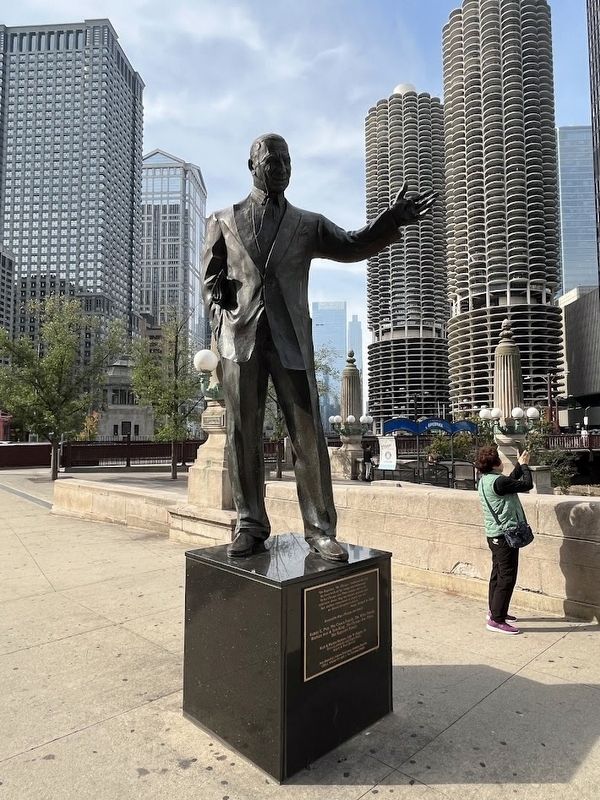
"Irv Kupcinet, 'Mr. Chicago,' embodied the city he loved with all his energy and enthusiasm. In his Chicago Sun-Times column and on his television shows, Kup was honest, accurate and fair, and his commitment to charity was one we should all aspire . . . — — Map (db m259827) HM
On this site, then the lake shore, Jean Baptiste Beaubien, Chicago's second civilian, in 1817, built a “mansion” to which he brought his bride, Josette LaFramboise. It remained their home until 1845. — — Map (db m72205) HM
Since the early 1900s, Jewelers Row has been an important center of jewelry, silver, and watch manufacturing and trade. These distinguished loft buildings and early 20th-century skyscrapers also reflect the development of Chicago commercial . . . — — Map (db m236784) HM
Since the early 1900s, Jewelers Row has been an important center of jewelry, silver, and watch manufacturing and trade. These distinguished loft buildings and early 20th-century skyscrapers also reflect the development of Chicago commercial . . . — — Map (db m242103) HM
Since the early 1900s, Jewelers Row has been an important center of jewelry, silver, and watch manufacturing and trade. These distinguished loft buildings and early 20th-century skyscrapers also reflect the development of Chicago commercial . . . — — Map (db m245007) HM
This International Style office building, located on historically-prestigious Michigan Avenue, was commissioned by African American entrepreneur John H. Johnson to house his nationally-important publishing company. His magazines Ebony and Jet were . . . — — Map (db m254874) HM
Jones Hall is dedicated to Tony Jones, CBE, in honor of his steadfast service and commitment to the School of the Art Institute of Chicago (SAIC). Serving as SAIC President (1986-1992, 1996-2008) and Chancellor (2008-2011), Jones embodied a vision . . . — — Map (db m291281) HM
Kin Link is the fourth artist project in this series of temporary mural banners for the Riverwalk. The artists and artworks in this series show the strength and diversity of Chicago, a city whose vitality comes from the variety of peoples . . . — — Map (db m256563) HM
Kin Link is the fourth artist project in this series of temporary mural banners for the Riverwalk. The artists and artworks in this series show the strength and diversity of Chicago, a city whose vitality comes from the variety of peoples . . . — — Map (db m256565) HM
Lake-Franklin Group
Burling & Adler, George Edbrooke, architects
1872 - 1875
This rare grouping of post-Fire buildings is the
best reminder of the wholesale district, an area
integral to the city's former role as the world's
largest . . . — — Map (db m181282) HM
Acclaimed as one of the most important, early examples of skeletal-frame commercial architecture, this National Historic Landmark was designed by the so-called "father of the skyscaper." It was built by Levi Leiter, a former partner of Marshall . . . — — Map (db m235659) HM
The city’s earliest surviving steal-frame building, a type of construction that changed commercial architecture. As one of the first structures clad in terra cotta, it marked an important step in the development of the architectural terra cotta . . . — — Map (db m47781) HM
In 2012, the Chicago Park District began transforming the northeastern part of Grant Park into Maggie Daley Park. For many decades, an expansive surface parking lot occupied this site with a portion of the Illinois Central's sunken rail yard . . . — — Map (db m249997) HM
In this building, an appropriate exterior expression for the new skeleton-framed skyscraper was found. The facade clearly reveals its underlying structure with broad windows set in a framework of narrow piers and spandrels. In its open and . . . — — Map (db m262737) HM
Daniel H. Burnham and Charles Atwood, 1892;
D.H.Burnham and Co., 1902, 1906, 1907;
Graham, Burnham & Co., 1914 architects
1892- 1914
The Marshall Field and Company Building is the “grande dame” of
Chicago department store . . . — — Map (db m134434) HM
This building is one of the most dramatic examples of the influence that the 1923 Chicago Zoning Ordinance had on the design of the city's high-rises in the 1920s. Rising 519 feet, it combines an exceptionally tall and thin, "spire-like" tower with . . . — — Map (db m234759) HM
Many noteworthy productions and famous performers have graced this stage, including Henry Fonda, Uta Hagen, Katherine Hepburn, Ethel Barrymore, Dustin Hoffman, James Earl Jones, Vivien Leigh, Geraldine Page, and Studs Terkel, to name a few.
. . . — — Map (db m275672) HM
Chicago City Council, 1969-1976
Mayor of the City of Chicago, 1976-1979
Illinois First District Appellate Court, 1984-1990
Illinois Supreme Court, 1990-2000
Chief Justice, Illinois Supreme Court, 1994-1997 — — Map (db m265604) HM
Conceived as part of Daniel Burnham's 1900 plan of Chicago, the Michigan Avenue Bridge and Wacker Drive were designed to improve transportation and to enhance Chicago's riverfront. The opening of the bridge in 1920, followed by the esplanade in 1926 . . . — — Map (db m259820) HM
[Text on the right]
The ASCE presented only ten such awards worldwide, each representing the most outstanding example of Civil engineering in a particular area of infrastructure over the past century.
Created in 1889, the District built canals . . . — — Map (db m155321) HM
Rounded corner bays, a feature of many early skyscrapers, enliven the silhouette of the Old Colony Building. Continuous vertical piers divide the long Dearborn Street façade into tall, narrow sections, while continuous horizontal spandrels visually . . . — — Map (db m241090) HM
This tall, slender skyscraper, with its fantastical terra-cotta ornament depicting both medieval and mythological creatures, is a rare office building designed by renowned theater architects C.W. and G.L. Rapp, who also designed the Chicago and . . . — — Map (db m256547) HM
Herbert Bell of the Bell & Zoller Coal Company commissioned this 23-story skyscraper in 1924. When completed, it was one of the first generation skyscrapers that sprang up on North Michigan Avenue as a result of Burnham and Bennett's 1909 Plan of . . . — — Map (db m236848) HM
Here stood Old Saint Mary’s Cathedral. Church of the first five Catholic bishops of Chicago-quarter, Van de Velde, O’Regan, Duggan, Foley. Opened for divine service December 25, 1843. Destroyed in the great fire of October 8-9, 1871 — — Map (db m223808) HM
Constructed as headquarters for the Oliver Typewriter Company, this Chicago School-style building clearly expresses its internal steel frame through a grid-like exterior. Classical cast-iron ornament subtly advertises the company's name and product. . . . — — Map (db m242893) HM
A premier example of soaring, streamlined, Art Deco-style skyscrapers built during the late 1920s. It features one of the city's most lavishly detailed lobbies, as well as exterior panels by sculptor Leon Hermant. This 49-story building was the . . . — — Map (db m256478) HM
With the last remaining cast-iron front in Chicago, this building illustrates a major step in the evolution of modern metal-frame construction technology. Built when Lake Street was the city's main commercial street, its west facade was remodeled . . . — — Map (db m236564) HM
This massive hotel, once the world's largest, bears the name of Potter Palmer, one of Chicago's most important businessmen. It is designed in the Classical Revival style with French Neoclassical influences. Interior spaces of note include the . . . — — Map (db m92465) HM
One of Chicago's finest 1920s-era skyscrapers, this building exemplifies the importance of the City's pioneering 1923 zoning ordinance, which encouraged Chicago's distinctive tower-embellished skyline. Designed by one of the City's leading . . . — — Map (db m242105) HM
Potter Palmer was a Chicago business magnate — well-known for a variety of endeavors, including his significant role in the development of downtown Chicago's iconic State Street. Bertha Honoré Palmer, 23 years Potter's junior, was a wealthy . . . — — Map (db m291043) HM
Builder: Marine Industries Limited, Sorel, Quebec, Canada
Launched on June 28, 1947
Hull Number: 144
Length: 372.6 ft.
Width: 62 ft.
Gross Tons: 7,600
Service: Operated by Canadian National Railway for service from Cape Tormentine, New . . . — — Map (db m47648) HM
The Great Chicago Fire in October eighteen hundred and seventy-one devastated the city. From its ashes the people of Chicago caused a new and greater city to rise imbued with that indomitable spirit and energy by which they have ever been guided. . . . — — Map (db m79609) HM
In honor of Rene Robert Cavalier Sieur de La Salle & Henry de Tonti who passed through this river on their way to the Mississippi December 1681
This Tablet is placed by the Illinois Society of Colonial Dames of America under the auspices of the . . . — — Map (db m47683) HM
Built in stages, this building combines a massive office block (originally called the Lumber Exchange Building) with a slender tower addition, reflecting the influence of Chicago's pioneering zoning ordinance of 1923 which encouraged set-back . . . — — Map (db m256468) HM
Its powerful exterior softened by John Root’s lively ornament, the Rookery typifies the 1880s' lingering picturesque attitude toward commercial architecture. A transitional structure in the evolution of modern architecture, it employs both . . . — — Map (db m47758) HM
Attributed to famed architect William Le Baron Jenney, the Rowe Building, a printing arts factory built in 1892, typifies the late nineteenth century Romanesque Revival style.
Renovated in 1980, the Rowe Building is a distinguished member of . . . — — Map (db m47780) HM
The Sauganash Hotel was built
in 1831 on what is now the south
east corner of Lake Street and
Wacker Drive. It was Chicago's
first hotel and it soon became the
social center of town.
In 1833, prominent local citizens
met in the Sauganash . . . — — Map (db m183335) HM
Chicago Landmark
Fort Dearborn served as the major western garrison of the United States until destroyed during an Indian uprising in August of 1812. A second fort, erected on the same site in 1816, was demolished in 1858.
Designated a Chicago . . . — — Map (db m47681) HM
The Morton Salt Company was the largest producer of salt in the United States in 1958, when its new corporate headquarters was completed on this city block site. The five-story building was considered one of the jewels of the new Wacker Drive . . . — — Map (db m270450) HM
The great Chicago fire began October 8, 1871, in the
O'Leary barn on De Koven Street. Fanned by a strong
wind, in a city largely built of wood structures, the
blaze raged for nearly 30 hours. Flames spread as
far north as Fullerton Avenue . . . — — Map (db m239712) HM
On this site stood the Sauganash Hotel, built in 1831 by pioneer Mark Beaubien, which was location of the frontier town’s first village board election in 1833. The Wigwam, an assembly hall built in 1860 (destroyed c. 1867) on the site of the hotel, . . . — — Map (db m47725) HM
This was Chicago’s main business street in 1834, connecting the village with Fort Dearborn. Years before this also was the site of a trading post with the Indians.
Erected by
Chicago’s Charter Jubilee
Authenticated by Chicago Historical . . . — — Map (db m47691) HM
(side 1)
Chicago’s Great Street
There is only one State Street. Widely celebrated in song, “That Great Street” has been known since the 1870s for its concentration of premier department stores and world-class . . . — — Map (db m81432) HM
[side 1]
Chicago’s Great Street
There is only one State Street. Widely celebrated in song, “That Great Street” has been known since the 1870s for its concentration of premier department stores and world-class architecture. . . . — — Map (db m235745) HM
The Steger Building was the headquarters for the Steger & Sons Manufacturing Company, who at the turn of the 20th century, were one of the country's most successful piano manufacturers. Located in Chicago's "Music Row," this building was one of a . . . — — Map (db m237447) HM
While still partially tied to its dock at the river’s edge, the excursion steamer Eastland rolled over on the morning of July 24, 1915. The result was one of the worst maritime disasters in American history. More than eight hundred people . . . — — Map (db m244410) HM
The "Great Migration" from the South to "the Promised Land" of Chicago brought more African Americans here from Mississippi than any other state, especially during and after World War II. With the migrants came the Delta blues that was the . . . — — Map (db m282904) HM
This site is designated a Literary Landmark in recognition of the use of bridges as sybmols by such authors as Carl Sandburg, Theodore Dreiser, and Upton Sinclair in Chicago's literary tradition — — Map (db m259812) HM
1909 The Burnham Plan saved the lakefront of Chicago for parks, monuments and museums. Three major sites in Grant Park comprise The Museum Campus.
1911-1919 The Field Museum of Natural History
1929 The John G. Shedd Aquarium . . . — — Map (db m289606) HM
These two statues, one symbolizing agriculture and the other industry, once stood over the main entrance of the Board of Trade Building built in 1885. The statues greeted commodity traders and the public for 45 years. Thought lost forever when the . . . — — Map (db m47760) HM
This building was the first permanent structure of the city's public library system. Designed to be a grand civic building, its exterior appearance and its interior spaces are based on classical Greek and Italian Renaissance precedents. The library . . . — — Map (db m110682) HM
This building was the first permanent structure of the city's public library system. Designed to be a grand civic building, its exterior appearance and its interior spaces are based on classical Greek and Italian Renaissance precedents. The library . . . — — Map (db m289937) HM
The Chicago Riverwalk provides a continuous walkway along the Main Branch of the Chicago River to Lake Michigan. The existing dock wall was extended into the Chicago River by welding new steel piles and pouring concrete, creating a new strip of . . . — — Map (db m256724) HM
For many years,"The Christmas Tree Ship,” loaded with trees,
docked at the southwest corner of the Clark Street Bridge.
From the ship, Captain Herman Schuenemann, known as
"Captain Santa,” with his wife, Barbara, and daughters
Elsie, Hazel and . . . — — Map (db m181315) HM
Built in 1912 as the Rothschild Building
Holabird and Roche – architect
Renamed the Goldblatt Building in 1936
Placed on the Nation Register of Historic Places in 1989
Rededicated by DePaul University September 14, 1993
Richard . . . — — Map (db m134433) HM
Built in 1883, the Donohue Building was the first large printing factory in historic Printing House Row. The Annex was added in 1913. The Donohue Buildings served until 1971 as the headquarters of the M.A. Donohue Publishing Company, a well known . . . — — Map (db m47779) HM
1869
The new water works was designed by Ellis Chesbrough. The intake crib
in the Lake supplied filtered water to the Pumping Station and the Tower.
The Water Tower, one of the only structures to survive the Chicago Fire, has . . . — — Map (db m289651) HM
This distinctive structure combines the structurally expressive character of the Chicago School with the decorative appearance of traditional masonry architecture. It was designed by Frederick P. Dinkelberg, an associate of one of the nation’s . . . — — Map (db m223813) HM
Joanne H. Alter was elected Commissioner of the Metropolitan Water Reclamation District of Greater Chicago, and served with distinction from 1972 until 1990. Commissioner Alter’s vision for improvement in the Chicago River led to the revitalization . . . — — Map (db m47665) HM
1920 The Michigan Avenue Bridge is the first double-deck trunnion bascule built to accomodate two levels of traffic.
1921-24 The Wrigley Building
1925 Tribune Tower — — Map (db m289618) HM
The once sewage-polluted Chicago River was reversed in 1900 to protect the city's drinking water. Today the river is a treasured natural resource. Learn more about the efforts to improve water quality of the river system at MWRD.org. — — Map (db m270460) HM
By 1854 Chicago had suffered for six years with fatal epidemics of typhoid fever and cholera. The Illinois and Michigan Canal was inadequate for carrying the polluted water away from Lake Michigan.
In 1871 new stronger pumps were . . . — — Map (db m289625) HM
At this site on February 23, 1905 The Rotary Club of Chicago was organized as the first of more than 31,600 Rotary Clubs established in 166 countries at the time of its centennial celebration. — — Map (db m223807) HM
The concept of dinner and dancing in The Empire Room continued until 1945, when Conrad N. Hilton purchased the Palmer House. Hilton loved the night life, and was considered a great dancer himself. He ordered a full stage built, and lighting and . . . — — Map (db m291046) HM
On this site, Sept. 23, 1846, the
Sisters of Mercy
who provided Chicago with its first hospital, began their charitable, educational and civic services to this city — — Map (db m99817) HM
Chicago’s famous Grand Pacific Hotel, then on the site of the present Continental Bank building, was the location of the General Time Convention of 1883 which, on October 11 of that year, adopted the current Standard Time System in the United . . . — — Map (db m47759) HM
The dancer Little Egypt" was a sensation at the 1893 exposition.
Completed in 1916, The Navy Pier was built as a terminal for both passenger and freight traffic.
"Chicago Day" October 9, 1893 was the 22nd anniversary of the great . . . — — Map (db m289653) HM
Trustees System Service Building
Thielbard and Fugard, architects;
Eugene and Gwen Lux and Edgar Miller, artists
1929-30
This bold Art-Deco style skyscraper, designed by noted Chicago
architects Thielbard and Fugard, is clad with . . . — — Map (db m181570) HM
A Memorial to Vietnam Veterans
You are entering a site dedicated to
Americans who served their country
with great honor and distinction
in the Vietnam War.
Your respect to their memory
is greatly appreciated.
no biking, no skateboarding,
no . . . — — Map (db m134949) WM
South Water Street 1834
South Water Street 1924
Wacker Drive
Begun 1924 Completed 1926
Built by the
City of Chicago
Wm. E. Dever Mayor
Francis X. Busch
Corporation Counsel
Board of Local Improvement
John J. Sloan . . . — — Map (db m47696) HM
At the time of its construction, in the aftermath of the Fire of 1871, this was one of the city's tallest buildings. Its limestone facades feature ornate Victorian-style details; its lobby includes a unique curving hardwood staircase. Structurally, . . . — — Map (db m117493) HM
[Front side, facing west:]
28 submarines built in Manitowoc, Wisconsin passed this spot
on their way to war after Pearl Harbor December 7, 1941
Dedicated to all U.S. Navy submariners past, present and future who defend our nation in peace . . . — — Map (db m256613) WM
186 entries matched your criteria. Entries 101 through 186 are listed above. ⊲ Previous 100