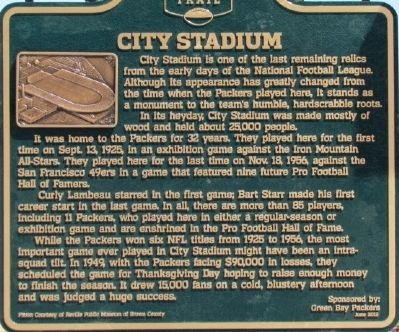
City Stadium is one of the last remaining relics from the early days of the National Football League. Although its appearance has greatly changed from the time when the Packers played here, it stands as a monument to the team's humble, hardscrabble . . . — — Map (db m120564) HM
Walking hand in hand, their faces aglow, Clarke Hinkle and his young admirer convey the timeless rapport between the Packers and their youthful fans. From the kids who cherished the tradition of players smuggling them into games through the back . . . — — Map (db m118188) HM
Upon this site stood Cnesses Israel Synagogue, the first Jewish congregation in Brown County dedicated September 4, 1904 (24 Elul 5664). Designed by local architect Henry A. Foeller, the synagogue was Moorish in design and had two octagonal towers . . . — — Map (db m51362) HM
The Columbus Community Club, which opened in 1925 as a recreational and social center, played many roles in Packers history.
In the 1920s, before radio broadcasts of Packer games, large crowds gathered on Sunday afternoons when the team was . . . — — Map (db m145621) HM
Earl "Curly" Lambeau founded the Green Bay Packers in 1919 and was the team's first playing star and its coach for 31 years. Lambeau was the first pass-minded coach in the NFL and his teams were like their leader, impatient and explosive. An . . . — — Map (db m118251) HM
Earl Louis “Curly” Lambeau is Green Bay's most famous native son and the driving force behind the city's most treasured jewel. The storied Green Bay Packers were largely his creation, and they've become his lasting legacy.
Born in . . . — — Map (db m145622) HM
Curly Lambeau occupied an office in the Northern Building for nearly 20 years while he was coaching the Packers, but visitors might have been taken aback by the sign on his door. It read: Massachusetts Mutual Life Insurance Co.
Lambeau was an . . . — — Map (db m120567) HM
The Packers were founded in downtown Green Bay in 1919 and have had a presence here ever since.
In 1921, their inaugural season in what is now the NFL, they held their first practice at the Old Courthouse Grounds at the southwest corner of . . . — — Map (db m145613) HM
The lumberjack Band was once synonymous with the Green Bay Packers. It performed at home games, pep rallies and other celebrations; and energized players and fans alike with its rollicking capers and snappy music. Loosely organized in 1921, the . . . — — Map (db m131513) HM
Curly Lambeau founded the Green Bay Packers in 1919 and was a driving force in the team's early years, including the 1921 decision to join what is now the NFL. He served as head coach for the franchise's first 31 seasons, leading the Packers to six . . . — — Map (db m77462) HM
The Elks Club was the site of an annual sports banquet that honored many of the biggest names in Packer history from the Curly Lambeau and Vince Lombardi eras.
The first was billed as the "Lombardi Testimonial Banquet" and was held in April . . . — — Map (db m120569) HM
The Zippin Pippin was Elvis Presley's favorite ride. The "King" rented Libertyland August 8, 1977 from 1:15 a.m. to 7 a.m. to entertain a group of about 10 guests. Decked in a blue jumpsuit with black leather belt, huge belt buckle with turquoise . . . — — Map (db m66565) HM
Near this site stood the first Catholic church in Green Bay begun in the year of our Lord 1823 by Father Gabriel Richard Vicar Apostolic of the Northwest and finished by Father Stephen Badin first resident pastor and missionary.
A short . . . — — Map (db m39394) HM
853 feet north 45 degrees, 7 minutes east, from this tablet, stands a flag pole, marking the southeast corner of the stockade of Fort Howard; occupied by United States troops August 1816, and almost continuously until 1852. On this site also stood . . . — — Map (db m100952) HM
In 1896, Michael Freimann built a large three story hotel building on what had previously been a vacant lot. The building first served as the O'Neil Hotel but was soon renamed the New Freimann Hotel in 1898. The building typically housed about ten . . . — — Map (db m39058) HM
Other than maybe Curly Lambeau, the Packers had no more important front man and no bigger booster than Calhoun over their first quarter-century. A gruff and colorful newspaperman who was fond of chewing on the stub of his cigar, Calhoun helped . . . — — Map (db m118189) HM
Commissioned by Congress in 1866, the lights were built in 1872 on Grassy Island, 15 miles north of this location. In 1966 they were transported from the island to the north side of the Green Bay Yachting Club harbor. They were moved to their . . . — — Map (db m248638) HM
The Green Bay - De Pere Antiquarian Society was founded in 1923 by a group of women concerned about the loss and destruction of artifacts and objects important to the history of the community. The Society was established to preserve and protect the . . . — — Map (db m118247) HM
The Green Bay Packers, an institution and a legend, are unique.
The only publicly-owned club in professional sports, they were founded as a town team in 1919 by E. L. "Curly" Lambeau, who coached them to six world championships. They acquired . . . — — Map (db m37200) HM
The Packers might have been born in the old Press-Gazette building five years before this one was completed, but the close ties between the team and the newspaper carried on here. Had it not been for the Press-Gazette, and particularly Andrew . . . — — Map (db m120570) HM
Hagemeister Park was the home of the Packers from 1919, their inaugural season as a semipro team, through 1922, their second year in the NFL.
Before East High School and City Stadium were built, Hagemeister Park included the tract of land from . . . — — Map (db m120571) HM
of the Morgan L. Martin family for 100 years (1837-1937). Martin was a prominent Green Bay attorney, civic leader, Indian agent and entrepreneur, originally from upstate New York, who helped lay the foundation for Wisconsin's statehood. In 1848, . . . — — Map (db m37204) HM
On this site Morgan L. Martin (1805-87) built this home in 1837, after his marriage to Elizabeth Smith of Plattsburgh, N.Y. It was a center of social, literary and political accomplishment for nearly a century. Coming here in 1827 as a young . . . — — Map (db m37202) HM
In 1829, citizens of the Green Bay area petitioned Congress to build a road to Chicago. Following an ancient Indian trail, the military road to connect Fort Howard at Green Bay with Fort Dearborn at Chicago was surveyed by the U.S. War Department . . . — — Map (db m68166) HM
The Hotel Northland was the social hub of Green Bay and more specifically the city's nerve center during football weekends and other Packers events from shortly after it opened in 1924 through the 1960s.
Vince Lombardi's introductory press . . . — — Map (db m145615) HM
The Indian Packing Corp. was the original sponsor of the Packers. Curly Lambeau was working at the packing plant in 1919 when he took the lead in organizing the team. Frank Peck, the company's president at the time, gave Lambeau $500 in cash to . . . — — Map (db m60562) HM
to many people for thousands of years before the first Europeans arrived. The rich waters of the bay attracted a number of American Indian Tribes - all members of a large and complex trading network stretching throughout North America.
Green . . . — — Map (db m43813) HM
1906-1958
We honor a man - a mountain tall
An answer to our Nation's call.
A hero's name to be inscrolled
In burnished letters set in cold.
A man to have - A man to hold
A man from which to form a mold
Sleep on - Brave Scion of the Sea . . . — — Map (db m131539) WM
Born John Victor McNally, he adopted the name Johnny Blood and used it throughout his pro football career, including his seven seasons with the Packers. Blood was a freewheeling halfback and the biggest playmaker on the great Packers teams that won . . . — — Map (db m118187) HM
Side One:
Liberty Bell 250th Anniversary
In 1751, while Benjamin Franklin was drafting his Plan of Union, the Pennsylvania Assembly ordered a bell from Whitechapel Bell Foundry of London, England. The bell's inscription was described as . . . — — Map (db m131540) HM
Since that frigid December day in 1993 when LeRoy Butler made a spontaneous leap into the arms of fans, the Lambeau Leap has become a Packers tradition. It declares that nothing gets in the way between Packers players and their fans. In all of . . . — — Map (db m89954) HM
Back when the Packers traveled exclusively by train, they were welcomed home here at the Milwaukee Road Depot by throngs of joyous fans after clinching three of the six NFL championships they won under Curly Lambeau. The celebrations took place . . . — — Map (db m145618) HM
The Chicago, Milwaukee and St. Paul Railroad…
later known as the Milwaukee Road came to Green Bay in 1873.
This depot was built in 1898 and was the only passenger depot located on the east side of the river. It served as a . . . — — Map (db m43821) HM
Dedicated to the Glory of God
and in Memory to All Men and
Women Who Served in the Naval
Forces of the United States
Erected by the Navy Club, Ship 18
1956
Rededicated June 1996 — — Map (db m66600) WM
Commemorating the discovery of Wisconsin in 1634 by Jean Nicolet, Emissary of Governor Champlain of New France. In this vicinity Nicolet first met the
Winnebago Indians. — — Map (db m39541) HM
Welcome to the Oneida Veterans Memorial
Civil War
About the War: The civil war was fought in 1861-1865 between the United States (the "Union" or the "North") and several southern slave states that declared their secession and . . . — — Map (db m78976) WM
The Packers Heritage Trail was designed as a self-guided walking tour past a treasure trove of landmarks that played a big part in the history of the Green Bay Packers from Curly Lambeau's era through Vince Lombardi's.
During those 50 years, . . . — — Map (db m145612) HM
The Packers moved into the south side of this building, located at 349 S. Washington St., in 1949 and occupied it until a new administration building was completed next to what is now Lambeau Field in 1963.
Curly Lambeau was the first coach to . . . — — Map (db m60579) HM
During the 32 seasons that the Packers played at City Stadium, they mostly practiced on nearby fields. As early as 1923, when East High was under construction, the Packers practiced in front of the school in Joannes Park.
In 1937, they created . . . — — Map (db m56411) HM
A triple-threat halfback with a nose for the end zone, Hornung was a playmaker and leader on Vince Lombardi's first three championship teams. "A great pressure player," was how Lombardi once described him. Hornung, who doubled as a kicker, set an . . . — — Map (db m118185) HM
in Wisconsin’s transportation system is the Port of Green Bay. It serves as a multi-modal distribution center connecting waterborne vessels with an extensive network of highways and railroads. The Port of Green Bay provides Northeast Wisconsin . . . — — Map (db m43812) HM
This liberty bell commemorates the 3,000 innocent lives
lost in terrorist attacks in New York, Washington and rural Pennsylvania. Firefighters, Law Enforcement Officers, Military Personnel, and everyday citizens responded with true courage, good . . . — — Map (db m43397) WM
The Packers used the Riverside as indoor practice facility when there were no such luxuries. Before their final game in 1940, Coach Curly Lambeau held practice here over two days due to snow, ice and sub-freezing temperatures. The Packers worked out . . . — — Map (db m145631) HM
Robert E. (Bob) Harlan, the ninth president in Packers history, played a central role in orchestrating the $295 million Lambeau Field redevelopment, first unveiled in 2000 and completed at the start of the 2003 season. Harlan's unwavering leadership . . . — — Map (db m77463) HM
In Loving Memory Of The Known And Unknown, The Found And The Unfound
The World Trade Center - American Airlines Flight 11 - American Airlines Flight 175 - United Airlines Flight 93 - United Airlines Flight 77 - The Pentagon
Wisconsin's . . . — — Map (db m157248) HM
St. Willebrord Catholic Church was where Vince Lombardi faithfully attended Mass during his 10 years in Green Bay. A devout Catholic, Lombardi would invariably arrive minutes before 8 a.m. on weekdays, park in the back lot and enter the church . . . — — Map (db m120575) HM
Bart Starr was one of the most admired Packers ever and one of the most generous when it came to sharing his time with young fans. It also was during his 16 seasons as a player, from 1956 to 1971, that autograph collecting mushroomed in popularity. . . . — — Map (db m118184) HM
Built in 1868, this example of mid-19th century architecture is one of the oldest homes on its original foundation with its original exterior.
On April 9, 1898, two residents of this home, Marcel and Mary Lambeau, gave birth to their first . . . — — Map (db m145610) HM
as well as Fort Crawford at Prairie du Chien, was built following the War of 1812 to establish a U.S. presence in the Wisconsin territory and strategically cut off British access to trade routes. The forts were also used to construct Wisconsin's . . . — — Map (db m43816) HM
The Roi-Porlier-Tank Cottage… has an extraordinary rich history in Green Bay, as it was home to a fur trader, schoolmaster, judge and missionary.
In 1803, a French Canadian fur trader by the name of Joseph Roi built the small cottage . . . — — Map (db m241106) HM
is a vital part of our local economy, our history and our lives. It plays an important role in the transportation of goods and commodities that are critical to the economic health of the region. The Port of Green Bay receives and/or sends . . . — — Map (db m43817) HM
and geographic location is everything. The sparkling waters of Green Bay and sweeping rivers feeding into it
have attracted numerous industries over the past few hundred years. The French fur-trading empire of the
early 1700s gave way to . . . — — Map (db m43819) HM
This statue, designed by Suamico native, Sydney Bedore, and dedicated on June 10, 1931 with Governor Phillip Lafollette among the speakers, represents a Fox Indian, Claude Allouez and Nicholas Perrot. Native Americans lived in Wisconsin for about . . . — — Map (db m39250) HM
June 17, 1906
July 9, 1958
Navy Cross
May 7 - 8, 1942
Distinguished Service Medal
July 1953 - June 1958
Legion of Merit W/Combat "V"
Dec. 1944 - May 1945
Distinguished Flying Cross W/Two Gold Stars
Nov 1942 - . . . — — Map (db m145609) HM
Vince Lombardi directed the Green Bay Packers to five NFL championships in seven years (1961-62, 1965-66-67) – a feat without parallel in pro football history. His 1966 and '67 teams also won the first two Super Bowls. Lombardi forged an impressive . . . — — Map (db m77461) HM
Major Zachary Taylor served as commandant of Fort Howard for nearly three years, arriving in the spring of 1817 with 500 men of the fifth United States Infantry.
He would become the twelfth president of the United States on the fifth of . . . — — Map (db m202937) HM
George Ferris, American Engineer, designed the original Ferris Wheel while at dinner in a Chicago restaurant to be built for the World's Columbian Exposition in Chicago in 1893. Supported by two 140 foot steel towers, its 45 foot axle was the . . . — — Map (db m289819) HM
The Friends of Bay Beach purchased The Falling Star from New Hampshire based Fiesta Shows in 2015. It was part of a three ride donation that also included The Bay Beast and The Rockin' Tug. The Bay Beach Falling Star is the second ever model . . . — — Map (db m254338) HM
This 1991 Chance Rides Sea Dragon was purchased from New Hampshire based Fiesta Shows in 2013. The Sea Dragon is the first major project completed through the partnership between the Green Bay Parks, Recreation & Forestry Department and The Friends . . . — — Map (db m254337) HM
Herbert Sellner invented the Tilt-A-Whirl in 1926. The following year, the ride debuted at the Minnesota State Fair. Since then, over 1,000 Tilt-A-Whirls have been manufactured by Sellner Manufacturing. In 1982, Bay Beach purchased this Tilt-A-Whirl . . . — — Map (db m289813) HM
The Zippin Pippin, designed by John Miller, was originally built in 1923. Miller, a renowned wooden coaster designer, also designed Bay Beach Amusement Park's original roller coasters, "The Greyhound" and "The Jack Rabbit". The Zippin Pippin is a . . . — — Map (db m254316) HM
The Site
The Delfosse-Allard site represents a campsite/village occupied intermittently from about 4000 B.C. to A.D. 1700. The site was first identified in 1906 and additional investigations took place in the late 1970s. The WIS 57 . . . — — Map (db m143343) HM
The Site
The Fabry Creek (Boss Tavern) site produced a range of artifacts related to three prehistoric occupations including:
• Paleoindian
• North Bay Middle Woodland
• Mero Complex Oneota
The site is part of a complex of . . . — — Map (db m143254) HM
While the WIS 57 corridor is rich in Euroamerican history, prior to the 19th Century, the Native American presence is the major historical record on the Door Peninsula. For perhaps 12,000 years, Indian peoples have lived on the Door Peninsula and . . . — — Map (db m143329) HM
The Site
The Heyrman I site represents a campsite and stone tool workshop occupied almost continuously from Paleoindian to Historic Euroamerican times.
The Heyrman I site was situated on a long, narrow, saddle-shaped sand ridge, running . . . — — Map (db m143544) HM
Many of the explorers who followed Columbus were more interested in finding an easy route to Asia than they were in exploring and settling this continent. In 1634 Jean Nicolet, emissary of Gov. Samuel de Champlain of New France, landed at Red Banks . . . — — Map (db m22457) HM
North Bay Middle Woodland on the Door Peninsula
North Bay Middle Woodland groups lived on the Door Peninsula from about A.D. 1 to A.D. 400. During the spring and summer months the people hunted and fished from camps on the Door Peninsula . . . — — Map (db m143291) HM
The Holdorf Site: A Chipped Stone Workshop
The Holdorf site was situated at the top of an upland knoll about three miles north of the Door/Kewaunee County border. The site was one of the most unusual investigated by WIS 57 archaeologists . . . — — Map (db m143538) HM
Why Was This Project Undertaken?
WIS 57 is the primary route into and out of the Door Peninsula's popular resort country and by the early 1990s had become inadequate to safely carry current traffic loads.
A Wisconsin Department of . . . — — Map (db m143303) HM
Historic Preservation and the WIS 57 Project
The National Historic Preservation Act of 1966 (NHPA) requires federal agencies to take into account the effect their projects might have on historic properties such as buildings and archaeological . . . — — Map (db m143313) HM
This site is part of a 4800-acre tract patented to Eleazer Williams by the United States. In 1882 Williams led a delegation of New York Indians to the Fox River Valley, hoping to set up an Indian Empire in the West. A year later he married the . . . — — Map (db m57219) HM
James Powlis, whose Oneida name Tewakatelyλ·thale! means "I'm Worried", was born around 1750, probably in New York State. In 1777, after the disintegration of the Iroquois Confederacy's neutrality, Congress sought to offset the allegiance of . . . — — Map (db m11097) HM
This house was built by two early founders of Wrightstown - Hoel S. Wright and Carl G. Mueller. Wright and his wife, Orilla, founded the settlement when they moved here in 1833 from Pawlett, Vermont. Wright operated a trading post, ran a ferry . . . — — Map (db m125734) HM
The Beef Slough was a sluggish branch of the Chippewa River that provided an excellent storage pond for the logs floated downstream by numerous logging companies. Here loggers were employed to arrange the mixed-up logs into orderly rafts to be towed . . . — — Map (db m10103) HM
Designed by and constructed under the direction of
The Corps of Engineers, United States Army
1932 – 1935
Contractor for lock – Ouilmette Construction & Engineering Co.
Contractor for dam – United Construction Co. . . . — — Map (db m17300) HM
This site and memorial is forever dedicated to the memories, valor, courage and ideals of those Buffalo County residents that have given their all and rest in burial sites at home, abroad and at sea. It is also dedicated to those that have endured . . . — — Map (db m73314) WM
Thomas A. Holmes (1804-1888) established the first permanent settlement in Buffalo County in 1839 at the present site of Fountain City. In the fall of that year Holmes and a party of twelve including his wife came up the Mississippi River to barter . . . — — Map (db m43205) HM
Before the white man came to this area Indians of the Chippewa, Winnebago and other tribes roamed freely along the Mississippi River. Recorded history tells of an Indian tribal battle that took place on these river banks which was witnessed by some . . . — — Map (db m43206) HM
Freedom Is Not Free
Military Service Emblems
Army • Navy • Air Force
Marine Corps • Coast Guard • Merchant Marine
Galen C. Aase •
Loren R. Aase •
William J. Aase •
Wayne M. Adams •
James R. Alf •
Mitchell Allen • . . . — — Map (db m78828) WM
The weather on April 21, 1980 was unseasonably hot and dry. On that day a temperature of 91 degrees combined with a humidity of 18 percent to set the stage for a catastrophic fire. At approximately 12:20 pm. that sweltering afternoon, the historic . . . — — Map (db m68642) HM
Canute Anderson was born Canute Ingverson Eggum in Laerdal, Norway. He arrived in the Grantsburg area in 1854, establishing a stopping place and trading post where the buildings southeast of this marker stand. Opening the first post office in his . . . — — Map (db m68715) HM
During the last Wisconsin glaciation the advance of the Grantsburg sublobe blocked drainage, resulting in the formation of Glacial Lake Grantsburg. Natural succession eventually formed the extensive peat marshes known today as Crex Meadows.
Prior . . . — — Map (db m68641) HM
The St. Croix River winds its way through wild and scenic countryside from its origin in a Spruce-Tamarack swamp near Upper St. Croix Lake. The waters of the Namekagon join the St. Croix 45 miles upstream from this sign. The river system varies from . . . — — Map (db m44547) HM
On Monday, June 18, 2001, at 8:20 p.m. an F3 tornado with gale-force winds of over 200 miles per hour blew through southern Burnett County and eastern Washburn County leaving in its wake a path of destruction through the townships of Bashaw, . . . — — Map (db m43504) HM
The Brothertown (Brotherton) are descendants of the Pequot and Mohegan (Algonquin-speaking) tribes in southern New England. They became a tribe in 1769 when seven Christian and English-speaking communities organized and moved to land in upstate New . . . — — Map (db m31792) HM
The Dick Cemetery, the smallest known Brothertown Indian cemetery in Wisconsin, was a private graveyard for the Dick family, descended from the Narragansett. The Brothertown Indians established the first permanent Baptist congregation on the . . . — — Map (db m254355) HM
This wooded site of 4.77 acres was purchased from Rudolph Puchner in 1915 for $2,500.00 by an organization of 12 women called the New Holstein Civic Society. Their purpose was to improve and beautify the city. Through diligent work and numerous . . . — — Map (db m46940) HM
B. Kuehl ·
J. Tams ·
J. Muenster ·
H. Banderob ·
L. Loewenhagen ·
H. Bock ·
H. Jensen ·
A. Ramm ·
G. Larsen ·
F. Roehr ·
D. Dammann ·
F. Temke ·
R. Luethge ·
J. Staube ·
J. Schilling ·
G. Bock ·
P. Heldt ·
P. . . . — — Map (db m47107) HM
Built for Hermann Christian Timm and his wife, Augusta (Muenster) Timm, the house was erected in two sections. A frame, Greek Revival-influenced residence was built for the Timm family in 1873. In 1892, a large stick style house was constructed onto . . . — — Map (db m31977) HM
Here We Honor
The Price of Freedom
Dedicated to the men and women of the New Holstein area who haved served their country in the armed services.
***2008***
US Flag Pole Donated In Memory Of Elmer E Abrahamson Jr. · . . . — — Map (db m46953) HM
In 1853, a group of German Catholics from Silesia, Prussia, emigrated to the Charlestown area. By 1866, the congregation had built a log church where they could assemble for services. They erected the current church in 1875, using limestone from a . . . — — Map (db m145723) HM
About one mile north of this site was located the High Cliff Zion Evangelical Church (Now United Methodist Church)
Church Organized February 28, 1872
Consolidated July 9, 1919
Many of the early members of this church, of which this cemetery was . . . — — Map (db m132641) HM
This was once the site of a thriving lime producing business known as the Western Lime and Cement Company. From beginning to end, production lasted approximately 100 years (1856-1956). All that remains today are the skeletons of the three kilns in . . . — — Map (db m164740) HM
A Distinguished Wisconsin Indian
in authentic tribal costume of 1827.
Designed by Adolphe E. Seebach
Erected by Sculpture House, New York
Erected and Presented by Banta Company Foundation
1961 — — Map (db m164772) HM
Around A.D. 1100, there was a large Native American village on the north side of Stockbridge Harbor. The pottery recovered from archaeological excavations at this site indicates that the villagers came from two formerly distinct cultural groups. . . . — — Map (db m31799) HM
3532 entries matched your criteria. Entries 101 through 200 are listed above. ⊲ Previous 100 — Next 100 ⊳