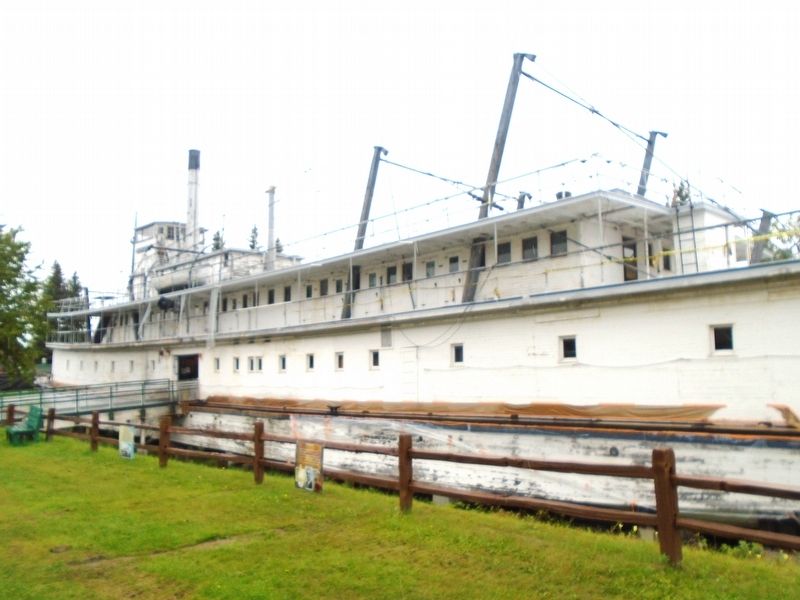
The Nenana built accommodations for 52 passengers but was never licensed to carry more than 16 by the Steamboat Inspection Service. During World War II Federal officials and military were not
considered "Passengers for hire." The Nenana would . . . — — Map (db m256664) HM
The Greater Fairbanks Opportunities leased the boat?
Newsminer July 1, 1958
Boatel Is Open
Fairbanks boatel, the sternwheeler Nenana which is docked near 2nd avenue and Lathrop street, opened last week, for the summer . . . — — Map (db m256690) HM
The SS Nenana was originally in a different place
in the park? She was moved more then [sic] 200 ft.
to be placed where she is now. She was originally
placed in a man made pond, facing the Pioneers Museum. — — Map (db m256661) HM
The SS Nenana fulfilled a significant role during World War II. She transported equipment and personnel needed to construct airfields and other military installments, including facilities and aircraft for the Lend Lease Act of 1941. She supplied . . . — — Map (db m256653) HM
During World War II the SS Nenana played an essential role, transporting equipment and personnel needed to construct airfields and other military install[ations], including facilities and aircraft for the Lend-Lease Act of 1941.
[Photo . . . — — Map (db m256691) HM
It took three days to bring the SS Nenana to Fairbanks from Nenana. The vessel traveled cautiously with a sounding boat out in front to test the river depth and check for sandbars.
She was still hung up on a sand bar by the mouth of the Chena . . . — — Map (db m256667) HM
Sternwheelers were the main transportation for the Interior in the early 1900's. The difficult terrain and lack of roads made the rivers a useful and efficient means of travel. The Tanana and Yukon Rivers naturally spread out in . . . — — Map (db m256895) HM
Suter, “The Live Jeweler” and E.R. Peoples, owner of E.R. Peoples General Merchandise, married two sisters in 1910.They built these two adjoining houses, together one of the first modern homes in town. — — Map (db m47408) HM
1955
The idea that sparked the creation of Pioneer Park came from a Fairbanks Golden Days Celebration Committee meeting. Robert Sheldon of Pioneers of Alaska Fairbanks Igloo No. 4 took the idea to the Fairbanks Pioneer Igloos to . . . — — Map (db m256603) HM
[Historic photo captions, clockwise from top center, read]
• Prospector Felix Pedro, Discoverer of the Fairbanks Mining District
• Prospector using rocker box to recover gold
• Hoisting with a windlass at the prospect site
• . . . — — Map (db m257482) HM
In November of 1907, a two-story wooden schoolhouse with a cupola was completed on this site. Over time, to accommodate growth, the schoolhouse was expanded and additions were made. In 1932, the school was destroyed by fire, but rebuit in 1934 as . . . — — Map (db m238727) HM
The Harding Car was built in 1905 in Chicago, Illinois and carried passengers until 1945. It was donated to the City of Fairbanks in 1959, and moved to the Park in 1965.
The Harding Car, also known as the Denali Car, is the train car that . . . — — Map (db m256596) HM
In August 1901, the sternwheeler Lavelle Young was chartered by E. T. Barnette from Captain C. W. Adams to transport Barnette, his wife Isabelle, three men in Barnette's employ, and 130 tons of supplies for Barnette's future . . . — — Map (db m256896) HM
The church had its beginning in the winter of 1902-03 when the
Rev. M. E. Krouse Ph. D., Presbyterian missionary of Rampart,
Alaska came to the new camp on the Chena [River] called Fairbanks. He
built a mission cabin, preached the first . . . — — Map (db m256859) HM
has been designated a
National Historic Landmark
This vessel possesses national significance in
commemorating the history of the United States
of America. The S. S. Nenana is the last
steamer of her type remaining in the . . . — — Map (db m256655) HM
From 1933 until the early 1940's, burial records were
poorly kept or lost, therefore there are nearly 200
unknown graves. The original markers were destroyed by
floods and the elements. Graves were located by ground
penetrating radar in the . . . — — Map (db m256405) HM
Wold family home from 1946 to 1969.
Joanne [Jo Ann], one of the daughters,
is known for her writing talents:
"This Old House",
and "Gold City Girl". — — Map (db m256935) HM
As nomadic hunter and gatherer people, the Athabascans relied on their ability to track and hunt herds of migrating caribou in order to survive Alaska's harsh climate. In the wild, caribou are migratory, traveling long distances each year from . . . — — Map (db m282375) HM
In Alaska, the remote areas of the state are knows as "The Bush" and the term "Bush Pilot" refers to the bold and adventuresome pilots who fly in and out of these remote locations. Even today, Bush Pilots - provide an important lifeline to . . . — — Map (db m282284) HM
Noticeable among the earliest pioneers settling in Fairbanks were prostitutes, women of the demimonde who stampeded to the new Fairbanks gold camp from Dawson, Circle City, Rampart and points beyond. In a city where men far outnumbered women, . . . — — Map (db m47404) HM
In Fairbanks, mining by individuals on small claims was the norm until the late 1920's.
The arrival of the Fairbanks Exploration (F.E.) Company brought professional mining engineers and the latest dredging equipment to the area. The company . . . — — Map (db m256493) HM
Steamboats crowded the Chena River in the few months between break-up and freeze-up, bringing passengers and much-needed merchandise to the isolated community. — — Map (db m256551) HM
Eight hundred people lived in Fairbanks in the winter of 1903. By the summer of 1904 the population had swelled to 5,000.
The thriving town had two newspapers and numerous hotels, like the two story
Pioneer. It featured 100 rooms, steam heat, . . . — — Map (db m256490) HM
Riverboats, bringing food and supplies to the miners on the creeks north of Fairbanks, plied the Chena River until the Tanana Valley Railroad was built in 1907.
To reach the gold-bearing gravels, early miners dug vertical shafts through 80-100 . . . — — Map (db m256489) HM
The role of transportation in advancing the civilization of the north can be traced from the very first forms of river travel between settlements on Alaska's river systems. Long before the first Russian traders sailed . . . — — Map (db m257398) HM
Like these waters that flow to the sea
we tread this uncertain path -
at this stepstone we pause,
looking to our past, forward to our destiny,
and leave these treasures of our time.
The opening of this Time Capsule
on 3 January . . . — — Map (db m257100) HM
The Alaska Highway was built in 1942 in 8 months. The Highway stretches 1422 miles from Dawson Creek, British Columbia, to Delta Junction. The Highway was built as a military necessity and followed along a line of existing airfields, winter . . . — — Map (db m257075) HM
Completed in 1942
Constructed in just 8 months in 1942, this 2,450 kilometre highway provided an essential transportation link to the northwest of North America during the Second World War, and has since remained a major . . . — — Map (db m257084) HM
During World War II under the leadership of
Major "Muktuk" Marston and 21 paid staff, 6,368 Volunteers from
7 Native ethnic groups and European Americans, whose collective
ages ranged from 12-80 years of age, including some 30 women, . . . — — Map (db m256484) HM WM
From the first communications project- an ill-fated attempt to string a trans-Siberian telegraph cable linking America with Europe in the 1860s to the satellite technology of today. Alaska has been a rugged proving
ground for the . . . — — Map (db m257333) HM
Alaska's heritage has evolved from its abundant supply of minerals. Centuries before the Russians settled here, Alaska natives utilized various minerals for carved utensils, ornaments, religious objects, and weapons.
The Russians discovered . . . — — Map (db m257331) HM
It was not a year
Just like other years;
Somehow 'Eighty-Four was special,
As if the hand of God
Had briefly brushed the place
And sparked a miracle.
It was a year to remember: the Bridge of Flags to lift the spirit; all those honored . . . — — Map (db m257282) HM
The first people to inhabit this great land are now known as Athabascan Indians. Despite popular anthropological beliefs that describe man's migration to Alaska via a land bridge or from the southern hemisphere, Athabascan mythology contains many . . . — — Map (db m257312) HM
In 1913 Fairbanks merchants invited Lilly and James V. Martin to bring their airplane to Fairbanks. The Martins shipped their crated airplane from Seattle. When it reached Fairbanks, Martin and his wife, who was England's first woman aviator, . . . — — Map (db m256495) HM
Captain E.T. Barnette, a passenger on the riverboat Lavelle Young, debarked near this site on August 26, 1901, and established a trading post which in 1902 became known as Fairbanks. — — Map (db m293748) HM
With no roads and sparse trails, the rivers were the highways in Alaska in the early 20th Century. Historically, the area along the Chena River has been a gathering place for people. It's likely that ages ago hunters and gatherers came to barter, . . . — — Map (db m257177) HM
Presented to the People of Fairbanks
by
Festival Fairbanks 84
and
The Fairbanks Downtown Association
[Dedicated] January 3, 1984 — — Map (db m257086) HM
For many years, farmers displayed locally grown grains and vegetables in the downtown area near the site of today's Visitors' Bureau log cabin on First Avenue. The display pictured here dates from around 1914. — — Map (db m257140) HM
The 1967 flood in Fairbanks made one thing clear-the city and nearby Fort Wainwright needed better flood control.
Planning Ahead
The Chena River has a history of flooding, but the damage from the 1967 flood was so extensive that it . . . — — Map (db m256591) HM
Clay Street Cemetery is the final resting place for a number of
Interior Alaska's early pioneers. Founded in 1903, it is a microcosm of
ethnicities, trades, society, and beliefs. The significance of Fairbanks'
first . . . — — Map (db m256401) HM
The history of Alaska would not be complete without mention of the fuel that made possible the exploration, settlement, and industries of this immense land. COAL from the corners of Alaska (Coal Cove on the Kenai Peninsula, Admiralty Island in . . . — — Map (db m257328) HM
Dedicated to the Recipients of the
Nation's Oldest Military Decoration
"The Purple Heart"
My stone is red for the blood they shed.
The medal I bear is my country’s
way to show they care.
If I could be seen by all . . . — — Map (db m256483) WM
When people first came to Fairbanks in 1902 buildings were of log. Later "tin" was used for roofing and siding. The waterfront N.C. Co. store and powerplant behind it
were wood, sided and roofed with "tin." The N.C. Co. . . . — — Map (db m257381) HM
“Instead of row after row of empty houses (Dawson), they are building new stores. The place is alive and busy-a little too crowded when we got there.” – a tourist in Fairbanks, 1928 — — Map (db m47406) HM
Dr. William Ranson Wood, born February 8, 1907,came to Alaska in 1960 to serve as the fourth president of the University of Alaska. His innovative leadership transformed a small institution into a multi- campus university of international . . . — — Map (db m290706) HM
It All Started with Gold
In 1901, Felix Pedro and Tom Gilmore were panning the creeks in the unexplored wilderness of the Tanana Valley. The same year, trader E. T. Barnette was traveling the river system to find a location for a trading . . . — — Map (db m257318) HM
Fairbanks Aerie No. 137 and Ladies Auxiliary
5th Day of March, A.D. 1905 • 15th Day of October, A.D. 1946
The Fairbanks Eagles Aerie No. 1037, the farthest-north Aerie, has a long and colorful history. Organized and chartered in 1905, its . . . — — Map (db m257425) HM
The Alaska Constitution provides that "the entire State shall be divided in boroughs, organized or unorganized." Delegates to the Constitutional Convention chose "borough" rather than the more commonly accepted term "county" to avoid restrictive . . . — — Map (db m257324) HM
In the winter of 1904, the first Fairbanks Public School was opened. Ten students finished the spring term. In the fall of 1905, the school enrolled 50 students. The next year, 150 students attended.
Construction of a much-needed new school on . . . — — Map (db m219204) HM
Noble Dick, M D · President • Wm S Burton · Vice President
Herb Kirby · Secretary • Curtis Adams · Treasurer
Jack Winston · Director • Brice Howard · Director
Arthur S Brown · Director
Don Adler · Harry Arend · Roy Ferguson · Kenneth . . . — — Map (db m257103) HM
Fairbanks first bank, First National Bank
of Fairbanks, opened its doors in 1905. We
served the Interior under that name until 1987
when we became Key Bank of Alaska. This plaque
represents our employees' pride in our . . . — — Map (db m257426) HM
Riverboats have plied the rivers of Alaska and the Yukon for more than 100 years. They were the primary mode of transportation to the gold fields of Interior Alaska, bringing prospectors and supplies to the growing boom towns along . . . — — Map (db m257436) HM
has been designated a
National Historic Landmark
This site possesses national significance
in commemorating the history of the
United States of America
—————————
This property
has been placed on the
National Register
of . . . — — Map (db m257155) HM
Residents of interior and northern Alaska are fortunate to have excellent health care resources. Strong support from the people in Fairbanks and the surrounding area has been the key in developing fine facilities and services. . . . — — Map (db m257337) HM
Over one hundred years ago, this narrow, period building began as the "First Avenue Bath House
and Health Clinic." Originally constructed of bare boards, this two-story building fronted First Avenue and the Chena River, tapering to one story for . . . — — Map (db m257157) HM
About 200 million years before Eskimos, whalers, white hunters, trappers or explorers set foot on the barren, pond-pocked tundra of the North Slope, 250 miles north of the Arctic Circle, dynamic geologic forces were at work forming the richest . . . — — Map (db m257376) HM
Too often wars are described in terms of presidents and generals, emperors and kings, in grand strategy and elaborate campaigns. But wars affect the lives of all people — the soldiers who fight and the women, children and men who support the . . . — — Map (db m257138) HM WM
In Memory Of:
All of our men and women who served in the U.S. Armed Forces; those who perished; our veterans
who suffered the ravages and wounds of war; American Prisoners of War; and those who still
remain missing in action.
You have the . . . — — Map (db m256482) WM
Construction of the Lacey Street Theater began in 1939, and this Art Deco style building opened in 1940. Austin E. “Cap” Lathrop, Fairbanks businessman and financier, was its owner. The Lacey Street Theater, with its distinguished neon sign, . . . — — Map (db m58989) HM
In 1916 Arthur Williams began construction of this house, a variation of the
popular bungalow home featured in printed guides that came to Alaska. Windows,
doors, and some finishing items were ordered from Seattle and installed, so the
term . . . — — Map (db m257181) HM
ARCO discovered Prudhoe Bay, the nation's largest oil field, in 1968.
When work began on field development and construction of the trans Alaska pipeline, Fairbanks became the major construction and supply center for this immense and . . . — — Map (db m257409) HM
The flag of Northern Commercial Company-a white and red banner initialed NC Co-was once as well known to Alaskans as the state flag is today.
For many years the main store of the company did business from the Fairbanks waterfront. The story of . . . — — Map (db m256552) HM
This plaque marks the original site of the Fairbanks USO organized by volunteers and chartered through USO World Headquarters in 1942. Its Mission was to serve the morale support needs of the men and women in the armed forces stationed away from . . . — — Map (db m256561) HM
For thousands of years the religion of Interior Alaska was that of the indigenous Athabascan people. The earliest Christian missionaries to Alaska were Russian Orthodox priests. By the early 1800s their influence reached the Yukon . . . — — Map (db m257433) HM
Fairbanks was a lively gold rush town-population 1,000-when its first newspaper began publication. It was just two years after E.T. Barrette cached his goods along the Chena River that printer George M. Hill hauled a printing plant from Dawson to . . . — — Map (db m257358) HM
Following the initial organization of Igloo #1 in February 1907 at Nome, Igloo #2 in June
1907 at Candle, and Igloo #3 at St. Michael, these igloos met in convention at Nome August 4, 1908, and created the "Grand Igloo, Pioneers of Alaska." . . . — — Map (db m257405) HM
No one knows for certain when the idea was first conceived to harness dogs for pulling sleds, although it is probable that dog traction has been around for at least a
thousand years. From the writings of the earliest European and . . . — — Map (db m257435) HM
Tanana Indians
The Tanana River Athabascan Indians inhabited the watershed of the Tanana River Traditionally hunters and gatherers, they traveled over wide areas in their pursuit of food.
In the late eighteenth century the . . . — — Map (db m257143) HM
In 1967, Fairbanks experienced the greatest flood in its history, as the Chena River
seemingly swallowed the city whole.
It's Raining, It's Pouring
Fairbanks residents expect cooler and shorter days and a little rain in August, but . . . — — Map (db m256584) HM
"I made the claim for this church that it meant light: that it meant more light here in Fairbanks."
-Archdeacon Hudson Stuck in the first service at St. Matthew's.
The Episcopal Church's activity in Alaska's vast interior had been . . . — — Map (db m257165) HM
presents this Clock Tower and Carillon
to the City of Fairbanks
September 20, 1990
commemorating the First Fifty Years of
Rotary Club Service in the Alaskan Interior
1940 - 1990
Rotary Club of Fairbanks, Alaska
During the . . . — — Map (db m257121) HM
Construction of an overland route from Valdez on Prince William Sound to Eagle on the Yukon River near the Canadian border started in 1899. Events in the Tanana Valley soon necessitated a trail from Fairbanks to Valdez. Between 1905 and 1906, the . . . — — Map (db m256556) HM
This solidly built, almost square, two-story home was constructed in the 1904 to
1905 time period as a family home for Falcon Joslin and his family. Falcon Joslin was
born in Tennessee and was educated as a lawyer. He practiced law in Seattle . . . — — Map (db m257184) HM
The First Presbyterian Church in Fairbanks has pervasive historic roots in both southeast Alaska and the Presbyterian Church in Portland, Oregon. Dr. and Reverend S. Hall Young established the first protestant church in Alaska in 1879 at Fort . . . — — Map (db m256477) HM
Captain E.T. Barnette, whose trading post on the Chena River became the city of Fairbanks, arrived here on the sternwheeler Lavelle Young with Captain Adams on August 26, 1901.
Felix Pedro and partners, mining for gold in the hills above town, . . . — — Map (db m47382) HM
"If we would provide an adequate defense for the United States,
we must have Greenland and Iceland to dominate the
North Atlantic and Alaska to dominate the North Pacific"
William Henry Seward
Secretary of State, 18[6]7
Since the United . . . — — Map (db m257414) HM
The Model Café
From 1907 until 1967, the Model Café was the center of social life for townspeople. Initially opened on First Avenue, the Café could be entered from both First and Second avenues.
The Fairbanks Rotary Club was . . . — — Map (db m257141) HM
The Modern Sled Dog
The original sled dogs were chosen for their size, brute strength
and stamina, but modern sled dogs are generally mixed-breed
"Alaskan" huskies who have been bred for generations for their
endurance, strength, speed, . . . — — Map (db m257060) HM
Gradually, prospectors drifted into the Interior. By 1900 about 100 hardy souls searched the hills and valleys of the Tanana Valley for precious metal. In 1902 Felix Pedro, an immigrant coal miner from Italy, struck gold.
He reported his find . . . — — Map (db m257139) HM
They came from near and far away, from every social and economic level, representing nearly all racial and ethnic groups, men and women, young and old, skilled and inexperienced, old hands from many and far-flung construction campaigns, and . . . — — Map (db m257390) HM
The University of Alaska began as the Alaska Agricultural College and School of Mines under the same federal laws as similar land-grant colleges throughout the continental United States. Its creation by Congress in 1915 and . . . — — Map (db m257406) HM
This Anchor
from the Navy Inactive Ship Facility
in Bremerton, Washington,
was presented as a gift to the
Citizens of Fairbanks from the
Gold Crew of the USS Alaska (SSBN 732)
on the occasion of the crew's official . . . — — Map (db m257127) HM
The structure of world peace cannot be the work of one man, or one party, or one nation...it must be a peace which rests in cooperative effort of the whole world.
Franklin Delano Roosevelt, March 1, 1945
Address to Congress on . . . — — Map (db m257135) HM WM
This is the site of the original cabin of James J. Wickersham. He was an author, pioneer judge, congressional delegate and Alaska Visionary.
Alaska Centennial 1867-1967
State of Alaska
Governor Walter J. Hickel
Alaska Centennial Commission — — Map (db m47384) HM
This is not the time for women to be patient. We are in a war and we need to fight it with all our ability and every weapon possible. Women pilots are a weapon waiting to be used.
Eleanor Roosevelt, 1942
LIFE [Magazine cover] JULY 19, . . . — — Map (db m257137) WM
With its challenging 1,000-miles of terrain and few checkpoints, the Yukon Quest International Sled Dog Race has been billed as the "world's toughest sled dog race." Conditions can include -60°F, rough jumble ice on the Yukon and fierce storms. . . . — — Map (db m257043) HM
Every summer in July, Fairbanks celebrates "Golden Days" in memory of Felix Pedro, a beloved, humble figure. Though there is a Barnette Elementary School and a Barnette street-there is no Barnette celebration. It took only 10 years for E. T. . . . — — Map (db m257491) HM
It took a tremendous amount of determination and fortitude to live in the Tanana Valley in the early days of Fairbanks Survival during the long winters that isolated the community from the outside world required fellowship. People had to depend . . . — — Map (db m257208) HM
Denali's high latitude (north of 63°) and high altitude (20,310 ft.) create intensely cold and windy conditions. Spring offered the optimal weather for approaching and climbing the mountain in 1913. Still, its remote location and frigid . . . — — Map (db m257234) HM
The Chena River affected all who lived in its valley. During the warm months fish camps sprang up along its banks. Caribou descended the hills to cross the river on their migration to calving grounds. Moose browsed along its backwaters, and . . . — — Map (db m257189) HM
851 entries matched your criteria. Entries 301 through 400 are listed above. ⊲ Previous 100 — Next 100 ⊳