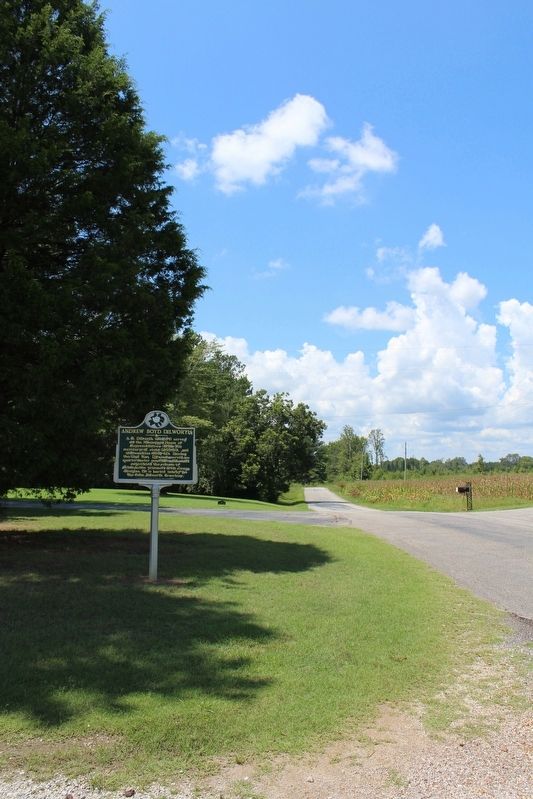
A.B. Dilworth (1814-1894) served in the Mississippi House of Representatives (1846-1850), secretary of state (1855-1860), and state auditor (1861-62). During the Civil War, Dilworth served as quartermaster general in Iuka and negotiated the release . . . — — Map (db m155403) HM
New Hope Presbyterian Church was organized in 1838 when six members began meeting in a school house near Troy, later renamed Danville. Rev. James B. Stafford served as the first pastor or the church from 1838 to 1854. The first sanctuary was a log . . . — — Map (db m155410) HM
Tents, army wagons and soldiers crowd the area around the railway depot and Tishomingo Hotel in this view. Over the course of the war it is estimated that about 300,000 troops served in Corinth or passed through this railroad junction. Civilians, . . . — — Map (db m51752) HM
On the morning of October 4, 1862, nearly 20,000 Confederates under Maj. Gen. Earl Van Dorn launched a massive assault on Maj. Gen. William S. Rosecrans' 20,000 Federal soldiers defending the interior line of Corinth's entrenchments. Attacking from . . . — — Map (db m63296) HM
“A fearful hand-to-hand fight was raging in the heart of the town – around the railroad depot, the Tishomingo Hotel, the Corinth House, and even in the yard around the headquarters of General Rosecrans, the old Duncan . . . — — Map (db m155254) HM
The famous long distance railroads intersecting in Corinth in 1862 formed two links in a shaky network of rails crisscrossing Mississippi and her neighboring states. This network proved critical when General Albert Sidney Johnston began . . . — — Map (db m155252) HM
“I was in the battle of Shiloh from the opening gun to the close; and while I was very young, the impressions made on my mind are vivid and lasting.”
Here in his boyhood home Thomas Dudley Duncan penned the story of those . . . — — Map (db m155251) HM
The firefighting apparatus displayed is a 1924 American LaFrance Type 75 triple combination pumper, chemical tank and hose car. Manufactured by the American LaFrance Company of Elmira, New York, it was delivered to the Corinth Fire Department by . . . — — Map (db m183952) HM
Civil War Dead
An estimated 700,000 Union and Confederate soldiers died in the Civil War between April 1861 and April 1865. As the death toll rose, the U.S. government struggled with the urgent but unplanned need to bury fallen Union troops. . . . — — Map (db m219989) HM
Dedicated to the memory of all those from Alcorn Co. who gave their lives in service of our country
ARMY - MARINES - NAVY - AIR FORCE
World War I
Perry A. Johns
John O. Power
Roy D. Todd
Oscar D. Wells
World War II . . . — — Map (db m184612) WM
And be it further enacted, That any person who shall willfully destroy, mutilate, deface, injure, or remove any monument, gravestone, or other structure, or shall willfully destroy, cut, break, injure, or remove any tree, shrub, or plant within . . . — — Map (db m89097) HM
William Lane Duncan moved his dry goods operation to Corinth in 1858. Already a local leader, the South Carolina native had twice won elections as Tishomingo County sheriff.
To accommodate his growing family, Duncan built this house at the . . . — — Map (db m155261) HM
Only extant redan of six built in 1862 by U.S. troops as outer defense south and west of town. Taken on Oct. 3, 1862, by C.S. forces after fierce fighting. Battle resumed on Oct. 4, but C.S. troops forced to withdraw. — — Map (db m66613) HM
Site of Battery Williams. On Oct. 4 the cannonade from here devastated the Confederate troops attacking Battery Robinette. The advance failed, forcing Gen. Van Dorn to withdraw his forces. — — Map (db m50324) HM
The South suffered a strategic disaster when Corinth and its railroads fell to Union forces on May 30, 1862. The destruction of the Union force garrisoned in Corinth and recapture of this rail center quickly became vital Confederate objectives. In . . . — — Map (db m66676) HM
Site of Battery Powell, one of the chain of seven redoubts built by Union troops to anchor the interior defensive line about the city. Captured briefly at noon on October 4 by CS Army forces after fierce fighting. — — Map (db m285753) HM
Genre-spanning keyboardist and songwriter
Bobby Emmons, a Corinth native, embarked upon
a music career in his teens. As a member of the
revered American Sound Studio house band in
Memphis, his Hammond organ both anchored
and enlivened pop, . . . — — Map (db m285747) HM
S. 3/10 mi. to rear of school. Of unique circular design, about 50 ft. in diameter, this pit was one of series built in 1862 as second line of defence against U.S. troops advancing from Shiloh. — — Map (db m50318) HM
The caboose was built in 1970 by the International Car Company of Kenton, Ohio. It operated on the Gulf, Mobile and Ohio Railroad until 1972 when the G,M & O merged with the Illinois Central Railroad forming the Illinois Central Gulf Railroad. In . . . — — Map (db m107788) HM
Earliest evidence of Corinth's
settlement. Oldest cemetery
in city with first burial
dated 1842. The city owned
the site from 1874 to 1940
when deeded to City Cemetery
Association, endowed by
Shelby H. Curlee. — — Map (db m220000) HM
Dedicated to the recipients' of this Nation's oldest military decoration "The Purple Heart"
My stone is red for the blood they shed the medal I bear is my country's way to show they care. If I could be seen by all mankind maybe peace will . . . — — Map (db m184195) HM
The Corinth Contraband Camp offered former slaves the first step toward self-sustainability and freedom through profitable farming. These men, women and children grew 300 acres of cotton and 400 acres of vegetables. All of the crops were sold, and . . . — — Map (db m153404) HM
Began 1854 as Cross City. Proximity to Tennessee River and the railroads made it of great strategic value during Civil War. Battle of Corinth fought here, Oct. 3-4, 1862. — — Map (db m21305) HM
Began 1854 as Cross City. Proximity to Tennessee River and the railroads made it of great strategic value during the Civil War. Battle of Corinth fought here, Oct. 3-4, 1862. — — Map (db m66533) HM
(front)
Col. W.P. Rogers
2nd Texas Reg't.
Killed at Ft. Robinette
Oct. 4, 1862.
As long as courage, manliness and
patriotism exist, the name of
Rogers will be honored among
men. He fell in the front of
battle in the . . . — — Map (db m89036) WM
This view of Corinth appeared in Frank Leslie's Illustrated Newspaper, June 21, 1862, not long after the Union army captured the town. Despite some inaccuracies, it depicts a scene familiar to many thousands of troops from both armies. . . . — — Map (db m51758) HM
On the morning of October 4, 1862, in an effort to retake Corinth's critical railroad junction, Confederate forces under Major General Earl Van Dorn launch a massive assault on Major General William Rosecrans's Union garrison. For a brief, . . . — — Map (db m183989) HM
Organized before 1848. Here in 1853 M.P. Lowery was ordained & in 1885 John Allen was dubbed "Private". Town destroyed in Civil War & abandoned because R.R. by-passed it. — — Map (db m155237) HM
Corinth's oldest church bldg.; erected 1871 by Cumberland Presbyterian Church, the First church est. in Corinth. 1906~1976 served as Fillmore St. Pres. Ch. Now used as chapel by First United Methodist Church. — — Map (db m28472) HM
In 1934, a group of local businessmen and farmers
met in the back of a furniture store in Corinth
and created the Alcorn County Electric Power
Association (ACEPA). Chartered on January 17,
1934, ACEPA began operations on June 1.
With local . . . — — Map (db m219996) HM
On May 10, 1863, troops of the Corinth garrison stacked their arms and gathered near the Verandah House for a speech by U.S. Army Adjutant General Lorenzo Thomas. At its former location just around the corner, Duncan House would have been an ideal . . . — — Map (db m155259) HM
W. 1/2 mi. Now Confederate Park. Here, Oct. 5, 1862, during Battle of Corinth, occurred a C.S.A. charge as heedless of cost as those of Pickett at Gettysburg and Light Brigade at Balaclava. — — Map (db m66738) HM
Built about 1857 for Hamilton Mask. Used in Civil War as Hq. of Generals Braxton Bragg, H.W. Halleck, and John B. Hood. Donated to Corinth in 1960 by S.H. Curlee family. — — Map (db m66558) HM
Site of hq. of Gen. Ulysses Simpson Grant in June, 1862. In mid-July Grant removed to plantation home of F. E. Whitfield, Sr., about 1 mi. S. of Corinth. — — Map (db m238370) HM
Founded in 1879 by the Milton B. Henry family on land sold by the Chickasaws to the U.S. government in 1832. Henry purchased 160 acres in 1856. Robert Henry Young, an infant grandson of M.B. Henry, was the first person buried here. The Henry . . . — — Map (db m66591) HM
Site of hq. of Gen. Albert Sidney Johnston, April 1~4, 1862. After his death at Shiloh, April 6, body was brought here where it lay in state, April 7, 1862. — — Map (db m29280) HM
Explored 1540-1, by De Soto. Colonized first by French, 1699. Became a colony of British, 1763; Spanish, 1779. Territory organized by U.S., 1798. Became 20th. state, 1817. — — Map (db m235748) HM
Built in 1857 for Judge W.H. Kilpatrick. Used in Civil War as headquarters of General Leonidas Polk. Bought in 1866 by Mrs. Thomas Quincy Martin and occupied continuously by her descendants. — — Map (db m66557) HM
Judge W.H. Kilpatrick of Corinth had Oak Home built in 1857 by Tom Chesney, a local house designer and builder. Mr. M.S. Miller, a civil engineer working in Corinth shortly before the war, made this sketch in 1860, the only known Civil War vintage . . . — — Map (db m66700) HM
William H. Moss received a tavern license in 1857 for his new inn, the Moss House Hotel. After the Battle of Shiloh, the Moss House, like Corinth's other hotels and public buildings, was pressed into service as a hospital. When Union troops occupied . . . — — Map (db m183650) HM
This now deactivated artillery round was recovered from the western side of the October 1862 Corinth battlefield. Called spherical case, this hollow projectile contained a small bursting charge of gunpowder, surrounded by 450 balls, each of .69 . . . — — Map (db m155257) HM
This 5-gun Union battery stood between the attacking Confederates and Corinth's inner defenses. As the Battle of Corinth progressed, Confederate troops of Brig. Gen. Dabney H. Maury's division crossed the railroad and attacked from the north; Maj. . . . — — Map (db m66689) HM
Among Corinth’s countless stories of personal wartime tragedy is that of General Albert Sidney Johnston, Confederate Commander of the War in the West, who made his headquarters in Rose Cottage. After Johnston received a fatal wound at the Battle of . . . — — Map (db m29291) HM
(Main Plaque): Here a newly freed people took their unswerving first steps on the long road to full citizenship. (Side Plaque): "This is a great opportunity afforded your race. Will you improve it?" --Lorenzo Thomas, Adjutant General, . . . — — Map (db m182915) HM
The Corinth House stood in the distance, facing the historic railroad crossing and the Tishomingo Hotel. This photograph shows it after the Union Army occupied Corinth.
In the exciting months before Corinth fell to the Union Army in 1862, . . . — — Map (db m51757) HM
Corinth City Hall now occupies this site, but early in the war the Houston Mitchell family lived in this spacious home. A favorite house among the general officers who served in Corinth at various times, the Mitchell residence was used as . . . — — Map (db m88942) HM
The Moss House, one of Corinth's popular hotels, stood across this intersection. When the Union army occupied Corinth in 1862, the Provost Marshal established headquarters in the building. Army officers who served as provost marshal had the . . . — — Map (db m66739) HM
Confederate and Union armies occupied Corinth throughout the war and whether planning battles or attending to the details of garrison life, staff officers were a frequent presence in this home. Col. Thomas Jordan, Beauregard’s chief-of-staff and the . . . — — Map (db m155260) HM
With the outbreak of the Civil War, the NE Miss. Village of Corinth assumed a strategic value surpassing all but a few Southern cities. Here the South’s two longest railroads met. The junction of the Memphis and Charleston (the South’s only E-W . . . — — Map (db m155231) HM
(Front): Texas remembers the valor and devotion of its sons which served at Corinth and its surrounding environs during the Western Campaign of 1862.
Here in the days following the retreat of Southern forces from the battlefield of . . . — — Map (db m42632) HM
"The heavy artillery will be placed in best positions to command the roads and approaches from the quarter of the enemy." P.G.T. Beauregard, April, 1862. The important railroad junction at Corinth had to be protected. In the spring of 1862 . . . — — Map (db m153498) HM
One of Corinth's founders, surveyor Hamilton Mask, built this Greek Revival home in 1857, pictured above as it appeared about 1862. It became known as the "Verandah House" because of its porches and served as headquarters for both Union and . . . — — Map (db m88943) HM
Built in 1857 by William L. Duncan, the Duncan House was the headquarters of Confederate general P.G.T. Beauregard after the Battle of Shiloh. In June 1862, Union general William Rosecrans made the house his headquarters during the Battle of . . . — — Map (db m155235) HM
Built shortly before the Battle of Corinth by W.L. Duncan, this five-room frame house originally stood on Jackson Street, around the corner from here. Several remodelings give the house a newer look than is shown in the 19th century sketch above, . . . — — Map (db m155236) HM
The Historic Corinth Railroad Junction is, and always has been, 1500 feet south of this location.
The rails here were used at the junction and replaced in the course of time. Here they serve as a reminder of the importance of the railroads to . . . — — Map (db m155250) HM
Here, at the hub of activity in 1862, stood the Tishomingo Hotel. The railway station (hidden by the train) is at the crossing of the Mobile & Ohio and Memphis & Charleston railroads. The Tishomingo was popular as an unofficial railway station and . . . — — Map (db m51753) HM
In 1991, the Secretary of the Interior designated sixteen Civil War historic sites in and around Corinth, Mississippi, as the Siege and Battle of Corinth National Historic Landmark District.
A National Historic Landmark (NHL) is officially . . . — — Map (db m183967) HM
This unusual Civil War photograph captures a news event as it is happening, rather than recording its aftermath. In the middle of the scene is a canvas topped speakers platform from which Union Adjutant General Lorenzo Thomas is speaking to . . . — — Map (db m89030) HM
Not a "spit and polish" outfit, but tough and practical fighters. A Civil War photographer caught this group in a candid mode. Before the 1850s, the public's conception of battle formed mostly from romanticized drawings and paintings. Photography . . . — — Map (db m51755) HM
Looking northwest in this view along the right-of-way of the Memphis & Charleston RR, you can see the earthworks of Battery Williams to the left of the tracks. Battery Robinett lies in the distance to the right. One of the many military tent camps . . . — — Map (db m29273) HM
For six months in 1862, the fight to control Corinth’s crucial railroad crossover made the young town second only to Richmond in military importance.
Noting her location at the junction of the two longest railroads in the South, General Ulysses . . . — — Map (db m155253) HM
For six months in 1862, the fight to control Corinth’s crucial railroad crossover made the young town second only to Richmond in military importance.
Noting her location at the junction of the two longest railroads in the South, General Ulysses . . . — — Map (db m183991) HM
"The array of modern machinery, representing a vast outlay of capital, the little army of men and women - chiefly the latter - working together in concentration and harmony that denote superb administration, the high-ceilinged, . . . — — Map (db m183943) HM
(front)
Rogers
Erected by the Texas Div.
United Daughters of the
Confederacy
the surviving members of the
family,
and admiring friends
August 15, A.D. 1912.
(back)
William P. Rogers
A native of Alabama . . . — — Map (db m89042) HM WM
—Three weeks after its victory at Shiloh on April 6-7, 1862, the Union army continued its advance on Corinth.
Farmington village stood here when the war arrived at Corinth in 1862. Its residents felt the first impact of battle. . . . — — Map (db m285754) HM
E. 9 mi. Founded 1836 as seat of “Old” Tishomingo, including present Alcorn & Prentiss counties. Named for battle of San Jacinto. Courthouse dates from 1854. Lost county seat, 1870. Home of Sen. E.W. Carmack. — — Map (db m77399) HM
Settled in 1840 as New Hope. Name changed to Kossuth in 1853 to honor Hungarian patriot Louis Kossuth. Home of Col. M.P. Lowery, found of Blue Mountain College. A skirmish occurred here during the Civil War. Alcorn Agricultural High School was . . . — — Map (db m155411) HM
(Side 1)
Samuel L. Neely (19) enlisted April 30th, 1861 at Corinth, Mississippi in Co. A (Tishomingo Riflemen) 2nd Reg't Mississippi Volunteers. Neely was in 16 battles and wounded in 7. He died August 21st, 1864, two days after he was . . . — — Map (db m155401) HM WM
Benton County was established in 1870 and was formed from portions of Tippah and Marshall counties. Lewis J. McDonald donated land for Ashland, which was incorporated in 1871 and named the county seat. The Benton County Courthouse was designed by . . . — — Map (db m171379) HM
(front)
A memorial to Benton Countians who gave their lives in service for their country.
W.W.I
Homer Beasley • Chaille Ferrell • Alfred Whitten • Robert Wynn
W.W.II
Preston C. Gresham • M.B. Brown Jr. • Olice J. Vauter • . . . — — Map (db m171413) WM
As a producer, studio engineer, trumpeter and bandleader, Willie Mitchell played a central role in the rise of Memphis as a center for soul music. Mitchell, born in Ashland on March 1, 1928, made many recordings under his own name, including . . . — — Map (db m171412) HM
Here, after a successful raid on the Federal supply base at Holly Springs the day before, Confederate troops led by Maj.~Gen. Earl Van Dorn were repelled by approx. 250 Federal troops posted at Davis Mill. — — Map (db m171375) HM
On October 14, 1862, Confederate Gen. John Pemberton assumed command in Mississippi and east Louisiana. Eleven days later, Gen. Ulysses Grant became commander of Union forces in the region. Over the next 8 1/2 months, their forces fought for control . . . — — Map (db m84782) HM
Front
The musical heritage of Calhoun County was illuminated in 2014 via international acclaim for longtime Bruce resident and Sabougla native Leo “Bud” Welch, The guitarist and vocalist began playing blues in his teens and returned to . . . — — Map (db m107618) HM
Dedicated
to the memory
of
all citizens
of
Calhoun County
Mississippi
who gave their lives
in the service
of
our country
________
World War I
World War II
Korean Conflict
Vietnam Era
________
1917 — . . . — — Map (db m108753) WM
First settler in what is now Calhoun City. Born 1776. Left S. Carolina in 1817 for Alabama. Came to Mississippi in 1840. Pioneer, politician, patriot, planter. Died October 20, 1855. Buried on old homesite ½ mi. NW. — — Map (db m107543) HM
During a raid in the winter of 1864-65, Union Brig. Gen. Benjamin Grierson's cavalry encountered Confederates at Egypt Station on the Mobile & Ohio R.R. The Confederate force included a large number of former Union prisoners of war released on . . . — — Map (db m107541) HM
Schoolhouses have occupied this site since Mississippi Normal College was established here in 1888. The college served as both a grade school for local pupils and a boarding school for college students. Classrooms and an auditorium occupied a pair . . . — — Map (db m155311) HM
(Side 1)
Houston area native Booker T. Washington White (c. 1904–1977) was one of the most expressive vocalists and powerful slide guitarists in the blues. A remarkable lyricist as well, he recorded such classics as “Shake ‘Em On . . . — — Map (db m155277) HM
(Marker #1)
Prehistoric Trade
Raw materials and articles from distant areas reached the Indians of the Bynum site by trade along trails that were the forerunners of the Natchez Trace.
Spool-shaped objects made of . . . — — Map (db m84830) HM
Estab. in 1909, this is one of Mississippi's oldest community libraries and its first Carnegie library. School superintendent L.B. Reid secured money from Andrew Carnegie Foundation for this facility. — — Map (db m107610) HM
(Front Side)
Dedicated to the men
of Chickasaw County
who served in the War for
Southern Independence
1861 - 1865
(Back Side)
Infantry
2nd Miss. Regiment, Co. G
6th Miss. Regiment, Co. F
9th Miss. Regiment, . . . — — Map (db m97568) WM
Dedicated to the citizens
of Chickasaw County
who served our country
in peacetime and war
with honor
Dedicated to the memory of all boys of Chickasaw County who gave their lives in service to their country
World War I
John R. . . . — — Map (db m97569) WM
On Natchez Trace. Named for Sam Houston, friend of Joel Pinson, donor of site. Made county seat at creation of Chickasaw Co., Feb. 9, 1836. In 1909 state's first Carnegie library built here. — — Map (db m107556) HM
Light Columns are architectural features that flank the main entrance steps of many public and government buildings. It is rare to find them on public buildings in small communities, but Houston High School, constructed in 1927, possessed two of the . . . — — Map (db m155310) HM
This monument marks the Natchez Trace through Chickasaw County. By the Treaty of Pontotoc in 1832, the Chickasaw Indians ceded to the United States their lands east of the Mississippi. In 1801-1802 the old Indian trail was converted into a wagon . . . — — Map (db m97567) HM
The original charter to construct what would eventually become the OH& CC Railroad was granted to the Grenada, Houston & Eastern Railway Company on February 6, 1860. Construction did not begin until 1902, with the first train reaching Houston in . . . — — Map (db m155275) HM
Erected in 1982 in honor of Joel Pinson who donated 80 acres original survey for the town of Houston in 1836. He requested it be named for his friend, Sam Houston, previous governor of Tennessee and only president of Republic of Texas. — — Map (db m97570) HM
The first archaeological work at Owl Creek Mounds was supervised by Moreau Chambers in August, 1935. He was employed by the Mississippi Department of Archives and History and assisted by Slater Gordon. E.T. Winston, a Pontotoc journalist and local . . . — — Map (db m84697) HM
In the summers of 1991 and 1992, archaeology field schools from Mississippi State University worked to learn more about the site. Most of the excavations were done on top of Mounds I and II, with small test units dug into Mounds III, IV, and V. . . . — — Map (db m84698) HM
Owl Creek Mounds were built between 800 and 900 years ago and were used for only about 100 years. This was determined by the dating of charcoal samples collected at the site and by studying the artifacts and type of building remains found in the . . . — — Map (db m84699) HM
Hernando De Soto landed in Florida at Tampa Bay in May, 1539. His army numbered around 800 Spaniards including two women. He also had 240 horses and several pigs. The expedition traveled through the Southeast to Texas and returned to the Mississippi . . . — — Map (db m84690) HM
The first humans came to North America by crossing the Bering Strait land bridge, which connected Siberia and Alaska. Their descendants arrived in this part of Mississippi nearly 12,000 years ago. The oldest mounds in the state were built by people . . . — — Map (db m84696) HM
Born circa 1760, William Colbert was a notable Chickasaw warrior. He fought in the American Revolution and beside Piominko in the 1790s. George Washington appointed him a major general in 1795. In 1813, William helped the Americans fight the Red . . . — — Map (db m155285) HM
501 entries matched your criteria. The first 100 are listed above. Next 100 ⊳