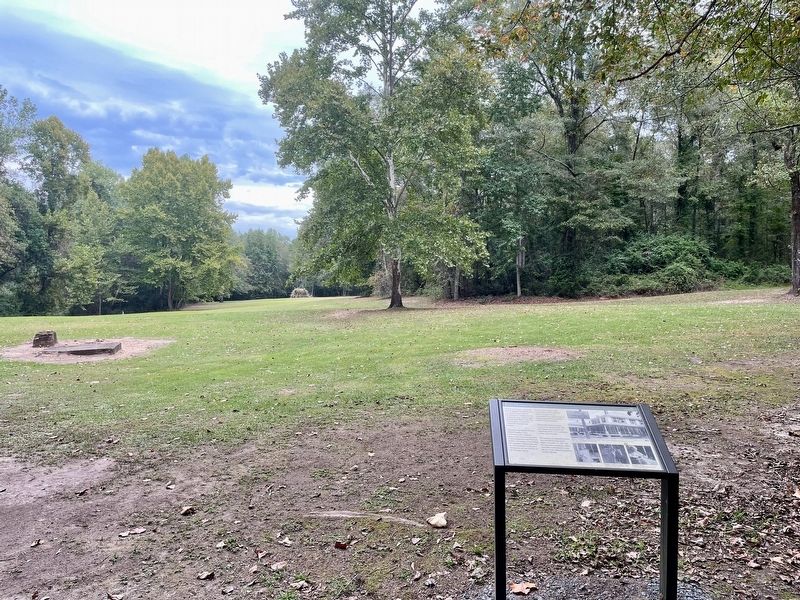
Erected on this site in 1904 by the
State of Alabama, the Hospital was
constructed to meet what was
described as the "pressing need" for
medical care of the veterans at the
Confederate Soldiers' Home. This
25-bed facility was said to . . . — — Map (db m206691) HM
T.V. McCoo High School
In 1957, Eufaula citizens supported a bond issue that included, among other education projects, construction funds to relocate and build a new Van Buren High School facility. Completed in the same year, the campus was . . . — — Map (db m197392) HM
Montebrier was built in 1866–67 for John William Mallet, a renowned scientist and educator and former Superintendent of Confederate Ordnance Laboratories. He came to Brierfield to assist General Josiah Gorgas, former Confederate Ordnance Bureau . . . — — Map (db m292815) HM
When seven injured "Freedom Riders" arrived at the Hospital on
this date, the mob that had attacked them earlier in the day
followed. The Riders were testing desegregation of public
transportation in the South by riding buses. The bus they . . . — — Map (db m106647) HM
In the early 1940s, all of the buildings
on Block 148 were demolished to make
way for two new buildings, the USO
Recreation Center and a public health
building. Paul W. Hofferbert designed the
USO building for the Army. Hofferbert
was a local . . . — — Map (db m217677) HM
This Church was used for a
Confederate Hospital
During the War
Between The States
Erected by
General John H. Forney
Chapter U.D.C. Sept 27, 1937 — — Map (db m36539) HM
This general practitioner's office is the only remaining structure of its type in northeast Alabama. It was built on the court-house square about 1850 by Dr. J. C. Francis, a beloved family doctor who served Jacksonville for more than 50 years. He . . . — — Map (db m23350) HM
Mose Hampton bought his freedom prior to the Civil War. He was a builder, assisted in laying out and surveying the town of Centre, a minister in the Episcopal Methodist North, and an inventor. Mr. Hampton owned land in the vicinity of this marker on . . . — — Map (db m120046) HM
Two cedar trees were planted and dedicated at the Alabama Confederate Soldiers' Home on February 12, 1928 in memory of Mrs. Sarah H. Bellinger and 1st Lt. Robert C. Norris.
Mrs. Bellinger and her husband, Dr. Carnot Bellinger, established the . . . — — Map (db m129412) HM
An Experimental Plant
During World War 1, construction of the first ammonia synthesis plant in the U.S. began on this location in October 1917. With plans acquired by American and British espionage, construction of U.S. Nitrate Plant No. 1 . . . — — Map (db m183927) HM
One of the framers of the
constitution of the State
of Ala, represented Monroe
Co. in the first legislature
of the new state in 1819, rep-
resented Butler, Conecuh &
Monroe Cos. in the State Sen-
ate 1820-1842-1845. He was the . . . — — Map (db m81321) HM
This two and a half story structure with unusual lower front extension was the home of Dr. John Watkins. Dr. Watkins was one of the first and few physicians in this part of the Mississippi Territory. Before coming to Burnt Corn, he lived in . . . — — Map (db m81297) HM
This pioneer surgeon, teacher and medical statesman was born May 12, 1922 in Evergreen. He worked at Conecuh Drug Company as a youngster and graduated from Evergreen High School (1940). His undergraduate degree was received from the University of . . . — — Map (db m81289) HM
Born into poverty in Nymph, Conecuh County, on March 3,
1912. Moddie Daniel Taylor was the only child of Herbert
and Celeste (Oliver) Taylor. After the family relocated
to Missouri, Taylor attended Lincoln University,
graduating as . . . — — Map (db m283840) HM
Preservation of this Weiss Cottage was initiated by the Cullman County Historical Society and implemented by the Cullman County Federation of Women’s Clubs, City of Cullman Bicentennial Commission and the City of Cullman Community Development . . . — — Map (db m33836) HM
Thomas Monroe Corbin and his wife, Ella, settled here in 1894 on 80 acres and built a home. As pioneers, they cleared the ground with crosscut saws, draft horses, double-bit axes, and shovels. Rocks from the field, removed with a horse-drawn slide, . . . — — Map (db m160656) HM
The Howell House was built in 1907 by Dr. Samuel Matthew Crawford Howell, Midland City's first doctor. City Hall was established here December 17.1992.
Mayor
Joe Bob Parker
Councilmen
Clarence Shirrah · Paul Davis · Wiley Gibson · . . . — — Map (db m191351) HM
Constructed in c. 1900 by G. P. Dowling, the Dowling-Steagall House is a Classical Revival dwelling featuring a full-height portico with Ionic columns and an elaborate door surround. A judge and prominent businessman, G. P. Dowling organized Ozark's . . . — — Map (db m36510) HM
This Marker is placed here as a memorial to
Dr. Eratus Byron Ard
and his wife
Zenada Byrd Ard
and to their family who occupied this property from 1895 to 1971.
Their children were:
Ligon Briggs Ard
Toxey Ard Sorrell . . . — — Map (db m184073) HM
The Cahaba Drug Store once covered this cellar hole. It was operated by Herbert Hudson and J. D. Craig.
On the same lot were T. L. Craig's large family grocery, Coleman's dry goods store, and Fellows' Jewelry.
All these men were related . . . — — Map (db m23008) HM
The Drug Store
This hole was once the cellar beneath a
drug store operated by Herbert Hudson
& James D. Craig. They sold medicines,
chemicals, paints, perfumes, and cigars.
On the same lot was Thomas L. Craig's
large family . . . — — Map (db m150849) HM
This Greek Revival dwelling was built c. 1850 by Dr. Albert Gallatin Mabry, a prominent physician and member of the Alabama Legislature. Dr. Mabry was a leader in organizing the Alabama State Medical Association and instrumental in passing . . . — — Map (db m83580) HM
William Bartram, America’s first native born artist-naturalist, passed through Elmore County during the Revolutionary era, making the first scientific notations of its flora, fauna and inhabitants. In 1776 the appointed botanist of Britain’s King . . . — — Map (db m69431) HM
This cemetery was established in 1854 when Pilgrims' Rest Baptist Church was founded across the road on September 17 in that same year. The cemetery remained prominent in Alco even though the original congregation moved and Alco Methodist Church . . . — — Map (db m130672) HM
On January 25, 1925 the Sisters acquired the 25 - bed Gadsden General Hospital on Chestnut Street and renamed it Holy Name of Jesus Hospital. The Hospital grew under the leadership of the Founders, Father Thomas A. Judge, C. M. and Mother Mary . . . — — Map (db m39141) HM
This is the site of the family home of Gadsden native General William Luther Sibert who played a major role in the construction of the Panama Canal. While serving in the U.S. Army Corps of Engineers, he was appointed chief engineer for the Atlantic . . . — — Map (db m39253) HM
Built in 1828-29 by John Gayle,
sixth governor of Alabama.
Birthplace of
Amelia Gayle Gorgas,
wife of Gen. Josiah Gorgas,
Chief of Ordnance, CSA,
mother of Wm. Crawford Gorgas,
US Surgeon General who freed
Canal Zone of yellow fever. . . . — — Map (db m83754) HM
Son of a beloved country doctor, he carried a dedicated spirit to the frontiers of science
Having won degrees at Alabama, Auburn, Missouri, Harvard and Cornell, he taught at Cornell, . . . — — Map (db m38191) HM
The original builders of the Omussee Creek mound
had abandoned the site by around 1550, but the
area continued to be occupied by Native American
groups well into the early nineteenth century. As early as
the 1630s, Spanish missionaries from . . . — — Map (db m115037) HM
Front of Marker:
Opened as Alabama Medical College in 1859 in Mobile by Josiah C. Nott and other physicians as part of the University of Alabama. Closed by the Civil War in 1861 it reopened in 1868. Reorganized in 1897, it became the . . . — — Map (db m83838) HM
Built 1940, 1420 7th Ave. N.
The Ballard House honors a time when thriving
neighborhoods; businesses, churches, social, cultural,
and civic organizations; made up a dynamic
African-American community during the first half of
the 20th . . . — — Map (db m187886) HM
In Tribute to
Pauline Bray Fletcher
1878 - 1970
The First Black Registered Nurse of Alabama
Through self-sacrifice, perseverance founded in 1926 Camp Pauline Bray Fletcher.
Renewing the faith and the good health of all black . . . — — Map (db m27393) HM
Dr. Mortimer Harvie Jordan and his wife, Florence E. Mudd, constructed their home between 1906 and 1908. After service in the Confederate army, Jordan studied medicine in Cincinnati and New York (under Alabama's famous gynecologist, Dr. J. Marion . . . — — Map (db m26743) HM
Named for St. Vincent de Paul, founder of the Daughters of Charity in France in 1633, the hospital opened December 20, 1898 in the temporarily rented Henry F. DeBardelaben mansion at 206 15th Street South. Father Patrick A. O’Reilly founded the . . . — — Map (db m27523) HM
The City of Hoover has grown rapidly since its incorporation in 1967 from a small four block area west of this site. A metal shed behind Employers Ins. Co. became the first fire station and “city hall.” A bank, grocery, hardware, drug . . . — — Map (db m28448) HM
1,000 feet East a small group of tents erected May, 1910 by the
Anti Tuberculosis Association of Jefferson County
constituted the first effort to aid victims of tuberculosis in North Alabama. — — Map (db m26964) HM
This boulevard was named in honor of Dr. Leonard Jerry Hicks by the City of Florence in 1981. Dr. Hicks was a prominent Black leader of the community and was recognized for his skills as a physician across the State of Alabama. He was born September . . . — — Map (db m35257) HM
Dr. Ellen D. Hoffleit, celebrated worldwide for her many contributions to astronomy, discovered more than 1,200 variable stars. She authored Yale Bright Star Catalogue which is used in almost every astronomical observatory in the world. . . . — — Map (db m219302) HM
On this site Nicholas Marcellus Hentz conducted a girls' school. Native of Metz, France, Hentz was a painter, entomologist, author, and was once a professor at University of North Alabama. Experimenting with silkworms, he planted groves of mulberry . . . — — Map (db m84029) HM
Side 1 Following an outbreak of the dreaded plague, smallpox (Variola), at Florence during the winter of 1865-66, the Board of Alderman adopted a resolution on January 2, 1866, that a Pesthouse be “erected at the vineyard as soon as . . . — — Map (db m84043) HM
Constructed by 1830 by Leroy Pope as a Stagecoach Stop, Tavern and Inn and named Pope's Tavern.
The building was used as a Hospital by both Union and Confederate Soldiers during the War between the States.
In 1874 it as purchased for a . . . — — Map (db m212435) HM
As an accomplished scientist, Jesse C. James did groundbreaking studies of Venus, Mars, and the Sun; and he managed the Harvard Astronomy Station in Texas. He garnered 12 patents and authored 22 papers in scientific journals.
Inducted 2019
City . . . — — Map (db m219180) HM
Side A
This circa 1820 house is thought to be one of the oldest houses in Courtland. Occupying a lot platted by the Courtland Land Company in 1818, the house faces North toward what was once the main Tuscumbia Road. Dr. Jack Shackelford . . . — — Map (db m84306) HM
A scientist of national fame, Peters (1810-1888) lived for many years in Moulton with his wife Naomi (Leetch), a relative of President James K. Polk, who possibly visited here. A man of many talents, Peters was a noted linguist, early civil rights . . . — — Map (db m69670) HM
(Side 1)
Dr. Charles Cary, a native of Iowa and graduate of Iowa State in 1887, came to Auburn in 1892 and taught the first class of veterinary medicine at Alabama Polytechnic Institute. He has been called the Father of Veterinary . . . — — Map (db m74436) HM
The East Alabama Methodist College occupying this site was used as a Confederate hospital
1864 • 1865
1888
Alabama Polytechnic Institute
Agricultural & Mechanical College
Burned June 24, 1887. — — Map (db m183920) HM
On this site in 1939, the Regional Laboratory for
Animal Disease Research (RLADR) was established at
Alabama Polytechnic Institute (API) during Dr. Luther
Duncan's presidency. The US Congressional Act of 1935
(PL 74-182) called for the . . . — — Map (db m294768) HM
Side 1
On February 9, 1876, the City of Opelika paid D.B. Preston $80 for two acres of land to establish an African-American section of Rosemere Cemetery. This rectangular area of the cemetery contains 176 blocks, with 16 being partial . . . — — Map (db m75139) HM
Dr. John Wesley Darden, was the first African American physician to treat patients within a 30-mile radius of Opelika. He built the Darden House in 1904, and later married Maude Jean Logan of Montgomery. Dr. and Mrs. Darden shaped many lives through . . . — — Map (db m75131) HM
In honor of Dr. J. W. Darden “A dedicated humanitarian, a builder of men, a physician, a Christian and a socially conscious citizen.” This marker honors Dr. Darden, his wife, Mrs. Jean Darden, the many teachers who gave so much of themselves to . . . — — Map (db m286106) HM
Founded in 1951, J.W. Darden served as Opelika's African American high school until integration in 1972. The school's namesake, Dr. John Wesley Darden, was the first African American doctor in Lee County. The school fostered pride and served as the . . . — — Map (db m285898) HM
01: Looking south on Railroad Street.
02: McWilliams Store, June 1913.
03: Drugstore interior, 1940s.
04: Citizens' Bank, early 1900s.
05: Elkmont Post Office, circa 1900s.
06: Telephone switchboard, early 1900s.
07: Elkmont Post . . . — — Map (db m93856) HM
Pettusville was named for Dr. Thomas Coleman Pettus (1816-1890) who came from Lunenburg Co., Virginia and purchased land that encompassed Bailes Hollow in the late 1840s. Dr. Pettus discovered seven "medicinal springs” deep in the hollow. The . . . — — Map (db m154186) HM
The camp on this site served as a military hospital, a camp of conscription and instruction, a supply depot, and a cemetery during the War Between the States. At one time, there were hundreds of headstones and rocks marking the final resting place . . . — — Map (db m73529) HM
It was under this tree that participants in the U.S. Public Health Study of Untreated Syphilis in Negro Males in Macon County, Alabama, met to wait for Nurse Rivers, the Shiloh School nurse, to come and either administer treatment, update health . . . — — Map (db m95113) HM
Oldest Identified Grave Site: 1881.
Grave sites include participants of the
U.S. Public Health Study of Syphilis in
Untreated Black Males, 1930-1972.
Designated State of Alabama Historic Site: 2006 — — Map (db m151227) HM
Shiloh-Rosenwald School
The Shiloh-Rosenwald School, located in Notasulga, was a collaboration between educator Booker T. Washington and Julius Rosenwald, CEO of Sears. Rosenwald schools are landmarks in the history of African-American . . . — — Map (db m95109) HM
William Bartram, America's first native born artist - naturalist, passed through Macon County during the Revolutionary era, making the first scientific notations of its flora, fauna and inhabitants. As the appointed botanist of Britain's King George . . . — — Map (db m99676) HM
The Tuskegee Veterans Administration Hospital (VA), established in 1923, is significant as the first VA hospital in the nation to be administered by an all African American medical staff.
After WWI, African American veterans found it difficult . . . — — Map (db m101900) HM
On February 10, 1940 George Washington Carver signed the deed of gift establishing the Carver Foundation with a $33,000 contribution from his personal savings. According to Carver, the foundation was established "for the purpose of combining . . . — — Map (db m101912) HM
The primary idea in all of my work was to help the farmer and fill the poor man's empty dinner pail . . .
—George Washington Carver
George Washington Carver taught classes and developed new products from peanuts, . . . — — Map (db m101938) HM
Let our societies spend less money in taking care of the sick, and much more money in promoting the health of the race . . . . Let us make health contagious in every community rather than disease. —Booker T. Washington, Address . . . — — Map (db m101940) HM
A life that stood out as a gospel of self-forgetting service. He could have added fortune to fame but caring for neither he found happiness and honor in being helpful to the world.
The centre of his world was the South where he was born in . . . — — Map (db m100165) HM
Situated on 167 acres of some of the most scenic land in North Alabama, the museum and its grounds contain items of local and national interest.
This property was willed to the City of Huntsville in 1955 by Dr. William Henry Burritt . . . — — Map (db m27876) HM
Over 200 soldiers were sent from Fort Barancas, Fl. each summer 1888 to 1898 to recuperate from yellow fever and malaria. Approximately 20 acres with a hospital. Joseph Boan, son of Mary and Sgt. Joseph Boan was born at Camp Monte Sano July 1888. . . . — — Map (db m154274) HM
(Front):Historic Viduta
"Viduta"-derived from Spanish "vida" meaning "life"
In a time when yellow fever, malaria, and cholera threatened, Dr. Thomas Fearn and his brothers Robert and George were drawn by the cool air and medicinal . . . — — Map (db m27795) HM
The Mobile Geological Laboratory (MOLAB) was built as part of the development of NASA's Lunar Roving Vehicle(LRV) program. NASA engineers and scientists studied a number of different concepts for vehicles to use on the lunar surface. This rover . . . — — Map (db m98200) HM
Used during the Apollo Lunar Landing Program of the 1960's and 1970's, the Saturn V rocket remains the largest, most powerful rocket ever built.
This full scale mock up was completed in July 1999 to serve as the focal point for the 30th . . . — — Map (db m85601) HM
A graduate student from The University of Alabama in Huntsville achieved a major advance in science at this site on January 29, 1987. He discovered that a material composed of Yttrium, Barium, Copper, and Oxygen would superconduct—show no electrical . . . — — Map (db m94963) HM
This plaque was placed here by citizens of Huntsville and Madison County, Alabama in honor of Dr. Wernher von Braun who directed research and development operations for the Army at Redstone Arsenal from 1950 to 1960, and served as Director of . . . — — Map (db m279895) HM
The first public school in Alabama built in 1835-36, used continuously since that time for the purpose of education except for a brief period during the Civil War when it was a hospital. Named for State Rep. Willoughby Barton of Mobile who was the . . . — — Map (db m143517) HM
Dr. Williams opened one of the early African-American drugstores- Live and Let Live on this site in 1901. Born on a sugar plantation in Louisiana, he graduated from Meharry Medical School in 1900 and was the second black physician to practice . . . — — Map (db m86393) HM
This was the residence of Dr. Franklin, who served the medical needs of Mobile for fifty-three years. He never turned an indigent patient away. Franklin was the only African-American to graduate from the University of Michigan in 1911. He opened his . . . — — Map (db m111350) HM
Dr. Harris, born April 6, 1868, in Montgomery, Alabama was one of the earliest black physicians to practice medicine in Mobile. He graduated in 1899 from Meharry Medical College in Nashville, Tennessee with dual degrees in dentistry and medicine. To . . . — — Map (db m86400) HM
On this site stood the Gov. John Gayle home, birthplace of William Crawford Gorgas, world famous sanitarian, Panama Canal Zone, 1902-14; Surgeon Gen. & Maj. General; conqueror of dread plagues of yellow fever and malaria. — — Map (db m98590) HM
(front side)Mobile’s Hidden Figures initiative originated from the Mobile United Leadership Mobile’s Class of 2017 inaugural Diversity and Inclusion team. The objective is to raise awareness of diverse community . . . — — Map (db m284650) HM
Built in 1830 by Thomas S. James, Mobile's third hospital has been preserved in its original design except for additions at each end, serving without interruption through disastrous fires, yellow fever epidemics, and war. For 83 years between . . . — — Map (db m86404) HM
Mobile Physician, 1829-1864. Son of Dr. Claudeus LeVert, who came to Virginia as fleet surgeon under General Rochambeau. This Italianate style building served as a doctor's office for one hundred years, 1858-1954.
Preserved by the action of the . . . — — Map (db m40667) HM
Established in 1947 by the Catholic Archdiocese of Mobile for the black community because segregation prevented black doctors from admitting patients to the City Hospital. Present building erected in 1950 and named for St. Martin de Porres, who was . . . — — Map (db m111355) HM
The cannon in front of you, buried muzzle-down during an
1873 land survey to mark a corner of the Mount Vernon
Military Reservation, is just one of many reminders that Mount
Vernon hosted important U.S. Army posts throughout the 19th
century. . . . — — Map (db m149304) HM
(obverse)
Mt. Vernon Arsenal and Barracks
Established 1828 by Congress to store arms and munitions for U. S. Army. Original structures completed 1830's.
Arsenal appropriated by Confederacy 1861; equipment moved to Selma . . . — — Map (db m70593) HM
The City of St Jude, always a refuge for African Americans, hosted the marchers on the last night of their journey. This religious complex—named for the patron saint of impossible situations—housed a school church and hospital and had a 36-acre . . . — — Map (db m91481) HM
(side 1)
City of St. Jude
Founded by Father Harold Purcell in the 1930s, the City of St. Jude included church, school, medical facilities, social center and rectory. Its mission was to provide spiritual, educational, social and . . . — — Map (db m86070) HM
This tablet marks the site of the office and infirmary of DR. J. MARION SIMS Here, in 1845, he performed the first closure of a vesico-vaginal fistula with wire suture, using a pewter spoon as speculum. This operation made him famous throughout the . . . — — Map (db m36576) HM
Hale Infirmary
On this site for nearly seven decades stood Hale Infirmary. It was
among 25 hospitals in Alabama, and the first in Montgomery, established during the Black Hospital Movement, an effort to overcome
healthcare inequities for . . . — — Map (db m240686) HM
Montgomery 1848-1849 Operations he devised cured a then considered hopeless malady—gaining him fame as a benefactor of women.
Founded—Women's Hospital—City of New York—-1855. Decorated by Emperor of France—Kings . . . — — Map (db m87208) HM
(Side A):Office of Dr. Luther Leonidas HillThis early 20th-century building was office of Dr. L.L. Hill who, in 1902, performed first open heart surgery in the Western Hemisphere when he sutured stab wound in young boy's heart. A . . . — — Map (db m86413) HM
Born on the west side of Holt Street, April 11, 1899, Percy Lavon Julian entered Depauw University in 1916; graduated in chemistry with Phi Beta Kappa honors. Earned master's from Harvard, Ph.D. at the University of Vienna. His studies led to a . . . — — Map (db m270170) HM
Born April 11, 1899, on the corner of Jefferson Davis Avenue and Holt
Street, Percy Lavon Julian was the eldest child of James S. Julian and
Elizabeth (Adams) Julian. He attended segregated public schools in
Montgomery and spent two years at . . . — — Map (db m270094) HM
The Plantanus orientalis is a descendant of the tree
under which Hippocrates taught the students of
medicine on the Greek Island of Kos around 400 B.C.
Hippocrates is often called the father of
western medicine because his philosophy . . . — — Map (db m289672) HM
Forest Avenue's Medical Facilities
With the growth of the Highland Park suburb in the 1890s, a medical community developed along Forest Avenue. In 1895, Dr. Isaac Watkins opened Highland Park Sanatorium in three frame houses in the 500 . . . — — Map (db m297027) HM
The restorative qualities of the mineral springs here attracted settlement in the early 1800s. Variously known as Chunn Springs (after Lancelot Chunn) and Manning Springs (after Robert Manning), the spot was named for early developers of the . . . — — Map (db m37208) HM
Former home of John Herbert Kelly, brigadier general, C.S. Army, born in Carrollton, March 31, 1840. Appointed to West Point at age 17, resigned a few months before graduation. Fought at Shiloh, Perryville, Murfreesboro and Chickamauga. Mortally . . . — — Map (db m37447) HM
In memory of those who returned home from our country’s wars but later died as a result of chemical agent poisoning, post traumatic stress disorder, or other combat - related causes. “They left the war, but the war never left them.” — — Map (db m249800) WM
6984 entries matched your criteria. The first 100 are listed above. Next 100 ⊳