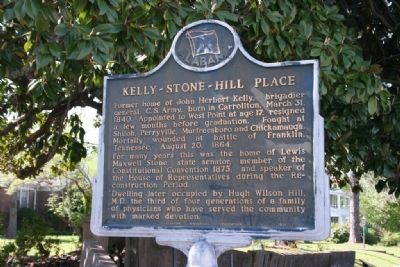
Former home of John Herbert Kelly, brigadier general, C.S. Army, born in Carrollton, March 31, 1840. Appointed to West Point at age 17, resigned a few months before graduation. Fought at Shiloh, Perryville, Murfreesboro and Chickamauga. Mortally . . . — — Map (db m37447) HM
In memory of those who returned home from our country’s wars but later died as a result of chemical agent poisoning, post traumatic stress disorder, or other combat - related causes. “They left the war, but the war never left them.” — — Map (db m249800) WM
Born in Henderson, Alabama in 1850, Fletcher Jackson Cowart began his working career as a public school teacher. He later served superintendencies for both the Pike County and the Troy City schools. He was editor of the Troy Messenger and a . . . — — Map (db m38934) HM
James Hardy and his twin brother, Julian, were born and reared in Newala, Alabama, 3 miles east of Montevallo. He attended the consolidated grammar school nearby which had 3 rooms for the 6 grades, then attended high school in Montevallo. James . . . — — Map (db m76244) HM
Founder of Buffalo Rock Company (1901) in Birmingham and creator of Buffalo Rock Ginger Ale, a medicinal tonic first used in the Civil War. Lee's vision and influential support inspired the construction of this road across Double Oak Mountain . . . — — Map (db m52693) HM
Side 1
Livingston, Alabama
Prior to the signing of the Treaty of Dancing Rabbit Creek on September 27, 1830, this site belonged to the Choctaw Nation. Early settlers to the area came from the Carolinas, Georgia, Tennessee, and . . . — — Map (db m92665) HM
Alabama’s first medical school.
Trained physicians who
rendered great service to
the State and Confederacy.
Closed by war
and death of its founder,
Philip M. Shepard, M.D. — — Map (db m28741) HM
Daughter of John Gayle, Governor of Alabama.
Wife of Josiah Gorgas, Brigadier General, C. S. A.
Mother of William Crawford Gorgas, Surgeon General, U. S. A.
Untiring nurse in Confederate Hospitals, 1861-1865.
First Historian Alabama Division, . . . — — Map (db m33653) HM
Alabama state hospitals inspired by Dorothea Dix in 1849. Opened 1861. Peter Bryce, J. T. Searcy and W. D. Partlow were the superintendents during the next 87 years. — — Map (db m40480) HM
One of four historic cemeteries located on the campus of Bryce Hospital, Alabama's oldest mental health facility, this cemetery features at least thirty-seven marked graves, the earliest of which dates to 1892. There are an undetermined number of . . . — — Map (db m235525) HM
One of four historic cemeteries located on the campus of Bryce Hospital, Alabama's oldest mental health facility, this cemetery was established in 1922 and was closed for burials in 1953. It contains approximately 1550 burials mostly marked with . . . — — Map (db m40449) HM
One of four historic cemeteries located on the campus of Bryce Hospital, Alabama's oldest mental health facility, this cemetery was established in 1953 and is still in use. It contains approximately 500 burials mostly marked with simple, . . . — — Map (db m235677) HM
Dr. Peter Bryce, first superintendent of the Alabama Insane (Bryce) Hospital was a leading proponent of humane treatment for people who experience mental illness. Born March 5, 1834, in Columbia SC, Bryce entered the South Carolina Military Academy . . . — — Map (db m235505) HM
Constructed in 1923 through gift of J. T. Horne, this building occupied by Druid City Hospital School of Nursing from 1923 to 1947. Used by University of Alabama from 1951 to 1954 to house first state supported collegiate school of nursing in . . . — — Map (db m29608) HM
Built 1829 as University dining hall.
Remodeled as a residence 1840.
Occupied by Gorgas family 1879-1953
(Reverse):
Preserved as a memorial to:
General Josiah Gorgas (1818-1883)
Chief of Ordnance, C. S. A. 1861-1865 . . . — — Map (db m29301) HM
Here, on the highest point of the original campus, stands the first celestial observatory at The University of Alabama and one of the oldest observatory buildings in the United States. Through the efforts of Professor F. A. P. Barnard, the first . . . — — Map (db m34842) HM
This is the oldest of four historic cemeteries located on the campus of Bryce Hospital, Alabama's oldest mental health facility. The first recorded burial dates to 1861. While only a few graves are currently marked, it is estimated that thousands of . . . — — Map (db m40450) HM
Erected: 1889
Reconstructed: 2000
Named for professor, scientist, and photographer F.A.P. Barnard who pioneered the study of astronomy at The University of Alabama and established its chapter of Phi Beta Kappa in 1851.
On August 26, 2000, . . . — — Map (db m29402) HM
These gates are replicas of the gates for Northington General Hospital, a U.S. Army Hospital that operated on this site during World War II. From 1947 to 1952, Northington General Hospital was the temporary home of DCH Regional Medical Center while . . . — — Map (db m35517) HM
Named for Eugene Allen Smith (1841-1927), University Professor and State Geologist, who served the State in this dual capacity for fifty-four years.
Smith rebuilt the collections of the Alabama Museum of Natural History, which had been . . . — — Map (db m29403) HM
Built by Robert Jemison Jr. Completed 1862, the 26 room Italian Villa style mansion is distinguished by its octagonal cupola and delicate carved fretwork. Jemison, a member of Alabama Legislature for 20 years (1840-63), 1861 Secession Convention (he . . . — — Map (db m35321) HM
Constructed as a guard house for the Alabama Corps of Cadets during the early 1860's, the Little Round House provided shelter from inclement weather for cadets on sentry duty. Until 1865, it also housed the University Drum Corps, which was composed . . . — — Map (db m25387) HM
Designed by Montgomery architect W. A. Crossland and named for noted professor and state geologist Michael Tuomey.
Tuomey's survey resulted in the landmark 1849 geological map of Alabama and his work began the Geological Survey of Alabama. . . . — — Map (db m259487) HM
Provided by local veterans and other dedicated citizens, this memorial pays tribute to all veterans of Tuscaloosa County who were engaged in the nine major American wars, 1776-1976. Rising centrally is the mainmast of World War II heavy cruiser USS . . . — — Map (db m35475) HM
The Tuscaloosa Veterans Administration (VA) Hospital was constructed in the early 1930's and was dedicated on July 6, 1932. The 272 bed General Medical and Surgical Hospital began admitting patients on July 15, 1932. In 1940, the hospital was . . . — — Map (db m203526) HM
This monument stands in front of the birthplace of Dr. Thomas Malcolm Blake (1917-1989), and near the site of his office where, for forty-seven years, he devoted his life to helping others, Dr. Blake’s birthplace was formerly the residence of the . . . — — Map (db m201733) HM
Born in a home near Double Springs on the Sipsey River, Dr. Benjamin Wallace Roden was the son of William Norris and Letha (Bruce) Roden. He attended schools in Marion County and studied botanical medicine under his father and other doctors, . . . — — Map (db m250573) HM
Thermosyphons keep the permafrost frozen
Thompson Drive crosses areas of continually frozen ground, known as permafrost. If the permafrost thaws and settling occurs, the entire roadway structure, including sidewalks, curbs and the . . . — — Map (db m256289) HM
Air convection embankments keep the air moving
The rock layers along the sides of Thompson Drive are part of a system known as an air convection embankment. This special type of roadway embankment has large rocks that allow air to . . . — — Map (db m256288) HM
There came upon this campus in the year Nineteen Twenty Two the First Engineer, and this was good. Then over the place spread Idiots, and the Engineer saw this was bad. And he cast a great stone saying: Whensoever this stone shall be removed by . . . — — Map (db m257452) HM
UAF's Poker Flat Research Range, 30 miles (48 kilometers) northeast of Fairbanks, is owned and operated by the UAF Geophysical Institute. It launches rockets under contract to the National Aeronautics and Space Administration. Poker Flat is the . . . — — Map (db m256299) HM
What is a Land, Sea and Space Grant institution? Only a handful of institutions in the country can claim the triple crown status of Land, Sea and Space Grant institution—UAF is one of them.
Land Grant
Founded in 1917 as the Alaska . . . — — Map (db m256284) HM
The blazing ball that is our sun blasts a constant stream of ionized gases into space. This solar
wind flows around Earth's magnetic field like a stream rushes around a boulder. Scientists
call the region within the windsock-shaped flow around . . . — — Map (db m256302)
Behind you is a Black Brant IX sounding rocket. Hundreds of similar rockets have been launched by NASA from the UAF Geophysical Institute's Poker Flat Research Range to study the aurora and near-Earth space. The 50-foot-long (15 meter), two-stage . . . — — Map (db m256303) HM
Doctor Stearns, the first
veterinarian in Fairbanks
built this cabin himself[.]
Doc was an avid
movie goer and also
operated a small farm. — — Map (db m256861) HM
Residents of interior and northern Alaska are fortunate to have excellent health care resources. Strong support from the people in Fairbanks and the surrounding area has been the key in developing fine facilities and services. . . . — — Map (db m257337) HM
Over one hundred years ago, this narrow, period building began as the "First Avenue Bath House
and Health Clinic." Originally constructed of bare boards, this two-story building fronted First Avenue and the Chena River, tapering to one story for . . . — — Map (db m257157) HM
"I made the claim for this church that it meant light: that it meant more light here in Fairbanks."
-Archdeacon Hudson Stuck in the first service at St. Matthew's.
The Episcopal Church's activity in Alaska's vast interior had been . . . — — Map (db m257165) HM
By August, 1904, when a Catholic priest arrived in Fairbanks, all choice lots in the center of town were taken. Father Francis Monroe, a Jesuit missionary, selected land at the edge of town, bordering the Chena River. The first Roman Catholic . . . — — Map (db m135350) HM
Dr. Maple was a structural engineer and principal designer of the trans-Alaska pipeline. He holds three patents for his development of innovative pipe supports that enabled the warm oil pipeline to safely traverse areas of permafrost. He pioneered . . . — — Map (db m58949) HM
This totem pole tells the story of the harnessing of the atom. The pole was carved in 1967 by Tlingit carver Amos Wallace of Juneau. His Tlingit name was Jeet Yaaw Dustaa of the T'akdeintaan Clan of the X'áakw Hít Tlingit (Freshwater-marked Coho . . . — — Map (db m181737) HM
Prospectors found gold in 1895 under the present Canyon Creek Highway Bridge and on Mills Creek. Those discoveries launched a rush to Turnagain Arm more than a year before the Klondike Gold Rush.
Prospectors Poke Around
After gold was . . . — — Map (db m49599) HM
The Christian cross was planted in Ketchikan's shoreline in 1897, when the settlement was only a creekside collection of Native homes and a trading site for the first white businessman in the area. The missionary priest who staked an ecclesiastical . . . — — Map (db m182004) HM
Along with other cultures, Tlingit, Haida and Tsimshian have long used rainforest plants for food and medicine. This wildflower garden contains many of them. The Native people have spiritual ties to these plants and great knowledge of their . . . — — Map (db m310922) HM
Balto was the lead dog of Gunnar Casson's dog team.
This team was the final team of the diphtheria serum run
to Nome from the Railroad Station in Nenana in 1925.
This sculpture was made possible by the efforts of the
Butte Elementary . . . — — Map (db m254875) HM
Ahtna Hwt'aene' and Dena'ina Peoples have used over 100 local wild plants
for everyday living tools, food, medicine, and ceremony. They believe that
plants should be treated with respect and they often speak to plants while
harvesting them. . . . — — Map (db m255182) HM
Did You Know?
Biologist have studied Mt. McKinley wolf packs since the 1930s. Early researchers, such as Adolph Murie, helped to dispel common myths about wolves and argued for their protection. Among many detailed observations, Murie . . . — — Map (db m257649) HM
This two-story, wood clapboard and gambrel roofed cottage-style house was constructed during the summer of 1916 by the United States Department of Commerce, Coast and Geodetic Survey. Prior to the purchase of Alaska by the United States from the . . . — — Map (db m181580) HM
This handsome example of Colonial Revival architecture was home to the manager of Round Valley's ACMIs. His wife, the area's first registered nurse, boarded expectant mothers & teachers from the high school. — — Map (db m36645) HM
Built during the great depression using native stone & W.P.A. labor, this twenty-bed facility finally opened in 1939 when a doctor agreed to come to Round Valley to finish, lease & run the hospital for 10 years. — — Map (db m36649) HM
Dedicated to the
Engineering Achievements of
Percy Jones, Jr.
1888 –
Chief locating engineer who by sheer genius personally located more miles of Arizona highways than any other person. His college training in mining and geology . . . — — Map (db m37899) HM
The Can Can Restaurant was established in 1879 by Quong Kee. It was one of Tombstone's best known restaurants. In 1886 it was purchased by John Henninger who turned it into a first class eating establishment. It had a number of proprietors until . . . — — Map (db m48513) HM
This control panel was used for the pressure lines.
The mined ore is usually crushed into small chunks and heaped on an impermeable plastic or clay lined leach pad where it can be irrigated with a leach solution to dissolve the valuable metals. The . . . — — Map (db m249731) HM
This 11-ton telescope, built by the Alvan Clark & Sons Telescope Manufacturing Company of Cambridgeport, Massachusetts, was installed at Lowell Observatory in 1909. It came with four secondary mirror combinations so that it could be operated at . . . — — Map (db m149451) HM
The rich diversity of plants and animals of the Flagstaff area was first recognized in the summer of 1889 when Dr. C. Hart Merriam led a biological survey to the San Francisco Peaks. Merriam's "Life Zone Theory" detailed that temperature and . . . — — Map (db m201772) HM
Understanding and predicting local weather patterns helps astronomers plan successful observing runs. Because of this, observatories such as Lowell typically maintain weather stations to monitor the conditions. One such station was set up at the . . . — — Map (db m149452) HM
Another life-long employee of Lowell Observatory, Henry is best remembered for his Proper Motion Study of 1971, which entailed repeating the Pluto search plates after 25 years to determine whatever changes had taken place in the background of . . . — — Map (db m149456) HM
Lowell Observatory has been designated a Registered National Historic Landmark Under the provisions of the Historic Sites Act of August 21, 1935 this site possesses exceptional value in commemorating or illustrating the History of The . . . — — Map (db m149455) HM
As the keystone shows, this building was constructed in 1911. Its owner was R.O. Raymond, M.D., one of Flagstaff’s first doctors. Raymond came west for his health. After a short stay in Williams, he moved to Flagstaff in 1906.
He was the . . . — — Map (db m59511) HM
For years, the only way to fight fire at the Observatory was with a soda acid fire extinguisher. This was a 30-gallon extinguisher on wheels that mixed water, soda and sulfuric acid (for pressure.) It was once used to save V.M. Slipher's house from . . . — — Map (db m263230) HM
A gift to the Observatory from President A. Lawrence Lowell through this instrument the ninth planet Pluto was first found in 1930 ”It means a planet out there as yet unseen by Man, but certain sometime to be detected and added to the . . . — — Map (db m149454) HM
The mountain in the distance, known as the San Francisco Peaks, soars to an elevation of 12,633 feet. Mr. C. Hart Merriam, while leading a scientific expedition to the Peaks in 1889, developed the concept of life zones. These zones describe how . . . — — Map (db m263186) HM
(Japanese marker text not transcribed)
U.S. Astronomer Percival Lowell, Specialist of Mars, and Anamizu
Anmaizu Town And Its Friend City, Flagstaff, Arizona, U.S.A.
Dr. Percival Lowell (1855-1916_, the world famous . . . — — Map (db m263297) HM
The first Chief Topographic Engineer of the U.S. Geological Survey 1919-1929 and the first President of the American Society of Photogrammetry 1934. He headed a Geological Survey expedition through the Grand Canyon in 1923 to acquire information . . . — — Map (db m157000) HM
Below you, the Colorado River makes a dramatic turn. Ever since the river entered Grand Canyon at Lees Ferry, it has been deepening its gorge east of the Kaibab Plateau. Here, the river turned west to cut straight through the plateau, opening a . . . — — Map (db m250582) HM
In 1898 the forested lands around
Williams were set aside as a forest
reserve that supplied timber for
the Saginaw-Manistee lumber mill
and box factory, which operated
from 1893 to 1942. Built by the
Rounseville brothers about 1915,
this . . . — — Map (db m236374) HM
An Ohio born dentist, Zane Grey spent many years under the Mogollon Rim, writing "To the Last Man" and a dozen other westerns with Arizona settings and characters. His prolific writings popularized the American cowboy as a taciturn, romantic . . . — — Map (db m67413) HM
Named for the rebellious medicine man who led the Chiricahua Apaches on their last raids, to surrender, and then into exile in Florida and Oklahoma. Their descendants lived in Eastern Arizona again. This was also the site of original Camp Thomas, . . . — — Map (db m28050) HM
He knew no yesterdays
His living was for tomorrow
Founder of the town of Chandler
Built the San Marcos Hotel
Arizona’s first veterinarian
Father of modern irrigation system
Pioneer rancher and developer of the southside area of . . . — — Map (db m70990) HM
Price Building, 1914
Chandler Historic Commercial District on the National Register of Historic Places
Chandler's first elected Mayor, David Jacobson, built this structure. It is named for Arthur E. Price, Chandler's first attorney and . . . — — Map (db m72051) HM
Greatest of the educated Apaches, this Mohave-Apache Indian was taken captive at the age of six by Pima Indians. He was sold to a white man who educated him as a physician. Dr. Montezuma had a splendid practice in Chicago and became a champion of . . . — — Map (db m27680) HM
Built in 1895 by Dr. Roland T. Rosson, Army doctor at Fort McDowell, Phoenix physician (1879-1897) and Mayor, this mansion is one of the few surviving examples of late Victorian architecture in Phoenix. It was acquired by the city through the . . . — — Map (db m291209) HM
Born of the selfless and compassionate services of those individuals
who gave medical, spiritual and other assistance to the sick and needy
in the Sunnyslope area. After the turn of the century, the Desert Mission
grew to be the center of these . . . — — Map (db m111478) HM
1921 - 1937 Sterling Drug Store
1937 - 1948 Scottsdale Pharmacy
1948 - Present Saba's Western Store
Built in 1921 by Dr. Walter S. Lawson to serve the needs of a growing farm village, this red brick building housed a drug store for . . . — — Map (db m141347) HM
Scottsdale City Councilman 1970-1978
Mayor of Scottsdale 1980-1996
"Serving the citizens of Scottsdale is the greatest job in the world."
Herb Drinkwater
"Mr. Scottsdale," Mayor Herb Drinkwater, served the citizens of Scottsdale . . . — — Map (db m141342) HM
Paiute people used the dark green leaves of datura, crushed as a poultice, to treat sores and swelling. This traditional medicinal plant was chewed to reduce toothache pain, as well as induce visions. Datura is highly poisonous. Please do not touch. — — Map (db m149368) HM
This building has been placed on
the National Register of
Historic Places
by the United States Department of the Interior
This adobe bungalow with low-pitched gable roofs and a partial front porch with tapered columns was the home of . . . — — Map (db m193553) HM
What you leave behind is not what is engraved in stone monuments, but what is woven into the lives of others. Pericles
The City of Kingman Historic Preservation Commission Proudly has recreated this "Miner's Mineral Monument" in . . . — — Map (db m278616) HM
The Rainbow Forest area was the original park head-quarters from 1906 to 1962. In the 1920s, the museum was housed in a tar paper building and instead of a walking trail, a bumpy road wove through Giant Logs. Clearly, many things have changed. But . . . — — Map (db m187257) HM
It is not known if the prehistoric Indians of the canyons used this plant, but both Navajos and Hopis make medicine from it, to cure stomach-ache. The Navajos use it to cure colds and headache. — — Map (db m144404) HM
Hopis made arrows from the wood of this plant and shredded the soft bark to make a padding for babies' cradleboards. Like many of these plants, it provided medicine, and was used as an emetic and as a wash for wounds. — — Map (db m144393) HM
This plant, when made into a brew, was a multipurpose medicine, prescribed for stomach trouble, kidney afflictions, venereal disease, and coughs. — — Map (db m144407) HM
Hopi Indians burn rabbit brush kindling with three other wood fuels in their ceremonial kivas. Slender, flexible stems are woven into basketry. Green dye comes from the inner bark, while early autumn flowers yield a yellow dye. The Hopis once . . . — — Map (db m144448) HM
Serviceberry is one of the enduring "life medicines" of the Navajos, which insure their survival, health, and harmony. It is gathered to treat nausea, stomach problems, animal bites, and recovery from childbirth. It is also valued as a medicine in . . . — — Map (db m144449) HM
Telescopes are most commonly known by the diameter of their objective lens or primary mirror. This telescope has a 1.3-meter (50-inch) primary mirror to gather starlight. Many of the observations made here are measurements of the brightnesses of . . . — — Map (db m305589) HM
The accompanying picture illustrates the light paths of the 2.1 m and coudé feed telescopes as well as the associated coudé spectrograph.
Light from the 2.1 m telescope can be brought to the Cassegrain focus directly under the primary mirror . . . — — Map (db m306436) HM
WIYN
Visible to the south is the octagonal dome enclosure of the 3.5 meter WIYN telescope. Dedicated in 1994, the WIYN Observatory was originally operated by a consortia consisting of the University of Wisconsin, Indiana University, Yale and . . . — — Map (db m305621) HM
In 1881, Emerson Stratton, a local rancher, led botanists J.G. and Sara Plummer Lemmon to the top of the Santa Catalina Mountains. Mr. Stratton was so impressed with Mrs. Lemmon that he named the peak after her on the day they arrived at the . . . — — Map (db m302098) HM
To Aid the Construction of the Mayall Telescope
Concrete donuts like this one are sometimes used to test the mounting equipment for large telescope mirrors. The "test dummy" replica must be the same diameter and the same weight as the much . . . — — Map (db m305310) HM
The Sanborn Fire Maps for the City of Tucson first recorded this building in 1883 as an adobe dwelling with an attached ramada. Between 1901 and 1930 additions were made to the main building and construction was completed on the outbuilding behind . . . — — Map (db m83244) HM
Kitt Peak
National Observatory
Founded 1958
The observatory’s objectives are to
strengthen basic research and education
in astronomy throughout the United States, its
territories and possessions. The observatory is
available to . . . — — Map (db m102813) HM
Steward Observatory
90 inch Reflector
University of Arizona
Erected 1967
Board of Regents
Jack Williams Governor · George W. Chambers President · Elwood W. Bradford · Sarah Folsom · Wesley P. Gross · Leon Levy · Norma Barr Rockfellow · . . . — — Map (db m102921) HM
This drawing shows the interior of the McMath solar telescope. You are looking at only part of telescope which is above ground. The tunnel for the light beam and the observing rooms where the scientific work is done are buried under the mountain. . . . — — Map (db m102919) HM
The accompanying picture shows a cross section of the solar vacuum telescope. This facility, built in 1973, is used to study the evolution of sunspots and other solar magnetic fields. It is operated daily by the National Solar Observatory (NSO) . . . — — Map (db m102918) HM
The octagon-shaped building that you see in the distance is the enclosure for the telescope of the WIYN Observatory. Completed in 1994, WIYN is owned and operated by the University of Wisconsin, Indiana University, Yale University, and the . . . — — Map (db m102920) HM
Dr. William Austin Cannon had this house built during 1904-1905. He was the first resident botanist with the Carnegie Desert Laboratory in 1902, and worked there until 1926. Dr. Cannon sold the house in 1913 to Dr. Andrew Ellicott Douglass, an . . . — — Map (db m83014) HM
This Colonial Revival adobe was the home of George Brockway and his wife Esther. Brockway was the town medical doctor, Pinal County Hospital Superintendent and Territorial Prison physician. He owned a drugstore, and in 1908 became the first mayor of . . . — — Map (db m26712) HM
This example of Early Transitional architecture combined Sonoran and Victorian elements. Built of adobe in 1880, the house was later veneered with red brick to give it a Victorian appearance. Physician William Harvey was known as an "Angel of Mercy" . . . — — Map (db m184138) HM
7233 entries matched your criteria. Entries 101 through 200 are listed above. ⊲ Previous 100 — Next 100 ⊳